Bahrain Telecom Cloud Billing Market Size & Growth Rate (2026-2032)
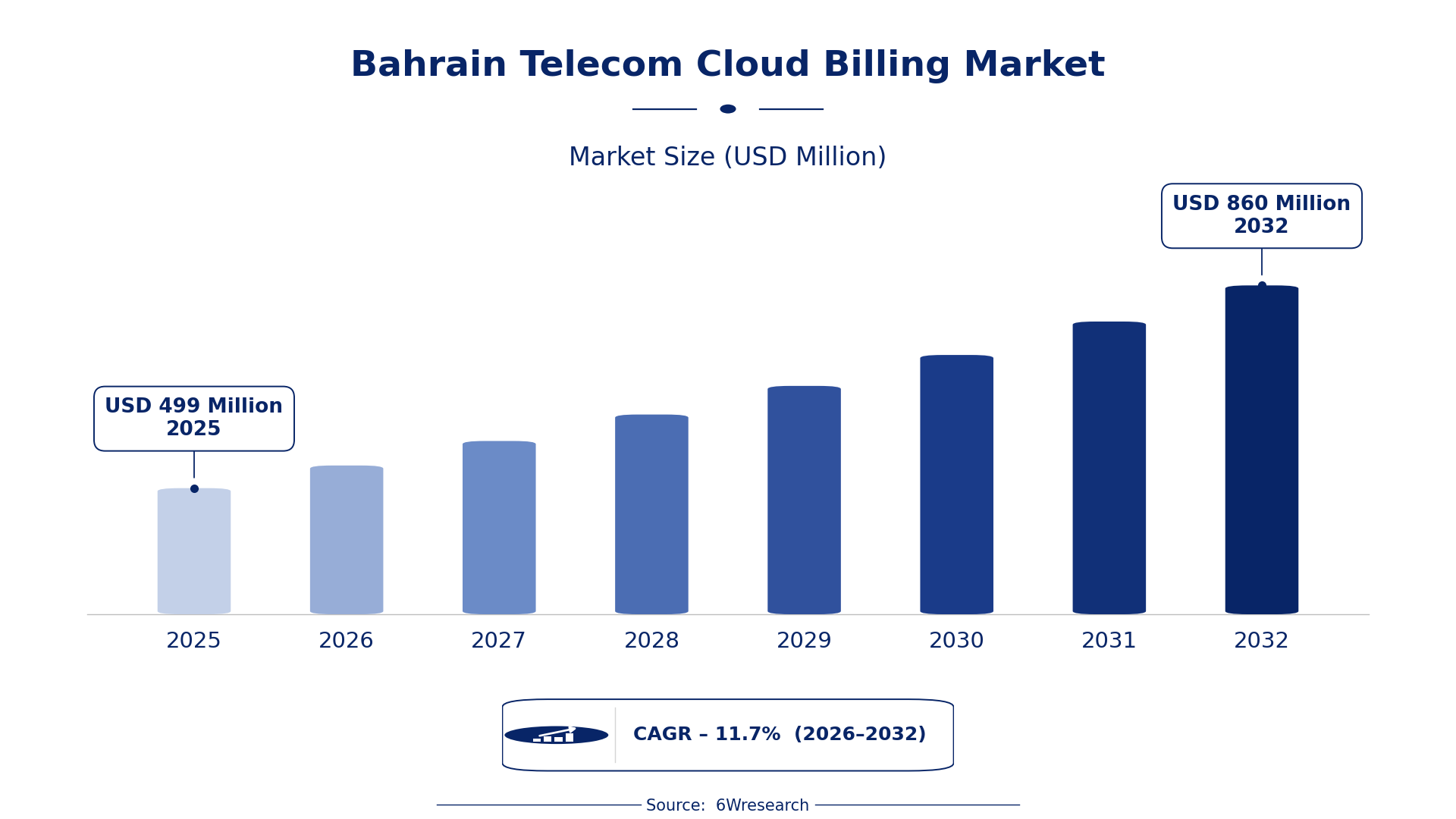
The Bahrain Telecom Cloud Billing Market was estimated at USD 499 Million in 2025 and is projected to reach USD 860 Million by 2032, growing at a CAGR of 11.7% from 2026 to 2032.
Bahrain Telecom Cloud Billing Market Synopsis
The primary driver behind the Bahrain Telecom Cloud Billing Market is the urgent transition from traditional billing systems to cloud-native solutions. Telecom operators are increasingly recognizing the need for scalable, automated platforms that can handle diverse pricing models and integrate seamlessly with other digital services.
As demand for customer-centric billing experiences grows, Bahraini telecom companies are leveraging cloud technologies to enhance flexibility and operational efficiency. The shift is also fueled by a broader trend towards digital transformation, with new revenue streams arising from IoT applications and OTT services.
Bahrain Telecom Cloud Billing Market Year-wise Growth Rate and Key Drivers
This graph illustrates the annual growth rates of the Bahrain Telecom Cloud Billing Market from 2021 to 2032, highlighting a steady upward trajectory and projected expansion over the forecast period.
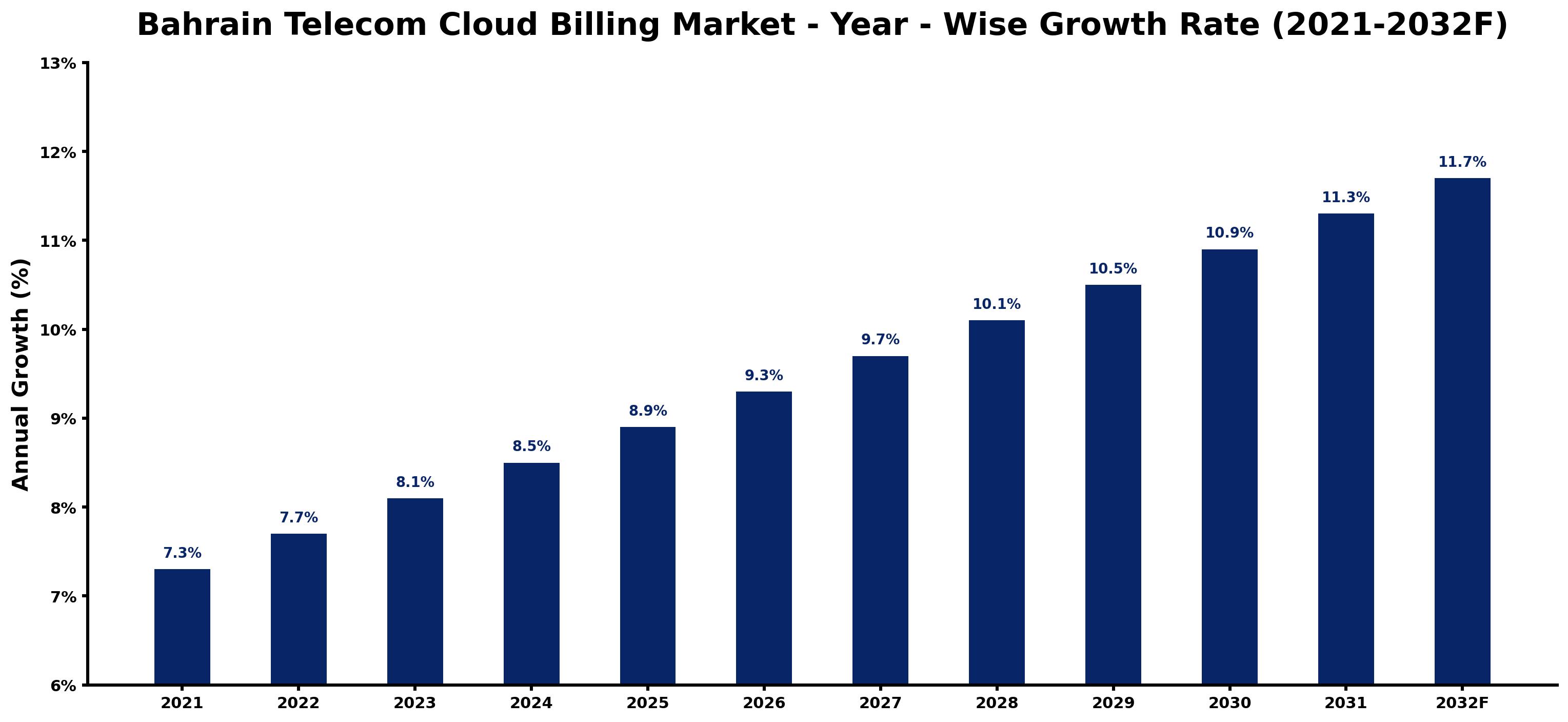
The table below presents the year‑wise growth rates along with the key drivers influencing the market
| Year | Growth Rate | Major Drivers |
| 2021 | 7.3% | Bahrain’s economic diversification strategy boosts telecom cloud adoption. |
| 2022 | 7.7% | Central Bank Bahrain encourages fintech solutions in telecommunications. |
| 2023 | 8.1% | Telecom regulations streamline cloud billing service provider entry. |
| 2024 | 8.5% | Increasing mobile penetration drives demand for cloud billing services. |
| 2025 | 8.9% | Telecom operators invest in scalable cloud infrastructure systems. |
| 2026 | 9.3% | Local businesses migrating to digital platforms increase billing demand. |
| 2027 | 9.7% | Rising internet usage among SMEs fuels cloud billing uptake. |
| 2028 | 10.1% | Bahraini telecoms leveraging AI for efficient billing processes. |
| 2029 | 10.5% | Government mandates for transparent billing enhance consumer trust. |
| 2030 | 10.9% | Increased cross-border telecom services drive cloud billing growth. |
| 2031 | 11.3% | Adoption of 5G technology accelerates cloud service billing innovation. |
| 2032 | 11.7% | Consumer preference for mobile apps accelerates cloud billing demand. |
Note: Market size estimations and growth projections presented in this report are based on 6Wresearch's proprietary forecasting methodology, utilizing the latest available industry data, government publications, and primary research inputs.
Bahrain Telecom Cloud Billing Market Key Takeaways
Below are some of the specific key takeaways from the market, including:
- The transition to cloud billing systems is accelerating due to the demand for real-time charging and complex pricing management.
- Telecom operators face integration challenges as they move away from legacy systems, impacting operational continuity.
- Investments are shifting towards solutions that enhance billing accuracy and improve customer engagement through self-service functionalities.
- The government supports cloud billing adoption through its "Cloud First" policy, fostering a favorable regulatory environment.
- The market is becoming more attractive for investors as service providers diversify their offerings beyond traditional telecom services.
Evaluation of Restraints in Bahrain Telecom Cloud Billing Market
Bahrain’s telecom cloud billing market is held back by several key restraints. The most pressing issue is the challenge of migrating from traditional billing systems, which many operators rely on, to cloud-based solutions. Such transitions can be disruptive and require significant resources. There’s also the concern surrounding data security; telecom providers manage sensitive billing information that must remain protected from breaches. Finally, local regulations regarding data sovereignty add another layer of complexity, making compliance a critical factor for operators looking to implement cloud billing solutions.
Bahrain Telecom Cloud Billing Market Trends
Current trends indicate that Bahraini telecom companies are increasingly adopting agile billing systems to support the diversification of their revenue streams. The rise in IoT applications and OTT content services demands flexible billing solutions capable of managing various pricing models. Furthermore, real-time analytics is becoming essential, enabling operators to respond swiftly to market changes and customer needs.
Another notable trend is the focus on enhancing customer experience. As competition intensifies, companies are investing in cloud billing solutions that integrate closely with CRM tools, providing a personalized billing experience that improves customer satisfaction and loyalty.
Bahrain Telecom Cloud Billing Market Opportunities
There’s a wealth of opportunity in the Bahrain Telecom Cloud Billing Market, particularly as service providers explore offerings around 5G and IoT services. The need for dynamic pricing models and accurate real-time usage tracking positions cloud billing solutions favorably for investment. Startups that focus on innovative Billing-as-a-Service (BaaS) models are particularly well-placed to capture market share, as traditional systems become less viable. Given Bahrain’s emphasis on digital transformation, the environment is ripe for investment in scalable, customer-centric billing systems.
Government Initiatives in the Bahrain Telecom Cloud Billing Market
The Bahraini government has taken proactive steps to cultivate a supportive environment for the telecom cloud billing market. Their "Cloud First" policy emphasizes the transition towards cloud solutions across sectors, providing clear guidelines and frameworks to encourage adoption. This regulatory support is crucial as telecom operators work to modernize their billing systems in line with customer expectations.
- A regulatory framework was introduced in 2023 to promote billing transparency and compliance with data protection standards.
- A national digital infrastructure upgrade programme began in late 2022, facilitating improved cloud service access for telecom companies.
- Currently underway is a collaborative initiative with telecom providers to enhance the security protocols for cloud billing solutions, focusing on data residency and encryption.
- A planned public-private partnership aimed at fostering innovation in cloud-based solutions is set to launch by 2024.
Future Insights of the Bahrain Telecom Cloud Billing Market
Looking ahead to 2026-2032, the Bahrain Telecom Cloud Billing Market is positioned for notable growth. Telecom operators will continue to migrate to advanced cloud billing systems, driven by the increasing complexity of service offerings and customer demands for tailored solutions. The emergence of 5G will further necessitate billing flexibility, paving the way for new pricing structures and automated billing functionalities. This transition will be supported by ongoing regulatory backing and a tech-savvy customer base eager for innovative services.
Bahrain Telecom Cloud Billing Market Latest Developments
Recent developments in the Bahrain Telecom Cloud Billing Market indicate a swift evolution towards more integrated and innovative billing solutions. Operators are actively seeking to enhance their offerings in response to the growing demand for better customer engagement and operational efficiency.
- A leading regional operator launched an advanced cloud billing platform in Q2 2025, aimed at streamlining operations and improving customer service.
- In early 2025, a partnership was formed between telecom firms to create an integrated billing solution that combines OTT services with traditional telecom offerings.
- Currently ongoing is the development of a multi-tenant billing engine that promises to support various pricing models, expected to reach completion by mid-2026.
- Anticipated for late 2025 is the rollout of an automated billing system, designed to enhance real-time usage tracking and customer self-service options.
Bahrain Telecom Cloud Billing Market - Key Attractiveness of the Report
- 10 Years of Market Numbers
- Historical Data Starting from 2022 to 2025
- Base Year: 2025
- Forecast Data until 2032
- Key Performance Indicators Impacting the Market
- Major Upcoming Developments and Projects
Key Highlights of the Report:
- Bahrain Telecom Cloud Billing Market Outlook
- Market Size of Bahrain Telecom Cloud Billing Market, 2025
- Forecast of Bahrain Telecom Cloud Billing Market, 2032
- Historical Data and Forecast of Bahrain Telecom Cloud Billing Revenues & Volume for the Period 2022-2032F
- Bahrain Telecom Cloud Billing Market Trend Evolution
- Bahrain Telecom Cloud Billing Market Drivers and Challenges
- Bahrain Telecom Cloud Billing Price Trends
- Bahrain Telecom Cloud Billing Porter's Five Forces
- Bahrain Telecom Cloud Billing Industry Life Cycle
- Historical Data and Forecast of Bahrain Telecom Cloud Billing Market Revenues & Volume By Type of Billing for the Period 2022-2032F
- Historical Data and Forecast of Bahrain Telecom Cloud Billing Market Revenues & Volume By Convergent for the Period 2022-2032F
- Historical Data and Forecast of Bahrain Telecom Cloud Billing Market Revenues & Volume By Prepaid for the Period 2022-2032F
- Historical Data and Forecast of Bahrain Telecom Cloud Billing Market Revenues & Volume By Postpaid for the Period 2022-2032F
- Historical Data and Forecast of Bahrain Telecom Cloud Billing Market Revenues & Volume By Interconnect for the Period 2022-2032F
- Historical Data and Forecast of Bahrain Telecom Cloud Billing Market Revenues & Volume By Roaming for the Period 2022-2032F
- Historical Data and Forecast of Bahrain Telecom Cloud Billing Market Revenues & Volume By Others (Direct to Consumer (D2C) and Metered) for the Period 2022-2032F
- Historical Data and Forecast of Bahrain Telecom Cloud Billing Market Revenues & Volume By Cloud Platform for the Period 2022-2032F
- Historical Data and Forecast of Bahrain Telecom Cloud Billing Market Revenues & Volume By SaaS for the Period 2022-2032F
- Historical Data and Forecast of Bahrain Telecom Cloud Billing Market Revenues & Volume By Others (IaaS and PaaS) for the Period 2022-2032F
- Historical Data and Forecast of Bahrain Telecom Cloud Billing Market Revenues & Volume By End User for the Period 2022-2032F
- Historical Data and Forecast of Bahrain Telecom Cloud Billing Market Revenues & Volume By Individuals for the Period 2022-2032F
- Historical Data and Forecast of Bahrain Telecom Cloud Billing Market Revenues & Volume By Enterprises for the Period 2022-2032F
- Historical Data and Forecast of Bahrain Telecom Cloud Billing Market Revenues & Volume By Application for the Period 2022-2032F
- Historical Data and Forecast of Bahrain Telecom Cloud Billing Market Revenues & Volume By Revenue Management for the Period 2022-2032F
- Historical Data and Forecast of Bahrain Telecom Cloud Billing Market Revenues & Volume By Account Management for the Period 2022-2032F
- Historical Data and Forecast of Bahrain Telecom Cloud Billing Market Revenues & Volume By Customer Management for the Period 2022-2032F
- Historical Data and Forecast of Bahrain Telecom Cloud Billing Market Revenues & Volume By Rate of Charging Mode for the Period 2022-2032F
- Historical Data and Forecast of Bahrain Telecom Cloud Billing Market Revenues & Volume By Subscription-Based for the Period 2022-2032F
- Historical Data and Forecast of Bahrain Telecom Cloud Billing Market Revenues & Volume By Usage-Based for the Period 2022-2032F
- Historical Data and Forecast of Bahrain Telecom Cloud Billing Market Revenues & Volume By Service for the Period 2022-2032F
- Historical Data and Forecast of Bahrain Telecom Cloud Billing Market Revenues & Volume By Professional for the Period 2022-2032F
- Historical Data and Forecast of Bahrain Telecom Cloud Billing Market Revenues & Volume By Managed for the Period 2022-2032F
- Bahrain Telecom Cloud Billing Import Export Trade Statistics
- Market Opportunity Assessment By Type of Billing
- Market Opportunity Assessment By Cloud Platform
- Market Opportunity Assessment By End User
- Market Opportunity Assessment By Application
- Market Opportunity Assessment By Rate of Charging Mode
- Market Opportunity Assessment By Service
- Bahrain Telecom Cloud Billing Top Companies Market Share
- Bahrain Telecom Cloud Billing Competitive Benchmarking By Technical and Operational Parameters
- Bahrain Telecom Cloud Billing Company Profiles
- Bahrain Telecom Cloud Billing Key Strategic Recommendations






































