Bahrain Textile Finishing Chemicals Market: Import Trend Analysis
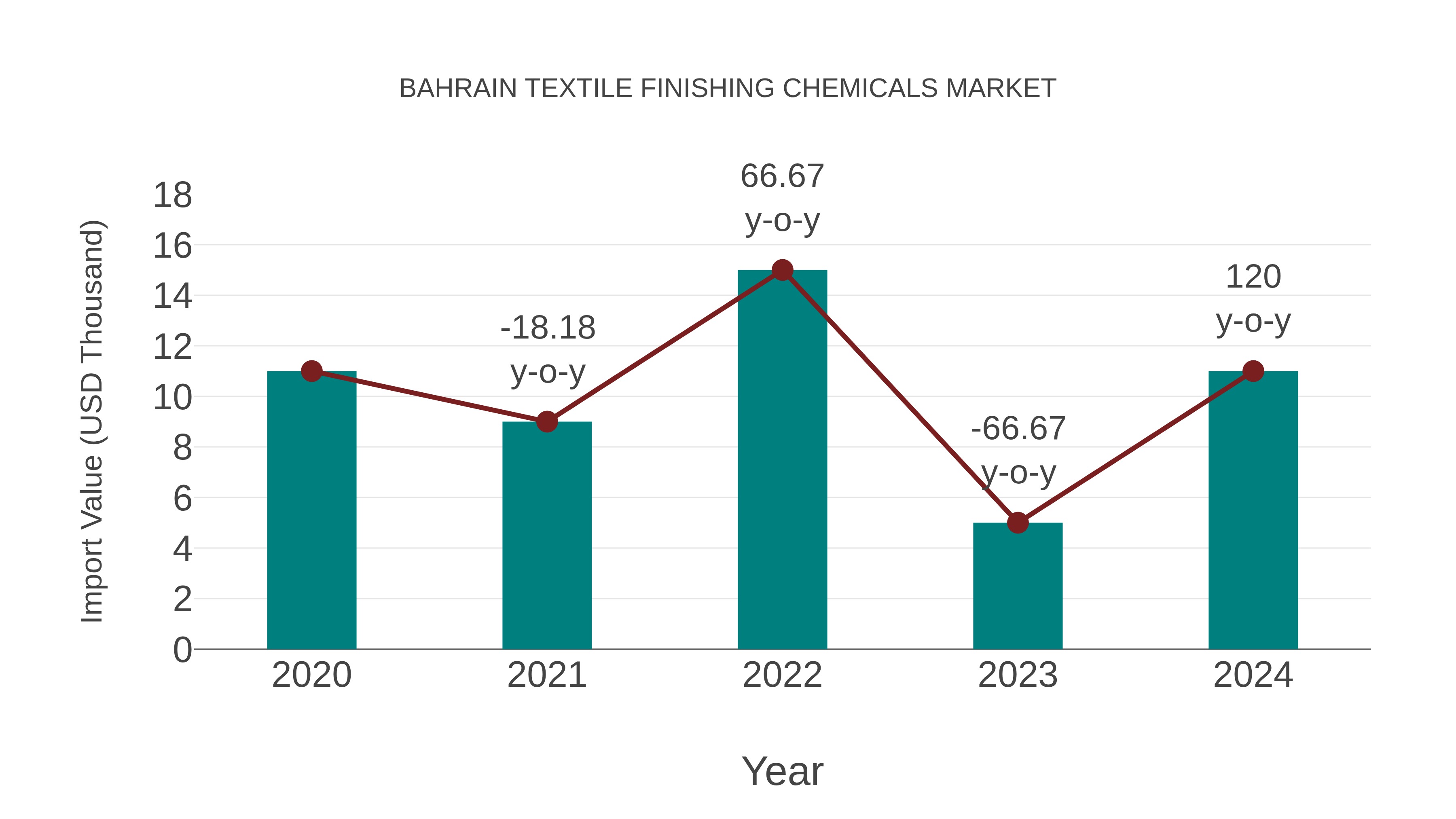
In 2024, Bahrain textile finishing chemicals market saw a notable increase in imports. The country experienced a growing demand for these chemicals, leading to a surge in imports to meet the industry`s needs.
Bahrain Textile Finishing Chemicals Market Overview
The Bahrain Textile Finishing Chemicals Market is witnessing steady growth driven by a growing textile industry in the region. The market is characterized by the increasing demand for high-quality finishing chemicals to enhance the properties of textiles, such as softness, color fastness, and durability. Key players in the market are focusing on developing innovative and sustainable solutions to cater to the evolving needs of the textile industry. The market is also influenced by stringent regulations pertaining to environmental sustainability, leading to a shift towards eco-friendly and biodegradable finishing chemicals. Overall, the Bahrain Textile Finishing Chemicals Market is poised for further expansion as manufacturers continue to invest in research and development to offer advanced solutions to meet the increasing demands of the textile sector.
Bahrain Textile Finishing Chemicals Market Trends and Opportunities
The Bahrain Textile Finishing Chemicals Market is experiencing growth due to increasing demand for high-quality finished textile products in industries such as fashion, home textiles, and automotive. Key trends in the market include a shift towards sustainable and eco-friendly finishing chemicals to meet consumer preferences for environmentally friendly products. Opportunities in the market lie in the development of innovative finishing chemicals that offer functionalities such as water and stain resistance, wrinkle-free properties, and UV protection. Additionally, there is a growing focus on research and development to enhance the performance and efficiency of textile finishing chemicals, catering to the evolving needs of manufacturers and consumers in Bahrain and the broader Middle East region.
Bahrain Textile Finishing Chemicals Market Challenges
In the Bahrain Textile Finishing Chemicals Market, challenges such as increasing competition from international suppliers offering lower-priced products, fluctuating raw material prices, and stringent environmental regulations are prominent. The market is also facing issues related to ensuring product quality and consistency to meet the demands of textile manufacturers. Additionally, the relatively small size of the market in Bahrain compared to larger regional markets poses a challenge in terms of economies of scale and overall profitability for suppliers. Adapting to evolving consumer preferences, technological advancements, and the need to invest in research and development to offer innovative solutions further add to the complex landscape of challenges faced by companies operating in the Bahrain Textile Finishing Chemicals Market.
Bahrain Textile Finishing Chemicals Market Drivers
The Bahrain Textile Finishing Chemicals Market is primarily driven by the increasing demand for high-quality and innovative textile products in the region. Consumers are seeking textiles with enhanced properties such as durability, water repellency, and wrinkle resistance, creating a need for advanced finishing chemicals. Additionally, the growing textile industry in Bahrain, driven by factors such as rising disposable incomes and changing fashion trends, is fueling the demand for textile finishing chemicals. Manufacturers are focusing on developing eco-friendly and sustainable finishing chemicals to align with the increasing environmental awareness among consumers, further driving market growth. Moreover, technological advancements in textile finishing processes and increasing investments in research and development activities are also contributing to the expansion of the Bahrain Textile Finishing Chemicals Market.
Bahrain Textile Finishing Chemicals Market Government Policy
The Bahraini government has implemented various policies to regulate and support the Textile Finishing Chemicals Market. These policies include strict environmental regulations to ensure the safe use and disposal of chemicals, as well as to protect the health of workers and the environment. Additionally, the government has established initiatives to promote research and development in the textile industry, encouraging innovation and the adoption of sustainable practices. Import restrictions and tariffs are also in place to regulate the importation of chemicals and protect local manufacturers. Overall, these policies aim to create a competitive and sustainable market for textile finishing chemicals in Bahrain, while ensuring compliance with international standards and promoting the growth of the industry.
Bahrain Textile Finishing Chemicals Market Future Outlook
The future outlook for the Bahrain Textile Finishing Chemicals Market appears promising due to the increasing demand for high-quality textiles in various industries such as fashion, home furnishings, and technical textiles. The market is projected to experience steady growth driven by the expanding textile industry in the region and the growing focus on sustainable and eco-friendly textile finishing solutions. Additionally, advancements in technology and innovation in textile chemicals are expected to further fuel market growth by offering improved performance characteristics and cost-effective solutions for manufacturers. With a growing emphasis on enhancing textile properties such as durability, stain resistance, and water repellency, the Bahrain Textile Finishing Chemicals Market is likely to witness a positive trajectory in the coming years.
Key Highlights of the Report:
- Bahrain Textile Finishing Chemicals Market Outlook
- Market Size of Bahrain Textile Finishing Chemicals Market, 2025
- Forecast of Bahrain Textile Finishing Chemicals Market, 2032
- Historical Data and Forecast of Bahrain Textile Finishing Chemicals Revenues & Volume for the Period 2022 - 2032F
- Bahrain Textile Finishing Chemicals Market Trend Evolution
- Bahrain Textile Finishing Chemicals Market Drivers and Challenges
- Bahrain Textile Finishing Chemicals Price Trends
- Bahrain Textile Finishing Chemicals Porter's Five Forces
- Bahrain Textile Finishing Chemicals Industry Life Cycle
- Historical Data and Forecast of Bahrain Textile Finishing Chemicals Market Revenues & Volume By Type for the Period 2022 - 2032F
- Historical Data and Forecast of Bahrain Textile Finishing Chemicals Market Revenues & Volume By Softening Finishes for the Period 2022 - 2032F
- Historical Data and Forecast of Bahrain Textile Finishing Chemicals Market Revenues & Volume By Repellent Finishes for the Period 2022 - 2032F
- Historical Data and Forecast of Bahrain Textile Finishing Chemicals Market Revenues & Volume By Wrinkle Free Finishes for the Period 2022 - 2032F
- Historical Data and Forecast of Bahrain Textile Finishing Chemicals Market Revenues & Volume By Coating Finishes for the Period 2022 - 2032F
- Historical Data and Forecast of Bahrain Textile Finishing Chemicals Market Revenues & Volume By Mothproofing Finishes for the Period 2022 - 2032F
- Historical Data and Forecast of Bahrain Textile Finishing Chemicals Market Revenues & Volume By Process for the Period 2022 - 2032F
- Historical Data and Forecast of Bahrain Textile Finishing Chemicals Market Revenues & Volume By Pad-Dry Cure Process for the Period 2022 - 2032F
- Historical Data and Forecast of Bahrain Textile Finishing Chemicals Market Revenues & Volume By Exhaust Dyeing Process for the Period 2022 - 2032F
- Bahrain Textile Finishing Chemicals Import Export Trade Statistics
- Market Opportunity Assessment By Type
- Market Opportunity Assessment By Process
- Bahrain Textile Finishing Chemicals Top Companies Market Share
- Bahrain Textile Finishing Chemicals Competitive Benchmarking By Technical and Operational Parameters
- Bahrain Textile Finishing Chemicals Company Profiles
- Bahrain Textile Finishing Chemicals Key Strategic Recommendations






































