Bahrain Three Wheeler Market Size, Share & Growth Rate
The Bahrain Three Wheeler Market was estimated at USD 916 Million in 2025 and is projected to reach USD 1685 Million by 2032, growing at a CAGR of 9.1% from 2026 to 2032. This growth trajectory is largely fueled by a burgeoning demand for cost-effective and fuel-efficient transportation solutions, especially in urban areas. Increasing urbanization and the rise of e-commerce are driving commercial applications of three-wheelers, while individual consumers appreciate their affordability for short-distance travel.
Bahrain Three Wheeler Market Year-wise Growth Rate and Key Drivers
This graph highlights how the Bahrain Three Wheeler Market has steadily grown over the years, supported by major growth factors.
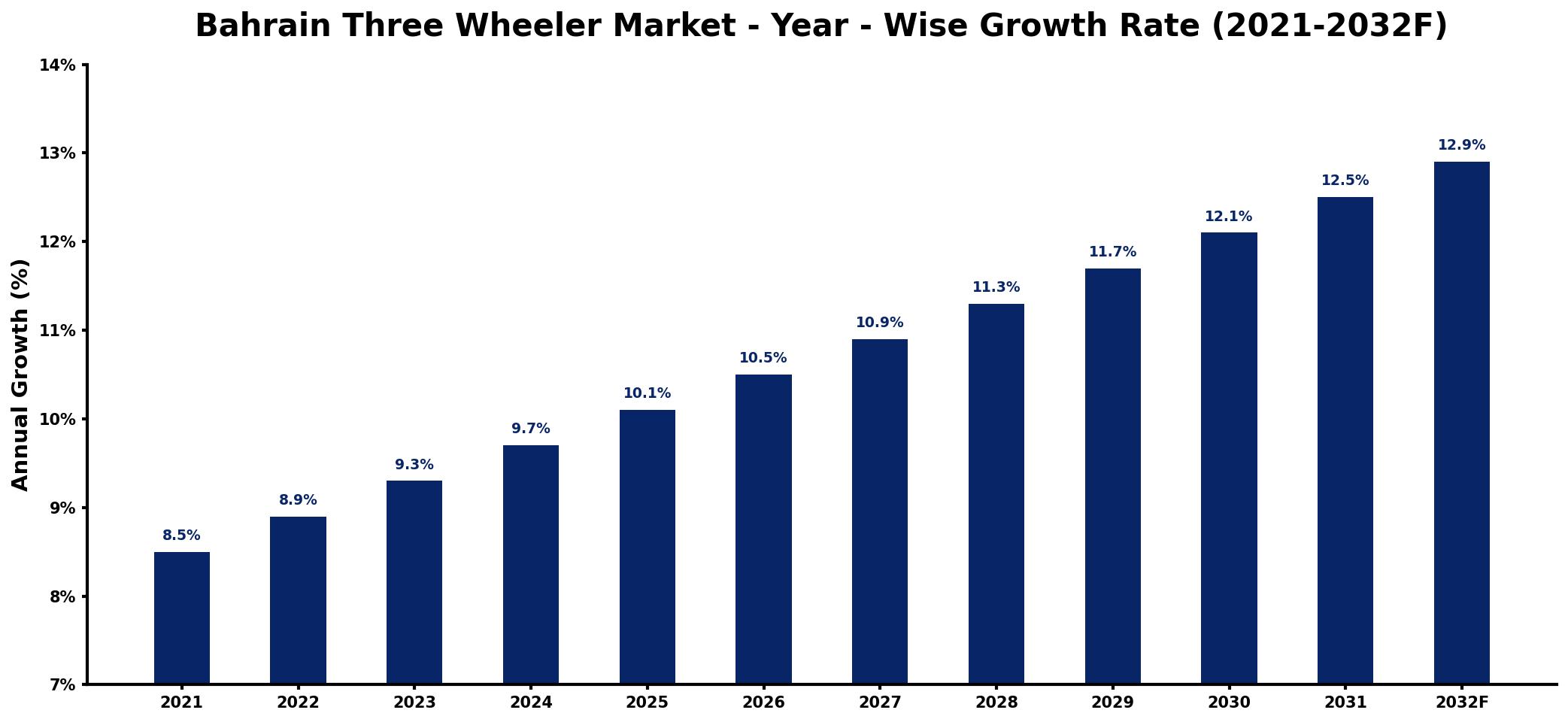
The table below presents the year‑wise growth rates along with the key drivers influencing the market
| Year | Growth Rate | Major Drivers |
| 2021 | 8.5% | Rise in urban mobility solutions |
| 2022 | 8.9% | Increased demand for last mile |
| 2023 | 9.3% | Growth in delivery services sector |
| 2024 | 9.7% | Expansion of e-commerce platforms |
| 2025 | 10.1% | Investment in infrastructure development |
| 2026 | 10.5% | Surge in tourism activities |
| 2027 | 10.9% | Boost in fuel efficiency technologies |
| 2028 | 11.3% | Heightened consumer preference for convenience |
| 2029 | 11.7% | expanding industrial usage applications |
| 2030 | 12.1% | Increase in shared mobility services |
| 2031 | 12.5% | Rising demand for affordable transport |
| 2032 | 12.9% | Advancements in electric vehicle technologies |
Note: Market size estimations and growth projections presented in this report are based on 6Wresearch's proprietary forecasting methodology, utilizing the latest available industry data, government publications, and primary research inputs.
Bahrain Three Wheeler Market Synopsis
In recent years, the Bahrain Three Wheeler Market has gained considerable momentum, driven by the need for efficient transport options amid rising traffic congestion and an expanding urban population. As three-wheelers find favor in various commercial sectors, their market presence is set to evolve, emphasizing sustainability and economic viability.
Looking ahead, the market faces a transformative phase characterized by greater acceptance of three-wheelers for personal and commercial uses. The momentum is further bolstered by government initiatives promoting green transport, positioning three-wheelers as viable alternatives to traditional vehicles.
Bahrain Three Wheeler Market Key Takeaways
- The market is expected to grow significantly, reaching USD 1685 Million by 2032.
- Urbanization and e-commerce are primary drivers of three-wheeler adoption.
- Government policies are increasingly supportive of sustainable transportation options.
- Affordability and fuel efficiency are key selling points for consumers and businesses.
- Three-wheelers are emerging as a preferred solution for short-distance transportation needs.
Evaluation of Restraints in Bahrain Three Wheeler Market
Despite the favorable growth trajectory, the Bahrain Three Wheeler Market encounters several limitations that may impede its expansion. Many consumers still prefer cars and motorcycles due to their enhanced comfort and speed. Moreover, the availability of affordable four-wheeled vehicles often overshadows the three-wheeler option. Government regulations aimed at emissions and safety standards create further hurdles for wider adoption, while the harsh climate conditions can make open three-wheeled vehicles less appealing for everyday use.
Bahrain Three Wheeler Market Trends
As the Bahrain Three Wheeler Market evolves, several trends are emerging that shape its future. The shift towards electric three-wheelers, driven by sustainability goals, is gaining traction as technology advances. Additionally, integration with logistics services and urban mobility solutions showcases an increasing versatility in application. The growing emphasis on last-mile delivery solutions is also driving innovation in three-wheeler design, ensuring they meet the specific needs of modern urban environments.
Bahrain Three Wheeler Market Opportunities
The investment landscape for the Bahrain Three Wheeler Market is ripe with potential. Opportunities exist for the development and deployment of electric and hybrid three-wheelers, which are increasingly favored in urban settings. Moreover, the logistics sector represents a significant area for growth, with demand for flexible transport solutions continuing to rise. In addition, tourism applications of three-wheelers, particularly in historical and urban centers, present a unique avenue for market expansion.
Government Initiatives in the Bahrain Three Wheeler Market
The government of Bahrain is actively promoting the three-wheeler market through various policies aimed at enhancing urban transport efficiency. These initiatives include regulatory frameworks that support the import and use of three-wheelers while ensuring compliance with environmental and operational standards. The Ministry of Industry and Commerce plays a pivotal role in enforcing these regulations, further bolstering a market that aligns with national goals of sustainability and improved urban mobility.
Future Insights of the Bahrain Three Wheeler Market
Looking ahead to 2026-2032, the Bahrain Three Wheeler Market is positioned for substantial growth, propelled by ongoing urbanization and technological advancements. The increasing adoption of electric vehicles will likely redefine market dynamics, paving the way for a more sustainable transport ecosystem. Furthermore, as consumer preferences evolve, the versatility of three-wheelers will expand, accommodating diverse transport needs across both commercial and personal segments.
Bahrain Three Wheeler Market Latest Developments (2025 - 2026)
Recent developments in the Bahrain Three Wheeler Market indicate a shift towards more sustainable transport solutions. New electric models are beginning to emerge, capturing interest from both consumers and businesses alike. Additionally, collaborations between governmental bodies and industry stakeholders are paving the way for enhanced regulatory frameworks and support for adopting innovative vehicle technologies. These trends signify a progressive outlook for the market, steering it towards greater integration with urban mobility initiatives.
Bahrain Three Wheeler Market - Key Attractiveness of the Report
- 10 Years of Market Numbers
- Historical Data Starting from 2022 to 2025
- Base Year: 2025
- Forecast Data until 2032
- Key Performance Indicators Impacting the Market
- Major Upcoming Developments and Projects
Key Highlights of the Report:
- Bahrain Three Wheeler Market Outlook
- Market Size of Bahrain Three Wheeler Market, 2025
- Forecast of Bahrain Three Wheeler Market, 2032
- Historical Data and Forecast of Bahrain Three Wheeler Revenues & Volume for the Period 2022-2032F
- Bahrain Three Wheeler Market Trend Evolution
- Bahrain Three Wheeler Market Drivers and Challenges
- Bahrain Three Wheeler Price Trends
- Bahrain Three Wheeler Porter's Five Forces
- Bahrain Three Wheeler Industry Life Cycle
- Historical Data and Forecast of Bahrain Three Wheeler Market Revenues & Volume By Fuel Type for the Period 2022-2032F
- Historical Data and Forecast of Bahrain Three Wheeler Market Revenues & Volume By Petrol/CNG for the Period 2022-2032F
- Historical Data and Forecast of Bahrain Three Wheeler Market Revenues & Volume By Diesel for the Period 2022-2032F
- Historical Data and Forecast of Bahrain Three Wheeler Market Revenues & Volume By Electric for the Period 2022-2032F
- Historical Data and Forecast of Bahrain Three Wheeler Market Revenues & Volume By Vehicle Type for the Period 2022-2032F
- Historical Data and Forecast of Bahrain Three Wheeler Market Revenues & Volume By Passenger Carrier for the Period 2022-2032F
- Historical Data and Forecast of Bahrain Three Wheeler Market Revenues & Volume By Load Carrier for the Period 2022-2032F
- Bahrain Three Wheeler Import Export Trade Statistics
- Market Opportunity Assessment By Fuel Type
- Market Opportunity Assessment By Vehicle Type
- Bahrain Three Wheeler Top Companies Market Share
- Bahrain Three Wheeler Competitive Benchmarking By Technical and Operational Parameters
- Bahrain Three Wheeler Company Profiles
- Bahrain Three Wheeler Key Strategic Recommendations






































