Bahrain Tung Oil Market Size, Share & Growth Rate
The Bahrain Tung Oil Market was estimated at USD 965 Million in 2025 and is projected to reach USD 1785 Million by 2032, growing at a CAGR of 9.2% from 2026 to 2032. This growth trajectory can be attributed to the increasing demand for eco-friendly wood finishing options and the expanding construction sector in Bahrain. As the furniture and renovation industries thrive, the need for high-quality, durable finishing products like tung oil is expected to surge.
Bahrain Tung Oil Market Year-wise Growth Rate and Key Drivers
This graph highlights how the Bahrain Tung Oil Market has steadily grown over the years, supported by major growth factors.
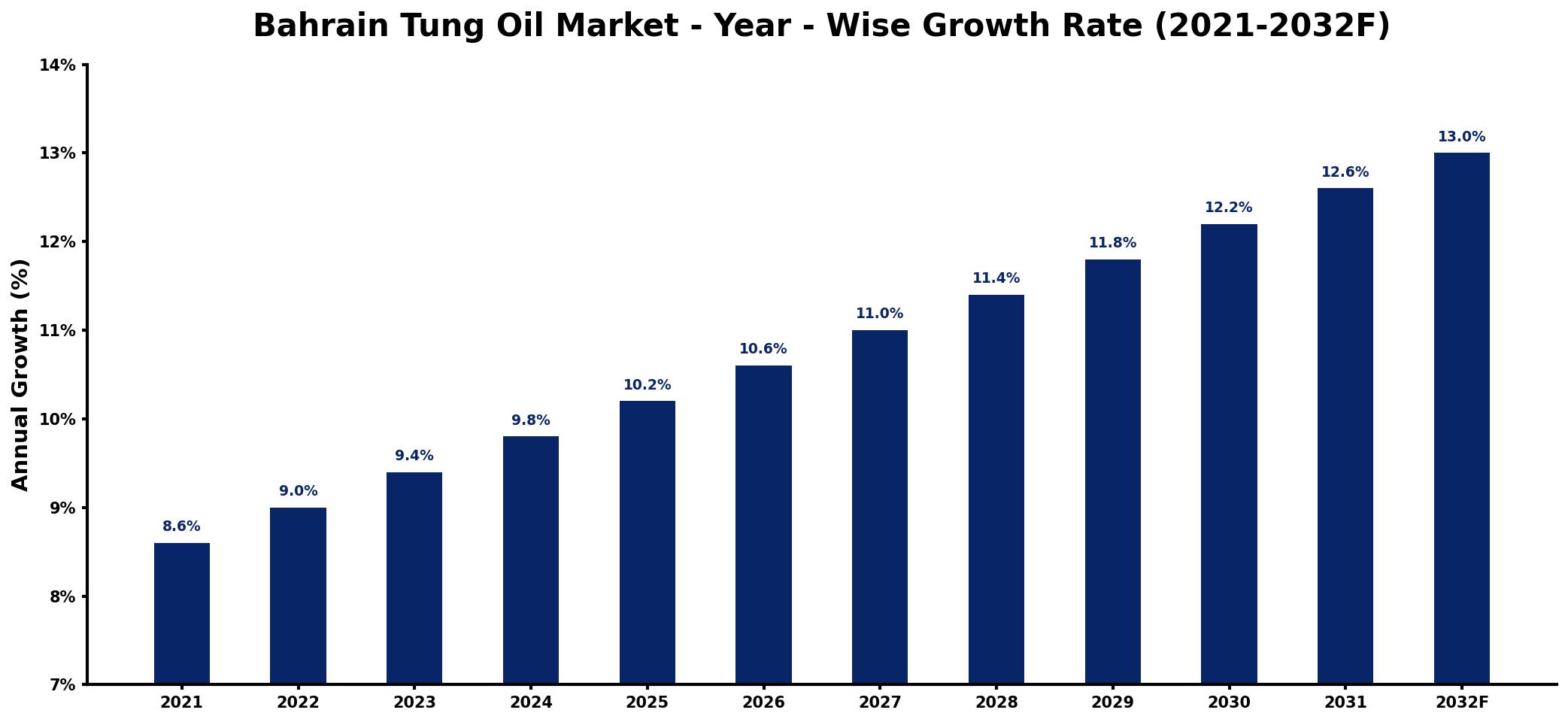
The table below presents the year‑wise growth rates along with the key drivers influencing the market
| Year | Growth Rate | Major Drivers |
| 2021 | 8.6% | Rising demand for eco-friendly alternatives |
| 2022 | 9.0% | Increased investment in sustainable materials |
| 2023 | 9.4% | growing regional consumption patterns |
| 2024 | 9.8% | increased production capacity utilization |
| 2025 | 10.2% | improved raw material availability |
| 2026 | 10.6% | Boost in home improvement activities |
| 2027 | 11.0% | Growing awareness of health benefits |
| 2028 | 11.4% | Increase in export opportunities abroad |
| 2029 | 11.8% | Enhanced product availability in retail |
| 2030 | 12.2% | Development of innovative application techniques |
| 2031 | 12.6% | Strengthening of local manufacturing capabilities |
| 2032 | 13.0% | Emergence of new market segments |
Note: Market size estimations and growth projections presented in this report are based on 6Wresearch's proprietary forecasting methodology, utilizing the latest available industry data, government publications, and primary research inputs.
Bahrain Tung Oil Market Synopsis
Currently, the tung oil market in Bahrain is characterized by its niche applications primarily in wood finishing, paints, and varnishes. As the country relies entirely on imports, the market dynamics are heavily influenced by global supply chains and consumer preferences for natural products.
In recent years, the trend towards sustainable construction has bolstered the appeal of tung oil, prized for its water-resistant and non-toxic properties. As awareness increases about its benefits, more industries are likely to explore its applications beyond traditional uses, offering potential for market expansion.
Bahrain Tung Oil Market Key Takeaways
- The market is growing due to rising demand for natural wood finishes and coatings.
- Bahrain's dependency on imports poses risks related to global pricing and supply stability.
- The trend towards sustainable construction significantly influences consumer preferences.
- Limited consumer awareness restricts the market to niche applications.
- Investment in local production and distribution networks presents opportunities for growth.
Evaluation of Restraints in Bahrain Tung Oil Market
The Bahrain Tung Oil Market faces considerable restraints stemming from its reliance on imports, making it vulnerable to fluctuations in global pricing and supply disruptions. Additionally, the relatively low consumer awareness regarding the benefits and applications of tung oil limits its market penetration, confining it to specialized segments. Competing cheaper alternatives such as linseed oil and synthetic coatings further challenge tung oil's position in the marketplace, requiring stakeholders to innovate and educate consumers about its unique advantages.
Bahrain Tung Oil Market Trends
Emerging trends in the Bahrain Tung Oil Market indicate a growing shift towards environmentally sustainable practices across various sectors. Consumers are increasingly seeking natural alternatives to synthetic coatings, driving the demand for tung oil. Furthermore, innovations in application technologies are enabling more efficient use of tung oil in construction and furniture manufacturing, enhancing its appeal. The increasing focus on eco-friendly construction materials is likely to sustain this momentum in the coming years.
Bahrain Tung Oil Market Opportunities
The Bahrain Tung Oil Market presents significant growth opportunities particularly in the construction and furniture sectors. With the ongoing construction boom, there is an increasing need for high-quality wood finishing and protective coatings. Investors can capitalize on this demand by exploring avenues for importing premium tung oil or even developing local distribution channels to meet the burgeoning needs of local artisans and manufacturers, thus enhancing market accessibility.
Government Initiatives in the Bahrain Tung Oil Market
The Bahraini government promotes policies that encourage the use of sustainable products and materials across industries. Through initiatives aimed at fostering environmentally responsible practices, there is increased support for companies that prioritize eco-friendly production methods. Public spending in sustainable development projects is also likely to bolster the demand for high-quality, natural finishes such as tung oil in the construction sector.
Future Insights of the Bahrain Tung Oil Market
Looking ahead to the period between 2026 and 2032, the Bahrain Tung Oil Market is poised for transformative growth. As awareness about the benefits of natural wood finishes spreads and sustainable practices become the norm, the market is likely to attract a broader consumer base. Enhanced distribution channels, along with rising investment in local production capabilities, will further reinforce the market's growth. With these shifts, tung oil is expected to carve out a more prominent niche in Bahrain's building and renovation sectors.
Bahrain Tung Oil Market Latest Developments (2025 - 2026)
Recent developments in the Bahrain Tung Oil Market indicate a surge in interest from both consumers and businesses as sustainability becomes a focal point in construction and manufacturing. Initiatives aimed at educating consumers about the advantages of tung oil are underway, which may further enhance its adoption. Additionally, local industry stakeholders are exploring collaborative efforts to streamline the supply chain and improve access to tung oil products, signaling a proactive response to market challenges.
Bahrain Tung Oil Market - Key Attractiveness of the Report
- 10 Years of Market Numbers
- Historical Data Starting from 2022 to 2025
- Base Year: 2025
- Forecast Data until 2032
- Key Performance Indicators Impacting the Market
- Major Upcoming Developments and Projects
Key Highlights of the Report:
- Bahrain Tung Oil Market Outlook
- Market Size of Bahrain Tung Oil Market, 2025
- Forecast of Bahrain Tung Oil Market, 2032
- Historical Data and Forecast of Bahrain Tung Oil Revenues & Volume for the Period 2022-2032F
- Bahrain Tung Oil Market Trend Evolution
- Bahrain Tung Oil Market Drivers and Challenges
- Bahrain Tung Oil Price Trends
- Bahrain Tung Oil Porter's Five Forces
- Bahrain Tung Oil Industry Life Cycle
- Historical Data and Forecast of Bahrain Tung Oil Market Revenues & Volume By Product Type for the Period 2022-2032F
- Historical Data and Forecast of Bahrain Tung Oil Market Revenues & Volume By Raw Tung Oil for the Period 2022-2032F
- Historical Data and Forecast of Bahrain Tung Oil Market Revenues & Volume By Boiled Tung Oil for the Period 2022-2032F
- Historical Data and Forecast of Bahrain Tung Oil Market Revenues & Volume By Application for the Period 2022-2032F
- Historical Data and Forecast of Bahrain Tung Oil Market Revenues & Volume By Wood Finishing for the Period 2022-2032F
- Historical Data and Forecast of Bahrain Tung Oil Market Revenues & Volume By Food and Beverage for the Period 2022-2032F
- Historical Data and Forecast of Bahrain Tung Oil Market Revenues & Volume By Medicines for the Period 2022-2032F
- Historical Data and Forecast of Bahrain Tung Oil Market Revenues & Volume By Others for the Period 2022-2032F
- Bahrain Tung Oil Import Export Trade Statistics
- Market Opportunity Assessment By Product Type
- Market Opportunity Assessment By Application
- Bahrain Tung Oil Top Companies Market Share
- Bahrain Tung Oil Competitive Benchmarking By Technical and Operational Parameters
- Bahrain Tung Oil Company Profiles
- Bahrain Tung Oil Key Strategic Recommendations






































