Bahrain Unified Communication and Collaboration (UCC) Market Size, Share & Growth Rate
The Bahrain Unified Communication and Collaboration (UCC) Market was estimated at USD 1464 Million in 2025 and is projected to reach USD 2428 Million by 2032, growing at a CAGR of 7.5% from 2026 to 2032. This robust growth trajectory is propelled by the rising adoption of hybrid work models across various sectors, combined with a growing reliance on seamless communication technologies. As businesses increasingly prioritize real-time collaboration, the demand for integrated UCC solutions continues to gain momentum.
Bahrain Unified Communication and Collaboration (UCC) Market Year-wise Growth Rate and Key Drivers
This graph highlights how the Bahrain Unified Communication and Collaboration (UCC) Market has steadily grown over the years, supported by major growth factors.
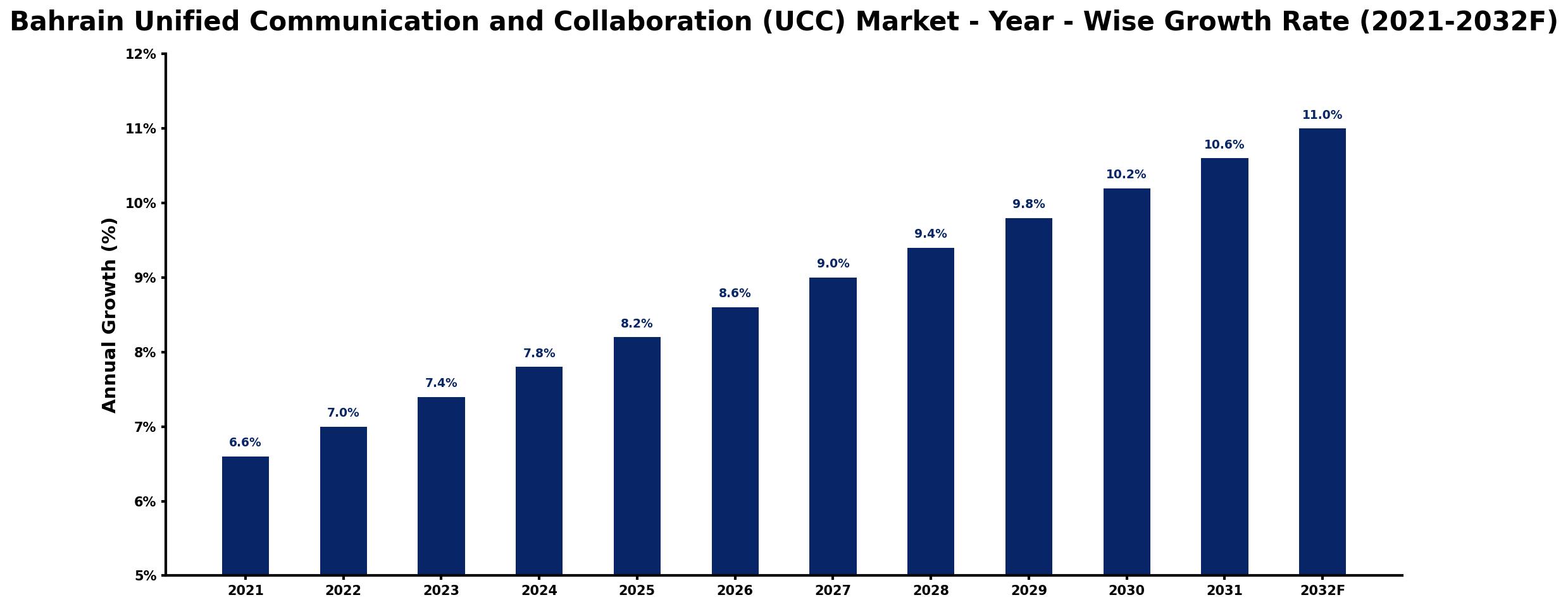
The table below presents the year‑wise growth rates along with the key drivers influencing the market
| Year | Growth Rate | Major Drivers |
| 2021 | 6.6% | increased remote work adoption |
| 2022 | 7.0% | growing digital transformation initiatives |
| 2023 | 7.4% | rising demand for cloud services |
| 2024 | 7.8% | expansion of mobile workforce solutions |
| 2025 | 8.2% | growing commercial sector adoption |
| 2026 | 8.6% | growing reliance on video conferencing |
| 2027 | 9.0% | increased focus on employee engagement |
| 2028 | 9.4% | adoption of AI-driven technologies |
| 2029 | 9.8% | growing need for real-time feedback |
| 2030 | 10.2% | expanding healthcare application demand |
| 2031 | 10.6% | rising trends in hybrid workplaces |
| 2032 | 11.0% | increased capital investment inflows |
Note: Market size estimations and growth projections presented in this report are based on 6Wresearch's proprietary forecasting methodology, utilizing the latest available industry data, government publications, and primary research inputs.
Bahrain Unified Communication and Collaboration (UCC) Market Synopsis
The demand for advanced UCC solutions in Bahrain is driven by enterprises seeking to enhance productivity and streamline operations through effective communication channels. Key sectors such as financial services, education, and government are leading this trend, embracing video conferencing, instant messaging, and integrated platforms to foster collaboration.
In response to a shifting work landscape, local IT firms are stepping up to provide tailored support and integration services, ensuring that organizations can utilize cloud-based solutions efficiently. This localized approach helps bridge the gap between global technologies and the unique needs of Bahraini businesses.
Bahrain Unified Communication and Collaboration (UCC) Market Key Takeaways
- The market is experiencing rapid growth due to the shift towards hybrid working models.
- Cloud-based solutions from major providers are dominating the landscape.
- Data security and compliance are central to purchasing decisions.
- Investment opportunities are abundant in video conferencing and instant messaging sectors.
- Localized support is crucial for successful UCC integration in Bahrain.
Evaluation of Restraints in Bahrain Unified Communication and Collaboration (UCC) Market
Despite the promising growth, the Bahrain UCC market is hampered by several restraints. Traditional businesses exhibit a reluctance to transition to cloud-based solutions, often due to data privacy concerns and fears surrounding cybersecurity risks. Such apprehensions are particularly pronounced in sectors where sensitive information is handled. Additionally, the high costs associated with premium software licenses, along with the complexities of integrating these new tools with existing legacy systems, can deter widespread adoption. Issues like inconsistent internet quality in remote areas further complicate user experiences, while the lack of multilingual support limits accessibility for a diverse workforce.
Bahrain Unified Communication and Collaboration (UCC) Market Trends
Current trends in the Bahrain UCC market highlight a strong preference for integrated platforms that offer seamless interoperability across various communication channels. The rise of mobile-first solutions is also evident, as organizations seek to empower employees to collaborate on-the-go. Furthermore, the increasing emphasis on data-driven decision-making is prompting companies to invest in analytics tools that provide insights into communication patterns, thereby optimizing operational efficiency. The post-pandemic era has undeniably shifted the paradigm of work, and the UCC market is adapting accordingly.
Bahrain Unified Communication and Collaboration (UCC) Market Opportunities
The opportunities within the Bahrain UCC market are significant, primarily fueled by the ongoing digital transformation across industries. Investors can capitalize on the increasing demand for video conferencing technologies and cloud-based communication systems. There is also a burgeoning market for instant messaging platforms that enhance team collaboration. With Bahrains evolving digital infrastructure, UCC providers are well-positioned to enter the Middle Eastern market, offering solutions tailored to local requirements, especially in collaboration with government entities and private enterprises.
Government Initiatives in the Bahrain Unified Communication and Collaboration (UCC) Market
The Bahraini government actively supports the adoption of UCC technologies as part of its broader digital transformation strategy. The Telecommunications Regulatory Authority (TRA) is championing the deployment of cloud-based communication tools, aiming to enhance operational efficiencies across various sectors, including government, healthcare, and education. Enterprises are encouraged to adopt these technologies through initiatives like Tamkeen grants and digital enablement programs, which facilitate access to enterprise-grade collaboration tools while ensuring compliance with local data protection laws.
Future Insights of the Bahrain Unified Communication and Collaboration (UCC) Market
Looking ahead to the period from 2026 to 2032, the Bahrain UCC market is anticipated to maintain its upward trajectory. Continuous advancements in communication technology will likely drive the need for more sophisticated solutions that cater to the evolving demands of the workforce. As businesses become increasingly reliant on real-time collaboration tools, the market will see sustained investment in security and compliance measures. Furthermore, the trend towards hybrid work is expected to solidify, reinforcing the necessity for robust UCC frameworks that support both remote and in-office employees.
Bahrain Unified Communication and Collaboration (UCC) Market Latest Developments (2025 - 2026)
Recent industry developments indicate a heightened focus on integrating advanced AI and machine learning capabilities into UCC solutions. This trend is poised to enhance user experience by providing personalized features that cater to specific communication needs. Additionally, partnerships between local firms and international UCC providers are fostering innovation, enabling businesses to leverage the latest technologies while ensuring compliance with local regulations. Overall, the landscape is rapidly evolving, reflecting the dynamic nature of communication and collaboration requirements in Bahrain.
Bahrain Unified Communication and Collaboration (UCC) Market - Key Attractiveness of the Report
- 10 Years of Market Numbers
- Historical Data Starting from 2022 to 2025
- Base Year: 2025
- Forecast Data until 2032
- Key Performance Indicators Impacting the Market
- Major Upcoming Developments and Projects
Key Highlights of the Report:
- Bahrain Unified Communication and Collaboration (UCC) Market Outlook
- Market Size of Bahrain Unified Communication and Collaboration (UCC) Market, 2025
- Forecast of Bahrain Unified Communication and Collaboration (UCC) Market, 2032
- Historical Data and Forecast of Bahrain Unified Communication and Collaboration (UCC) Revenues & Volume for the Period 2022-2032F
- Bahrain Unified Communication and Collaboration (UCC) Market Trend Evolution
- Bahrain Unified Communication and Collaboration (UCC) Market Drivers and Challenges
- Bahrain Unified Communication and Collaboration (UCC) Price Trends
- Bahrain Unified Communication and Collaboration (UCC) Porter's Five Forces
- Bahrain Unified Communication and Collaboration (UCC) Industry Life Cycle
- Historical Data and Forecast of Bahrain Unified Communication and Collaboration (UCC) Market Revenues & Volume By Components for the Period 2022-2032F
- Historical Data and Forecast of Bahrain Unified Communication and Collaboration (UCC) Market Revenues & Volume By Types for the Period 2022-2032F
- Historical Data and Forecast of Bahrain Unified Communication and Collaboration (UCC) Market Revenues & Volume By Services for the Period 2022-2032F
- Historical Data and Forecast of Bahrain Unified Communication and Collaboration (UCC) Market Revenues & Volume By Types for the Period 2022-2032F
- Historical Data and Forecast of Bahrain Unified Communication and Collaboration (UCC) Market Revenues & Volume By UCaaS for the Period 2022-2032F
- Historical Data and Forecast of Bahrain Unified Communication and Collaboration (UCC) Market Revenues & Volume By IP Telephony for the Period 2022-2032F
- Historical Data and Forecast of Bahrain Unified Communication and Collaboration (UCC) Market Revenues & Volume By Video Conferencing Systems for the Period 2022-2032F
- Historical Data and Forecast of Bahrain Unified Communication and Collaboration (UCC) Market Revenues & Volume By Services for the Period 2022-2032F
- Historical Data and Forecast of Bahrain Unified Communication and Collaboration (UCC) Market Revenues & Volume By UC Managed Services for the Period 2022-2032F
- Historical Data and Forecast of Bahrain Unified Communication and Collaboration (UCC) Market Revenues & Volume By Professional Services for the Period 2022-2032F
- Historical Data and Forecast of Bahrain Unified Communication and Collaboration (UCC) Market Revenues & Volume By Deployment Mode for the Period 2022-2032F
- Historical Data and Forecast of Bahrain Unified Communication and Collaboration (UCC) Market Revenues & Volume By On-premises for the Period 2022-2032F
- Historical Data and Forecast of Bahrain Unified Communication and Collaboration (UCC) Market Revenues & Volume By Public Cloud for the Period 2022-2032F
- Historical Data and Forecast of Bahrain Unified Communication and Collaboration (UCC) Market Revenues & Volume By Hybrid Cloud for the Period 2022-2032F
- Historical Data and Forecast of Bahrain Unified Communication and Collaboration (UCC) Market Revenues & Volume By Organization Size for the Period 2022-2032F
- Historical Data and Forecast of Bahrain Unified Communication and Collaboration (UCC) Market Revenues & Volume By Large Enterprises for the Period 2022-2032F
- Historical Data and Forecast of Bahrain Unified Communication and Collaboration (UCC) Market Revenues & Volume By Small and Medium- Sized Enterprises (SMEs) for the Period 2022-2032F
- Historical Data and Forecast of Bahrain Unified Communication and Collaboration (UCC) Market Revenues & Volume By Vertical for the Period 2022-2032F
- Historical Data and Forecast of Bahrain Unified Communication and Collaboration (UCC) Market Revenues & Volume By BFSI for the Period 2022-2032F
- Historical Data and Forecast of Bahrain Unified Communication and Collaboration (UCC) Market Revenues & Volume By IT and Telecom for the Period 2022-2032F
- Historical Data and Forecast of Bahrain Unified Communication and Collaboration (UCC) Market Revenues & Volume By Retail and Consumer Goods for the Period 2022-2032F
- Historical Data and Forecast of Bahrain Unified Communication and Collaboration (UCC) Market Revenues & Volume By Healthcare for the Period 2022-2032F
- Historical Data and Forecast of Bahrain Unified Communication and Collaboration (UCC) Market Revenues & Volume By Public Sector and Utilities for the Period 2022-2032F
- Historical Data and Forecast of Bahrain Unified Communication and Collaboration (UCC) Market Revenues & Volume By Logistics and Transportation for the Period 2022-2032F
- Historical Data and Forecast of Bahrain Unified Communication and Collaboration (UCC) Market Revenues & Volume By Travel and Hospitality for the Period 2022-2032F
- Historical Data and Forecast of Bahrain Unified Communication and Collaboration (UCC) Market Revenues & Volume By Other Verticals (Education, Manufacturing and Media and Entertainment) for the Period 2022-2032F
- Bahrain Unified Communication and Collaboration (UCC) Import Export Trade Statistics
- Market Opportunity Assessment By Components
- Market Opportunity Assessment By Types
- Market Opportunity Assessment By Services
- Market Opportunity Assessment By Deployment Mode
- Market Opportunity Assessment By Organization Size
- Market Opportunity Assessment By Vertical
- Bahrain Unified Communication and Collaboration (UCC) Top Companies Market Share
- Bahrain Unified Communication and Collaboration (UCC) Competitive Benchmarking By Technical and Operational Parameters
- Bahrain Unified Communication and Collaboration (UCC) Company Profiles
- Bahrain Unified Communication and Collaboration (UCC) Key Strategic Recommendations






































