Bangladesh 3D Glasses Market Summary
The bangladesh 3d glasses market was estimated at USD 446 Million in 2025 and is projected to reach USD 614 Million by 2032, growing at a CAGR of 5.7% from 2026 to 2032.
Bangladesh 3D Glasses Market Year-wise Growth Rate and Key Drivers
This graph highlights how the Bangladesh 3D Glasses Market has steadily grown over the past five years, supported by major growth factors.
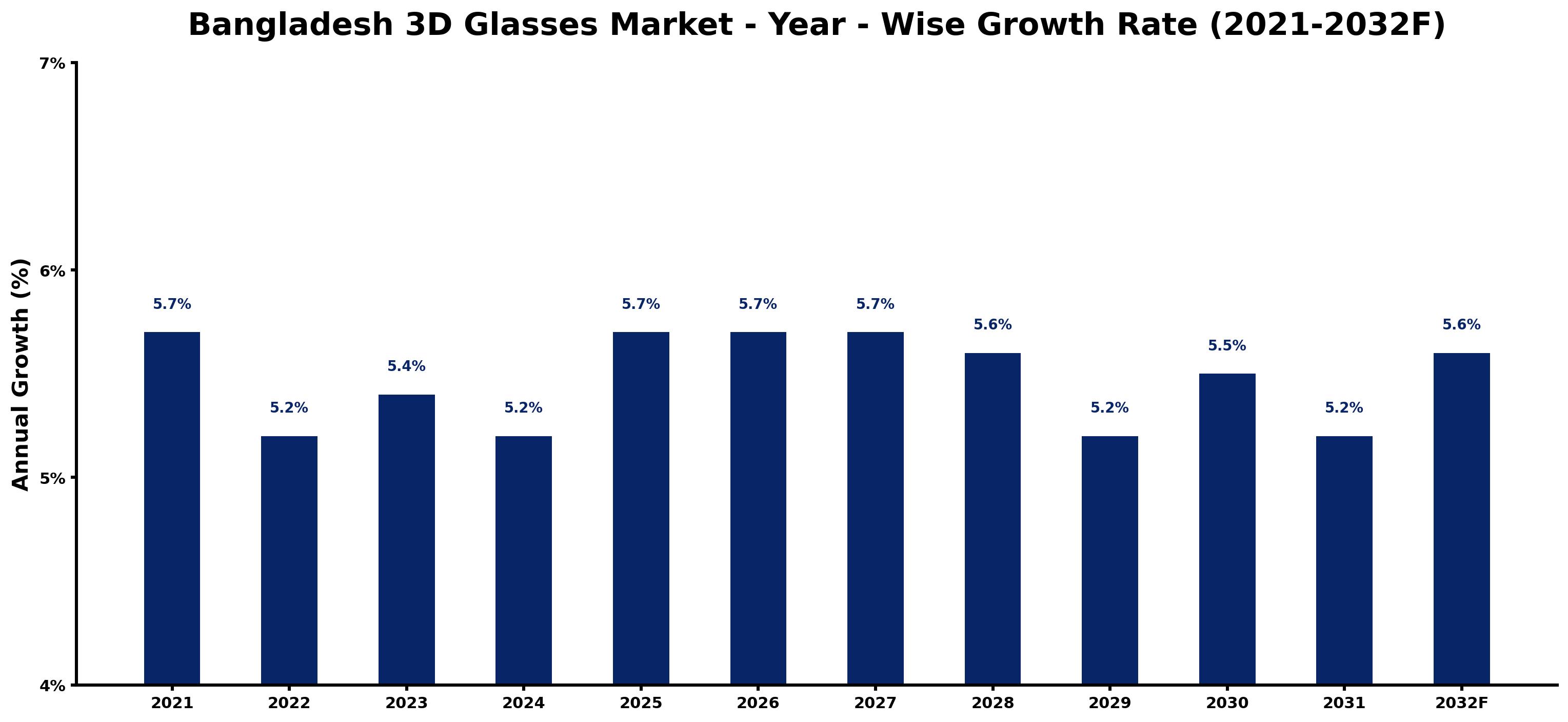
The table below presents the year wise growth rates along with the key drivers influencing the market
| Year | Growth Rate | Major Drivers |
| 2021 | 5.7% | Emerging gaming trends in Bangladesh bolster interest in immersive 3D experiences. |
| 2022 | 5.2% | Local manufacturers begin producing affordable 3D glasses, enhancing market accessibility. |
| 2023 | 5.4% | Increased smartphone penetration creates opportunities for mobile 3D applications and content. |
| 2024 | 5.2% | Virtual reality gaming centers open across urban areas, driving consumer engagement. |
| 2025 | 5.7% | Bangladesh's growing entertainment industry embraces 3D technology for cinematic experiences. |
| 2026 | 5.7% | Educational institutions explore 3D glasses for enhanced learning in science and arts. |
| 2027 | 5.7% | International collaborations spark innovation in augmented reality applications and content. |
| 2028 | 5.6% | E-commerce platforms expand to include 3D product visualizations, attracting tech-savvy consumers. |
| 2029 | 5.2% | Investment in local tech startups focuses on developing interactive 3D content for users. |
| 2030 | 5.5% | Demand for virtual travel experiences increases, positioning 3D glasses as essential tools. |
| 2031 | 5.2% | Media partnerships evolve to offer exclusive 3D content, attracting diverse audience segments. |
| 2032 | 5.6% | Emerging trends in smart home technology integrate 3D experiences into everyday life. |
Note - Market size estimations and growth projections presented in this report are based on 6Wresearch's advanced forecasting approach, validated with industry datasets as of June 2026.
Bangladesh 3D Glasses Market Synopsis
The Bangladesh 3D Glasses Market is projected to reach 5.7% and witness significant growth during the forecast period (2026-2032). The market is driven by an increasing demand for immersive visual experiences across various sectors, including entertainment, education, and gaming. The rising popularity of advanced 3D technology among consumers has created a strong demand for high-quality, affordable 3D glasses. Furthermore, innovations in design aimed at improving comfort and usability are contributing to the market's positive trajectory.
Bangladesh 3D Glasses Market Growth Drivers
Several factors are propelling the growth of the Bangladesh 3D glasses market. Firstly, the expanding entertainment industry, characterized by the popularity of 3D films and gaming, is a critical driver of demand. Moreover, as virtual reality applications gain traction, the necessity for specialized eyewear becomes increasingly apparent. Additionally, the emphasis on high-quality visuals by educational institutions is further fostering the market, as schools and universities integrate 3D technology into their curriculums.
- The rise of affordable technological solutions has made 3D glasses more accessible to a broader audience in Bangladesh, contributing to market growth.
- Innovations in design, such as lightweight materials and ergonomic shapes, have improved user comfort, encouraging longer usage and boosting sales.
- The convergence of augmented reality (AR) and virtual reality (VR) is driving the demand for versatile 3D glasses that cater to multiple applications.
- Consumer preferences are shifting towards eco-friendly products, leading manufacturers to explore sustainable materials for 3D glasses production.
- Increased marketing efforts and brand awareness campaigns have played a significant role in educating consumers about the benefits of high-quality 3D eyewear.
Bangladesh 3D Glasses Market Challenges and Restraints
Despite the positive outlook, the Bangladesh 3D glasses market faces several challenges that could hinder growth. A significant concern is the influx of low-cost, counterfeit products that undermine the reputation of legitimate brands, leading to consumer distrust. Additionally, the market suffers from a lack of awareness regarding the importance of high-quality 3D glasses among potential buyers, making it imperative for manufacturers to enhance educational efforts.
- Counterfeit products often offer subpar performance, resulting in negative consumer experiences that can deter future purchases of genuine brands.
- There is a limited availability of advanced manufacturing technologies within Bangladesh, which leads to a dependency on imported materials and components.
- Consumer misconceptions about the functionality and benefits of premium 3D glasses may inhibit market expansion, highlighting the need for targeted marketing efforts.
- The fluctuating prices of imported goods due to tariffs and taxes can affect retail pricing, making it challenging for local businesses to maintain competitive pricing.
- The complexity of supply chains can result in delays and cost increases, further straining the ability of manufacturers to meet consumer demand effectively.
Bangladesh 3D Glasses Market Investment Opportunities
The Bangladesh 3D glasses market presents numerous investment opportunities, particularly as consumer engagement with 3D technologies continues to rise. There is a substantial demand for innovative, affordable options tailored specifically for local consumers. This opens avenues for investments in design and manufacturing that prioritize quality and affordability.
- Investing in R&D for new technologies such as Bluetooth-enabled 3D glasses can offer a competitive advantage in enhancing the user experience.
- Opportunities exist for local production facilities to reduce dependency on imports, thus lowering costs while creating jobs within the local economy.
- Partnerships with the entertainment industry can lead to co-branding opportunities that enhance visibility and promote product sales.
- Adopting environmentally sustainable practices in manufacturing can attract a growing segment of eco-conscious consumers.
- Perfecting user-friendly designs that address consumer comfort and style preferences can significantly drive market penetration and consumer loyalty.
Bangladesh 3D Glasses Market Government Investment and Initiatives
While the Bangladeshi government does not have dedicated policies specifically targeting the 3D glasses market, broader trade and regulatory frameworks directly influence its growth. Import duties and taxes on 3D glasses can affect market pricing, impacting consumer access to innovative products. Quality standards mandated by regulatory authorities require manufacturers to comply, ensuring consumer safety while promoting brand reliability.
- The government's push for technological advancement in local industries may incentivize investments in the production of 3D glasses.
- Regulatory measures aimed at protecting intellectual property rights are vital to combat counterfeiting, ultimately fostering a healthier market environment.
- Public awareness initiatives can enhance understanding of the significance of quality in consumer electronics, including 3D glasses.
- Investment in infrastructure to support local manufacturing will be essential for reducing costs and improving supply chains.
- The government may also explore public-private partnerships to advance technology integration in cultural sectors, boosting demand for 3D glasses.
Bangladesh 3D Glasses Market Latest Developments (May 2025 - June 2026)
Recent developments in the Bangladesh 3D glasses market from May 2025 to June 2026 indicate a trend towards increased consumer engagement with 3D content. Noteworthy advancements have been observed in the design and functionality of 3D glasses, with manufacturers striving to create products that enhance user comfort and connectivity. The market is witnessing a surge in demand for glasses equipped with smart technology, enabling seamless integration with mobile devices. Additionally, there has been a growing focus on sustainable materials, reflecting consumer priorities toward environmentally conscious products.
Bangladesh 3D Glasses Market - Key Attractiveness of the Report
- 10 Years of Market Numbers
- Historical Data Starting from 2022 to 2025
- Base Year: 2025
- Forecast Data until 2032
- Key Performance Indicators Impacting the Market
- Major Upcoming Developments and Projects
Key Highlights of the Report:
- Bangladesh 3D Glasses Market Outlook
- Market Size of Bangladesh 3D Glasses Market, 2025
- Forecast of Bangladesh 3D Glasses Market, 2032F
- Historical Data and Forecast of Bangladesh 3D Glasses Revenues & Volume for the Period 2022-2032F
- Bangladesh 3D Glasses Market Trend Evolution
- Bangladesh 3D Glasses Market Drivers and Challenges
- Bangladesh 3D Glasses Price Trends
- Bangladesh 3D Glasses Porter's Five Forces
- Bangladesh 3D Glasses Industry Life Cycle
- Historical Data and Forecast of Bangladesh 3D Glasses Market Revenues & Volume By Product Type for the Period 2022-2032F
- Historical Data and Forecast of Bangladesh 3D Glasses Market Revenues & Volume By Active shutter for the Period 2022-2032F
- Historical Data and Forecast of Bangladesh 3D Glasses Market Revenues & Volume By Polarized for the Period 2022-2032F
- Historical Data and Forecast of Bangladesh 3D Glasses Market Revenues & Volume By Anaglyph for the Period 2022-2032F
- Historical Data and Forecast of Bangladesh 3D Glasses Market Revenues & Volume By Applications for the Period 2022-2032F
- Historical Data and Forecast of Bangladesh 3D Glasses Market Revenues & Volume By Media for the Period 2022-2032F
- Historical Data and Forecast of Bangladesh 3D Glasses Market Revenues & Volume By Cinemas for the Period 2022-2032F
- Bangladesh 3D Glasses Import Export Trade Statistics
- Market Opportunity Assessment By Product Type
- Market Opportunity Assessment By Applications
- Bangladesh 3D Glasses Top Companies Market Share
- Bangladesh 3D Glasses Competitive Benchmarking By Technical and Operational Parameters
- Bangladesh 3D Glasses Company Profiles
- Bangladesh 3D Glasses Key Strategic Recommendations






































