Bangladesh Aerostat Systems Market Size, Share & Growth Rate
The Bangladesh Aerostat Systems Market was estimated at USD 690 Million in 2025 and is projected to reach USD 988 Million by 2032, growing at a CAGR of 5.3% from 2026 to 2032. This growth is primarily fueled by the government's commitment to bolstering surveillance capabilities across various sectors, including military operations and disaster management. The rising need for effective aerial solutions to monitor borders and critical infrastructure is also contributing significantly to this upward trajectory.
Bangladesh Aerostat Systems Market Year-wise Growth Rate and Key Drivers
This graph highlights how the Bangladesh Aerostat Systems Market has steadily grown over the years, supported by major growth factors.
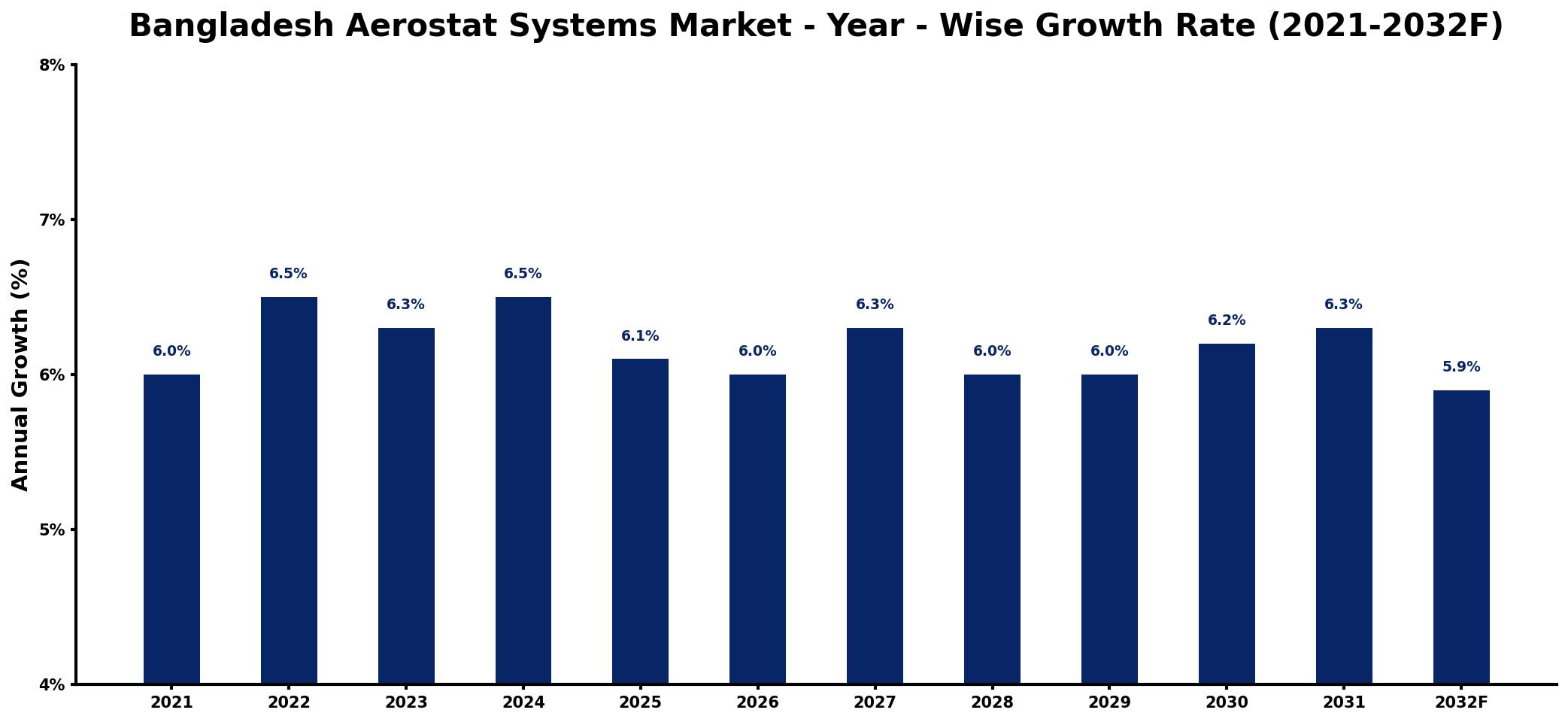
The table below presents the year‑wise growth rates along with the key drivers influencing the market
| Year | Growth Rate | Major Drivers |
| 2021 | 6.0% | Rising defense spending initiatives |
| 2022 | 6.5% | Increased surveillance application demand |
| 2023 | 6.3% | Growing interest in border security |
| 2024 | 6.5% | Expansion of telecommunications infrastructure |
| 2025 | 6.1% | Emergence of new market applications |
| 2026 | 6.0% | Investment in disaster management solutions |
| 2027 | 6.3% | Heightened focus on environmental monitoring |
| 2028 | 6.0% | Advancements in technology integration |
| 2029 | 6.0% | Strengthened public safety measures |
| 2030 | 6.2% | Growing popularity in event management |
| 2031 | 6.3% | Increased interest in research applications |
| 2032 | 5.9% | Focus on urban development projects |
Note: Market size estimations and growth projections presented in this report are based on 6Wresearch's proprietary forecasting methodology, utilizing the latest available industry data, government publications, and primary research inputs.
Bangladesh Aerostat Systems Market Synopsis
The demand for aerostat systems in Bangladesh is surging, driven by enhanced surveillance and monitoring needs in both military and civil applications. Recent investments in technology are making these systems increasingly viable for border security, disaster response, and infrastructure oversight.
Moreover, partnerships between local and international firms are stimulating innovation and expanding the market. These collaborations are crucial for integrating advanced technologies that boost the capabilities of aerostat systems, such as higher endurance and improved sensor technology.
Bangladesh Aerostat Systems Market Key Takeaways
- Increasing government initiatives are propelling the adoption of aerostat systems for enhanced security.
- Collaborations between domestic and international companies are fostering technological advancements.
- Investments in lightweight materials and enhanced sensors are driving market innovation.
- The market presents lucrative opportunities for investment in surveillance technologies and support services.
- Regulatory compliance remains essential for successful market entry and operation.
Evaluation of Restraints in Bangladesh Aerostat Systems Market
Despite its growth potential, the Bangladesh Aerostat Systems Market faces several limitations. Key challenges include a lack of widespread understanding of aerostat technology among stakeholders, which can impede market expansion. Moreover, the high initial costs associated with procuring and deploying these systems deter some potential adopters. Additionally, regulatory constraints related to airspace and licensing can hinder operational effectiveness. The absence of a robust local supply chain and manufacturing base for aerostat components further complicates the market landscape, creating obstacles for industry players aiming to capitalize on emerging opportunities.
Bangladesh Aerostat Systems Market Trends
Several trends are shaping the Bangladesh Aerostat Systems Market. There is a marked increase in investment towards surveillance applications in the military and civil sectors, underpinned by rising concerns over national security and the need for disaster management solutions. Technological advancements play a crucial role, with innovations in sensor technology and materials paving the way for lighter, more efficient aerostat systems. Furthermore, the market is witnessing a gradual shift toward integrated systems that combine surveillance with communication capabilities.
Bangladesh Aerostat Systems Market Opportunities
The Bangladesh Aerostat Systems Market is ripe with investment opportunities. With the government prioritizing security enhancements, theres a robust demand for aerostat systems tailored for various applications, including border security and disaster management. Investors can explore avenues in system supply, maintenance services, or bespoke solutions in partnership with government agencies. Furthermore, as awareness of aerostat technology grows, the potential for local production of components presents an avenue for enhancing market stability and growth.
Government Initiatives in the Bangladesh Aerostat Systems Market
The Bangladeshi government is actively promoting the aerostat systems market through various policies aimed at enhancing national security and monitoring capabilities. Allocations in budgetary spending are being directed towards the acquisition and deployment of aerostat systems, particularly in defense and disaster response sectors. Additionally, initiatives encouraging domestic manufacturing and technology transfers are being put in place to reduce dependence on foreign suppliers and foster local industry growth.
Future Insights of the Bangladesh Aerostat Systems Market
Looking ahead to 2026-2032, the Bangladesh Aerostat Systems Market is projected to sustain its growth momentum. As the country seeks to modernize its defense and surveillance infrastructure, the adoption of aerostat systems is likely to increase. Moreover, as advancements in technologies continue to improve the efficacy of these systems, demand will only grow stronger. The convergence of rising security concerns and governmental support will likely solidify the market's position as a vital component of Bangladesh's overall defense strategy.
Bangladesh Aerostat Systems Market Latest Developments (2025 - 2026)
In recent months, there has been a noticeable uptick in collaborations between domestic manufacturers and international technology providers aimed at enhancing the aerostat capabilities in Bangladesh. Newer models with advanced surveillance features and extended operational ranges are being tested, reflecting a commitment to modernization in defense strategy. Additionally, training programs for skilled personnel are being initiated to ensure proper maintenance and operation of these sophisticated systems, signaling a proactive approach to workforce development within the industry.
Bangladesh Aerostat Systems Market - Key Attractiveness of the Report
- 10 Years of Market Numbers
- Historical Data Starting from 2022 to 2025
- Base Year: 2025
- Forecast Data until 2032
- Key Performance Indicators Impacting the Market
- Major Upcoming Developments and Projects
Key Highlights of the Report:
- Bangladesh Aerostat Systems Market Outlook
- Market Size of Bangladesh Aerostat Systems Market, 2025
- Forecast of Bangladesh Aerostat Systems Market, 2032
- Historical Data and Forecast of Bangladesh Aerostat Systems Revenues & Volume for the Period 2022-2032F
- Bangladesh Aerostat Systems Market Trend Evolution
- Bangladesh Aerostat Systems Market Drivers and Challenges
- Bangladesh Aerostat Systems Price Trends
- Bangladesh Aerostat Systems Porter's Five Forces
- Bangladesh Aerostat Systems Industry Life Cycle
- Historical Data and Forecast of Bangladesh Aerostat Systems Market Revenues & Volume By Product Type for the Period 2022-2032F
- Historical Data and Forecast of Bangladesh Aerostat Systems Market Revenues & Volume By Balloon for the Period 2022-2032F
- Historical Data and Forecast of Bangladesh Aerostat Systems Market Revenues & Volume By Airship for the Period 2022-2032F
- Historical Data and Forecast of Bangladesh Aerostat Systems Market Revenues & Volume By Hybrid for the Period 2022-2032F
- Historical Data and Forecast of Bangladesh Aerostat Systems Market Revenues & Volume By Propulsion System for the Period 2022-2032F
- Historical Data and Forecast of Bangladesh Aerostat Systems Market Revenues & Volume By Powered for the Period 2022-2032F
- Historical Data and Forecast of Bangladesh Aerostat Systems Market Revenues & Volume By Unpowered for the Period 2022-2032F
- Historical Data and Forecast of Bangladesh Aerostat Systems Market Revenues & Volume By Class for the Period 2022-2032F
- Historical Data and Forecast of Bangladesh Aerostat Systems Market Revenues & Volume By Compact-sized for the Period 2022-2032F
- Historical Data and Forecast of Bangladesh Aerostat Systems Market Revenues & Volume By Mid-sized for the Period 2022-2032F
- Historical Data and Forecast of Bangladesh Aerostat Systems Market Revenues & Volume By Large Sized for the Period 2022-2032F
- Historical Data and Forecast of Bangladesh Aerostat Systems Market Revenues & Volume By Payload for the Period 2022-2032F
- Historical Data and Forecast of Bangladesh Aerostat Systems Market Revenues & Volume By Electro-optic/infrared Sensors for the Period 2022-2032F
- Historical Data and Forecast of Bangladesh Aerostat Systems Market Revenues & Volume By Communication Intelligence for the Period 2022-2032F
- Historical Data and Forecast of Bangladesh Aerostat Systems Market Revenues & Volume By Cameras for the Period 2022-2032F
- Historical Data and Forecast of Bangladesh Aerostat Systems Market Revenues & Volume By Electronic Intelligence for the Period 2022-2032F
- Historical Data and Forecast of Bangladesh Aerostat Systems Market Revenues & Volume By Surveillance Radar for the Period 2022-2032F
- Historical Data and Forecast of Bangladesh Aerostat Systems Market Revenues & Volume By Inertial Navigation System for the Period 2022-2032F
- Bangladesh Aerostat Systems Import Export Trade Statistics
- Market Opportunity Assessment By Product Type
- Market Opportunity Assessment By Propulsion System
- Market Opportunity Assessment By Class
- Market Opportunity Assessment By Payload
- Bangladesh Aerostat Systems Top Companies Market Share
- Bangladesh Aerostat Systems Competitive Benchmarking By Technical and Operational Parameters
- Bangladesh Aerostat Systems Company Profiles
- Bangladesh Aerostat Systems Key Strategic Recommendations






































