Bangladesh Agriculture Market Size, Share & Growth Rate
The Bangladesh Agriculture Market was estimated at USD 483 Million in 2025 and is projected to reach USD 636 Million by 2032, growing at a CAGR of 4.0% from 2026 to 2032. This growth is primarily driven by the increasing demand for food products due to the country's rapidly growing population and urbanization. Furthermore, government initiatives aimed at enhancing agricultural productivity through modern technology and sustainable practices are pivotal to this growth trajectory.
Bangladesh Agriculture Market Year-wise Growth Rate and Key Drivers
This graph highlights how the Bangladesh Agriculture Market has steadily grown over the years, supported by major growth factors.
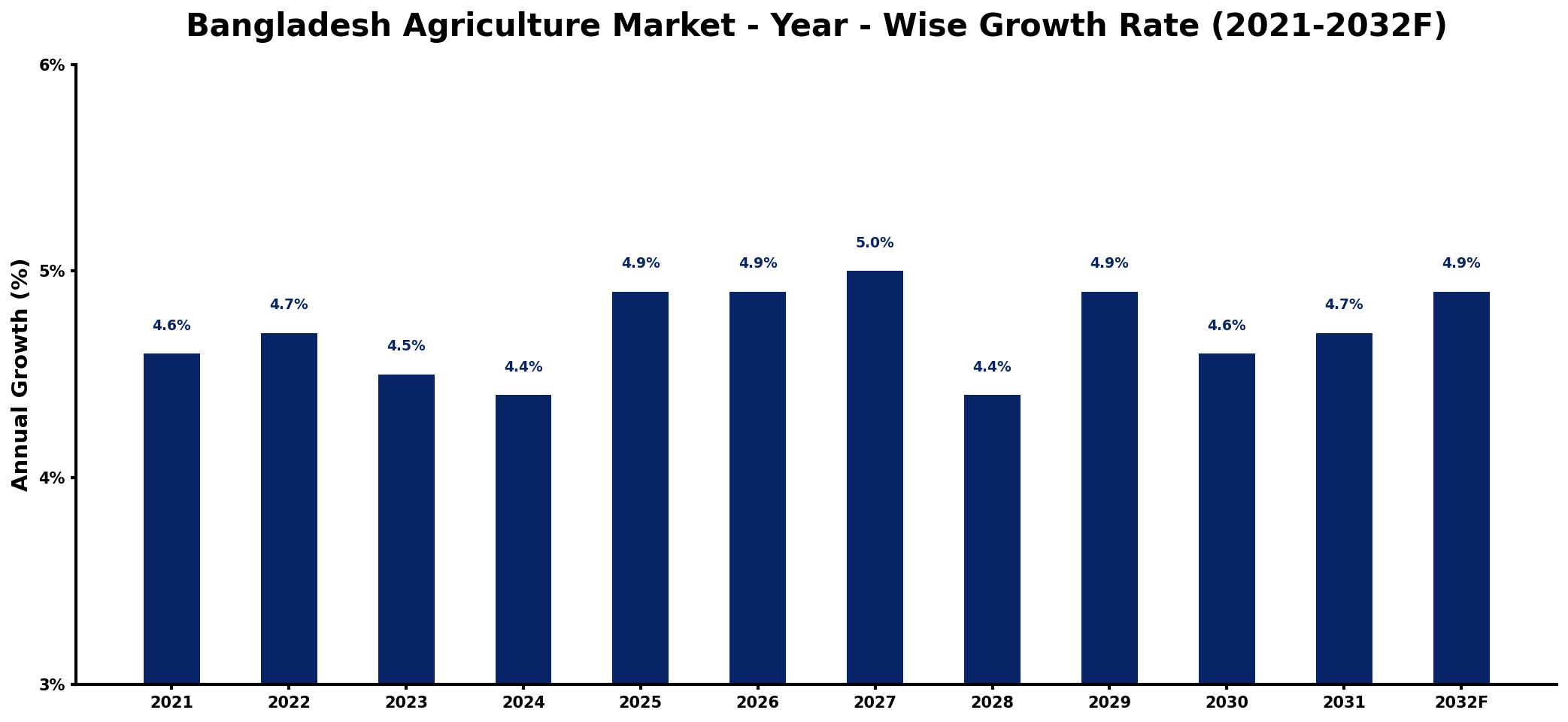
The table below presents the year‑wise growth rates along with the key drivers influencing the market
| Year | Growth Rate | Major Drivers |
| 2021 | 4.6% | Rising consumer food demand |
| 2022 | 4.7% | Investment in irrigation systems |
| 2023 | 4.5% | Technological advancements in farming |
| 2024 | 4.4% | Increased export opportunities emerging |
| 2025 | 4.9% | Growth in organic farming initiatives |
| 2026 | 4.9% | Development of rural infrastructure projects |
| 2027 | 5.0% | Expansion of agro-based industries |
| 2028 | 4.4% | Strengthening local supply chains |
| 2029 | 4.9% | Enhanced access to financing options |
| 2030 | 4.6% | Growing interest in sustainable practices |
| 2031 | 4.7% | Improved market access for farmers |
| 2032 | 4.9% | Rise in value-added products |
Note: Market size estimations and growth projections presented in this report are based on 6Wresearch's proprietary forecasting methodology, utilizing the latest available industry data, government publications, and primary research inputs.
Bangladesh Agriculture Market Synopsis
In Bangladesh, agriculture is not merely a sector; it is the backbone of the economy, employing over 40% of the labor force. The nation is renowned for its diverse range of crops, including rice, jute, and vegetables, reflecting both traditional agricultural heritage and modern demands.
As the country grapples with challenges like land degradation and climate change, the shift towards sustainable farming practices becomes imperative. Government support and investment in agricultural technology further facilitate the sector's transition into a more resilient and productive future.
Bangladesh Agriculture Market Key Takeaways
- The agriculture sector is vital to Bangladesh's economy, contributing significantly to employment and food security.
- Government policies are increasingly focused on sustainable practices and technological innovation in farming.
- Rising consumer demand for organic and specialty crops is shaping market dynamics.
- Investment in agricultural infrastructure and processing is crucial for reducing post-harvest losses.
- Smallholder farmers continue to be the backbone of the industry, often blending traditional methods with modern practices.
Evaluation of Restraints in Bangladesh Agriculture Market
While the Bangladesh agriculture market holds significant promise, it is constrained by several real factors. Limited access to modern technology hampers productivity, as many farmers rely on outdated methods. Inadequate infrastructure, particularly in storage and transportation, results in substantial post-harvest losses. Additionally, unpredictable weather patterns and water scarcity further threaten crop yields. These challenges make it imperative to adopt comprehensive strategies that enhance support mechanisms for farmers while promoting technological advancements.
Bangladesh Agriculture Market Trends
The market is witnessing a remarkable trend towards the integration of technology in agricultural practices. Farmers are increasingly adopting precision agriculture techniques and leveraging digital platforms for market access, which enhances efficiency and crop management. Sustainability is another focal point, with a growing awareness among consumers driving demand for organic produce. Furthermore, initiatives aimed at improving financial access for smallholders are shaping a more resilient agricultural landscape.
Bangladesh Agriculture Market Opportunities
Investment opportunities abound within the Bangladesh agriculture market. Agri-tech innovations, including crop monitoring systems and precision farming tools, present significant potential for enhancing agricultural productivity. Additionally, the development of cold storage facilities and irrigation systems is critical to improving post-harvest management. The burgeoning market for processed agricultural products also signals promising avenues for investment, particularly in food processing and packaging sectors.
Government Initiatives in the Bangladesh Agriculture Market
The Bangladeshi government is actively implementing policies that bolster the agriculture sector through subsidies for agricultural inputs and improved access to credit for farmers. Investments in irrigation infrastructure and research initiatives aim to introduce new crop varieties that enhance yields. Furthermore, programs supporting small-scale farmers and encouraging crop diversification are pivotal in ensuring sustainable growth and development within the sector.
Future Insights of the Bangladesh Agriculture Market
The future of the Bangladesh agriculture market looks encouraging, driven by increasing government support and technological advancements. With a strong focus on modernizing farming practices and enhancing infrastructure, the sector is expected to become more productive and efficient. The ongoing rise in urbanization and population will continue to spur demand for agricultural products, paving the way for sustained growth and investment opportunities in the years ahead.
Bangladesh Agriculture Market Latest Developments (2025 - 2026)
Recent developments within the Bangladesh agriculture sector indicate a shift towards more innovative practices. There has been a notable increase in pilot programs that test new agricultural technologies, including digital marketplaces for farmers. Additionally, various training initiatives are being launched to educate smallholders on sustainable practices and financial management, further empowering them in a transforming agricultural landscape.
Bangladesh Agriculture Market - Key Attractiveness of the Report
- 10 Years of Market Numbers
- Historical Data Starting from 2022 to 2025
- Base Year: 2025
- Forecast Data until 2032
- Key Performance Indicators Impacting the Market
- Major Upcoming Developments and Projects
Key Highlights of the Report:
- Bangladesh Agriculture Market Outlook
- Market Size of Bangladesh Agriculture Market, 2025
- Forecast of Bangladesh Agriculture Market, 2032
- Historical Data and Forecast of Bangladesh Agriculture Revenues & Volume for the Period 2022-2032F
- Bangladesh Agriculture Market Trend Evolution
- Bangladesh Agriculture Market Drivers and Challenges
- Bangladesh Agriculture Price Trends
- Bangladesh Agriculture Porter's Five Forces
- Bangladesh Agriculture Industry Life Cycle
- Historical Data and Forecast of Bangladesh Agriculture Market Revenues & Volume By Type for the Period 2022-2032F
- Historical Data and Forecast of Bangladesh Agriculture Market Revenues & Volume By Animal Produce for the Period 2022-2032F
- Historical Data and Forecast of Bangladesh Agriculture Market Revenues & Volume By Crop Production for the Period 2022-2032F
- Historical Data and Forecast of Bangladesh Agriculture Market Revenues & Volume By Distribution Channel for the Period 2022-2032F
- Historical Data and Forecast of Bangladesh Agriculture Market Revenues & Volume By Supermarkets/Hypermarkets for the Period 2022-2032F
- Historical Data and Forecast of Bangladesh Agriculture Market Revenues & Volume By Convenience Stores for the Period 2022-2032F
- Historical Data and Forecast of Bangladesh Agriculture Market Revenues & Volume By E-Commerce for the Period 2022-2032F
- Historical Data and Forecast of Bangladesh Agriculture Market Revenues & Volume By Others for the Period 2022-2032F
- Historical Data and Forecast of Bangladesh Agriculture Market Revenues & Volume By Nature for the Period 2022-2032F
- Historical Data and Forecast of Bangladesh Agriculture Market Revenues & Volume By Organic for the Period 2022-2032F
- Historical Data and Forecast of Bangladesh Agriculture Market Revenues & Volume By Conventional for the Period 2022-2032F
- Bangladesh Agriculture Import Export Trade Statistics
- Market Opportunity Assessment By Type
- Market Opportunity Assessment By Distribution Channel
- Market Opportunity Assessment By Nature
- Bangladesh Agriculture Top Companies Market Share
- Bangladesh Agriculture Competitive Benchmarking By Technical and Operational Parameters
- Bangladesh Agriculture Company Profiles
- Bangladesh Agriculture Key Strategic Recommendations






































