Bangladesh Animal Feed Enzymes Market Size, Share & Growth Rate
The Bangladesh Animal Feed Enzymes Market was estimated at USD 182 Million in 2025 and is projected to reach USD 239 Million by 2032, growing at a CAGR of 4.0% from 2026 to 2032. This growth trajectory is primarily driven by a combination of rising consumer demand for higher-quality livestock products and increased awareness regarding the benefits of feed enzymes in enhancing nutrient absorption. Furthermore, the gradual shift towards sustainable farming practices is encouraging the adoption of enzyme solutions to improve feed efficiency and overall animal health.
Bangladesh Animal Feed Enzymes Market Year-wise Growth Rate and Key Drivers
This graph highlights how the Bangladesh Animal Feed Enzymes Market has steadily grown over the years, supported by major growth factors.
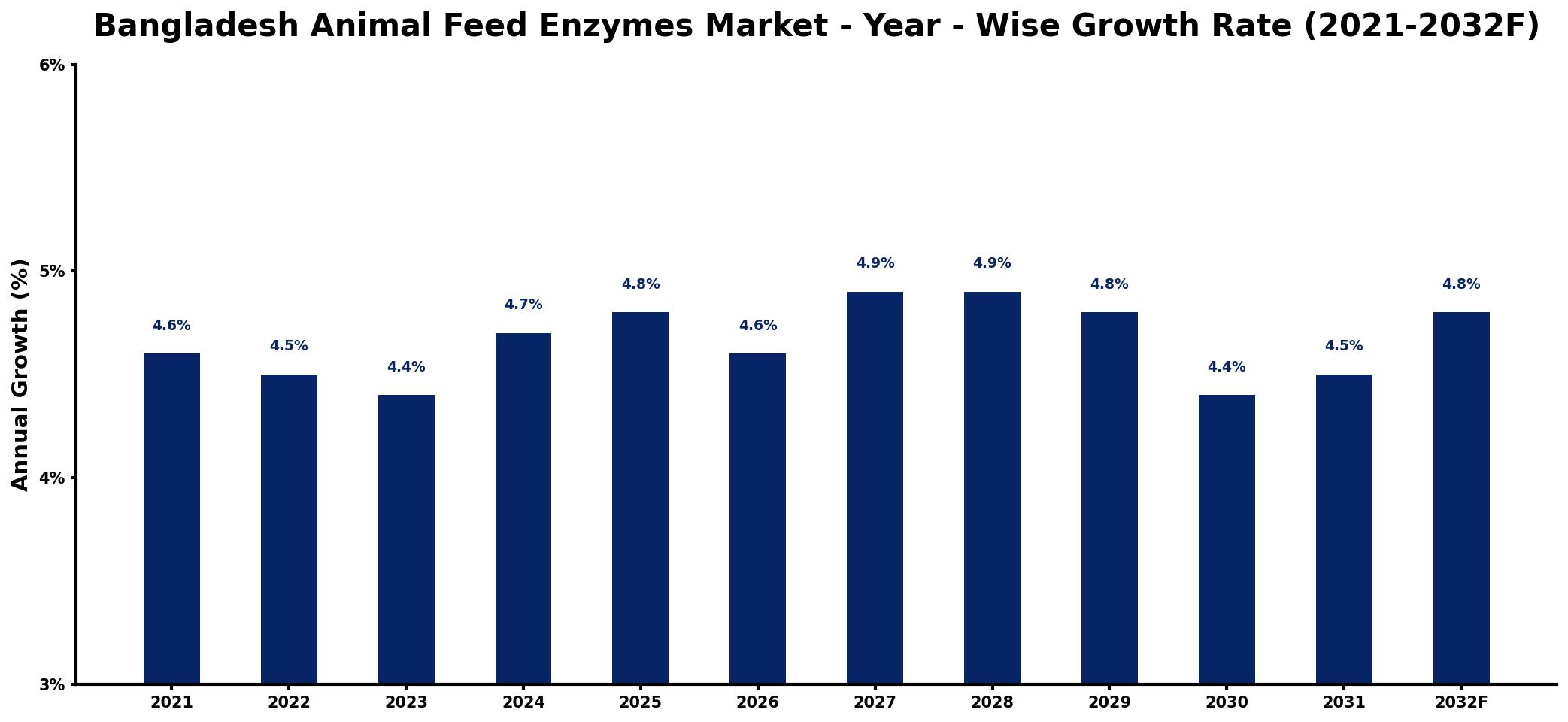
The table below presents the year‑wise growth rates along with the key drivers influencing the market
| Year | Growth Rate | Major Drivers |
| 2021 | 4.6% | Rising livestock production levels |
| 2022 | 4.5% | Increased health consciousness among consumers |
| 2023 | 4.4% | Growing demand for sustainable practices |
| 2024 | 4.7% | Expansion of aquaculture industry |
| 2025 | 4.8% | Higher investment in livestock technologies |
| 2026 | 4.6% | Emergence of innovative processing methods |
| 2027 | 4.9% | Strengthened export opportunities in region |
| 2028 | 4.9% | Growing awareness of nutritional benefits |
| 2029 | 4.8% | Increased collaboration with research institutions |
| 2030 | 4.4% | Diversification of livestock product offerings |
| 2031 | 4.5% | Strengthening of regulatory support frameworks |
| 2032 | 4.8% | increased overall sector activity |
Note: Market size estimations and growth projections presented in this report are based on 6Wresearch's proprietary forecasting methodology, utilizing the latest available industry data, government publications, and primary research inputs.
Bangladesh Animal Feed Enzymes Market Synopsis
The growing livestock sector in Bangladesh is creating a specific demand for enzymes such as phytase, protease, and carbohydrases, which are crucial for improving the digestibility of feed ingredients. With rising disposable incomes, farmers are more inclined to invest in quality feed solutions that enhance livestock productivity and health.
In addition, government initiatives aimed at promoting animal welfare and improving the livestock industry are set to drive the utilization of feed enzymes. This focus on nutritional enhancement in animal feed is crucial to meeting the burgeoning domestic and export demand for animal products.
Bangladesh Animal Feed Enzymes Market Key Takeaways
- The market is expected to expand due to the increasing adoption of enzymes for improving feed efficiency.
- Rising awareness about animal nutrition among farmers is fueling demand for advanced enzyme solutions.
- Government policies are favorable towards ensuring the safety and quality of feed enzymes.
- The market is witnessing a trend towards sustainable and eco-friendly enzyme formulations.
- Investment in R&D is critical for developing tailored enzyme products for diverse livestock needs.
Evaluation of Restraints in Bangladesh Animal Feed Enzymes Market
Despite its growth potential, the Bangladesh Animal Feed Enzymes Market faces several challenges that could impede its expansion. Limited awareness among farmers and feed manufacturers about the advantages of incorporating enzymes into animal feed remains a significant barrier. Furthermore, inadequate regulations and standards governing feed enzyme usage contribute to concerns regarding product quality and safety. The relatively high costs associated with advanced enzyme solutions, alongside a scarcity of innovative production technologies, could deter broader adoption. Addressing these issues requires collaborative efforts from stakeholders, including educational initiatives and improved regulatory frameworks.
Bangladesh Animal Feed Enzymes Market Trends
The market is currently experiencing a shift towards enzymes that support sustainable agriculture practices, reflecting a growing consciousness around environmental impacts. Innovations in enzyme formulations aimed at specific dietary needs for various livestock species are on the rise, enhancing feed efficiency and supporting overall animal health. Moreover, the demand for products that align with organic and eco-friendly farming practices is increasing, indicating a notable trend towards sustainability in animal nutrition.
Bangladesh Animal Feed Enzymes Market Opportunities
The Bangladesh Animal Feed Enzymes Market offers significant investment opportunities, particularly as demand for livestock products continues to escalate. Companies can gain competitive advantage by investing in research and development of tailored enzyme products that address the unique challenges faced by local farmers. Forming partnerships with domestic feed manufacturers and distributors will further facilitate effective market penetration. As the livestock sector grows, addressing the needs for cost-effective and efficient feed solutions presents a lucrative opportunity for industry participants.
Government Initiatives in the Bangladesh Animal Feed Enzymes Market
The government of Bangladesh has initiated several policies to enhance the quality of animal feed and promote sustainable practices in livestock farming. These initiatives focus on ensuring food safety and improving productivity within the sector. Additionally, there is a concerted effort to encourage research and development in animal nutrition, aimed at fostering innovation in the formulation and application of feed enzymes. Such policies not only aim to protect animal health but also to ensure human health through safer food products.
Future Insights of the Bangladesh Animal Feed Enzymes Market
Looking ahead to 2026-2032, the Bangladesh Animal Feed Enzymes Market is poised for continued growth, driven by the escalating demand for high-quality animal feed. The increasing focus on animal welfare, combined with advancements in enzyme technologies and formulations, suggests a favorable environment for market expansion. Investment in R&D will be critical to support innovation and meet the evolving needs of the livestock industry, while the push for sustainability will also shape future product offerings.
Bangladesh Animal Feed Enzymes Market Latest Developments (2025 - 2026)
Recent developments within the Bangladesh Animal Feed Enzymes Market indicate a strong push towards the adoption of innovative enzyme solutions tailored to specific livestock dietary needs. Ongoing collaborations between industry stakeholders aim to enhance product quality and expand distribution networks. Furthermore, there is an increased emphasis on educational programs to raise awareness among farmers regarding the benefits of feed enzymes, indicating a proactive approach to overcoming existing market challenges.
Bangladesh Animal Feed Enzymes Market - Key Attractiveness of the Report
- 10 Years of Market Numbers
- Historical Data Starting from 2022 to 2025
- Base Year: 2025
- Forecast Data until 2032
- Key Performance Indicators Impacting the Market
- Major Upcoming Developments and Projects
Key Highlights of the Report:
- Bangladesh Animal Feed Enzymes Market Outlook
- Market Size of Bangladesh Animal Feed Enzymes Market, 2025
- Forecast of Bangladesh Animal Feed Enzymes Market, 2032
- Historical Data and Forecast of Bangladesh Animal Feed Enzymes Revenues & Volume for the Period 2022-2032F
- Bangladesh Animal Feed Enzymes Market Trend Evolution
- Bangladesh Animal Feed Enzymes Market Drivers and Challenges
- Bangladesh Animal Feed Enzymes Price Trends
- Bangladesh Animal Feed Enzymes Porter's Five Forces
- Bangladesh Animal Feed Enzymes Industry Life Cycle
- Historical Data and Forecast of Bangladesh Animal Feed Enzymes Market Revenues & Volume By Formulation for the Period 2022-2032F
- Historical Data and Forecast of Bangladesh Animal Feed Enzymes Market Revenues & Volume By Dry for the Period 2022-2032F
- Historical Data and Forecast of Bangladesh Animal Feed Enzymes Market Revenues & Volume By Liquid for the Period 2022-2032F
- Historical Data and Forecast of Bangladesh Animal Feed Enzymes Market Revenues & Volume By Product for the Period 2022-2032F
- Historical Data and Forecast of Bangladesh Animal Feed Enzymes Market Revenues & Volume By Phytase for the Period 2022-2032F
- Historical Data and Forecast of Bangladesh Animal Feed Enzymes Market Revenues & Volume By Carbohydrase for the Period 2022-2032F
- Historical Data and Forecast of Bangladesh Animal Feed Enzymes Market Revenues & Volume By Protease for the Period 2022-2032F
- Historical Data and Forecast of Bangladesh Animal Feed Enzymes Market Revenues & Volume By Non starch polysaccharides for the Period 2022-2032F
- Historical Data and Forecast of Bangladesh Animal Feed Enzymes Market Revenues & Volume By Livestock for the Period 2022-2032F
- Historical Data and Forecast of Bangladesh Animal Feed Enzymes Market Revenues & Volume By Poultry for the Period 2022-2032F
- Historical Data and Forecast of Bangladesh Animal Feed Enzymes Market Revenues & Volume By Swine for the Period 2022-2032F
- Historical Data and Forecast of Bangladesh Animal Feed Enzymes Market Revenues & Volume By Ruminant for the Period 2022-2032F
- Historical Data and Forecast of Bangladesh Animal Feed Enzymes Market Revenues & Volume By Aquaculture for the Period 2022-2032F
- Historical Data and Forecast of Bangladesh Animal Feed Enzymes Market Revenues & Volume By Others for the Period 2022-2032F
- Bangladesh Animal Feed Enzymes Import Export Trade Statistics
- Market Opportunity Assessment By Formulation
- Market Opportunity Assessment By Product
- Market Opportunity Assessment By Livestock
- Bangladesh Animal Feed Enzymes Top Companies Market Share
- Bangladesh Animal Feed Enzymes Competitive Benchmarking By Technical and Operational Parameters
- Bangladesh Animal Feed Enzymes Company Profiles
- Bangladesh Animal Feed Enzymes Key Strategic Recommendations






































