Bangladesh Big Data Market Size & Growth Rate (2026-2032)

The Bangladesh Big Data Market was estimated at USD 487 Million in 2025 and is projected to reach USD 647 Million by 2032, growing at a CAGR of 5.0% from 2026 to 2032.
Bangladesh Big Data Market Synopsis
The surge in data-driven decision-making is the most powerful force driving the Bangladesh Big Data market. Organizations across sectors like banking, telecommunications, and healthcare are increasingly recognizing the value of harnessing large datasets to derive actionable insights.
Government initiatives aimed at promoting digitalization are further propelling this market forward. As the demand for sophisticated data analytics tools rises, businesses are eager to invest in solutions that enhance their operational efficiency and decision-making capabilities.
Bangladesh Big Data Market Year-wise Growth Rate and Key Drivers
This graph illustrates the annual growth rates of the Bangladesh Big Data Market from 2021 to 2032, highlighting a steady upward trajectory and projected expansion over the forecast period.
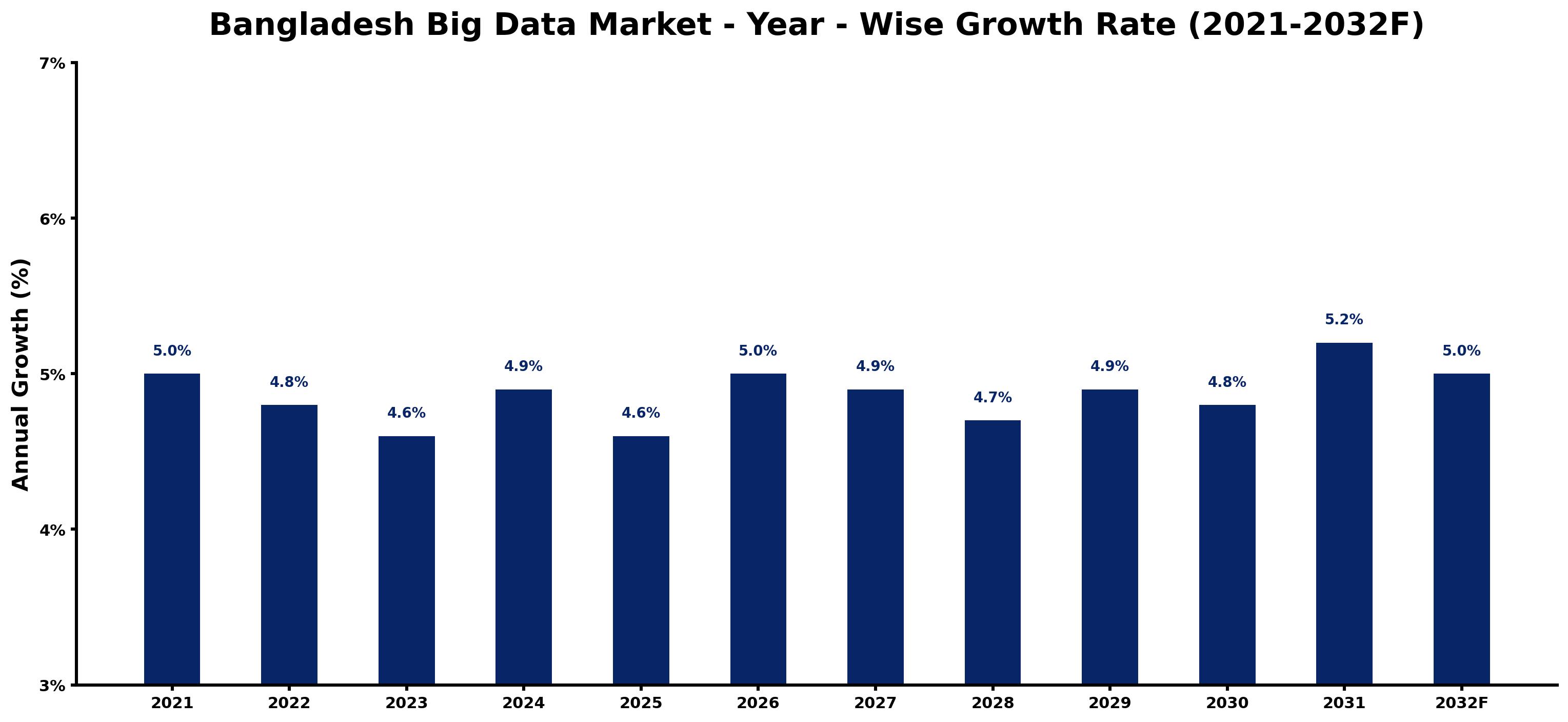
The table below presents the year‑wise growth rates along with the key drivers influencing the market
| Year | Growth Rate | Major Drivers |
| 2021 | 5.0% | Government's Digital Bangladesh initiative boosting data utilization. |
| 2022 | 4.8% | Increased adoption of data-driven decision-making in businesses. |
| 2023 | 4.6% | Growing smartphone penetration enhancing data collection capabilities. |
| 2024 | 4.9% | Emergence of local data science education programs boosting talent. |
| 2025 | 4.6% | Advent of fintech solutions requiring big data analytics. |
| 2026 | 5.0% | Rising interest in AI applications fueled by big data. |
| 2027 | 4.9% | Government policies incentivizing data privacy compliance initiatives. |
| 2028 | 4.7% | Surge in e-commerce activities driving demand for analytics. |
| 2029 | 4.9% | Development of urban agglomerations increasing data generation. |
| 2030 | 4.8% | Integration of IoT technologies challenging data management systems. |
| 2031 | 5.2% | Strengthening of data protection laws encouraging market trust. |
| 2032 | 5.0% | Local startups leveraging analytics for innovative service delivery. |
Note: Market size estimations and growth projections presented in this report are based on 6Wresearch's proprietary forecasting methodology, utilizing the latest available industry data, government publications, and primary research inputs.
Bangladesh Big Data Market Key Takeaways
Below are some of the specific key takeaways from the market, including:
- The market is growing due to an increase in data generation across various sectors.
- Investment in data analytics tools is critical for organizations to remain competitive.
- Government support through digital initiatives is fostering market expansion.
- There is a pressing need for skilled professionals in data science and analytics.
- Data privacy and security concerns are significant barriers to market growth.
Evaluation of Restraints in Bangladesh Big Data Market
Despite its growth, the Bangladesh Big Data market faces considerable restraints. One of the most pressing challenges is the shortage of skilled professionals. Companies are struggling to find data scientists and analysts who can effectively interpret complex datasets. This skills gap hampers organizations' ability to fully leverage big data analytics.
In addition to the skills shortage, infrastructure limitations remain a critical barrier. Many regions still lack reliable internet connectivity, which is essential for implementing data-driven solutions. on top of that, concerns about data privacy and security further complicate the adoption of big data technologies, as businesses must navigate a landscape fraught with potential risks.
Bangladesh Big Data Market Trends
A notable trend in the Bangladesh Big Data market is the increasing integration of artificial intelligence (AI) and machine learning (ML) technologies. Organizations are not just collecting data; they are deploying advanced analytics to gain deeper insights and improve operational efficiency. This trend is supported by the growing volume of data generated by IoT devices, which is further fueling the demand for sophisticated analytics solutions.
on top of that, businesses are shifting towards cloud-based analytics services, allowing for greater flexibility and scalability. As companies recognize the importance of real-time data analysis, the adoption of cloud solutions is expected to escalate, shaping the future of big data analytics in Bangladesh.
Bangladesh Big Data Market Opportunities
The Bangladesh Big Data market is ripe with opportunities for growth and investment. With the government's focus on digital transformation, there is a strong push for organizations to adopt big data technologies. This presents a lucrative opportunity for software vendors and service providers looking to offer tailored analytics solutions.
Additionally, the rising demand for training programs in data science and analytics presents a substantial opportunity for educational institutions. By addressing the skills gap, training institutes can equip professionals with the necessary expertise to meet the evolving needs of the market.
Government Initiatives in the Bangladesh Big Data Market
The Bangladeshi government is actively fostering the growth of the Big Data market through various initiatives. By implementing policies that promote digitalization and the adoption of analytics, the government is setting a conducive environment for businesses to thrive in this sector.
- A national digital infrastructure upgrade programme is currently underway to enhance connectivity and support data analytics capabilities.
- In 2025, a regulatory framework was introduced mandating data protection measures to enhance consumer trust and security.
- The government is offering tax incentives for companies investing in big data technologies to spur further adoption.
- A planned public-private initiative aims to establish training programs for data analytics professionals, expected to launch by 2027.
- Recent discussions have been initiated to create a national data strategy to streamline data management practices across industries.
Future Insights of the Bangladesh Big Data Market
Looking ahead to 2026-2032, the Bangladesh Big Data market is set for impressive growth. The increasing adoption of advanced analytics, AI, and ML technologies across various industries will drive demand for big data solutions. As organizations continue to seek insights from large data volumes, the market will expand, presenting significant opportunities for solution providers.
The government's continued support for digital initiatives will further fuel growth. As companies prioritize investments in data analytics capabilities, the landscape will evolve, leading to innovative solutions and services that cater to diverse business needs.
Bangladesh Big Data Market Latest Developments
In the past year, the Bangladesh Big Data market has seen a flurry of activity as organizations seek to enhance their data analytics capabilities. Companies are increasingly investing in solutions that allow them to harness the power of big data for improved decision-making and operational efficiency.
- A major technology vendor launched an upgraded analytics platform in early 2025, enabling businesses to process and analyze data more effectively.
- A leading regional operator announced a partnership in Q1 2025 with a data analytics firm to enhance its customer insights through advanced analytics.
- Currently ongoing is a pilot project initiated in mid-2025 focusing on integrating AI-driven analytics into healthcare systems to improve patient outcomes.
- A rollout of cloud-based data management solutions is expected to begin in the second half of 2026, aimed at supporting businesses with scalable analytics capabilities.
- A new initiative to create a data-sharing framework among public institutions is planned for late 2026 to enhance collaboration and data-driven governance.
Bangladesh Big Data Market - Key Attractiveness of the Report
- 10 Years of Market Numbers
- Historical Data Starting from 2022 to 2025
- Base Year: 2025
- Forecast Data until 2032
- Key Performance Indicators Impacting the Market
- Major Upcoming Developments and Projects
Key Highlights of the Report:
- Bangladesh Big Data Market Outlook
- Market Size of Bangladesh Big Data Market, 2025
- Forecast of Bangladesh Big Data Market, 2032
- Historical Data and Forecast of Bangladesh Big Data Revenues & Volume for the Period 2022-2032F
- Bangladesh Big Data Market Trend Evolution
- Bangladesh Big Data Market Drivers and Challenges
- Bangladesh Big Data Price Trends
- Bangladesh Big Data Porter's Five Forces
- Bangladesh Big Data Industry Life Cycle
- Historical Data and Forecast of Bangladesh Big Data Market Revenues & Volume By Business Function for the Period 2022-2032F
- Historical Data and Forecast of Bangladesh Big Data Market Revenues & Volume By Finance for the Period 2022-2032F
- Historical Data and Forecast of Bangladesh Big Data Market Revenues & Volume By Marketing and Sales for the Period 2022-2032F
- Historical Data and Forecast of Bangladesh Big Data Market Revenues & Volume By Human Resources for the Period 2022-2032F
- Historical Data and Forecast of Bangladesh Big Data Market Revenues & Volume By Operations for the Period 2022-2032F
- Historical Data and Forecast of Bangladesh Big Data Market Revenues & Volume By Industry Vertical for the Period 2022-2032F
- Historical Data and Forecast of Bangladesh Big Data Market Revenues & Volume By BFSI for the Period 2022-2032F
- Historical Data and Forecast of Bangladesh Big Data Market Revenues & Volume By Government and Defense for the Period 2022-2032F
- Historical Data and Forecast of Bangladesh Big Data Market Revenues & Volume By Healthcare and Life Sciences for the Period 2022-2032F
- Historical Data and Forecast of Bangladesh Big Data Market Revenues & Volume By Manufacturing for the Period 2022-2032F
- Historical Data and Forecast of Bangladesh Big Data Market Revenues & Volume By Retail and Consumer Goods for the Period 2022-2032F
- Historical Data and Forecast of Bangladesh Big Data Market Revenues & Volume By Media and Entertainment for the Period 2022-2032F
- Historical Data and Forecast of Bangladesh Big Data Market Revenues & Volume By Telecommunications and IT for the Period 2022-2032F
- Historical Data and Forecast of Bangladesh Big Data Market Revenues & Volume By Transportation and Logistics for the Period 2022-2032F
- Historical Data and Forecast of Bangladesh Big Data Market Revenues & Volume By Component for the Period 2022-2032F
- Historical Data and Forecast of Bangladesh Big Data Market Revenues & Volume By Solutions for the Period 2022-2032F
- Historical Data and Forecast of Bangladesh Big Data Market Revenues & Volume By Big Data Analytics for the Period 2022-2032F
- Historical Data and Forecast of Bangladesh Big Data Market Revenues & Volume By Data Discovery for the Period 2022-2032F
- Historical Data and Forecast of Bangladesh Big Data Market Revenues & Volume By Data Visualization for the Period 2022-2032F
- Historical Data and Forecast of Bangladesh Big Data Market Revenues & Volume By Data Management for the Period 2022-2032F
- Historical Data and Forecast of Bangladesh Big Data Market Revenues & Volume By Services for the Period 2022-2032F
- Historical Data and Forecast of Bangladesh Big Data Market Revenues & Volume By Deployment Mode for the Period 2022-2032F
- Historical Data and Forecast of Bangladesh Big Data Market Revenues & Volume By Cloud for the Period 2022-2032F
- Historical Data and Forecast of Bangladesh Big Data Market Revenues & Volume By Public Cloud for the Period 2022-2032F
- Historical Data and Forecast of Bangladesh Big Data Market Revenues & Volume By Private Cloud for the Period 2022-2032F
- Historical Data and Forecast of Bangladesh Big Data Market Revenues & Volume By Hybrid Cloud for the Period 2022-2032F
- Historical Data and Forecast of Bangladesh Big Data Market Revenues & Volume By On-premises for the Period 2022-2032F
- Historical Data and Forecast of Bangladesh Big Data Market Revenues & Volume By Organization Size for the Period 2022-2032F
- Historical Data and Forecast of Bangladesh Big Data Market Revenues & Volume By Small and Medium-Sized Enterprises for the Period 2022-2032F
- Historical Data and Forecast of Bangladesh Big Data Market Revenues & Volume By Large Enterprises for the Period 2022-2032F
- Bangladesh Big Data Import Export Trade Statistics
- Market Opportunity Assessment By Business Function
- Market Opportunity Assessment By Industry Vertical
- Market Opportunity Assessment By Component
- Market Opportunity Assessment By Deployment Mode
- Market Opportunity Assessment By Organization Size
- Bangladesh Big Data Top Companies Market Share
- Bangladesh Big Data Competitive Benchmarking By Technical and Operational Parameters
- Bangladesh Big Data Company Profiles
- Bangladesh Big Data Key Strategic Recommendations






































