Bangladesh Bottled Water Market (2026-2032) | Companies, Size & Revenue, Analysis, Value, Share, Segmentation, Growth, Outlook, Forecast, Trends, Industry, Competitive Landscape
Market Forecast By Quality (Premium, Non-Premium), By Type (Still Water, Spring Water, Sparkling Water, Purified Water, Mineral Water), By Product (Still Bottle Water, Packaged Drinking Water, Functional Water Bottle, Flavored Bottled Water, Distilled Bottled Water, arbonated Bottle Water), By Material (Polyethylene Terephthalate (PET), Glass), By Purchasing Sources (Supermarket/Hypermarket, Online Retail Stores, Grocery Stores, Food Serving Places, E-retailers, Clubs, Home and Office Delivery, Others), By Pack Size (1501 ml and above, 1001 ml - 1500 ml, 501 ml - 1000 ml, 331 ml - 500ml, 330 ml), By End-user Packaging (Plastic Bottle, Glass Bottle, Drum (Bulk), Can) And Competitive Landscape
| Product Code: ETC015592 | Publication Date: Jun 2023 | Updated Date: Mar 2026 | Product Type: Report | |
| Publisher: 6Wresearch | Author: Ravi Bhandari | No. of Pages: 70 | No. of Figures: 35 | No. of Tables: 5 |
Bangladesh Bottled Water Market Size Growth Rate
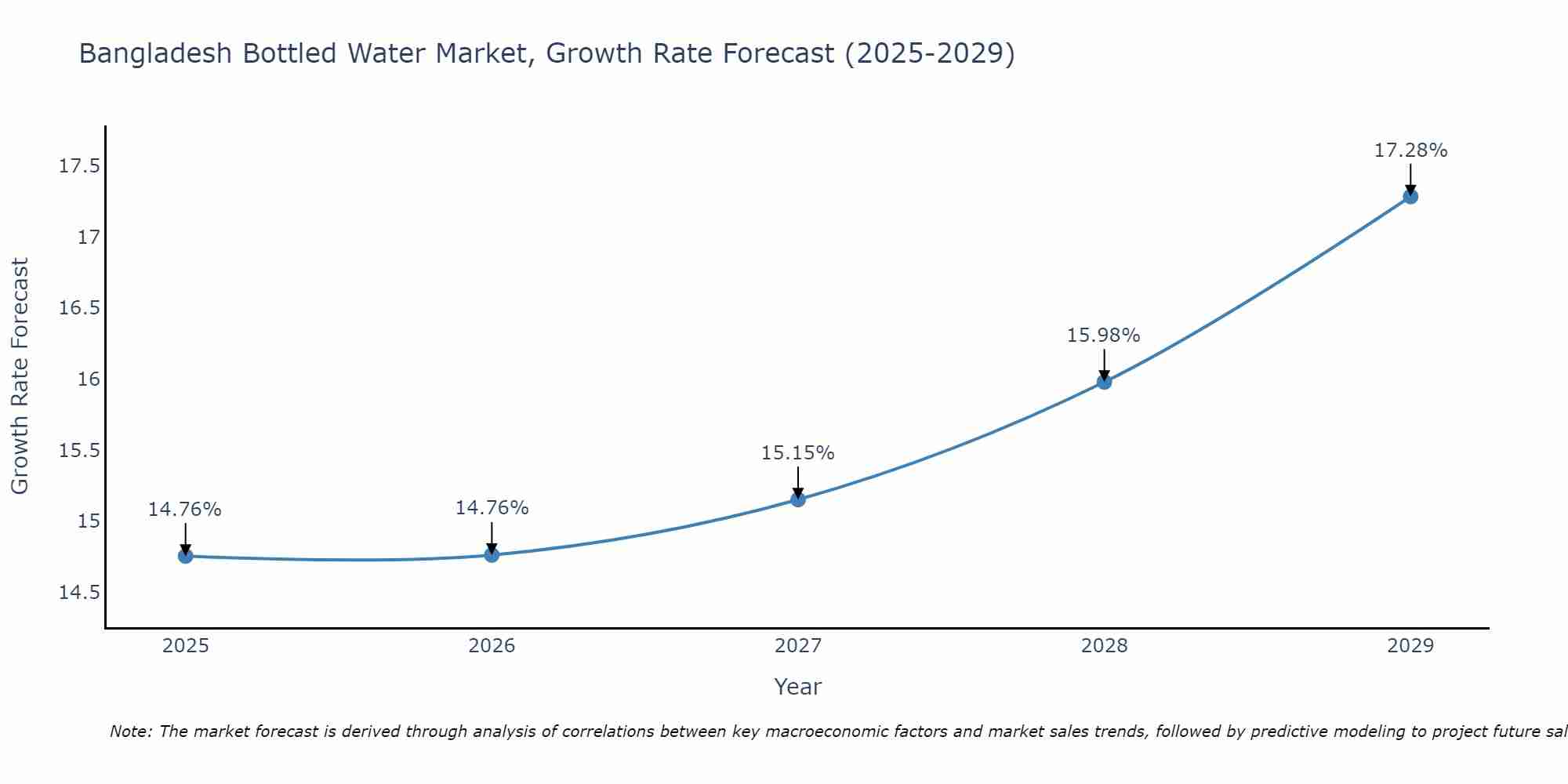
The Bangladesh Bottled Water Market is likely to experience consistent growth rate gains over the period 2025 to 2029. From 14.76% in 2025, the growth rate steadily ascends to 17.28% in 2029.
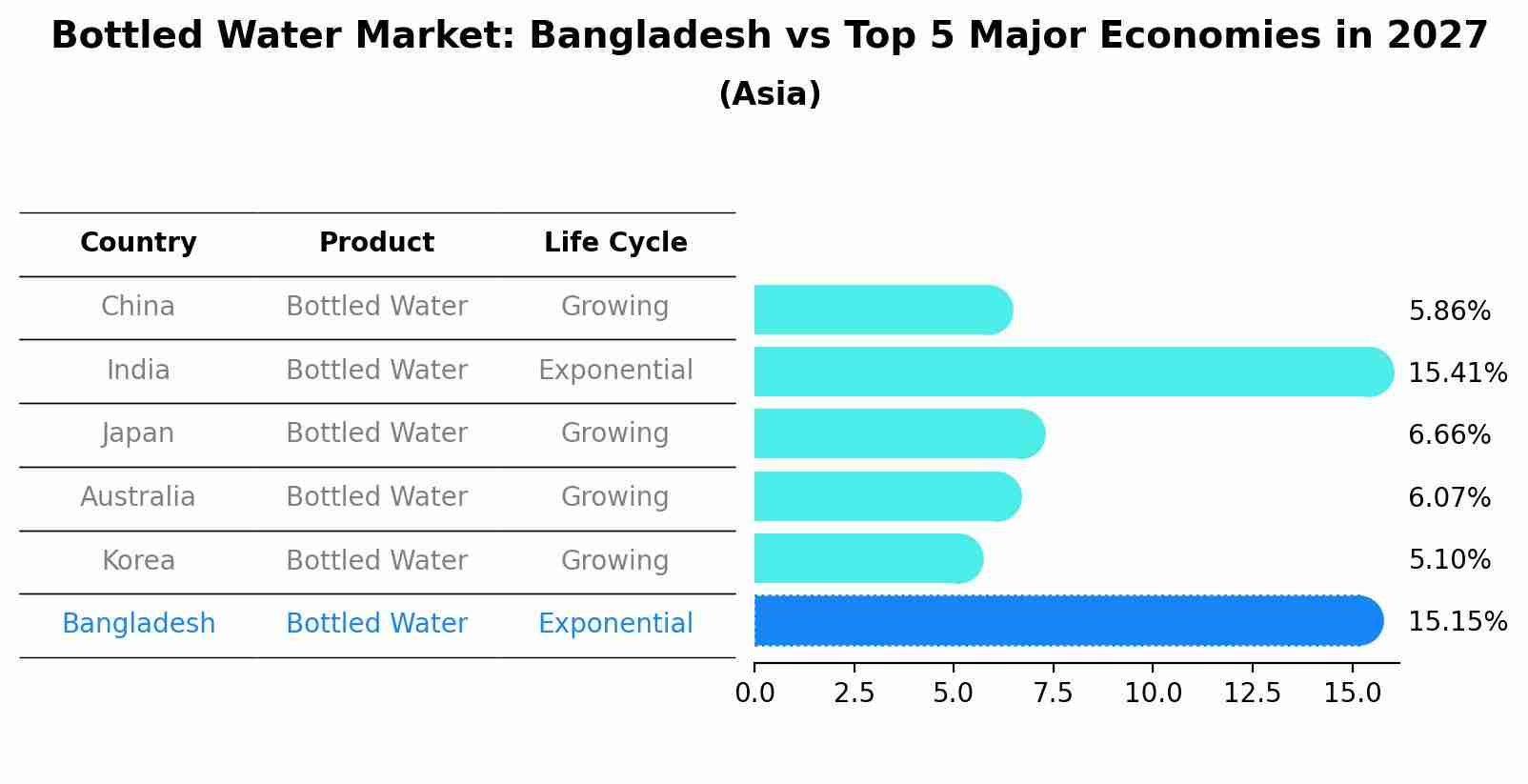
Bottled Water Market: Bangladesh vs Top 5 Major Economies in 2027 (Asia)
By 2027, the Bottled Water market in Bangladesh is anticipated to reach a growth rate of 15.15%, as part of an increasingly competitive Asia region, where China remains at the forefront, supported by India, Japan, Australia and South Korea, driving innovations and market adoption across sectors.
Bangladesh Bottled Water Market Growth Rate
According to 6Wresearch internal database and industry insight, the Bangladesh Bottled Water Market is projected to grow at a compound annual growth rate (CAGR) of 8.4% during the forecast period (2026-2032).
Topics Covered in the Bangladesh Bottled Water Market Report
The Bangladesh Bottled Water Market report thoroughly covers the market by quality, type, product, material, purchasing sources, pack size, and end-user packaging. The report provides an unbiased and detailed analysis of ongoing market trends, opportunities/high-growth areas, and market drivers, which help stakeholders devise and align their market strategies according to the current and future market dynamics.
Bangladesh Bottled Water Market Highlights
| Report Name | Bangladesh Bottled Water Market |
| Forecast period | 2026-2032 |
| CAGR | 8.4% |
| Growing Sector | Functional Beverages |
Bangladesh Bottled Water Market Synopsis
The Bangladesh Bottled Water Market is experiencing major growth owing to the rising concerns about water contamination and increasing consumer preference for safe drinking water. Consumers are progressively moving toward packaged drinking water due to its accessibility and dependability in maintaining hygiene standards. The growth of urban populations and the increasing purchasing power are supporting consumers to buy bottled water for daily use, and it is expected to accelerate the expansion of the market.
Evaluation of Growth Drivers in the Bangladesh Bottled Water Market
Below mentioned are some prominent drivers and their influence on market dynamics:
| Drivers | Primary Segments Affected | Why it Matters (Evidence) |
| Rising Concerns Regarding Water Quality | All Segments | Consumers increasingly prefer packaged water due to concerns about drinking water safety. |
| Urbanization and Population Growth | All Segments | Growing urban populations increase the demand for convenient and reliable drinking water options. |
| Expansion of Food Service Industry | Food Serving Places | Restaurants, cafes, and hotels create strong demand for bottled water products. |
| Growth of Retail Distribution Channels | Supermarkets, Grocery Stores | Expansion of retail outlets improves product availability for consumers. |
| Increasing Consumer Awareness | Premium Segment | There is a rising health awareness, which pushes consumers to choose high-quality bottled water products. |
The Bangladesh bottled water market is projected to grow at a CAGR of 8.4% during the forecast period (2026-2032). Factors such as increasing health concerns, rising disposable income, and growing demand for packaged drinking water are driving the growth of the market in Bangladesh. Moreover, the advancement of technology has enabled manufacturers to introduce new packaging solutions with enhanced shelf life that would further contribute to the expansion of this industry over the coming years. Furthermore, an increase in awareness regarding water safety and hygiene will fuel market growth over the forecast period.
Evaluation of Restraints in the Bangladesh Bottled Water Market
Below mentioned are some major restraints and their influence on market dynamics:
| Restraints | Primary Segments Affected | What This Means (Evidence) |
| Environmental Concerns | PET Packaging | Growing concerns regarding plastic waste may affect demand for plastic bottled water packaging. |
| Price Sensitivity | Non-Premium Segment | Consumers may prefer cheaper alternatives in price-sensitive markets. |
| Stringent Quality Regulations | Manufacturers | Several guidelines may results in higher operational expenses. |
| Competition from Local Brands | All Segments | Strong competition from local brands is affecting the growth of the market. |
| Availability of Filtered Water | Residential Consumption | Increasing use of home water purification systems may limit bottled water consumption. |
Bangladesh Bottled Water Market Challenges
Despite of strong growth prospects, the Bangladesh Bottled Water Market revenue can be affected due to the major challenges. Environmental problems related to plastic packaging and waste disposal restrict the growth of bottled water consumption. The presence of multiple local and regional manufacturers leads to intense price competition, which will directly impact the profit margins of producers. Product safety requirements together with supply chain quality control standards represent major obstacles that market players need to overcome.
Bangladesh Bottled Water Market Trends:
The following are major trends transforming the growth of the market:
- Increased Demand for Premium Bottled Water: To meet the health-conscious needs of consumers, producers are focusing to widen their offerings by introducing flavored and functional water in the country.
- Surge of Flavored and Functional Water: With a focus on wellness, manufacturers are expanding their portfolios to include health-improving water options to attract the growing health-conscious demographic.
- An Expansion of Online Retail Channels: E-commerce platforms are increasingly becoming a preferred purchasing avenue, which provides consumers with easy access to bottled water products.
Investment Opportunities in the Bangladesh Bottled Water Market:
The following are key investment opportunities that are expected to increase the revenue of the market:
- An Expansion of Bottling Facilities: Investing in advanced bottling plants can increase production capacity, meeting the increasing demand for bottled water in Bangladesh.
- Development of Premium Water Brands: Introducing high-end bottled water options aimed at affluent customers can attract a segment looking for a premium quality in the market.
- Sustainable Packaging Solutions: Investing in eco-friendly packaging technologies can enhance brand appeal and contribute to long-term market development.
Top 5 Leading Players in the Bangladesh Bottled Water Market
Below is a comprehensive list of leading players operating in the Bangladesh Bottled Water Market:
1. Mum (ACME Group)
| Company Name | Mum (ACME Group) |
| Established Year | 2000 |
| Headquarters | Bangladesh |
| Official Website | Click Here |
Mum is a pioneer in the Bangladeshi bottled water market, known for producing high-quality mineral water. The brand enjoys a strong presence in both retail outlets and restaurants across the country.
2. Fresh (Meghna Group of Industries - MGI)
| Company Name | Fresh (Meghna Group of Industries - MGI) |
| Established Year | 1976 |
| Headquarters | Bangladesh |
| Official Website | - |
Fresh is known for its widespread distribution network and is one of the prominent players in the Bangladeshi bottled water market, offering bottled water products that are easily available in supermarkets and grocery stores nationwide.
3. PRAN Drinking Water (PRAN-RFL Group)
| Company Name | PRAN Drinking Water (PRAN-RFL Group) |
| Established Year | 1981 |
| Headquarters | Bangladesh |
| Official Website | Click Here |
PRAN Drinking Water, part of the PRAN-RFL Group, offers a variety of bottled water sizes and is a major player in the overall beverage sector in Bangladesh. It is widely recognized and available across multiple retail and food service channels.
4. Spa (Akij Group)
| Company Name | Spa (Akij Group) |
| Established Year | 2006 |
| Headquarters | Bangladesh |
| Official Website | Click Here |
Spa, a popular and established bottled water brand under Akij Group, is well known for its quality and is widely distributed in retail stores across Bangladesh.
5. Jibon (SFDL - Sajeeb Group)
| Company Name | Jibon (SFDL - Sajeeb Group) |
| Established Year | 1992 |
| Headquarters | Bangladesh |
| Official Website | Click Here |
Jibon, a well-known bottled water brand from Sajeeb Group (SFDL), consistently ranks among the top players in the market, offering reliable, affordable bottled water to consumers nationwide.
Government Regulations Introduced in the Bangladesh Bottled Water Market
According to Bangladesh government data, several guidelines have been adopted to guarantee the safety and quality of bottled drinking water. The system, such as the Bangladesh Standards and Testing Institution, controls production standards, labelling requirements and packaging rules to sustain product safety, and it is estimated to fuel the growth of the market. These guidelines confirm that bottled water manufacturers follow strict quality standards, which increase consumer confidence and boost the expansion of the market.
Future Insights of the Bangladesh Bottled Water Market
The Bangladesh Bottled Water Market revenue is anticipated to increase in the coming years, which is spurred by the increasing concerns about water safety and the rising demand for convenient packaged beverages. In addition to that, the availability of modern retail stores and e-commerce platforms is expected to give a sharp fillip to product-stocking accessibility and distribution all across the country. Moreover, manufacturers are increasing focus on product modification and brand development to attract a broader consumer base.
Market Segmentation Analysis
This report provides an inclusive study of the following market segments and their leading categories:
By Quality – Non-Premium to Dominate the Market
According to Mansi, Senior Research Analyst, 6Wresearch, non-premium bottled water is anticipated to lead the Bangladesh Bottled Water Market due to its cost effectiveness and extensive accessibility across retail outlets.
By Type – Purified Water to Lead the Market
Purified water is projected to lead the Bangladesh Bottled Water market due to its widespread convenience, affordability and the evolving consumer preference for safe drinking water in urban and semi-urban areas.
By Product – Packaged Drinking Water to Dominate the Market
Packaged drinking water is anticipated to dominate the Bangladesh Bottled Water market due to its widespread accessibility, lightweight packaging and the rising consumer demand for safe drinking water.
By Material – PET Bottles to Lead the Market
Polyethylene Terephthalate (PET) bottles are projected to lead the Bangladesh Bottled Water market which is spurred by their low weight characteristics, cost effectiveness, toughness and ease of transportation.
By End-user Packaging – Plastic Bottles to Dominate the Market
Plastic bottle packaging is projected to lead the Bangladesh Bottled Water market due to its cost effectiveness, extensive presence, lightweight nature and accessibility for transportation and daily use.
Key Attractiveness of the Report
- 10 Years of Market Numbers
- Historical Data Starting from 2022 to 2025
- Base Year: 2025
- Forecast Data until 2032
- Key Performance Indicators Impacting the Market
- Major Upcoming Developments and Projects
Key Highlights of the Report:
- Bangladesh Bottled Water Market Outlook
- Market Size of Bangladesh Bottled Water Market, 2025
- Forecast of Bangladesh Bottled Water Market, 2032
- Historical Data and Forecast of Bangladesh Bottled Water Revenues & Volume for the Period 2022-2032
- Bangladesh Bottled Water Market Trend Evolution
- Bangladesh Bottled Water Market Drivers and Challenges
- Bangladesh Bottled Water Price Trends
- Bangladesh Bottled Water Porter's Five Forces
- Bangladesh Bottled Water Industry Life Cycle
- Historical Data and Forecast of Bangladesh Bottled Water Market Revenues & Volume By Product Type for the Period 2022-2032
- Historical Data and Forecast of Bangladesh Bottled Water Market Revenues & Volume By Still Water for the Period 2022-2032
- Historical Data and Forecast of Bangladesh Bottled Water Market Revenues & Volume By Sparkling Water for the Period 2022-2032
- Historical Data and Forecast of Bangladesh Bottled Water Market Revenues & Volume By Functional Water for the Period 2022-2032
- Historical Data and Forecast of Bangladesh Bottled Water Market Revenues & Volume By Others for the Period 2022-2032
- Historical Data and Forecast of Bangladesh Bottled Water Market Revenues & Volume By Packaging for the Period 2022-2032
- Historical Data and Forecast of Bangladesh Bottled Water Maarket Revenues & Volume By PET for the Period 2022-2032
- Historical Data and Forecast of Bangladesh Bottled Water Market Revenues & Volume By Cans for the Period 2022-2032
- Historical Data and Forecast of Bangladesh Bottled Water Market Revenues & Volume By Others for the Period 2022-2032
- Historical Data and Forecast of Bangladesh Bottled Water Market Revenues & Volume By Distribution Channel for the Period 2022-2032
- Historical Data and Forecast of Bangladesh Bottled Water Market Revenues & Volume By Off-trade for the Period 2022-2032
- Historical Data and Forecast of Bangladesh Bottled Water Market Revenues & Volume By On-trade for the Period 2022-2032
- Bangladesh Bottled Water Import Export Trade Statistics
- Market Opportunity Assessment By Product Type
- Market Opportunity Assessment By Packaging
- Market Opportunity Assessment By Distribution Channel
- Bangladesh Bottled Water Top Companies Market Share
- Bangladesh Bottled Water Competitive Benchmarking By Technical and Operational Parameters
- Bangladesh Bottled Water Company Profiles
- Bangladesh Bottled Water Key Strategic Recommendations
Markets Covered
The market report for the Bangladesh Bottled Water Market has been segmented and sub-segmented into the following categories:
By Quality
- Premium
- Non-Premium
By Type
- Still Water
- Spring Water
- Sparkling Water
- Purified Water
- Mineral Water
By Product
- Still Bottle Water
- Packaged Drinking Water
- Functional Water Bottle
- Flavored Bottled Water
- Distilled Bottled Water
- Carbonated Bottle Water
By Material
- Polyethylene Terephthalate (PET)
- Glass
By Purchasing Sources
- Supermarket/Hypermarket
- Online Retail Stores
- Grocery Stores
- Food Serving Places
- E-retailers
- Clubs
- Home and Office Delivery
- Others
By Pack Size
- 1501 ml and above
- 1001 ml – 1500 ml
- 501 ml – 1000 ml
- 331 ml – 500 ml
- 330 ml
By End-user Packaging
- Plastic Bottle
- Glass Bottle
- Drum (Bulk)
- Can
Bangladesh Bottled Water Market (2026-2032): FAQs
The Bangladesh Bottled Water Market is anticipated to experience major growth at a CAGR of 8.4% during the forecast period (2026-2032).
Non-premium bottled water leads the Bangladesh Bottled Water market due to its cost effectiveness and extensive availability.
Major opportunities include growth of bottling facilities, green packaging solutions and expansion of premium bottled water brands.
Grocery stores dominate the Bangladesh Bottled Water market due to their strong distribution network and convenience.
6Wresearch actively monitors the Bangladesh Bottled Water Market and publishes its comprehensive annual report, highlighting emerging trends, growth drivers, revenue analysis, and forecast outlook. Our insights help businesses to make data-backed strategic decisions with ongoing market dynamics. Our analysts track relevent industries related to the Bangladesh Bottled Water Market, allowing our clients with actionable intelligence and reliable forecasts tailored to emerging regional needs.
Yes, we provide customisation as per your requirements. To learn more, feel free to contact us on sales@6wresearch.com
| 1 Executive Summary |
| 2 Introduction |
| 2.1 Key Highlights of the Report |
| 2.2 Report Description |
| 2.3 Market Scope & Segmentation |
| 2.4 Research Methodology |
| 2.5 Assumptions |
| 3 Bangladesh Bottled Water Market Overview |
| 3.1 Bangladesh Country Macro Economic Indicators |
| 3.2 Bangladesh Bottled Water Market Revenues & Volume, 2022 & 2032F |
| 3.3 Bangladesh Bottled Water Market - Industry Life Cycle |
| 3.4 Bangladesh Bottled Water Market - Porter's Five Forces |
| 3.5 Bangladesh Bottled Water Market Revenues & Volume Share, By Product Type, 2022 & 2032F |
| 3.6 Bangladesh Bottled Water Market Revenues & Volume Share, By Packaging, 2022 & 2032F |
| 3.7 Bangladesh Bottled Water Market Revenues & Volume Share, By Distribution Channel, 2022 & 2032F |
| 4 Bangladesh Bottled Water Market Dynamics |
| 4.1 Impact Analysis |
| 4.2 Market Drivers |
| 4.2.1 Increasing health consciousness and awareness among consumers regarding safe drinking water |
| 4.2.2 Improving disposable income levels leading to higher spending on convenience products like bottled water |
| 4.2.3 Growth in urbanization and changing lifestyle preferences favoring on-the-go hydration solutions |
| 4.3 Market Restraints |
| 4.3.1 Environmental concerns related to plastic waste generated by bottled water consumption |
| 4.3.2 Competition from alternative beverages like juices, energy drinks, and flavored water |
| 4.3.3 Price sensitivity among price-conscious consumers in a developing market like Bangladesh |
| 5 Bangladesh Bottled Water Market Trends |
| 6 Bangladesh Bottled Water Market, By Types |
| 6.1 Bangladesh Bottled Water Market, By Product Type |
| 6.1.1 Overview and Analysis |
| 6.1.2 Bangladesh Bottled Water Market Revenues & Volume, By Product Type, 2022- 2032F |
| 6.1.3 Bangladesh Bottled Water Market Revenues & Volume, By Still Water, 2022- 2032F |
| 6.1.4 Bangladesh Bottled Water Market Revenues & Volume, By Sparkling Water, 2022- 2032F |
| 6.1.5 Bangladesh Bottled Water Market Revenues & Volume, By Functional Water, 2022- 2032F |
| 6.1.6 Bangladesh Bottled Water Market Revenues & Volume, By Others, 2022- 2032F |
| 6.2 Bangladesh Bottled Water Market, By Packaging |
| 6.2.1 Overview and Analysis |
| 6.2.2 Bangladesh Bottled Water Market Revenues & Volume, By PET, 2022- 2032F |
| 6.2.3 Bangladesh Bottled Water Market Revenues & Volume, By Cans, 2022- 2032F |
| 6.2.4 Bangladesh Bottled Water Market Revenues & Volume, By Others, 2022- 2032F |
| 6.3 Bangladesh Bottled Water Market, By Distribution Channel |
| 6.3.1 Overview and Analysis |
| 6.3.2 Bangladesh Bottled Water Market Revenues & Volume, By Off-trade, 2022- 2032F |
| 6.3.3 Bangladesh Bottled Water Market Revenues & Volume, By On-trade, 2022- 2032F |
| 7 Bangladesh Bottled Water Market Import-Export Trade Statistics |
| 7.1 Bangladesh Bottled Water Market Export to Major Countries |
| 7.2 Bangladesh Bottled Water Market Imports from Major Countries |
| 8 Bangladesh Bottled Water Market Key Performance Indicators |
| 8.1 Consumer perception and trust in bottled water brands |
| 8.2 Adoption rate of eco-friendly packaging solutions within the bottled water market |
| 8.3 Frequency of product innovations and new product launches in the market |
| 8.4 Consumer preferences for packaging sizes and formats offered by bottled water brands |
| 8.5 Growth in distribution channels for bottled water products, such as online sales or vending machines |
| 9 Bangladesh Bottled Water Market - Opportunity Assessment |
| 9.1 Bangladesh Bottled Water Market Opportunity Assessment, By Product Type, 2022 & 2032F |
| 9.2 Bangladesh Bottled Water Market Opportunity Assessment, By Packaging, 2022 & 2032F |
| 9.3 Bangladesh Bottled Water Market Opportunity Assessment, By Distribution Channel, 2022 & 2032F |
| 10 Bangladesh Bottled Water Market - Competitive Landscape |
| 10.1 Bangladesh Bottled Water Market Revenue Share, By Companies, 2025 |
| 10.2 Bangladesh Bottled Water Market Competitive Benchmarking, By Operating and Technical Parameters |
| 11 Company Profiles |
| 12 Recommendations |
| 13 Disclaimer |
Global Go To Market Strategy - 2030
Export potential enables firms to identify high-growth global markets with greater confidence by combining advanced trade intelligence with a structured quantitative methodology. The framework analyzes emerging demand trends and country-level import patterns while integrating macroeconomic and trade datasets such as GDP and population forecasts, bilateral import–export flows, tariff structures, elasticity differentials between developed and developing economies, geographic distance, and import demand projections. Using weighted trade values from 2020–2024 as the base period to project country-to-country export potential for 2030, these inputs are operationalized through calculated drivers such as gravity model parameters, tariff impact factors, and projected GDP per-capita growth. Through an analysis of hidden potentials, demand hotspots, and market conditions that are most favorable to success, this method enables firms to focus on target countries, maximize returns, and global expansion with data, backed by accuracy.
By factoring in the projected importer demand gap that is currently unmet and could be potential opportunity, it identifies the potential for the Exporter (Country) among 190 countries, against the general trade analysis, which identifies the biggest importer or exporter.
To discover high-growth global markets and optimize your business strategy:
Click Here
Pricing
- Single User License$ 1,995
- Department License$ 2,400
- Site License$ 3,120
- Global License$ 3,795

Leadership Perspectives from Industry Events
Search
Thought Leadership and Analyst Meet





Our Clients








6WResearch In News
- India Air Conditioner Market Set for Strong Rebound in 2026 After Weather-Led Correction and GST-Driven Recovery: 6Wresearch
- ADAS in India: How Automatic Emergency Braking, Blind Spot Detection & Driver Monitoring are Transforming Road Safety
- Doha a strategic location for EV manufacturing hub: IPA Qatar
- Demand for luxury TVs surging in the GCC, says Samsung
- Empowering Growth: The Thriving Journey of Bangladesh’s Cable Industry
- Demand for luxury TVs surging in the GCC, says Samsung
Latest Reports
- Nicaragua RPG Gaming Market (2026-2032)
- New Zealand RPG Gaming Market (2026-2032)
- Netherlands RPG Gaming Market (2026-2032)
- Nauru RPG Gaming Market (2026-2032)
- Namibia RPG Gaming Market (2026-2032)
- Mozambique RPG Gaming Market (2026-2032)
- Montenegro RPG Gaming Market (2026-2032)
- Mongolia RPG Gaming Market (2026-2032)
- Monaco RPG Gaming Market (2026-2032)
- Micronesia RPG Gaming Market (2026-2032)
Industry Events and Analyst Meet

EV India Expo 2026

HIMTEX 2026

India Refining Summit 2026

India EV Show 2026

EV tech India Expo 2026
Whitepaper
- Middle East & Africa Commercial Security Market Click here to view more.
- Middle East & Africa Fire Safety Systems & Equipment Market Click here to view more.
- GCC Drone Market Click here to view more.
- Middle East Lighting Fixture Market Click here to view more.
- GCC Physical & Perimeter Security Market Click here to view more.


