Bangladesh Candy Market (2025-2029) | Companies, Forecast, Industry, Outlook, Value, Analysis, Trends, Size, Revenue, Growth & Share
Market Forecast By Product Type (Chocolate Candy, Non-Chocolate Candy), By Distribution (Supermarkets and Hypermarkets, Convenience Stores, Specalist Retailers, Online Retail, Others) And Competitive Landscape
| Product Code: ETC040153 | Publication Date: Jan 2021 | Updated Date: Sep 2025 | Product Type: Report | |
| Publisher: 6Wresearch | Author: Ravi Bhandari | No. of Pages: 70 | No. of Figures: 35 | No. of Tables: 5 |
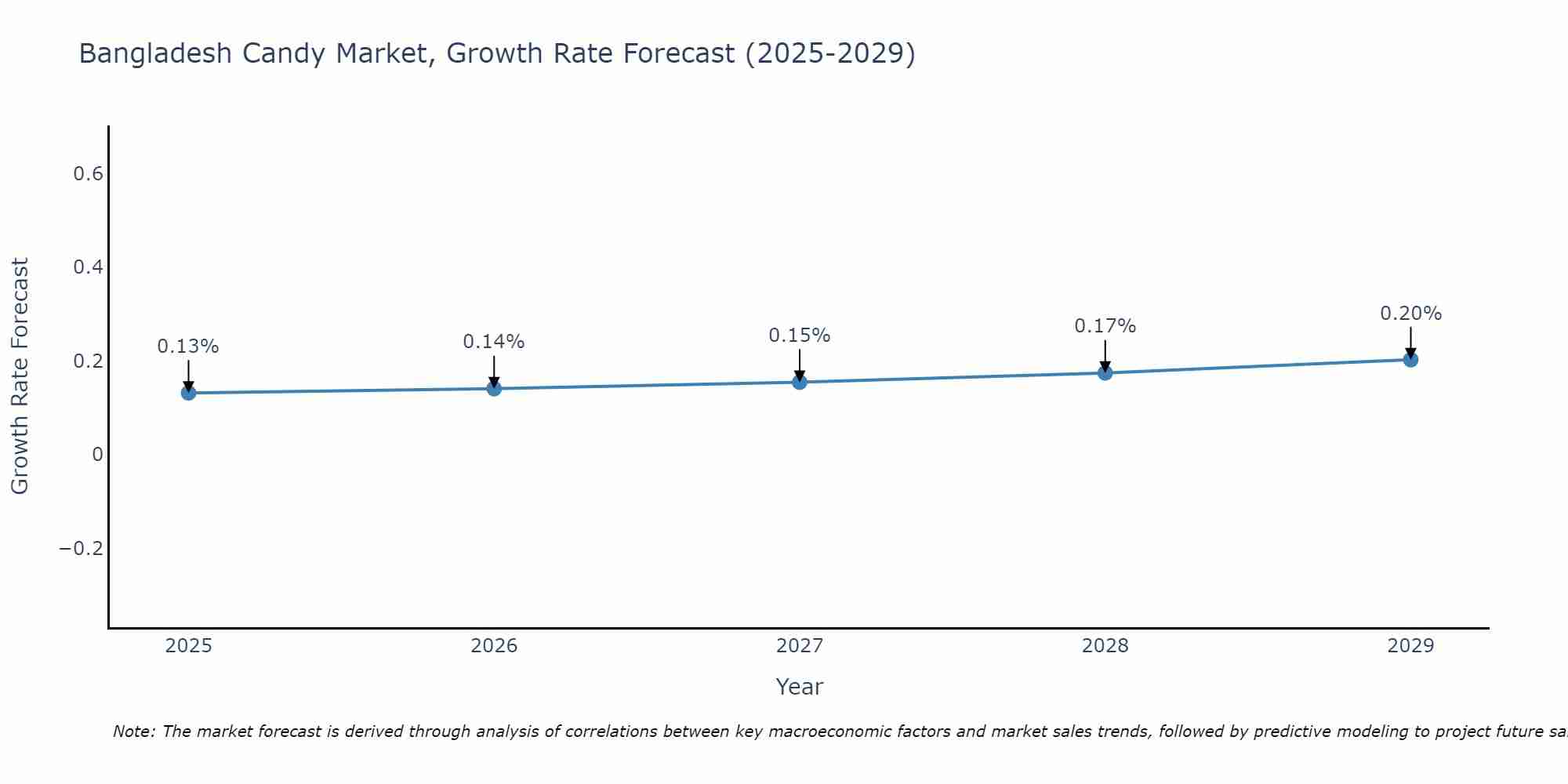
Bangladesh Candy Market Size Growth Rate
The Bangladesh Candy Market is poised for steady growth rate improvements from 2025 to 2029. Commencing at 0.13% in 2025, growth builds up to 0.20% by 2029.
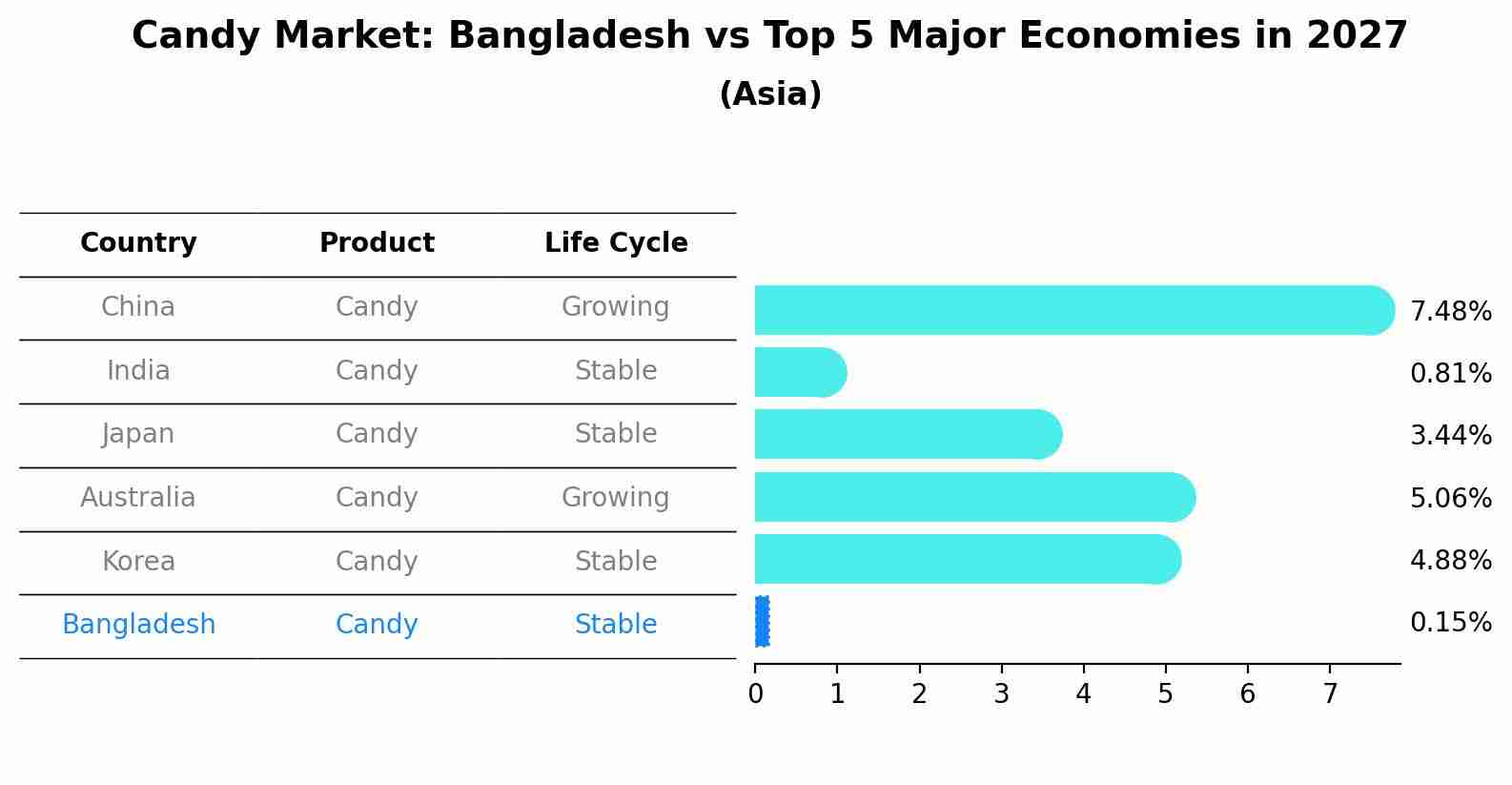
Candy Market: Bangladesh vs Top 5 Major Economies in 2027 (Asia)
Bangladesh's Candy market is anticipated to experience a stable growth rate of 0.15% by 2027, reflecting trends observed in the largest economy China, followed by India, Japan, Australia and South Korea.
Bangladesh Candy Market Highlights
| Report Name | Bangladesh Candy Market |
| Forecast Period | 2025-2031 |
| CAGR | 0.20% |
| Growing Sector | Online Retail Disturbution |
Topics Covered in the Bangladesh Candy Market
The Bangladesh Candy Market report thoroughly covers the market by product type and distribution channels, and regions. The market report provides an unbiased and detailed analysis of the ongoing market trends, opportunities/high growth areas, and market drivers, which would help stakeholders to devise and align their market strategies according to the current and future market dynamics.
Bangladesh Candy Market Synopsis
The Bangladesh Candy Market is anticipated to undergo major growth as disposable income rises, and urbanization occurs at a major level. High demand for confectionery products, particularly chocolate candy, along with the increasing presence of international brands and local manufacturers, are major factors propelling market growth. Additionally, developing consumer choices for their own enjoyment and gifting candy products will help support the sector.
Bangladesh Candy Market is projected to grow at a CAGR of 0.20% during 2025–2029. Factors propelling this growth consist of the increasing availability of distinctive candy products, the increasing urban middle-class population, and potent demand for budget-friendly yet luxurious offerings. The growing popularity of chocolate and sugar-free candy varieties, along with increased gifting trends, are expected to be key factors proliferating this growth. Consumers are becoming mindful of their health, as growing awareness about health is increasing amongst consumers. Moreover, domestic candy manufacturers are increasingly extending their product ranges to fulfil the needs of diverse consumer tastes and preferences.
Bangladesh Candy Market Challenges
Despite growing opportunities, the Bangladesh Candy Market faces some challenges, consisting of the high cost of raw materials, changing sugar prices, and insufficient infrastructure for cold storage, which can hamper the availability of candies in rural areas. Additionally, increasing health concerns and awareness about sugar intake have led to some consumers' unwillingness toward sugary products. Regulatory challenges, such as changing food safety laws and a lack of consistency in regulations across the country, also create obstacles to the growth of the Bangladesh Candy Industry.
Bangladesh Candy Market Trends
The Bangladesh Candy Market is undergoing trends such as the growing acceptance of healthier alternatives like sugar-free candies and organic ingredients. Other trends consist of the increase of new product innovations, such as chocolate with heavenly and tempting flavours, health-conscious candy options, and vegan-friendly products. Furthermore, there is increasing popularity for personalized candies used for events and special occasions, which is becoming a major segment.
Creative designs of candy’s are further making the consumers feel enriched and get attracted towards this market in a huge way. Additionally, brands are allocating their money to eco-friendly packaging solutions to captivate environmentally conscious consumers.
Investment Opportunities in the Bangladesh Candy Industry
The Bangladesh Candy Industry presents several investment opportunities, consisting of expanding distribution networks, particularly in rural areas. Local manufacturers are concentrating on ethnic candy varieties, and regional flavours are attracting increasing consumer interest. This trend also solidifies cultural importance and will offer homegrown brands a competitive advantage over others. Additionally, this will cater to the demand of unique preferences of consumers in a huge way.
Leading Players of the Bangladesh Candy Market
The Bangladesh Candy Market is highly competitive, with both local and international brands concentrating on new product combinations and innovations, marketing strategies, and distribution channels to gain Bangladesh Candy Market Share. Leading companies in this sector consist of Square Toiletries, Pran-RFL Group, ACI Limited, and local candy manufacturers like Khaas Food. International players like Nestlé and Mars are also extending their footprint in Bangladesh, concentrating on premium chocolate and confectionery products.
Government Regulations Introduced in the Bangladesh Candy Market
According to Bangladeshi government data, several regulations to ensure consumer safety and product quality are introduced by the government. The Bangladesh Food Safety Authority (BFSA) directs candy products to ensure they address food safety and hygiene standards. The Ministry of Commerce and the Bangladesh Export Processing Zones Authority (BEPZA) have also launched regulations to support food processing industries, consisting of candy manufacturing. The government’s support for food export development and digital payment regulations has also bolstered the Bangladesh Candy Market Growth.
Future Insights of the Bangladesh Candy Market
Bangladesh Candy Market is predicted to continue its increasing growth, with a major focus on luxurous, health-conscious, and convenient candy options. Future advancements may consist of the integration of AI-driven personalization in candy purchasing and online shopping platforms, as well as creativity in candy packaging, such as eco-friendly materials.
The increasing demand for gift-ready candy packages and seasonal offerings, especially during festivals, will lead to increased growth. Additionally, extension into untapped rural regions and increasing urban retail penetration will contribute to Bangladesh Candy Market Growth.
Market Segmentation Analysis
The report offers a comprehensive study of the subsequent market segments and their leading categories.
Chocolate Candy to Dominate the Market - by Product Type
Chocolate Candy remains a dominating category in the Bangladesh Candy Market, as the growing middle class increasingly selects luxurious chocolate products for gifting and personal consumption. Brands are providing distinctive chocolate-based products, ranging from bars to pralines and chocolates with exotic flavours.
Supermarkets and Hypermarkets to Dominate the Market - by Distribution Channel
According to Kapil, Senior Research Analyst at 6Wresearch, supermarkets and hypermarkets dominate the distribution channel segment in the Bangladesh Candy Market. These outlets are highly favoured for bulk purchases. Convenience stores are also gaining popularity, especially in urban areas where consumers are wanting quick and easy purchases.
Key Attractiveness of the Report
- 10 Years of Market Numbers.
- Historical Data Starting from 2021 to 2024.
- Base Year: 2024.
- Forecast Data until 2029.
- Key Performance Indicators Impacting the Market.
- Major Upcoming Developments and Projects.
Key Highlights of the Report:
- Bangladesh Candy Market Outlook
- Market Size of Bangladesh Candy Market, 2024
- Forecast of Bangladesh Candy Market, 2029
- Historical Data and Forecast of Bangladesh Candy Revenues & Volume for the Period 2019-2029
- Bangladesh Candy Market Trend Evolution
- Bangladesh Candy Market Drivers and Challenges
- Bangladesh Candy Price Trends
- Bangladesh Candy Porter's Five Forces
- Bangladesh Candy Industry Life Cycle
- Historical Data and Forecast of Bangladesh Candy Market Revenues & Volume By Product Type for the Period 2019-2029
- Historical Data and Forecast of Bangladesh Candy Market Revenues & Volume By Chocolate Candy for the Period 2019-2029
- Historical Data and Forecast of Bangladesh Candy Market Revenues & Volume By Non-Chocolate Candy for the Period 2019-2029
- Historical Data and Forecast of Bangladesh Candy Market Revenues & Volume By Distribution for the Period 2019-2029
- Historical Data and Forecast of Bangladesh Candy Market Revenues & Volume By Supermarkets and Hypermarkets for the Period 2019-2029
- Historical Data and Forecast of Bangladesh Candy Market Revenues & Volume By Convenience Stores for the Period 2019-2029
- Historical Data and Forecast of Bangladesh Candy Market Revenues & Volume By Specalist Retailers for the Period 2019-2029
- Historical Data and Forecast of Bangladesh Candy Market Revenues & Volume By Online Retail for the Period 2019-2029
- Historical Data and Forecast of Bangladesh Candy Market Revenues & Volume By Others for the Period 2019-2029
- Bangladesh Candy Import Export Trade Statistics
- Market Opportunity Assessment By Product Type
- Market Opportunity Assessment By Distribution
- Bangladesh Candy Top Companies Market Share
- Bangladesh Candy Competitive Benchmarking By Technical and Operational Parameters
- Bangladesh Candy Company Profiles
- Bangladesh Candy Key Strategic Recommendations
Market Covered
The market report provides a detailed analysis of the following market segments:
By Product Type
- Chocolate Candy
- Non-Chocolate Candy
By Distribution
- Supermarkets and Hypermarkets
- Convenience Stores
- Specialist Retailers
- Online Retail
- Others
Bangladesh Candy Market (2025-2029): FAQs
The Bangladesh Candy Market is projected to grow at a CAGR of approximately 0.20% during the forecast period 2025-2029.
Key growth factors consist of increasing disposable income, rising consumer preference for premium candies and growing demand for innovative candy products.
Sugar-based candies lead the market, particularly traditional and ethnic varieties.
E-commerce and modern retail outlets such as supermarkets and hypermarkets are extending, providing access to luxurious and high- quality candy products.
6Wresearch actively monitors the Bangladesh Candy Market and publishes its comprehensive annual report, highlighting emerging trends, growth drivers, revenue analysis, and forecast outlook. Our insights help businesses to make data-backed strategic decisions with ongoing market dynamics. Our analysts track relevent industries related to the Bangladesh Candy Market, allowing our clients with actionable intelligence and reliable forecasts tailored to emerging regional needs.
Yes, we provide customisation as per your requirements. To learn more, feel free to contact us on sales@6wresearch.com
| 1 Executive Summary |
| 2 Introduction |
| 2.1 Key Highlights of the Report |
| 2.2 Report Description |
| 2.3 Market Scope & Segmentation |
| 2.4 Research Methodology |
| 2.5 Assumptions |
| 3 Bangladesh Candy Market Overview |
| 3.1 Bangladesh Country Macro Economic Indicators |
| 3.2 Bangladesh Candy Market Revenues & Volume, 2019 & 2029F |
| 3.3 Bangladesh Candy Market - Industry Life Cycle |
| 3.4 Bangladesh Candy Market - Porter's Five Forces |
| 3.5 Bangladesh Candy Market Revenues & Volume Share, By Product Type, 2019 & 2029F |
| 3.6 Bangladesh Candy Market Revenues & Volume Share, By Distribution, 2019 & 2029F |
| 4 Bangladesh Candy Market Dynamics |
| 4.1 Impact Analysis |
| 4.2 Market Drivers |
| 4.3 Market Restraints |
| 5 Bangladesh Candy Market Trends |
| 6 Bangladesh Candy Market, By Types |
| 6.1 Bangladesh Candy Market, By Product Type |
| 6.1.1 Overview and Analysis |
| 6.1.2 Bangladesh Candy Market Revenues & Volume, By Product Type, 2019 - 2029F |
| 6.1.3 Bangladesh Candy Market Revenues & Volume, By Chocolate Candy, 2019 - 2029F |
| 6.1.4 Bangladesh Candy Market Revenues & Volume, By Non-Chocolate Candy, 2019 - 2029F |
| 6.2 Bangladesh Candy Market, By Distribution |
| 6.2.1 Overview and Analysis |
| 6.2.2 Bangladesh Candy Market Revenues & Volume, By Supermarkets and Hypermarkets, 2019 - 2029F |
| 6.2.3 Bangladesh Candy Market Revenues & Volume, By Convenience Stores, 2019 - 2029F |
| 6.2.4 Bangladesh Candy Market Revenues & Volume, By Specalist Retailers, 2019 - 2029F |
| 6.2.5 Bangladesh Candy Market Revenues & Volume, By Online Retail, 2019 - 2029F |
| 6.2.6 Bangladesh Candy Market Revenues & Volume, By Others, 2019 - 2029F |
| 7 Bangladesh Candy Market Import-Export Trade Statistics |
| 7.1 Bangladesh Candy Market Export to Major Countries |
| 7.2 Bangladesh Candy Market Imports from Major Countries |
| 8 Bangladesh Candy Market Key Performance Indicators |
| 9 Bangladesh Candy Market - Opportunity Assessment |
| 9.1 Bangladesh Candy Market Opportunity Assessment, By Product Type, 2019 & 2029F |
| 9.2 Bangladesh Candy Market Opportunity Assessment, By Distribution, 2019 & 2029F |
| 10 Bangladesh Candy Market - Competitive Landscape |
| 10.1 Bangladesh Candy Market Revenue Share, By Companies, 2024 |
| 10.2 Bangladesh Candy Market Competitive Benchmarking, By Operating and Technical Parameters |
| 11 Company Profiles |
| 12 Recommendations |
| 13 Disclaimer |
Export potential assessment - trade Analytics for 2030
Export potential enables firms to identify high-growth global markets with greater confidence by combining advanced trade intelligence with a structured quantitative methodology. The framework analyzes emerging demand trends and country-level import patterns while integrating macroeconomic and trade datasets such as GDP and population forecasts, bilateral import–export flows, tariff structures, elasticity differentials between developed and developing economies, geographic distance, and import demand projections. Using weighted trade values from 2020–2024 as the base period to project country-to-country export potential for 2030, these inputs are operationalized through calculated drivers such as gravity model parameters, tariff impact factors, and projected GDP per-capita growth. Through an analysis of hidden potentials, demand hotspots, and market conditions that are most favorable to success, this method enables firms to focus on target countries, maximize returns, and global expansion with data, backed by accuracy.
By factoring in the projected importer demand gap that is currently unmet and could be potential opportunity, it identifies the potential for the Exporter (Country) among 190 countries, against the general trade analysis, which identifies the biggest importer or exporter.
To discover high-growth global markets and optimize your business strategy:
Click Here
Pricing
- Single User License$ 1,995
- Department License$ 2,400
- Site License$ 3,120
- Global License$ 3,795

Search
Thought Leadership and Analyst Meet





Our Clients








Latest Reports
- Syria Air Conditioner Market (2026-2032) | Outlook, Competition, Drivers, Trends, Demand, Competitive, Strategic Insights, Companies, Challenges, Strategy, Consumer Insights, Analysis, Opportunities, Growth, Size, Share, Industry, Revenue, Segments, Value, Segmentation, Supply, Forecast, Restraints,
- Philippines Polyhydroxybutyrate-co-Hydroxyvalerate Market (2026-2032) | Trends, Insights, Challenges, Restraints, Competition, Size, Value, Forecast, Pricing, Share, Outlook, Revenue, Investment Opportunities, Strategy, Drivers, Demand, Growth, segmentation, Analysis, Companies
- Peru Polyhydroxybutyrate-co-Hydroxyvalerate Market (2026-2032) | Growth, Demand, Challenges, Share, Trends, Analysis, Pricing, Investment Opportunities, Drivers, Value, Forecast, Competition, Size, Companies, Insights, Outlook, Restraints, segmentation, Revenue, Strategy
- Pakistan Polyhydroxybutyrate-co-Hydroxyvalerate Market (2026-2032) | Restraints, segmentation, Pricing, Forecast, Share, Strategy, Competition, Trends, Insights, Drivers, Challenges, Growth, Revenue, Outlook, Value, Investment Opportunities, Companies, Size, Analysis, Demand
- Oman Polyhydroxybutyrate-co-Hydroxyvalerate Market (2026-2032) | Drivers, segmentation, Insights, Competition, Pricing, Outlook, Size, Revenue, Challenges, Forecast, Analysis, Growth, Value, Share, Trends, Investment Opportunities, Strategy, Restraints, Companies, Demand
- Nigeria Polyhydroxybutyrate-co-Hydroxyvalerate Market (2026-2032) | Value, Investment Opportunities, Analysis, Revenue, Restraints, Pricing, Outlook, Competition, Demand, Growth, Forecast, Companies, Trends, Challenges, segmentation, Drivers, Insights, Share, Size, Strategy
- Nepal Polyhydroxybutyrate-co-Hydroxyvalerate Market (2026-2032) | Insights, Analysis, Drivers, Share, Revenue, Demand, segmentation, Investment Opportunities, Competition, Forecast, Growth, Pricing, Companies, Strategy, Trends, Restraints, Challenges, Outlook, Size, Value
- Myanmar Polyhydroxybutyrate-co-Hydroxyvalerate Market (2026-2032) | Outlook, Revenue, Strategy, Restraints, Drivers, segmentation, Share, Forecast, Competition, Insights, Growth, Pricing, Size, Demand, Value, Companies, Trends, Challenges, Investment Opportunities, Analysis
- Morocco Polyhydroxybutyrate-co-Hydroxyvalerate Market (2026-2032) | Outlook, Investment Opportunities, Restraints, Strategy, Forecast, Challenges, Drivers, Growth, Companies, segmentation, Trends, Size, Competition, Revenue, Demand, Insights, Share, Analysis, Value, Pricing
- Mexico Polyhydroxybutyrate-co-Hydroxyvalerate Market (2026-2032) | Size, Drivers, Outlook, Share, Strategy, Growth, Pricing, Challenges, Companies, Demand, Value, Investment Opportunities, Restraints, Trends, Forecast, segmentation, Analysis, Insights, Competition, Revenue
Industry Events and Analyst Meet

HIMTEX 2026

India Refining Summit 2026

India EV Show 2026

EV tech India Expo 2026

Auto Tech Asia 2026
Whitepaper
- Middle East & Africa Commercial Security Market Click here to view more.
- Middle East & Africa Fire Safety Systems & Equipment Market Click here to view more.
- GCC Drone Market Click here to view more.
- Middle East Lighting Fixture Market Click here to view more.
- GCC Physical & Perimeter Security Market Click here to view more.
6WResearch In News
- Doha a strategic location for EV manufacturing hub: IPA Qatar
- Demand for luxury TVs surging in the GCC, says Samsung
- Empowering Growth: The Thriving Journey of Bangladesh’s Cable Industry
- Demand for luxury TVs surging in the GCC, says Samsung
- Video call with a traditional healer? Once unthinkable, it’s now common in South Africa
- Intelligent Buildings To Smooth GCC’s Path To Net Zero


