Bangladesh Chamotte Market Size, Share & Growth Rate
The Bangladesh Chamotte Market was estimated at USD 235 Million in 2025 and is projected to reach USD 313 Million by 2032, growing at a CAGR of 4.2% from 2026 to 2032. This positive trajectory is largely driven by the booming construction and ceramics sectors, both vital for the nations ongoing infrastructure projects and urban development initiatives. As demand surges for refractory materials, particularly in fire brick production, the chamotte market is poised for substantial growth in the coming years.
Bangladesh Chamotte Market Year-wise Growth Rate and Key Drivers
This graph highlights how the Bangladesh Chamotte Market has steadily grown over the years, supported by major growth factors.
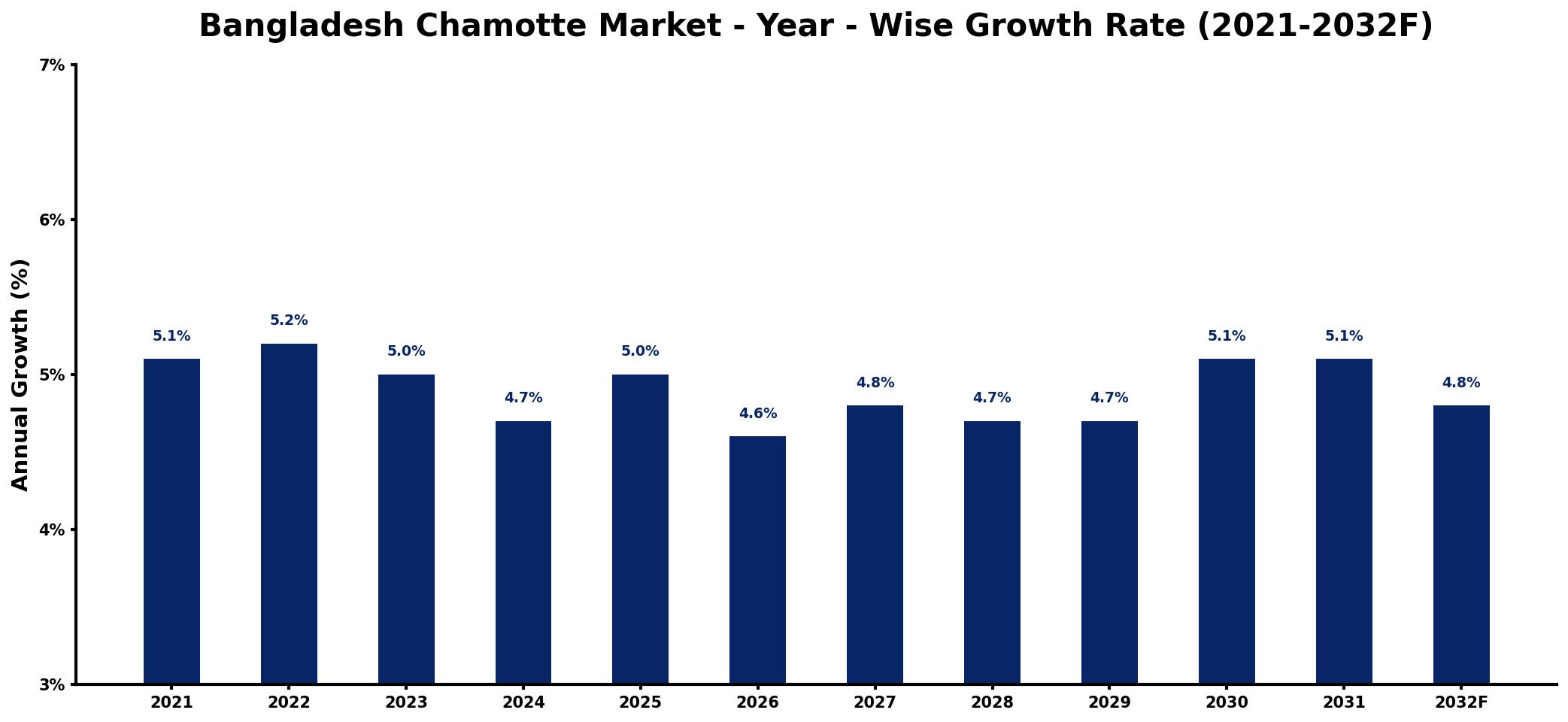
The table below presents the year‑wise growth rates along with the key drivers influencing the market
| Year | Growth Rate | Major Drivers |
| 2021 | 5.1% | Rising demand in construction sector |
| 2022 | 5.2% | Increased investment in infrastructure projects |
| 2023 | 5.0% | Expansion of ceramic manufacturing capacity |
| 2024 | 4.7% | Growing exports to regional markets |
| 2025 | 5.0% | Enhanced production technologies adoption |
| 2026 | 4.6% | Strengthened local supply chain networks |
| 2027 | 4.8% | Surge in industrial applications usage |
| 2028 | 4.7% | Development of eco-friendly alternatives |
| 2029 | 4.7% | Increased government support initiatives |
| 2030 | 5.1% | Higher consumer spending on construction |
| 2031 | 5.1% | Growing interest in sustainable materials |
| 2032 | 4.8% | Emergence of new market players |
Note: Market size estimations and growth projections presented in this report are based on 6Wresearch's proprietary forecasting methodology, utilizing the latest available industry data, government publications, and primary research inputs.
Bangladesh Chamotte Market Synopsis
The Bangladesh Chamotte market has recently benefitted from a dynamic expansion fueled by escalating industrial activities and infrastructure development. With increasing investments in the construction sector, the demand for chamotte as a crucial raw material is on the rise, presenting robust opportunities for local manufacturers.
Looking ahead, the market is expected to sustain its growth momentum as government initiatives favor enhanced production capacities and quality improvements. The focus on eco-friendly manufacturing processes will likely define the future landscape of the industry, responding to both environmental regulations and consumer preferences.
Bangladesh Chamotte Market Key Takeaways
- The market is expected to grow at a CAGR of 4.2% from 2026 to 2032.
- Increased investments in construction and infrastructure are driving chamotte demand.
- Focus on sustainability is influencing production processes and product offerings.
- Research and development efforts are enhancing chamotte's quality and applications.
- The local industry faces competition from imported products and fluctuating raw material prices.
Evaluation of Restraints in Bangladesh Chamotte Market
Despite its promising growth trajectory, the Bangladesh Chamotte market grapples with several restraints that could impede its potential. A key limitation is the inconsistent availability of high-quality raw materials, which directly affects production standards and costs. Moreover, fluctuations in international prices for chamotte create uncertainty for local manufacturers who must balance profitability with market demands. Regulatory inconsistencies and inadequate infrastructure further complicate logistics and distribution, thereby hindering the markets overall efficiency and competitiveness.
Bangladesh Chamotte Market Trends
Current trends within the Bangladesh Chamotte market reveal a significant shift towards sustainable practices. Manufacturers are increasingly adopting eco-friendly production methods, influenced by both consumer demand and regulatory pressures. Additionally, theres a growing emphasis on the customization of chamotte products to meet specific industry needs, particularly in the ceramics and refractories sectors. As companies invest in advanced technologies, innovations in product formulations are also emerging, aimed at enhancing the performance characteristics of chamotte in various applications.
Bangladesh Chamotte Market Opportunities
The investment landscape in the Bangladesh Chamotte market is ripe with opportunities as the demand for high-quality fire-resistant materials continues to rise. Establishing production facilities and distribution networks could yield lucrative returns, particularly as urbanization accelerates across the country. Furthermore, advancements in technology present a unique chance for firms to develop novel chamotte products that comply with evolving environmental standards and market preferences, thus enabling them to carve out a competitive edge.
Government Initiatives in the Bangladesh Chamotte Market
The Bangladesh government has enacted various policies aimed at bolstering the chamotte industry. These include protective import tariffs designed to shield local manufacturers from foreign competition, as well as incentives to encourage investments in production facilities. Regulatory measures are also in place to ensure that environmental standards are met, promoting sustainable practices within the industry. Furthermore, there is a concerted effort to support research and development, fostering innovation and quality enhancements throughout the sector.
Future Insights of the Bangladesh Chamotte Market
Looking towards 2026-2032, the Bangladesh Chamotte market is expected to evolve significantly, propelled by ongoing industrial growth and infrastructure projects. The burgeoning construction and ceramics industries will serve as primary drivers of demand, underscoring the importance of chamotte in producing essential materials like bricks and tiles. Additionally, the integration of technological advancements will likely lead to better product performance and sustainability, positioning the market favorably in the competitive landscape.
Bangladesh Chamotte Market Latest Developments (2025 - 2026)
Recent developments in the Bangladesh Chamotte market indicate a strong focus on upgrading manufacturing capabilities and enhancing product quality. Industry participants are prioritizing investments in new technologies that improve production efficiency and reduce environmental impact. Moreover, strategic partnerships and collaborations among local manufacturers are becoming increasingly common as players look to leverage shared expertise and resources to meet rising market demands effectively.
Bangladesh Chamotte Market - Key Attractiveness of the Report
- 10 Years of Market Numbers
- Historical Data Starting from 2022 to 2025
- Base Year: 2025
- Forecast Data until 2032
- Key Performance Indicators Impacting the Market
- Major Upcoming Developments and Projects
Key Highlights of the Report:
- Bangladesh Chamotte Market Outlook
- Market Size of Bangladesh Chamotte Market, 2025
- Forecast of Bangladesh Chamotte Market, 2032
- Historical Data and Forecast of Bangladesh Chamotte Revenues & Volume for the Period 2022-2032F
- Bangladesh Chamotte Market Trend Evolution
- Bangladesh Chamotte Market Drivers and Challenges
- Bangladesh Chamotte Price Trends
- Bangladesh Chamotte Porter's Five Forces
- Bangladesh Chamotte Industry Life Cycle
- Historical Data and Forecast of Bangladesh Chamotte Market Revenues & Volume By Type for the Period 2022-2032F
- Historical Data and Forecast of Bangladesh Chamotte Market Revenues & Volume By Clinker for the Period 2022-2032F
- Historical Data and Forecast of Bangladesh Chamotte Market Revenues & Volume By Cement Clinker for the Period 2022-2032F
- Historical Data and Forecast of Bangladesh Chamotte Market Revenues & Volume By Application for the Period 2022-2032F
- Historical Data and Forecast of Bangladesh Chamotte Market Revenues & Volume By Cement for the Period 2022-2032F
- Historical Data and Forecast of Bangladesh Chamotte Market Revenues & Volume By Silicate Material for the Period 2022-2032F
- Historical Data and Forecast of Bangladesh Chamotte Market Revenues & Volume By Others for the Period 2022-2032F
- Bangladesh Chamotte Import Export Trade Statistics
- Market Opportunity Assessment By Type
- Market Opportunity Assessment By Application
- Bangladesh Chamotte Top Companies Market Share
- Bangladesh Chamotte Competitive Benchmarking By Technical and Operational Parameters
- Bangladesh Chamotte Company Profiles
- Bangladesh Chamotte Key Strategic Recommendations






































