Bangladesh Coconut Products Market Size Growth Rate
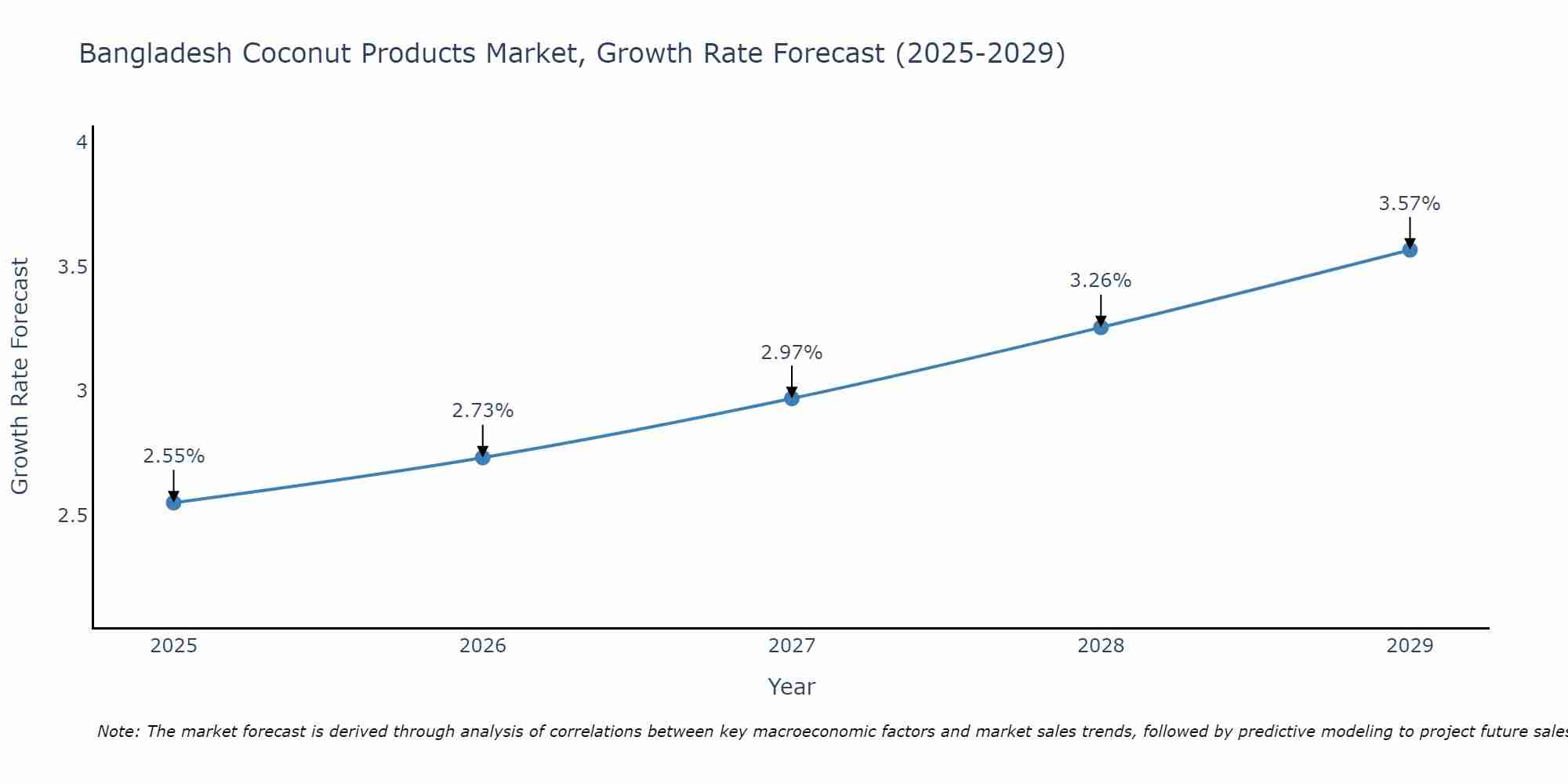
The Bangladesh Coconut Products Market is likely to experience consistent growth rate gains over the period 2025 to 2029. From 2.55% in 2025, the growth rate steadily ascends to 3.57% in 2029.
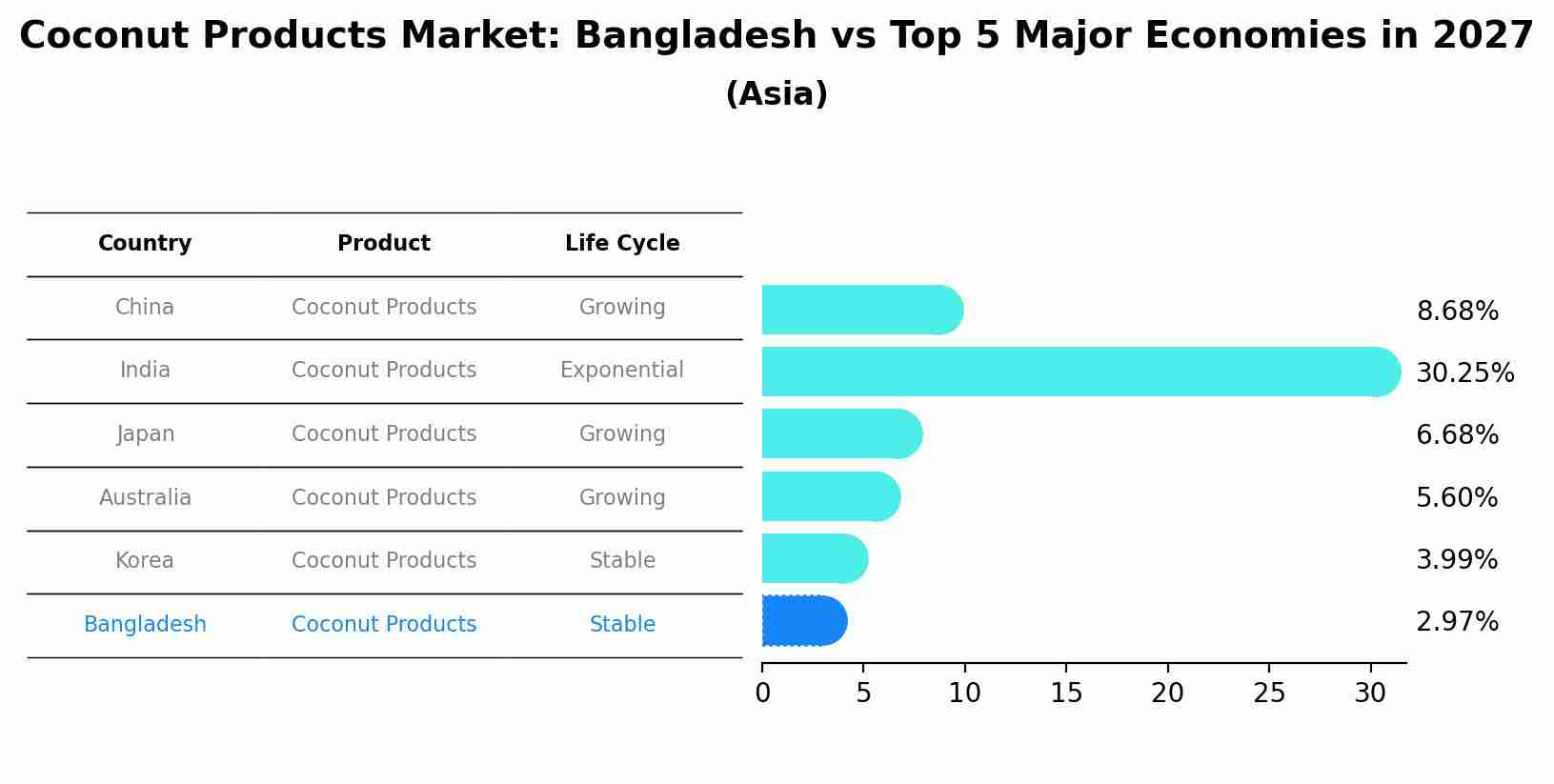
Coconut Products Market: Bangladesh vs Top 5 Major Economies in 2027 (Asia)
In the Asia region, the Coconut Products market in Bangladesh is projected to expand at a stable growth rate of 2.97% by 2027. The largest economy is China, followed by India, Japan, Australia and South Korea.
Bangladesh Coconut Products Market Overview
Apart from coconut oil, a variety of coconut-based products such as coconut water, milk, and snacks have gained popularity in Bangladesh. The market for coconut products is witnessing steady growth, fueled by their perceived health benefits and diverse culinary uses.
Drivers of the market
The Bangladesh Coconut Products market is thriving, fueled by the diverse range of coconut-derived products such as coconut water, coconut milk, coconut flour, and coconut-based snacks gaining popularity among consumers. Coconut products are valued for their nutritional benefits, including hydration, electrolyte replenishment, and dietary fiber content. The increasing demand for natural and plant-based food alternatives also contributes to the market expansion.
Challenges of the market
Challenges facing the coconut products market include limited value addition and product diversification, inadequate market infrastructure, and issues related to packaging and labeling compliance. Market players also need to address concerns regarding product adulteration and food safety.
Government Policy of the market
The coconut products market in Bangladesh encompasses a wide range of products derived from coconut, including coconut oil, coconut milk, coconut water, desiccated coconut, and coconut-based snacks and confectionery. The government has introduced policies to support the growth of the coconut products market, such as initiatives to promote value addition, enhance product quality and safety standards, and facilitate market access and export promotion. These policies include measures to provide training and technical assistance to coconut processors, improve post-harvest handling practices, and develop infrastructure and logistics for coconut supply chain management. Furthermore, the government is working to promote domestic consumption of coconut products through awareness campaigns, product diversification, and market development initiatives.
Key Highlights of the Report:
- Bangladesh Coconut Products Market Outlook
- Market Size of Bangladesh Coconut Products Market, 2024
- Forecast of Bangladesh Coconut Products Market, 2031
- Historical Data and Forecast of Bangladesh Coconut Products Revenues & Volume for the Period 2021-2031
- Bangladesh Coconut Products Market Trend Evolution
- Bangladesh Coconut Products Market Drivers and Challenges
- Bangladesh Coconut Products Price Trends
- Bangladesh Coconut Products Porter's Five Forces
- Bangladesh Coconut Products Industry Life Cycle
- Historical Data and Forecast of Bangladesh Coconut Products Market Revenues & Volume By Type for the Period 2021-2031
- Historical Data and Forecast of Bangladesh Coconut Products Market Revenues & Volume By Coconut Water for the Period 2021-2031
- Historical Data and Forecast of Bangladesh Coconut Products Market Revenues & Volume By Coconut Oil for the Period 2021-2031
- Historical Data and Forecast of Bangladesh Coconut Products Market Revenues & Volume By Coconut Milk for the Period 2021-2031
- Historical Data and Forecast of Bangladesh Coconut Products Market Revenues & Volume By Dried Coconut Products for the Period 2021-2031
- Historical Data and Forecast of Bangladesh Coconut Products Market Revenues & Volume By Others for the Period 2021-2031
- Historical Data and Forecast of Bangladesh Coconut Products Market Revenues & Volume By Application for the Period 2021-2031
- Historical Data and Forecast of Bangladesh Coconut Products Market Revenues & Volume By Food for the Period 2021-2031
- Historical Data and Forecast of Bangladesh Coconut Products Market Revenues & Volume By Beverage for the Period 2021-2031
- Historical Data and Forecast of Bangladesh Coconut Products Market Revenues & Volume By Cosmetics for the Period 2021-2031
- Historical Data and Forecast of Bangladesh Coconut Products Market Revenues & Volume By Others for the Period 2021-2031
- Historical Data and Forecast of Bangladesh Coconut Products Market Revenues & Volume By Form for the Period 2021-2031
- Historical Data and Forecast of Bangladesh Coconut Products Market Revenues & Volume By Solid for the Period 2021-2031
- Historical Data and Forecast of Bangladesh Coconut Products Market Revenues & Volume By Liquid for the Period 2021-2031
- Bangladesh Coconut Products Import Export Trade Statistics
- Market Opportunity Assessment By Type
- Market Opportunity Assessment By Application
- Market Opportunity Assessment By Form
- Bangladesh Coconut Products Top Companies Market Share
- Bangladesh Coconut Products Competitive Benchmarking By Technical and Operational Parameters
- Bangladesh Coconut Products Company Profiles
- Bangladesh Coconut Products Key Strategic Recommendations






































