Bangladesh Computer Software Market Size, Share & Growth Rate
The Bangladesh Computer Software Market was estimated at USD 365 Million in 2025 and is projected to reach USD 490 Million by 2032, growing at a CAGR of 4.3% from 2026 to 2032. This growth is primarily fueled by increasing internet penetration, a strong emphasis on digital transformation across sectors, and the burgeoning demand for IT outsourcing. As the government continues to support the IT sector and initiatives aimed at enhancing digital literacy gain momentum, the market is set for robust expansion.
Bangladesh Computer Software Market Year-wise Growth Rate and Key Drivers
This graph highlights how the Bangladesh Computer Software Market has steadily grown over the years, supported by major growth factors.
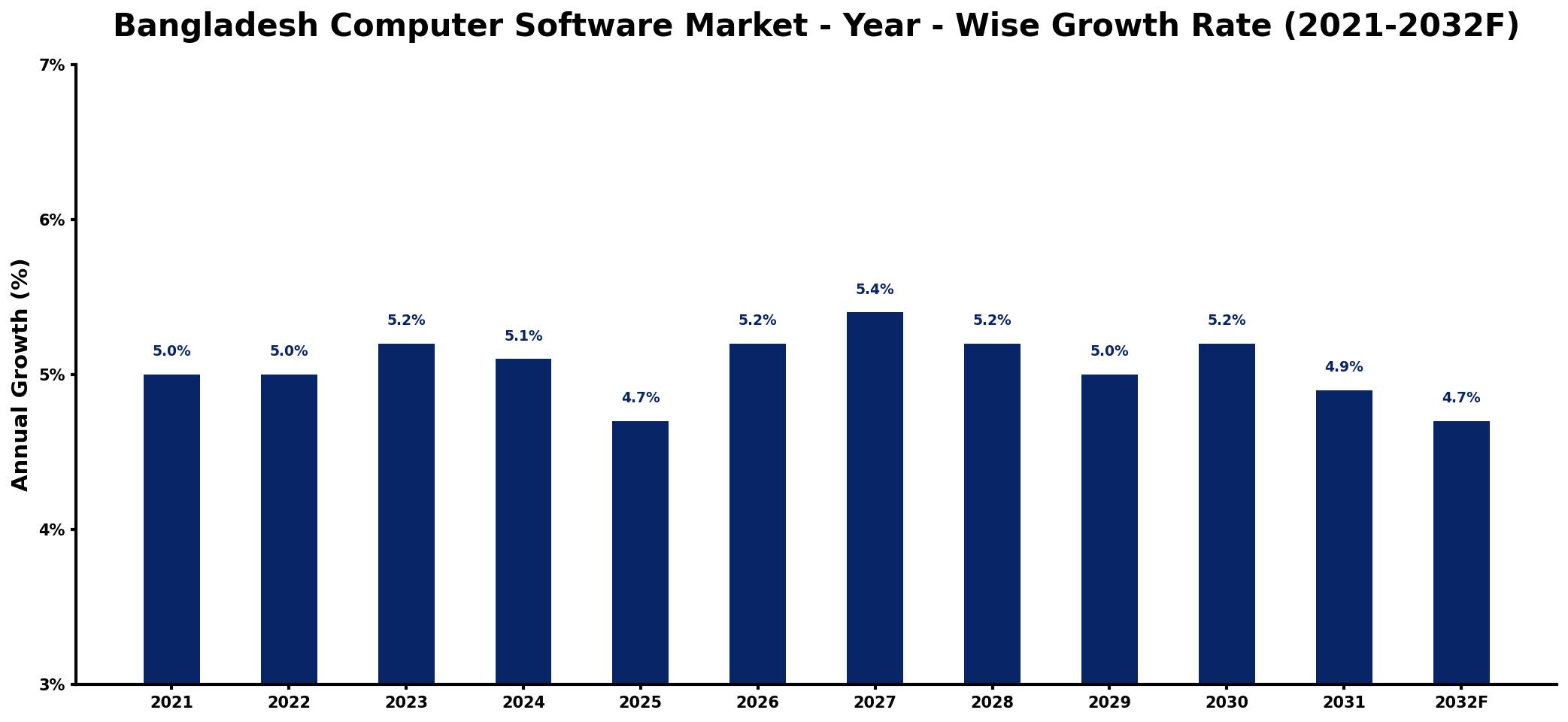
The table below presents the year‑wise growth rates along with the key drivers influencing the market
| Year | Growth Rate | Major Drivers |
| 2021 | 5.0% | Increased digital transformation initiatives |
| 2022 | 5.0% | Rising demand for automation tools |
| 2023 | 5.2% | Expansion of e-commerce platforms |
| 2024 | 5.1% | Growth in cloud computing adoption |
| 2025 | 4.7% | Emergence of fintech innovations |
| 2026 | 5.2% | Surge in mobile application development |
| 2027 | 5.4% | Investment in cybersecurity solutions |
| 2028 | 5.2% | Advancements in artificial intelligence |
| 2029 | 5.0% | Growing interest in data analytics |
| 2030 | 5.2% | Development of remote work technologies |
| 2031 | 4.9% | Shift towards subscription-based services |
| 2032 | 4.7% | Demand for integrated business solutions |
Note: Market size estimations and growth projections presented in this report are based on 6Wresearch's proprietary forecasting methodology, utilizing the latest available industry data, government publications, and primary research inputs.
Bangladesh Computer Software Market Synopsis
The most powerful driver currently shaping the Bangladesh Computer Software Market is the widespread adoption of digital technologies. As various industries like banking, healthcare, and education increasingly rely on software solutions, there is a growing demand for tailored applications that meet specific needs.
Moreover, the emergence of a young, tech-savvy workforce is further catalyzing market expansion. This demographic not only embraces innovative solutions but also contributes significantly to the country's IT labor pool, thus providing a competitive edge in software development capabilities.
Bangladesh Computer Software Market Key Takeaways
- The market is projected to grow significantly, driven by increasing digitalization efforts across various sectors.
- There is a notable rise in demand for mobile applications and e-commerce solutions amid a surge in online transactions.
- Government initiatives aimed at promoting the IT sector provide substantial support and growth opportunities.
- The countrys young population and increasing internet connectivity create a fertile environment for innovation.
- Investment in emerging technologies like AI and blockchain presents lucrative opportunities for market players.
Evaluation of Restraints in Bangladesh Computer Software Market
Despite the promising landscape, the Bangladesh Computer Software Market faces significant restraints that could impede growth. A critical shortage of skilled software developers poses a serious challenge, as demand continues to outpace supply. Inadequate infrastructure, characterized by frequent power outages and slow internet speeds, hinders development processes and affects overall efficiency. Additionally, limited access to financing for startups, combined with insufficient intellectual property protection, creates a daunting environment for new entrants and innovation. These hurdles underscore the importance of collaborative efforts between government and industry stakeholders to cultivate a more supportive framework for growth.
Bangladesh Computer Software Market Trends
The market is currently witnessing several notable trends. The adoption of cloud computing continues to rise, as companies seek scalable and efficient software solutions. Furthermore, artificial intelligence is making inroads, with organizations exploring its potential to enhance user experiences and operational efficiency. E-commerce solutions are gaining traction, spurred by a growing preference for online shopping among consumers. Additionally, a pronounced shift towards mobile applications is evident, fueled by increased smartphone penetration and consumer demand for convenience.
Bangladesh Computer Software Market Opportunities
Investment opportunities abound within the Bangladesh Computer Software Market. Custom software development tailored to various sectors is a prime area for growth, particularly as companies seek innovative solutions to streamline operations. There is a burgeoning market for educational software designed to enhance digital learning experiences. Furthermore, Software as a Service (SaaS) models targeted at small and medium enterprises present an attractive avenue for investment. Moreover, the increasing emphasis on artificial intelligence, blockchain, and the Internet of Things (IoT) highlights significant long-term potential for investors willing to navigate this evolving landscape.
Government Initiatives in the Bangladesh Computer Software Market
The Bangladeshi government has instituted a range of policies aimed at bolstering the computer software market. These include tax incentives for software development firms and funding opportunities to support emerging tech startups. Additionally, efforts are underway to enhance the nation's digital infrastructure and promote skill development in the IT sector through targeted training programs. There are also initiatives in place to protect intellectual property rights, contributing to a more secure environment for software innovation and investment. Collectively, these strategies are designed to attract investment and foster a thriving ecosystem for the computer software industry.
Future Insights of the Bangladesh Computer Software Market
Looking ahead to 2026-2032, the Bangladesh Computer Software Market is expected to witness dynamic growth fueled by accelerating digitization across diverse industries. With increasing demand for innovative software solutions in e-commerce, mobile applications, and digital finance, local software companies will likely experience a significant uptick in opportunities. The nation's robust IT workforce, combined with favorable labor costs and supportive government policies, positions Bangladesh as a competitive player in the global outsourcing landscape. Overall, the future landscape appears optimistic, characterized by technological advancement and a supportive business climate.
Bangladesh Computer Software Market Latest Developments (2025 - 2026)
Recent developments within the Bangladesh Computer Software Market highlight a trend towards greater collaboration between local firms and international technology companies. This partnership model is aimed at driving innovation and enhancing software capabilities. Additionally, companies are increasingly investing in research and development to create cutting-edge solutions that cater to evolving market demands. Training programs targeting skill enhancement for software developers are gaining traction, reflecting a proactive approach to addressing the skills gap and preparing the workforce for future challenges.
Bangladesh Computer Software Market - Key Attractiveness of the Report
- 10 Years of Market Numbers
- Historical Data Starting from 2022 to 2025
- Base Year: 2025
- Forecast Data until 2032
- Key Performance Indicators Impacting the Market
- Major Upcoming Developments and Projects
Key Highlights of the Report:
- Bangladesh Computer Software Market Outlook
- Market Size of Bangladesh Computer Software Market, 2025
- Forecast of Bangladesh Computer Software Market, 2032
- Historical Data and Forecast of Bangladesh Computer Software Revenues & Volume for the Period 2022-2032F
- Bangladesh Computer Software Market Trend Evolution
- Bangladesh Computer Software Market Drivers and Challenges
- Bangladesh Computer Software Price Trends
- Bangladesh Computer Software Porter's Five Forces
- Bangladesh Computer Software Industry Life Cycle
- Historical Data and Forecast of Bangladesh Computer Software Market Revenues & Volume By Type for the Period 2022-2032F
- Historical Data and Forecast of Bangladesh Computer Software Market Revenues & Volume By Operating Systems & Productivity Software Publishing for the Period 2022-2032F
- Historical Data and Forecast of Bangladesh Computer Software Market Revenues & Volume By Database, Storage & Backup Software Publishing for the Period 2022-2032F
- Historical Data and Forecast of Bangladesh Computer Software Market Revenues & Volume By Business Analytics & Enterprise Software for the Period 2022-2032F
- Historical Data and Forecast of Bangladesh Computer Software Market Revenues & Volume By Video Game Software for the Period 2022-2032F
- Historical Data and Forecast of Bangladesh Computer Software Market Revenues & Volume By Design for the Period 2022-2032F
- Historical Data and Forecast of Bangladesh Computer Software Market Revenues & Volume By Editing & Rendering Software for the Period 2022-2032F
- Historical Data and Forecast of Bangladesh Computer Software Market Revenues & Volume By Application for the Period 2022-2032F
- Historical Data and Forecast of Bangladesh Computer Software Market Revenues & Volume By Personal for the Period 2022-2032F
- Historical Data and Forecast of Bangladesh Computer Software Market Revenues & Volume By Business/Commercial for the Period 2022-2032F
- Historical Data and Forecast of Bangladesh Computer Software Market Revenues & Volume By Industrial for the Period 2022-2032F
- Historical Data and Forecast of Bangladesh Computer Software Market Revenues & Volume By Industry Verticals for the Period 2022-2032F
- Historical Data and Forecast of Bangladesh Computer Software Market Revenues & Volume By BFSI for the Period 2022-2032F
- Historical Data and Forecast of Bangladesh Computer Software Market Revenues & Volume By Media & Entertainment for the Period 2022-2032F
- Historical Data and Forecast of Bangladesh Computer Software Market Revenues & Volume By IT & Telecommunications for the Period 2022-2032F
- Historical Data and Forecast of Bangladesh Computer Software Market Revenues & Volume By Energy & Utilities for the Period 2022-2032F
- Historical Data and Forecast of Bangladesh Computer Software Market Revenues & Volume By Government & Public Sector for the Period 2022-2032F
- Historical Data and Forecast of Bangladesh Computer Software Market Revenues & Volume By Retail & Consumer Goods for the Period 2022-2032F
- Historical Data and Forecast of Bangladesh Computer Software Market Revenues & Volume By Manufacturing for the Period 2022-2032F
- Historical Data and Forecast of Bangladesh Computer Software Market Revenues & Volume By Others for the Period 2022-2032F
- Bangladesh Computer Software Import Export Trade Statistics
- Market Opportunity Assessment By Type
- Market Opportunity Assessment By Application
- Market Opportunity Assessment By Industry Verticals
- Bangladesh Computer Software Top Companies Market Share
- Bangladesh Computer Software Competitive Benchmarking By Technical and Operational Parameters
- Bangladesh Computer Software Company Profiles
- Bangladesh Computer Software Key Strategic Recommendations






































