Bangladesh Cutting Equipment Market Size, Share & Growth Rate
The Bangladesh Cutting Equipment Market was estimated at USD 463 Million in 2025 and is projected to reach USD 640 Million by 2032, growing at a CAGR of 4.7% from 2026 to 2032. This trajectory is primarily driven by the rapid expansion of the manufacturing sector, particularly in automotive and construction. Government initiatives focused on infrastructure development and industrial growth further enhance the demand for precision cutting tools, positioning this market for substantial growth over the next several years.
Bangladesh Cutting Equipment Market Year-wise Growth Rate and Key Drivers
This graph highlights how the Bangladesh Cutting Equipment Market has steadily grown over the years, supported by major growth factors.
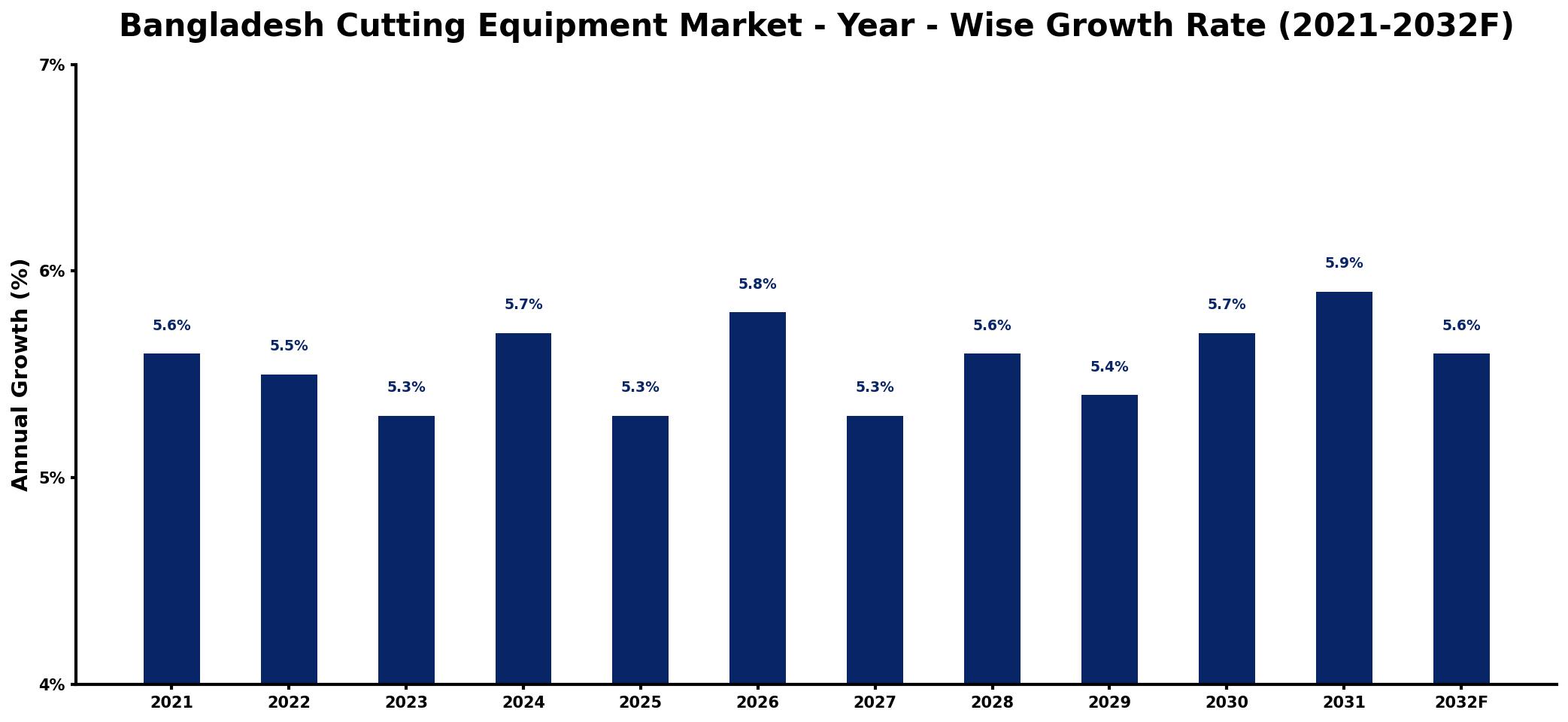
The table below presents the year‑wise growth rates along with the key drivers influencing the market
| Year | Growth Rate | Major Drivers |
| 2021 | 5.6% | Growing construction sector demands tools |
| 2022 | 5.5% | Increased manufacturing output driving sales |
| 2023 | 5.3% | Rising demand in automotive industry |
| 2024 | 5.7% | Expansion of infrastructure projects underway |
| 2025 | 5.3% | Surge in consumer electronics production |
| 2026 | 5.8% | Investments in renewable energy initiatives |
| 2027 | 5.3% | Uptrend in agricultural mechanization efforts |
| 2028 | 5.6% | Boost in export-oriented manufacturing activities |
| 2029 | 5.4% | Technological advancements enhancing productivity |
| 2030 | 5.7% | Growing focus on sustainable practices |
| 2031 | 5.9% | Rising urbanization creating new opportunities |
| 2032 | 5.6% | Increased government spending on infrastructure |
Note: Market size estimations and growth projections presented in this report are based on 6Wresearch's proprietary forecasting methodology, utilizing the latest available industry data, government publications, and primary research inputs.
Bangladesh Cutting Equipment Market Synopsis
The strongest force shaping the Bangladesh Cutting Equipment Market is the increasing demand for high-quality cutting tools driven by the burgeoning manufacturing sector. Industries such as automotive, metal fabrication, and woodworking are experiencing heightened activity, fueling the need for advanced cutting equipment.
As the government continues to prioritize infrastructural advancements and industrialization, businesses are increasingly investing in cutting-edge machinery to maintain competitive advantages. This paradigm shift toward precision and automation is significantly influencing market dynamics, creating opportunities for both local production and importation of innovative cutting tools.
Bangladesh Cutting Equipment Market Key Takeaways
- The market is expanding due to the rapid growth of the manufacturing and construction sectors.
- Government policies are favoring industrial development, resulting in increased investment in cutting technologies.
- There is a rising trend towards automation, enhancing efficiency and productivity in operations.
- Key challenges include access to advanced technology and a shortage of skilled technicians.
- Growth in demand for precision tools across various industries is driving market opportunities.
Evaluation of Restraints in Bangladesh Cutting Equipment Market
Despite its growth potential, the Bangladesh Cutting Equipment Market faces significant restraints. One of the primary concerns is the limited availability of advanced technology, which can hinder operational efficiencies. Many companies, particularly smaller enterprises, struggle to afford the latest cutting equipment due to financial constraints. Furthermore, the industry grapples with a skills gap; there is a notable shortage of trained technicians capable of operating and maintaining sophisticated machinery, which could slow the adoption rate of these essential tools.
Bangladesh Cutting Equipment Market Trends
Current trends indicate a strong shift towards automation in cutting equipment, driven by the need for increased efficiency and reduced operational costs. Manufacturers are increasingly incorporating smart technologies into their machinery, enabling better precision and control during operations. Additionally, sustainable practices are becoming more prevalent, with companies seeking environmentally friendly solutions that can reduce waste and energy consumption.
Moreover, there is a growing interest in customizable cutting solutions that cater specifically to the unique demands of various industries. This trend underscores the need for manufacturers to innovate and provide specialized products that can meet the diverse needs of the market.
Bangladesh Cutting Equipment Market Opportunities
The Bangladesh Cutting Equipment Market presents significant growth and investment opportunities, particularly in sectors like automotive and construction. As companies seek to upgrade their equipment for better efficiency, there is a rising demand for high-precision tools that can enhance productivity. Additionally, potential partnerships with international suppliers could bolster technology transfer and bring advanced machinery to the market. This, combined with ongoing government support for industrial development, creates a conducive environment for growth.
Government Initiatives in the Bangladesh Cutting Equipment Market
The government of Bangladesh has implemented various initiatives to stimulate industrial growth and attract foreign investment. Programs aimed at enhancing infrastructure and easing regulatory barriers are encouraging businesses to invest in advanced cutting equipment. Furthermore, policies that support technological innovation are essential for helping local manufacturers compete on a global scale, ensuring that they can meet the rising demands of domestic and international markets.
Future Insights of the Bangladesh Cutting Equipment Market
Looking ahead, the Bangladesh Cutting Equipment Market is poised for notable advancements as automation and smart technologies become more integrated into manufacturing processes. Between 2026 and 2032, we can expect a pronounced shift towards more efficient, customizable equipment that meets the evolving needs of industries. The alignment of government policies with industrial aspirations will likely further enhance market stability, attracting both local and foreign investments that foster innovation and growth.
Bangladesh Cutting Equipment Market Latest Developments (2025 - 2026)
Recent developments in the Bangladesh Cutting Equipment Market indicate a growing emphasis on technological integration and automation. Companies are increasingly showcasing advanced cutting technologies at local trade expos, reflecting the market's readiness to adopt smarter solutions. Furthermore, collaborations between local firms and international technology providers are becoming more frequent, signaling a positive trend toward enhanced capabilities in cutting machinery.
Bangladesh Cutting Equipment Market - Key Attractiveness of the Report
- 10 Years of Market Numbers
- Historical Data Starting from 2022 to 2025
- Base Year: 2025
- Forecast Data until 2032
- Key Performance Indicators Impacting the Market
- Major Upcoming Developments and Projects
Key Highlights of the Report:
- Bangladesh Cutting Equipment Market Outlook
- Market Size of Bangladesh Cutting Equipment Market, 2025
- Forecast of Bangladesh Cutting Equipment Market, 2032
- Historical Data and Forecast of Bangladesh Cutting Equipment Revenues & Volume for the Period 2022-2032F
- Bangladesh Cutting Equipment Market Trend Evolution
- Bangladesh Cutting Equipment Market Drivers and Challenges
- Bangladesh Cutting Equipment Price Trends
- Bangladesh Cutting Equipment Porter's Five Forces
- Bangladesh Cutting Equipment Industry Life Cycle
- Historical Data and Forecast of Bangladesh Cutting Equipment Market Revenues & Volume By Equipment Type for the Period 2022-2032F
- Historical Data and Forecast of Bangladesh Cutting Equipment Market Revenues & Volume By Manual for the Period 2022-2032F
- Historical Data and Forecast of Bangladesh Cutting Equipment Market Revenues & Volume By Mechanized for the Period 2022-2032F
- Historical Data and Forecast of Bangladesh Cutting Equipment Market Revenues & Volume By Cutting Technology for the Period 2022-2032F
- Historical Data and Forecast of Bangladesh Cutting Equipment Market Revenues & Volume By Plasma cutting for the Period 2022-2032F
- Historical Data and Forecast of Bangladesh Cutting Equipment Market Revenues & Volume By Oxy-fuel cutting for the Period 2022-2032F
- Historical Data and Forecast of Bangladesh Cutting Equipment Market Revenues & Volume By Laser cutting for the Period 2022-2032F
- Historical Data and Forecast of Bangladesh Cutting Equipment Market Revenues & Volume By Waterjet cutting for the Period 2022-2032F
- Historical Data and Forecast of Bangladesh Cutting Equipment Market Revenues & Volume By Carbon arc cutting for the Period 2022-2032F
- Historical Data and Forecast of Bangladesh Cutting Equipment Market Revenues & Volume By End Use Industry for the Period 2022-2032F
- Historical Data and Forecast of Bangladesh Cutting Equipment Market Revenues & Volume By Construction for the Period 2022-2032F
- Historical Data and Forecast of Bangladesh Cutting Equipment Market Revenues & Volume By Heavy metal fabrication for the Period 2022-2032F
- Historical Data and Forecast of Bangladesh Cutting Equipment Market Revenues & Volume By Shipbuilding & offshore for the Period 2022-2032F
- Historical Data and Forecast of Bangladesh Cutting Equipment Market Revenues & Volume By Automotive for the Period 2022-2032F
- Historical Data and Forecast of Bangladesh Cutting Equipment Market Revenues & Volume By Others for the Period 2022-2032F
- Historical Data and Forecast of Bangladesh Cutting Equipment Market Revenues & Volume By Type for the Period 2022-2032F
- Historical Data and Forecast of Bangladesh Cutting Equipment Market Revenues & Volume By Equipment for the Period 2022-2032F
- Historical Data and Forecast of Bangladesh Cutting Equipment Market Revenues & Volume By Consumables/Accessories for the Period 2022-2032F
- Bangladesh Cutting Equipment Import Export Trade Statistics
- Market Opportunity Assessment By Equipment Type
- Market Opportunity Assessment By Cutting Technology
- Market Opportunity Assessment By End Use Industry
- Market Opportunity Assessment By Type
- Bangladesh Cutting Equipment Top Companies Market Share
- Bangladesh Cutting Equipment Competitive Benchmarking By Technical and Operational Parameters
- Bangladesh Cutting Equipment Company Profiles
- Bangladesh Cutting Equipment Key Strategic Recommendations






































