Estonia Cutting Equipment Market Top 5 Importing Countries and Market Competition (HHI) Analysis
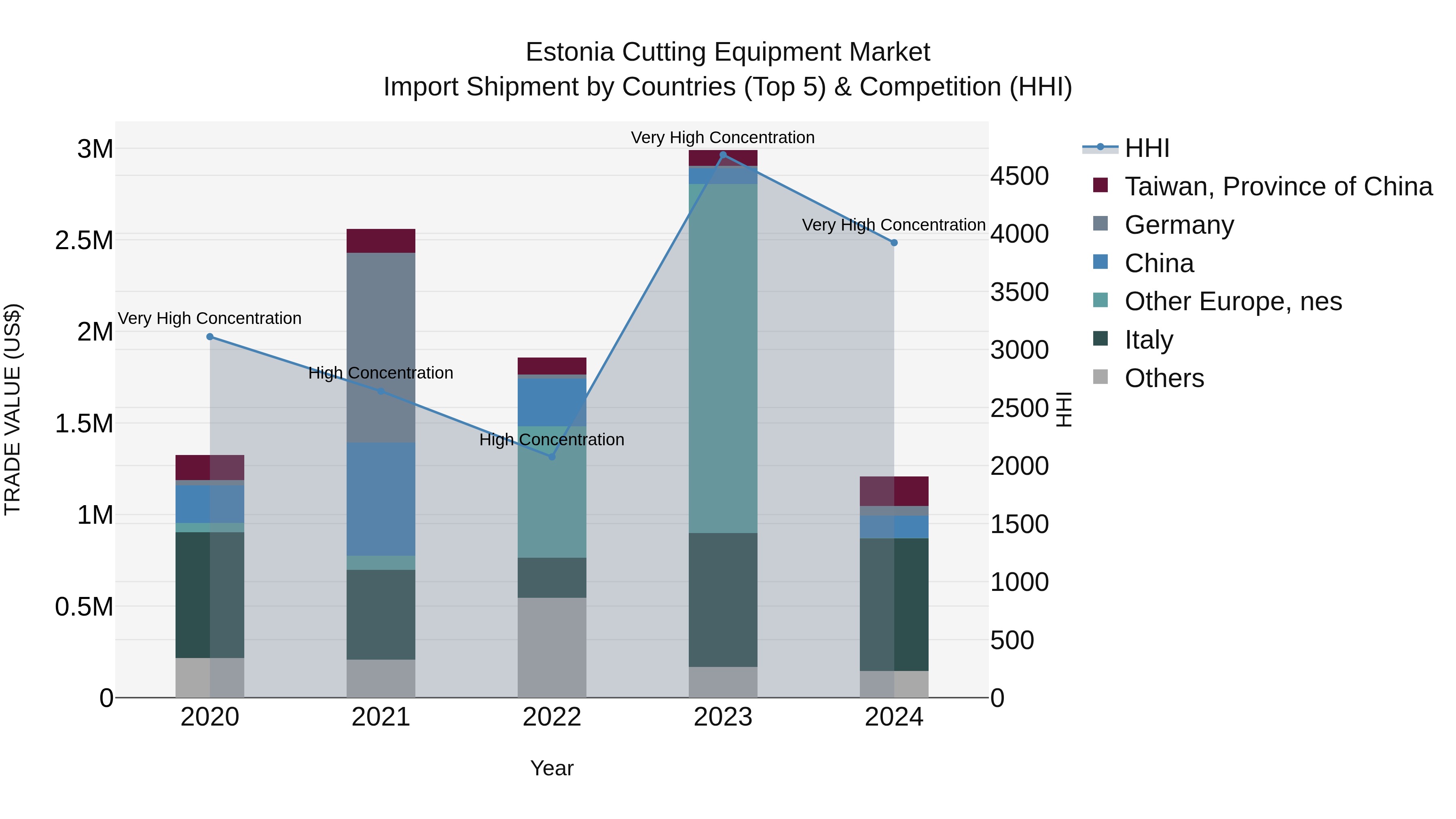
Estonia`s cutting equipment import market in 2024 saw significant contributions from top exporters like Italy, Taiwan, China, Czechia, and Germany. Despite the negative CAGR from 2020-24, the market remained highly concentrated with a notable decrease in growth rate from 2023-24. This data suggests a competitive landscape with potential challenges for importers and opportunities for market players to adapt and innovate in response to the changing market dynamics.
Estonia Cutting Equipment Market Overview
The cutting equipment market in Estonia is experiencing growth as industries such as manufacturing, construction, and automotive seek more advanced and efficient cutting solutions. Cutting equipment includes tools and machines used to cut various materials like metal, wood, and plastic. With the rise in industrial automation and the demand for higher precision in manufacturing processes, Estonias cutting equipment market is expected to grow. This market will benefit from innovations in automated cutting systems, which increase productivity and reduce material waste, aligning with the country`s broader goals of efficiency and sustainability.
Drivers of the market
The cutting equipment market in Estonia is driven by the increasing demand from industries such as construction, automotive, and manufacturing, where precision cutting tools are essential. The growth of automation and the need for high-precision cutting in various manufacturing processes is pushing the demand for advanced cutting equipment. Moreover, innovations in cutting technology, such as laser and waterjet cutting systems, are improving efficiency and accuracy, further driving the market. The rise in demand for custom-made products also contributes to the growth of cutting equipment used in specialized manufacturing processes.
Challenges of the market
The Estonia Cutting Equipment Market faces challenges related to technological advancements, automation, and the need for precise, high-quality tools. As industries such as manufacturing, construction, and textiles require more advanced cutting technologies, the demand for high-performance equipment increases. However, these cutting-edge solutions can be expensive, especially for smaller companies with limited budgets. Additionally, the market is affected by fluctuating raw material costs, which can drive up the cost of cutting equipment. There is also a growing demand for eco-friendly solutions in the cutting process, which challenges manufacturers to create tools that are energy-efficient and have a minimal environmental impact.
Government Policy of the market
The government supports the industrial sector by offering subsidies for the development and modernization of cutting equipment. Policies aim to improve energy efficiency and precision in manufacturing processes.
Key Highlights of the Report:
- Estonia Cutting Equipment Market Outlook
- Market Size of Estonia Cutting Equipment Market, 2024
- Forecast of Estonia Cutting Equipment Market, 2031
- Historical Data and Forecast of Estonia Cutting Equipment Revenues & Volume for the Period 2021-2031
- Estonia Cutting Equipment Market Trend Evolution
- Estonia Cutting Equipment Market Drivers and Challenges
- Estonia Cutting Equipment Price Trends
- Estonia Cutting Equipment Porter`s Five Forces
- Estonia Cutting Equipment Industry Life Cycle
- Historical Data and Forecast of Estonia Cutting Equipment Market Revenues & Volume By Equipment Type for the Period 2021-2031
- Historical Data and Forecast of Estonia Cutting Equipment Market Revenues & Volume By Manual for the Period 2021-2031
- Historical Data and Forecast of Estonia Cutting Equipment Market Revenues & Volume By Mechanized for the Period 2021-2031
- Historical Data and Forecast of Estonia Cutting Equipment Market Revenues & Volume By Cutting Technology for the Period 2021-2031
- Historical Data and Forecast of Estonia Cutting Equipment Market Revenues & Volume By Plasma cutting for the Period 2021-2031
- Historical Data and Forecast of Estonia Cutting Equipment Market Revenues & Volume By Oxy-fuel cutting for the Period 2021-2031
- Historical Data and Forecast of Estonia Cutting Equipment Market Revenues & Volume By Laser cutting for the Period 2021-2031
- Historical Data and Forecast of Estonia Cutting Equipment Market Revenues & Volume By Waterjet cutting for the Period 2021-2031
- Historical Data and Forecast of Estonia Cutting Equipment Market Revenues & Volume By Carbon arc cutting for the Period 2021-2031
- Historical Data and Forecast of Estonia Cutting Equipment Market Revenues & Volume By End Use Industry for the Period 2021-2031
- Historical Data and Forecast of Estonia Cutting Equipment Market Revenues & Volume By Construction for the Period 2021-2031
- Historical Data and Forecast of Estonia Cutting Equipment Market Revenues & Volume By Heavy metal fabrication for the Period 2021-2031
- Historical Data and Forecast of Estonia Cutting Equipment Market Revenues & Volume By Shipbuilding & offshore for the Period 2021-2031
- Historical Data and Forecast of Estonia Cutting Equipment Market Revenues & Volume By Automotive for the Period 2021-2031
- Historical Data and Forecast of Estonia Cutting Equipment Market Revenues & Volume By Others for the Period 2021-2031
- Historical Data and Forecast of Estonia Cutting Equipment Market Revenues & Volume By Type for the Period 2021-2031
- Historical Data and Forecast of Estonia Cutting Equipment Market Revenues & Volume By Equipment for the Period 2021-2031
- Historical Data and Forecast of Estonia Cutting Equipment Market Revenues & Volume By Consumables/Accessories for the Period 2021-2031
- Estonia Cutting Equipment Import Export Trade Statistics
- Market Opportunity Assessment By Equipment Type
- Market Opportunity Assessment By Cutting Technology
- Market Opportunity Assessment By End Use Industry
- Market Opportunity Assessment By Type
- Estonia Cutting Equipment Top Companies Market Share
- Estonia Cutting Equipment Competitive Benchmarking By Technical and Operational Parameters
- Estonia Cutting Equipment Company Profiles
- Estonia Cutting Equipment Key Strategic Recommendations






































