Bangladesh Drill Pipe Market Size, Share & Growth Rate
The Bangladesh Drill Pipe Market was estimated at USD 273 Million in 2025 and is projected to reach USD 368 Million by 2032, growing at a CAGR of 4.4% from 2026 to 2032. This growth trajectory is primarily fueled by an increase in oil and gas exploration activities, both onshore and offshore. The government's commitment to boosting domestic production and the rising investments in energy infrastructure further underpin this expanding market.
Bangladesh Drill Pipe Market Year-wise Growth Rate and Key Drivers
This graph highlights how the Bangladesh Drill Pipe Market has steadily grown over the years, supported by major growth factors.
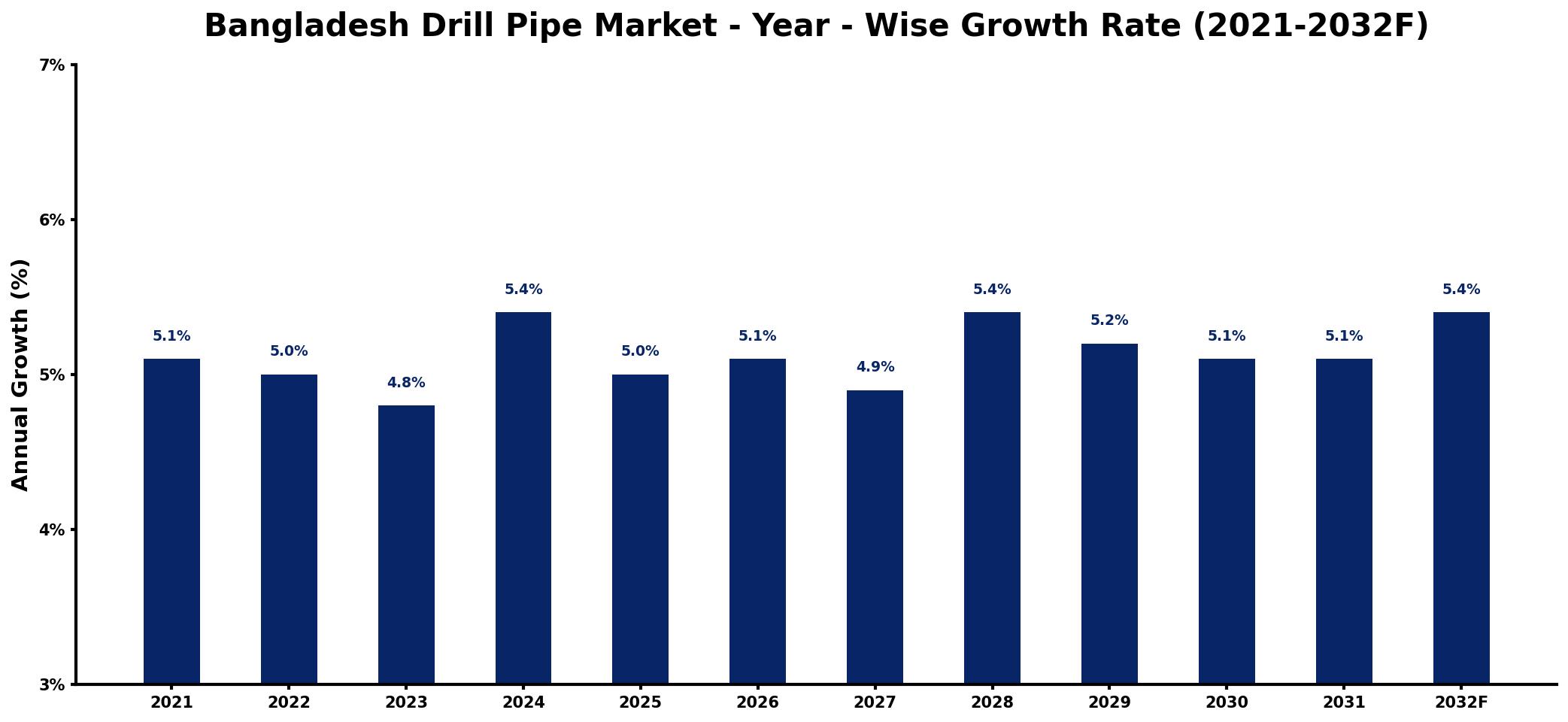
The table below presents the year‑wise growth rates along with the key drivers influencing the market
| Year | Growth Rate | Major Drivers |
| 2021 | 5.1% | Increased infrastructure development projects |
| 2022 | 5.0% | Rising energy sector investments |
| 2023 | 4.8% | Growing industrial manufacturing activities |
| 2024 | 5.4% | Expansion of oil exploration initiatives |
| 2025 | 5.0% | Strengthening mining operations demand |
| 2026 | 5.1% | Boosting renewable energy projects |
| 2027 | 4.9% | Increased construction sector growth |
| 2028 | 5.4% | Enhancing transportation infrastructure investments |
| 2029 | 5.2% | Growing urbanization and population |
| 2030 | 5.1% | Rising foreign direct investments |
| 2031 | 5.1% | Strengthening domestic production capabilities |
| 2032 | 5.4% | Expanding regional trade agreements |
Note: Market size estimations and growth projections presented in this report are based on 6Wresearch's proprietary forecasting methodology, utilizing the latest available industry data, government publications, and primary research inputs.
Bangladesh Drill Pipe Market Synopsis
The Bangladesh drill pipe market has recently gained momentum, reflecting the surge in energy demands and exploration activities. As the market evolves, it is poised for significant expansion due to favorable government policies aimed at enhancing the oil and gas sector.
In the coming years, Bangladesh will likely experience continued growth in drilling operations. This development will not only enhance the local oil and gas output but will also attract investments in advanced technologies to further optimize drilling efficiency and reduce operational costs.
Bangladesh Drill Pipe Market Key Takeaways
- The market is set for a robust CAGR of 4.4%, reflecting an upward trend in oil and gas exploration.
- Government initiatives are driving domestic oil and gas production, enhancing local demand for drill pipes.
- Technological advancements are central to improving efficiency and sustainability in drilling operations.
- Investment in energy infrastructure presents lucrative opportunities for drill pipe manufacturers and suppliers.
- Collaboration among industry stakeholders is fostering innovation and skills development within the market.
Evaluation of Restraints in Bangladesh Drill Pipe Market
Despite its growth potential, the Bangladesh Drill Pipe Market faces several significant restraints. Limited access to advanced technologies and equipment can hinder operational efficiency, while inadequate infrastructure poses challenges for timely drilling operations. Furthermore, the shortage of skilled manpower adds another layer of complexity, potentially slowing down the pace of market development. Companies must also navigate regulatory hurdles and obtain necessary permits, which can delay project timelines. Addressing these issues is critical for realizing the market's full potential and ensuring a sustainable growth environment.
Bangladesh Drill Pipe Market Trends
Currently, the market is witnessing a pronounced shift towards adopting advanced drilling technologies designed to enhance operational efficiency while reducing costs. Companies are increasingly investing in environmentally friendly drilling solutions to align with global sustainability trends. This growing emphasis on innovation is prompting players to develop advanced drill pipe materials and designs that perform effectively in challenging environments. Additionally, collaborations within the industry are promoting technology transfer and the development of skilled labor, which will be crucial in shaping the future of the market.
Bangladesh Drill Pipe Market Opportunities
The ongoing exploration and production activities in Bangladesh present significant investment opportunities within the drill pipe market. There is a substantial demand for high-quality drill pipes driven by increased energy needs and government initiatives. Companies that focus on manufacturing or supplying drill pipes can tap into this expanding market. Furthermore, advancements in drilling technologies and the potential for untapped offshore resources enhance the prospects for growth and profitability. Strategic partnerships with local firms or involvement in government-led projects may provide an advantageous entry point for investors.
Government Initiatives in the Bangladesh Drill Pipe Market
The Bangladeshi government is actively pursuing policies to bolster domestic manufacturing and reduce reliance on imported drill pipes. Incentives such as tax breaks and subsidies are being offered to local manufacturers, aimed at fostering a competitive environment. The government also imposes tariffs on imported drill pipes to protect domestic industries and encourages R&D initiatives in the oil and gas sector to drive innovation. These policies are designed to create a self-sufficient market while enhancing the overall economic landscape.
Future Insights of the Bangladesh Drill Pipe Market
Looking ahead to 2026-2032, the Bangladesh Drill Pipe Market is poised for sustained growth, driven by continued exploration and production activities. The government's efforts to attract foreign investment and improve the energy infrastructure will likely foster an environment conducive to market expansion. Moreover, the discovery of new reserves and advances in drilling technology are expected to create additional demand for drill pipes. As the market evolves, both domestic and international manufacturers and suppliers will find a wealth of opportunities to engage with.
Bangladesh Drill Pipe Market Latest Developments (2025 - 2026)
Recent developments in the Bangladesh drill pipe market reflect a strong commitment to enhancing operational capabilities. There has been a noticeable push towards adopting new technologies that improve drilling efficiency and sustainability. In addition, collaboration initiatives between public and private sectors are increasingly focused on training programs aimed at addressing skill gaps in the workforce. Overall, these trends signal an optimistic outlook for the market as stakeholders work together to capitalize on emerging opportunities.
Bangladesh Drill Pipe Market - Key Attractiveness of the Report
- 10 Years of Market Numbers
- Historical Data Starting from 2022 to 2025
- Base Year: 2025
- Forecast Data until 2032
- Key Performance Indicators Impacting the Market
- Major Upcoming Developments and Projects
Key Highlights of the Report:
- Bangladesh Drill Pipe Market Outlook
- Market Size of Bangladesh Drill Pipe Market, 2025
- Forecast of Bangladesh Drill Pipe Market, 2032
- Historical Data and Forecast of Bangladesh Drill Pipe Revenues & Volume for the Period 2022-2032F
- Bangladesh Drill Pipe Market Trend Evolution
- Bangladesh Drill Pipe Market Drivers and Challenges
- Bangladesh Drill Pipe Price Trends
- Bangladesh Drill Pipe Porter's Five Forces
- Bangladesh Drill Pipe Industry Life Cycle
- Historical Data and Forecast of Bangladesh Drill Pipe Market Revenues & Volume By Type for the Period 2022-2032F
- Historical Data and Forecast of Bangladesh Drill Pipe Market Revenues & Volume By Standard Drill Pipe for the Period 2022-2032F
- Historical Data and Forecast of Bangladesh Drill Pipe Market Revenues & Volume By Heavy Weight Drill Pipe for the Period 2022-2032F
- Historical Data and Forecast of Bangladesh Drill Pipe Market Revenues & Volume By Drill Collar for the Period 2022-2032F
- Historical Data and Forecast of Bangladesh Drill Pipe Market Revenues & Volume By Deployment for the Period 2022-2032F
- Historical Data and Forecast of Bangladesh Drill Pipe Market Revenues & Volume By Onshore for the Period 2022-2032F
- Historical Data and Forecast of Bangladesh Drill Pipe Market Revenues & Volume By Offshore for the Period 2022-2032F
- Bangladesh Drill Pipe Import Export Trade Statistics
- Market Opportunity Assessment By Type
- Market Opportunity Assessment By Deployment
- Bangladesh Drill Pipe Top Companies Market Share
- Bangladesh Drill Pipe Competitive Benchmarking By Technical and Operational Parameters
- Bangladesh Drill Pipe Company Profiles
- Bangladesh Drill Pipe Key Strategic Recommendations






































