Bangladesh Education and Learning Analytics Market (2026-2032) Outlook | Analysis, Growth, Forecast, Share, Value, Industry, Companies, Trends, Size, Revenue
Market Forecast By Application (People Acquisition and Retention, Curriculum Development and Intervention Management, Performance Management, Budget and Finance Management, Operations Management, Others), By Components (Software, Services), By Deployment Model (On-premises, Cloud), By End User (Academic, Enterprise/corporate) And Competitive Landscape
| Product Code: ETC4397553 | Publication Date: Jul 2023 | Updated Date: Jul 2026 | Product Type: Report | |
| Publisher: 6Wresearch | Author: Vasudha | No. of Pages: 85 | No. of Figures: 45 | No. of Tables: 25 |
Bangladesh Education and Learning Analytics Market Size & Growth Rate (2026-2032)
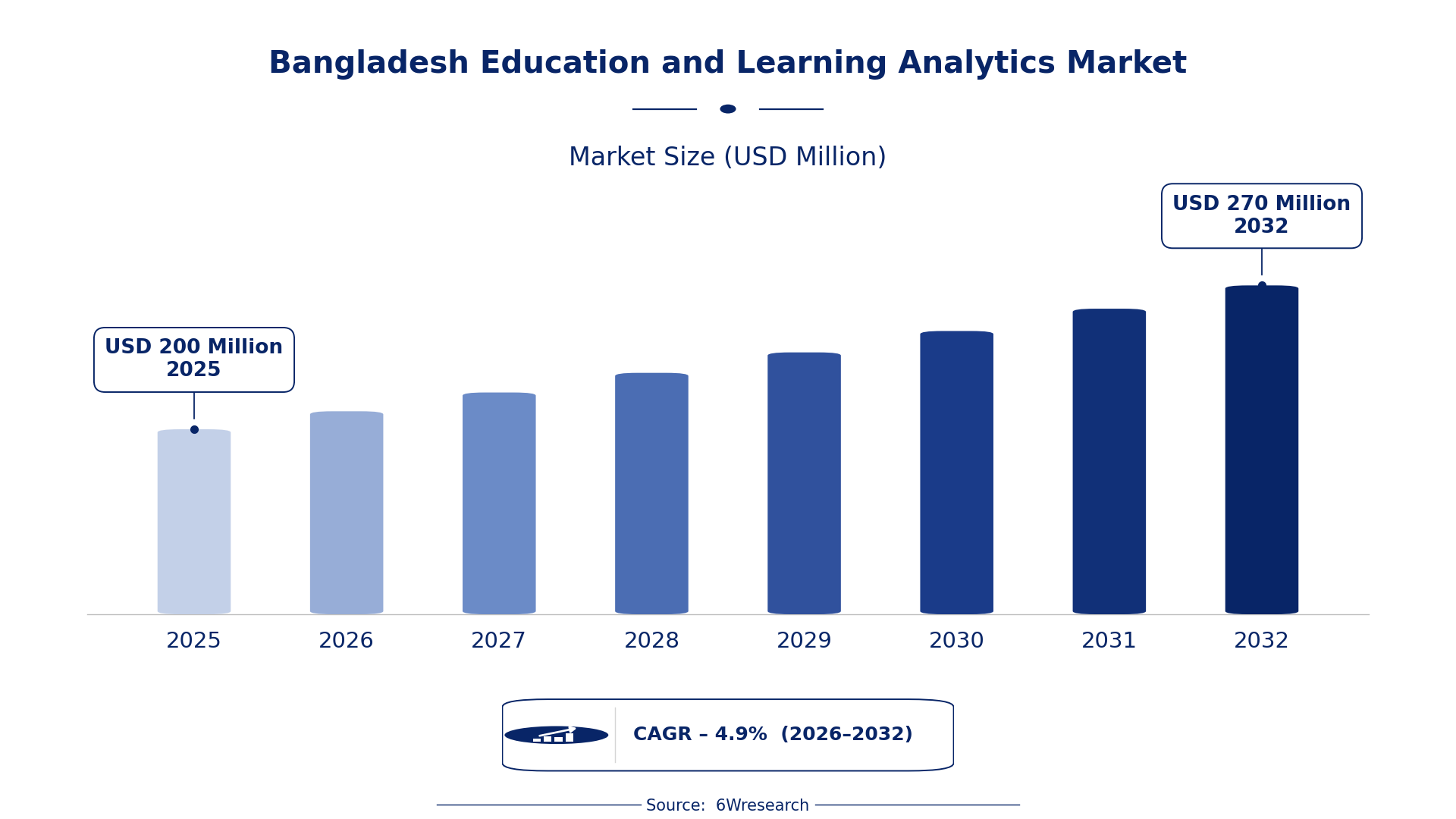
The Bangladesh Education and Learning Analytics Market was estimated at USD 200 Million in 2025 and is projected to reach USD 270 Million by 2032, growing at a CAGR of 5.1% from 2026 to 2032.
Bangladesh Education and Learning Analytics Market Synopsis
The Bangladesh Education and Learning Analytics Market is on an upward trajectory, driven by a surge in digital integration within educational institutions. While recent developments have laid a solid foundation, the market is gearing up for an acceleration in growth as more stakeholders embrace data analytics to refine educational strategies.
As schools and universities increasingly recognize the value of data-driven insights, the focus is shifting towards enhancing student performance and optimizing teaching methodologies. This shift not only signals a commitment to improving educational outcomes but also paves the way for innovative solutions tailored to the unique needs of the Bangladeshi education sector.
Bangladesh Education and Learning Analytics Market Year-wise Growth Rate and Key Drivers
This graph highlights how the Bangladesh Education and Learning Analytics Market has steadily grown over the past five years, supported by major growth factors.
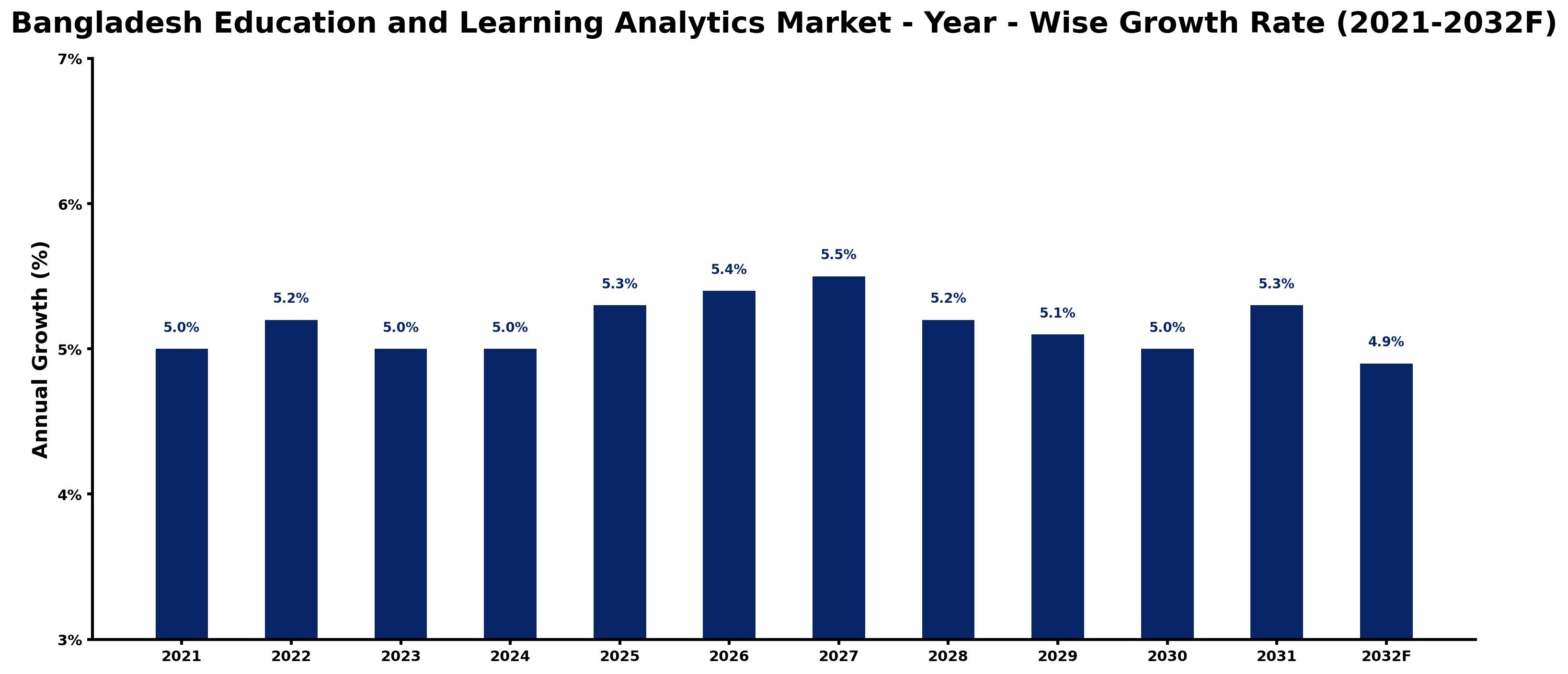
The table below presents the year‑wise growth rates along with the key drivers influencing the market
| Year | Growth Rate | Major Drivers |
| 2021 | 5.0% | Government initiatives promoting digital literacy in schools |
| 2022 | 5.2% | Rise of edtech startups enhancing learning experiences |
| 2023 | 5.0% | Increased funding for educational technology integration |
| 2024 | 5.0% | Focus on personalized learning through data analytics |
| 2025 | 5.3% | Youth population driving demand for tailored learning solutions |
| 2026 | 5.4% | Partnerships with NGOs to improve educational access |
| 2027 | 5.5% | Government policy supporting STEM education advancements |
| 2028 | 5.2% | Growing interest in skill-based learning programs |
| 2029 | 5.1% | Increased awareness of data analytics in education |
| 2030 | 5.0% | Emergence of AI-driven tools for student assessments |
| 2031 | 5.3% | Collaboration with international organizations for educational reform |
| 2032 | 4.9% | Focus on curriculum diversification through data insights |
Note: Market size estimations and growth projections presented in this report are based on 6Wresearch's proprietary forecasting methodology, utilizing the latest available industry data, government publications, and primary research inputs.
Bangladesh Education and Learning Analytics Market Key Takeaways
Below are some of the specific key takeaways from the market, including:
- The market is experiencing a notable shift towards personalized learning through data analytics.
- Government initiatives are crucial in promoting digital education and learning analytics adoption.
- Demand for advanced analytics tools is increasing, particularly in tracking student progress and performance.
- Collaboration between educational institutions and technology providers is becoming more common.
- Challenges such as data privacy and infrastructure inadequacies remain significant barriers.
Evaluation of Restraints in Bangladesh Education and Learning Analytics Market
Several obstacles are hindering the growth of the Bangladesh Education and Learning Analytics Market. Limited access to quality data is a primary concern, stemming from insufficient infrastructure for effective data collection and management. This is compounded by a lack of standardized data-sharing processes among educational institutions, which can inhibit collaboration and the sharing of insights.
on top of that, there is a glaring shortage of skilled professionals capable of analyzing and interpreting educational data. This talent gap presents a significant hurdle for institutions aiming to implement effective analytics solutions. Privacy concerns and data security issues further complicate the landscape, making it imperative for stakeholders to invest in robust governance frameworks to protect sensitive information.
Bangladesh Education and Learning Analytics Market Trends
Current trends indicate a strong push towards the integration of artificial intelligence and machine learning in educational analytics. Institutions are increasingly seeking tools that not only track performance but also predict outcomes based on historical data. This predictive analytics capability is becoming essential for tailoring learning experiences to individual student needs.
Additionally, the rise of e-learning platforms is further fueling demand for analytics solutions. As remote and hybrid learning models gain traction, educational institutions are investing in technologies that can provide insights into engagement levels and learning effectiveness.
Bangladesh Education and Learning Analytics Market Opportunities
The market is ripe for innovation, particularly in the development of AI-powered learning platforms that enhance personalization in education. There is also significant potential in creating predictive analytics models that can provide actionable insights for educators.
Partnerships between technology providers and educational institutions offer another avenue for growth, enabling tailored solutions that address the specific challenges faced by the Bangladeshi education system. Investing in infrastructure and data literacy training will be crucial in unlocking the market's full potential.
Government Initiatives in the Bangladesh Education and Learning Analytics Market
Government policy is playing a vital role in shaping the Bangladesh Education and Learning Analytics Market. With an emphasis on digital education and technology integration, public-sector initiatives are paving the way for a more data-driven approach to learning. These policies not only facilitate the adoption of analytics solutions but also aim to enhance overall educational quality.
- A recently completed initiative focused on upgrading digital infrastructure in schools to support data collection and analytics.
- Currently ongoing programs aim to promote digital literacy among educators, enabling them to effectively utilize learning analytics tools.
- A planned public-private initiative is expected to enhance access to digital educational resources by 2027.
- The Digital Bangladesh Vision emphasizes integrating technology into education to foster innovative teaching methods and improve student outcomes.
- New policies are being developed to create standardized frameworks for data governance and privacy protection in educational settings.
Future Insights of the Bangladesh Education and Learning Analytics Market
Looking ahead to 2026-2032, the Bangladesh Education and Learning Analytics Market is set to expand significantly as institutions increasingly recognize the value of data analytics. The emphasis on personalized learning and predictive analytics will drive demand for innovative solutions, reshaping how educators approach teaching and assessment.
As government initiatives continue to support digital education, the market will likely see a surge in investments aimed at enhancing data capabilities. This momentum will create a fertile ground for technological advancements and partnerships that can lead to improved educational outcomes nationwide.
Bangladesh Education and Learning Analytics Market Latest Developments
In the past year, the Bangladesh Education and Learning Analytics Market has witnessed a flurry of activity, reflecting a growing commitment to harnessing data for educational improvement. Institutions are increasingly adopting learning analytics tools, driven by the need for better insights into student performance and engagement.
- A major technology vendor launched a new analytics platform tailored for educational institutions, aimed at enhancing student performance tracking, in early 2025.
- An initiative began in mid-2025 to integrate learning analytics into the curricula of selected universities, which remains underway.
- A partnership between several educational institutions and tech providers is expected to roll out a comprehensive data analytics training program for educators by late 2026.
- By Q3 2025, a pilot program focused on using predictive analytics for student retention strategies will be initiated in several colleges.
Bangladesh Education and Learning Analytics Market - Key Attractiveness of the Report
- 10 Years of Market Numbers
- Historical Data Starting from 2022 to 2025
- Base Year: 2025
- Forecast Data until 2032
- Key Performance Indicators Impacting the Market
- Major Upcoming Developments and Projects
Key Highlights of the Report:
- Bangladesh Education and Learning Analytics Market Outlook
- Market Size of Bangladesh Education and Learning Analytics Market, 2025
- Forecast of Bangladesh Education and Learning Analytics Market, 2032
- Historical Data and Forecast of Bangladesh Education and Learning Analytics Revenues & Volume for the Period 2022-2032F
- Bangladesh Education and Learning Analytics Market Trend Evolution
- Bangladesh Education and Learning Analytics Market Drivers and Challenges
- Bangladesh Education and Learning Analytics Price Trends
- Bangladesh Education and Learning Analytics Porter's Five Forces
- Bangladesh Education and Learning Analytics Industry Life Cycle
- Historical Data and Forecast of Bangladesh Education and Learning Analytics Market Revenues & Volume By Application for the Period 2022-2032F
- Historical Data and Forecast of Bangladesh Education and Learning Analytics Market Revenues & Volume By People Acquisition and Retention for the Period 2022-2032F
- Historical Data and Forecast of Bangladesh Education and Learning Analytics Market Revenues & Volume By Curriculum Development and Intervention Management for the Period 2022-2032F
- Historical Data and Forecast of Bangladesh Education and Learning Analytics Market Revenues & Volume By Performance Management for the Period 2022-2032F
- Historical Data and Forecast of Bangladesh Education and Learning Analytics Market Revenues & Volume By Budget and Finance Management for the Period 2022-2032F
- Historical Data and Forecast of Bangladesh Education and Learning Analytics Market Revenues & Volume By Operations Management for the Period 2022-2032F
- Historical Data and Forecast of Bangladesh Education and Learning Analytics Market Revenues & Volume By Others for the Period 2022-2032F
- Historical Data and Forecast of Bangladesh Education and Learning Analytics Market Revenues & Volume By Components for the Period 2022-2032F
- Historical Data and Forecast of Bangladesh Education and Learning Analytics Market Revenues & Volume By Software for the Period 2022-2032F
- Historical Data and Forecast of Bangladesh Education and Learning Analytics Market Revenues & Volume By Services for the Period 2022-2032F
- Historical Data and Forecast of Bangladesh Education and Learning Analytics Market Revenues & Volume By Deployment Model for the Period 2022-2032F
- Historical Data and Forecast of Bangladesh Education and Learning Analytics Market Revenues & Volume By On-premises for the Period 2022-2032F
- Historical Data and Forecast of Bangladesh Education and Learning Analytics Market Revenues & Volume By Cloud for the Period 2022-2032F
- Historical Data and Forecast of Bangladesh Education and Learning Analytics Market Revenues & Volume By End User for the Period 2022-2032F
- Historical Data and Forecast of Bangladesh Education and Learning Analytics Market Revenues & Volume By Academic for the Period 2022-2032F
- Historical Data and Forecast of Bangladesh Education and Learning Analytics Market Revenues & Volume By Enterprise/corporate for the Period 2022-2032F
- Bangladesh Education and Learning Analytics Import Export Trade Statistics
- Market Opportunity Assessment By Application
- Market Opportunity Assessment By Components
- Market Opportunity Assessment By Deployment Model
- Market Opportunity Assessment By End User
- Bangladesh Education and Learning Analytics Top Companies Market Share
- Bangladesh Education and Learning Analytics Competitive Benchmarking By Technical and Operational Parameters
- Bangladesh Education and Learning Analytics Company Profiles
- Bangladesh Education and Learning Analytics Key Strategic Recommendations
Frequently Asked Questions About the Market Study (FAQs):
The market was estimated at USD 200 Million in 2025 and is projected to reach USD 270 Million by 2032, growing at a CAGR of 5.1% from 2026 to 2032.
Government initiatives focused on digital education and technology integration are crucial for supporting the adoption of learning analytics. Programs aimed at enhancing digital literacy and infrastructure upgrades are creating an environment conducive to market growth.
The integration of AI and machine learning into educational analytics is a key trend. Institutions are increasingly interested in predictive analytics to personalize learning experiences and improve student engagement.
Opportunities lie in developing AI-powered platforms, creating predictive analytics models, and establishing partnerships between tech providers and educational institutions to tailor solutions.
The market faces challenges such as limited access to quality data, a shortage of skilled professionals, and privacy concerns regarding data security, all of which need to be addressed for meaningful progress.
6Wresearch actively monitors the Bangladesh Education and Learning Analytics Market and publishes its comprehensive annual report, highlighting emerging trends, growth drivers, revenue analysis, and forecast outlook. Our insights help businesses to make data-backed strategic decisions with ongoing market dynamics. Our analysts track relevent industries related to the Bangladesh Education and Learning Analytics Market, allowing our clients with actionable intelligence and reliable forecasts tailored to emerging regional needs.
Yes, we provide customisation as per your requirements. To learn more, feel free to contact us on sales@6wresearch.com
1 Executive Summary |
2 Introduction |
2.1 Key Highlights of the Report |
2.2 Report Description |
2.3 Market Scope & Segmentation |
2.4 Research Methodology |
2.5 Assumptions |
3 Bangladesh Education and Learning Analytics Market Overview |
3.1 Bangladesh Country Macro Economic Indicators |
3.2 Bangladesh Education and Learning Analytics Market Revenues & Volume, 2022 & 2032F |
3.3 Bangladesh Education and Learning Analytics Market - Industry Life Cycle |
3.4 Bangladesh Education and Learning Analytics Market - Porter's Five Forces |
3.5 Bangladesh Education and Learning Analytics Market Revenues & Volume Share, By Application , 2022 & 2032F |
3.6 Bangladesh Education and Learning Analytics Market Revenues & Volume Share, By Components, 2022 & 2032F |
3.7 Bangladesh Education and Learning Analytics Market Revenues & Volume Share, By Deployment Model, 2022 & 2032F |
3.8 Bangladesh Education and Learning Analytics Market Revenues & Volume Share, By End User, 2022 & 2032F |
4 Bangladesh Education and Learning Analytics Market Dynamics |
4.1 Impact Analysis |
4.2 Market Drivers |
4.2.1 Increasing demand for personalized learning solutions in the education sector |
4.2.2 Government initiatives to promote digital learning and analytics in education |
4.2.3 Growing adoption of technology in educational institutions |
4.3 Market Restraints |
4.3.1 Limited infrastructure and access to technology in rural areas of Bangladesh |
4.3.2 Data privacy and security concerns related to analytics in education |
4.3.3 Resistance to change and traditional teaching methods in some educational institutions |
5 Bangladesh Education and Learning Analytics Market Trends |
6 Bangladesh Education and Learning Analytics Market, By Types |
6.1 Bangladesh Education and Learning Analytics Market, By Application |
6.1.1 Overview and Analysis |
6.1.2 Bangladesh Education and Learning Analytics Market Revenues & Volume, By Application , 2022-2032F |
6.1.3 Bangladesh Education and Learning Analytics Market Revenues & Volume, By People Acquisition and Retention, 2022-2032F |
6.1.4 Bangladesh Education and Learning Analytics Market Revenues & Volume, By Curriculum Development and Intervention Management, 2022-2032F |
6.1.5 Bangladesh Education and Learning Analytics Market Revenues & Volume, By Performance Management, 2022-2032F |
6.1.6 Bangladesh Education and Learning Analytics Market Revenues & Volume, By Budget and Finance Management, 2022-2032F |
6.1.7 Bangladesh Education and Learning Analytics Market Revenues & Volume, By Operations Management, 2022-2032F |
6.1.8 Bangladesh Education and Learning Analytics Market Revenues & Volume, By Others, 2022-2032F |
6.2 Bangladesh Education and Learning Analytics Market, By Components |
6.2.1 Overview and Analysis |
6.2.2 Bangladesh Education and Learning Analytics Market Revenues & Volume, By Software, 2022-2032F |
6.2.3 Bangladesh Education and Learning Analytics Market Revenues & Volume, By Services, 2022-2032F |
6.3 Bangladesh Education and Learning Analytics Market, By Deployment Model |
6.3.1 Overview and Analysis |
6.3.2 Bangladesh Education and Learning Analytics Market Revenues & Volume, By On-premises, 2022-2032F |
6.3.3 Bangladesh Education and Learning Analytics Market Revenues & Volume, By Cloud, 2022-2032F |
6.4 Bangladesh Education and Learning Analytics Market, By End User |
6.4.1 Overview and Analysis |
6.4.2 Bangladesh Education and Learning Analytics Market Revenues & Volume, By Academic, 2022-2032F |
6.4.3 Bangladesh Education and Learning Analytics Market Revenues & Volume, By Enterprise/corporate, 2022-2032F |
7 Bangladesh Education and Learning Analytics Market Import-Export Trade Statistics |
7.1 Bangladesh Education and Learning Analytics Market Export to Major Countries |
7.2 Bangladesh Education and Learning Analytics Market Imports from Major Countries |
8 Bangladesh Education and Learning Analytics Market Key Performance Indicators |
8.1 Student engagement levels with learning analytics tools |
8.2 Adoption rate of analytics solutions by educational institutions |
8.3 Improvement in academic performance and learning outcomes among students |
9 Bangladesh Education and Learning Analytics Market - Opportunity Assessment |
9.1 Bangladesh Education and Learning Analytics Market Opportunity Assessment, By Application , 2022 & 2032F |
9.2 Bangladesh Education and Learning Analytics Market Opportunity Assessment, By Components, 2022 & 2032F |
9.3 Bangladesh Education and Learning Analytics Market Opportunity Assessment, By Deployment Model, 2022 & 2032F |
9.4 Bangladesh Education and Learning Analytics Market Opportunity Assessment, By End User, 2022 & 2032F |
10 Bangladesh Education and Learning Analytics Market - Competitive Landscape |
10.1 Bangladesh Education and Learning Analytics Market Revenue Share, By Companies, 2025 |
10.2 Bangladesh Education and Learning Analytics Market Competitive Benchmarking, By Operating and Technical Parameters |
11 Company Profiles |
12 Recommendations |
13 Disclaimer |
Global Go To Market Strategy - 2030
Export potential enables firms to identify high-growth global markets with greater confidence by combining advanced trade intelligence with a structured quantitative methodology. The framework analyzes emerging demand trends and country-level import patterns while integrating macroeconomic and trade datasets such as GDP and population forecasts, bilateral import–export flows, tariff structures, elasticity differentials between developed and developing economies, geographic distance, and import demand projections. Using weighted trade values from 2020–2024 as the base period to project country-to-country export potential for 2030, these inputs are operationalized through calculated drivers such as gravity model parameters, tariff impact factors, and projected GDP per-capita growth. Through an analysis of hidden potentials, demand hotspots, and market conditions that are most favorable to success, this method enables firms to focus on target countries, maximize returns, and global expansion with data, backed by accuracy.
By factoring in the projected importer demand gap that is currently unmet and could be potential opportunity, it identifies the potential for the Exporter (Country) among 190 countries, against the general trade analysis, which identifies the biggest importer or exporter.
To discover high-growth global markets and optimize your business strategy:
Click Here
Pricing
- Single User License$ 1,995
- Department License$ 2,400
- Site License$ 3,120
- Global License$ 3,795

Leadership Perspectives from Industry Events
Search
6Wresearch in the News
 Forbes
Citing 6Wresearch analytics to map global infrastructure and pharmaceutical industry trajectories.
 Bloomberg Law
Direct syndication of 6Wresearch's macro data points, capturing complex supply chain shifts.
 Reuters
Tracking industrial manufacturing adjustments and electronic security ecosystem scaling.
 Mint
Mint
Utilizing deep-tech sector market sizing to analyze global automation and robotics.
 The Economic Times
Anchoring features on industrial IoT growth metrics and connected smart-grid devices.
 Business Standard
Featuring strategic evaluations of Advanced Driver Assistance Systems (ADAS) and AI road safety.
 The Hindu
Spotlighting core commercial metrics ranging from unmanned aerial vehicles (UAVs) to consumer durables.
 Financial Express
Anchoring quarterly reviews on cross-border real estate tech and structural hardware manufacturing.
 Yahoo Finance
Syndicating the tracker's $30.1 billion untapped-market findings, spotlighting Japan, the US and China as India's top new-potential importers.
 India Today
Carrying the release on smartphones leading India's export potential to $94 billion by 2031, per 6WExportGTM data.
 Dailyhunt
Distributing the tracker findings to its regional readership, framing India's export diversification into Japan and Mexico.
 PR Newswire Original release
Publishing the full India Export Attractiveness Tracker 2026, detailing new trade corridors across iron ore, LCVs and pharmaceuticals.
 The Industrial
Highlighting the tracker's read on India's semiconductor ambitions and long-term chip-assembly export potential.
 PTI News
Reporting on the $66.81 billion pharmaceuticals export opportunity flagged in the tracker, amid looming US generic-drug tariffs.
 Tribune India
Covering the tracker's tariff-versus-regulation analysis across India's mature export markets in the US, China and UAE.
 ANI News
Amplifying the report's findings on polished diamonds, refined petroleum and medicines as India's core export engines.
 International Business Magazine
Covering the report's insight into how AEB, blind spot detection, and driver monitoring are reshaping India's ADAS market.
 Focus Gaming News
Highlighting the research forecast for Egypt's gambling market, projecting steady growth through 2032.
Thought Leadership and Analyst Meet





Our Clients








Latest Reports
- Poland Engine Ignition Components Market (2026-2032)
- Peru Engine Ignition Components Market (2026-2032)
- Pakistan Engine Ignition Components Market (2026-2032)
- Oman Engine Ignition Components Market (2026-2032)
- Nigeria Engine Ignition Components Market (2026-2032)
- Nepal Engine Ignition Components Market (2026-2032)
- Myanmar Engine Ignition Components Market (2026-2032)
- Morocco Engine Ignition Components Market (2026-2032)
- Mexico Engine Ignition Components Market (2026-2032)
- Malaysia Engine Ignition Components Market (2026-2032)
Industry Events and Analyst Meet

EV India Expo 2026

HIMTEX 2026

India Refining Summit 2026

India EV Show 2026

EV tech India Expo 2026
Whitepaper
- Middle East & Africa Commercial Security Market Click here to view more.
- Middle East & Africa Fire Safety Systems & Equipment Market Click here to view more.
- GCC Drone Market Click here to view more.
- Middle East Lighting Fixture Market Click here to view more.
- GCC Physical & Perimeter Security Market Click here to view more.


