Bangladesh Electrical Equipment Market Summary
The bangladesh electrical equipment market was estimated at USD 232 Million in 2025 and is projected to reach USD 320 Million by 2032, growing at a CAGR of 5.6% from 2026 to 2032.
Bangladesh Electrical Equipment Market Year-wise Growth Rate and Key Drivers
This graph highlights how the Bangladesh Electrical Equipment Market has steadily grown over the past five years, supported by major growth factors.
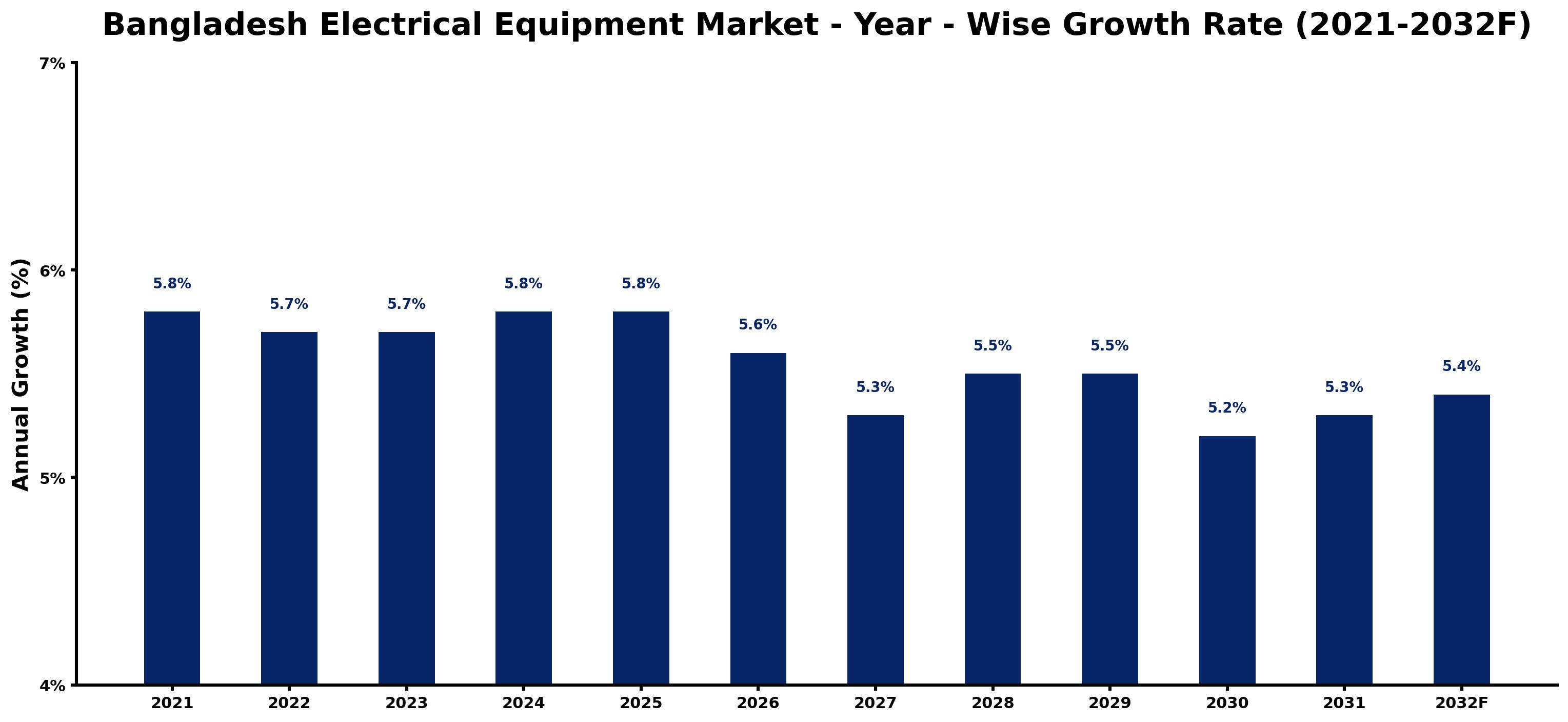
The table below presents the year wise growth rates along with the key drivers influencing the market
| Year | Growth Rate | Major Drivers |
| 2021 | 5.8% | Post-lockdown retail projects sparked increased investments in electrical infrastructure across Bangladesh. |
| 2022 | 5.7% | Legacy copper grid failures highlighted a pressing need for modern electrical solutions nationwide. |
| 2023 | 5.7% | Enterprise budgets prioritizing energy efficiency have led to new product developments in electrical equipment. |
| 2024 | 5.8% | The expansion of the telecommunications sector necessitated enhanced electrical support systems across urban areas. |
| 2025 | 5.8% | Investments in renewable energy sources created new opportunities for advanced electrical technologies. |
| 2026 | 5.6% | Rural electrification programs aimed to bridge the energy gap in underserved regions across Bangladesh. |
| 2027 | 5.3% | Technological innovations in smart grid systems began to reshape electrical distribution networks significantly. |
| 2028 | 5.5% | Growing urbanization prompted a demand for more robust electrical equipment in metropolitan developments. |
| 2029 | 5.5% | Partnerships between local manufacturers and global firms improved product quality and market reach. |
| 2030 | 5.2% | Rising consumer expectations for energy-efficient appliances influenced market trends significantly. |
| 2031 | 5.3% | The construction boom in commercial sectors drove the need for advanced electrical installations. |
| 2032 | 5.4% | Sustainability initiatives among corporations fostered increased interest in eco-friendly electrical solutions. |
Note - Market size estimations and growth projections presented in this report are based on 6Wresearch's advanced forecasting approach, validated with industry datasets as of June 2026.
Bangladesh Electrical Equipment Market Synopsis
The Bangladesh Electrical Equipment Market is projected to reach 5.6% and witness significant growth during the forecast period (2026-2032). The ongoing urbanization and industrial expansion in Bangladesh are major catalysts driving the demand for electrical equipment. This market encompasses various components, including wires and cables, switchgear, lighting products, transformers, and generators. The increasing number of construction projects in both residential and commercial sectors, alongside the growth of industries such as textiles and IT services, is propelling market dynamics. Furthermore, government initiatives aimed at improving overall infrastructure and enhancing electricity access in rural areas are crucial to the continued progress of the market.
Bangladesh Electrical Equipment Market Growth Drivers
The Bangladesh Electrical Equipment Market is significantly influenced by multiple growth drivers:
- The rapid urbanization process in Bangladesh results in heightened demand for efficient electrical installations in new residential and commercial buildings.
- Industrialization is further bolstered by the government's focus on developing sectors like textiles, pharmaceuticals, and IT, all of which require robust electrical infrastructure.
- Ongoing construction projects create a consistent demand for electrical components, particularly in urban centers where infrastructure is rapidly upgrading.
- Government initiatives aimed at enhancing electricity access in rural areas stimulate demand for various electrical equipment, promoting market growth.
- Innovation and competition among local and international manufacturers fuel advancements in product offerings, leading to increased market attractiveness.
Bangladesh Electrical Equipment Market Trends and Opportunities
The market shows notable trends that reflect changing consumer preferences and technological advancements. A significant trend is the increasing demand for energy-efficient and eco-friendly products, arising from a growing emphasis on sustainability. Energy-efficient electrical equipment helps reduce overall power consumption, aligning with global environmental goals.
In addition to energy efficiency, there is a marked shift towards smart technologies within the electrical equipment sector. The deployment of smart meters, automation systems, and advanced sensors is enhancing energy management capabilities across residential and commercial applications. Furthermore, the demand for renewable energy solutions, such as solar panels and wind turbines, is gaining traction, providing investors with opportunities in the burgeoning market segment of renewable electrical technologies.
Bangladesh Electrical Equipment Market Challenges and Restraints
Despite showing promise, the Bangladesh Electrical Equipment Market faces several challenges that could impede its overall growth:
- Unreliable power supply within the country increases the necessity for backup power solutions, driving demand for generators and inverters.
- The inconsistency of government policies creates an unpredictable environment for market growth and can deter investment.
- Counterfeit and low-quality products in the electrical equipment market pose significant safety concerns for consumers, often leading to negative perceptions of the overall market quality.
- Access to financing options remains limited for both consumers and businesses, potentially restricting investments in essential electrical equipment.
- The economic fluctuations that affect raw material prices can further complicate market operations, impacting both profitability and pricing strategies.
Bangladesh Electrical Equipment Market Investment Opportunities
The landscape of the Bangladesh Electrical Equipment Market is ripe with investment opportunities across diverse segments:
- Power transmission and distribution equipment are vital to meet the growing urban demand, presenting a valuable investment avenue.
- Lighting products continue to evolve, with advanced technology making them energy-efficient and attractive to new developments.
- Switchgear and control panels are integral in managing electricity safely and effectively throughout expanding infrastructures.
- Investment in renewable energy technologies is pivotal, especially as the government emphasizes sustainability and energy independence.
- With a young and increasing population, the demand for modern and efficient electrical equipment is expected to rise, making it an advantageous sector for potential investors.
Bangladesh Electrical Equipment Market Government Investment and Initiatives
The government of Bangladesh has undertaken various initiatives to foster the growth of the electrical equipment market. Policies promoting tax incentives and duty exemptions for local manufacturers aim to stimulate production, reducing dependency on imports. Additionally, efforts to enhance the regulatory framework ensure that quality standards are upheld across the industry. The introduction of renewable energy policies is also significant, encouraging investments in sustainable solutions and promoting energy efficiency measures. These initiatives collectively create a conducive environment for growth within the electrical market while supporting advancements in technology and sustainability.
Bangladesh Electrical Equipment Market Latest Developments (May 2025 - June 2026)
Recent developments within the Bangladesh Electrical Equipment Market indicate a continued focus on sustainability and technological integration. Manufacturers are increasingly prioritizing the development of energy-efficient and eco-friendly products to meet regulatory requirements and consumer preferences. The growing trend towards smart technologies is seeing heightened investment in automation systems and renewable energy solutions, such as solar energy. Additionally, the government has launched new initiatives aimed at increasing electricity accessibility in rural areas, further driving market demand. Overall, these trends highlight a shift towards more sophisticated and environmentally responsible electrical solutions within the market.
Bangladesh Electrical Equipment Market - Key Attractiveness of the Report
- 10 Years of Market Numbers
- Historical Data Starting from 2022 to 2025
- Base Year: 2025
- Forecast Data until 2032
- Key Performance Indicators Impacting the Market
- Major Upcoming Developments and Projects
Key Highlights of the Report:
- Bangladesh Electrical Equipment Market Outlook
- Market Size of Bangladesh Electrical Equipment Market, 2025
- Forecast of Bangladesh Electrical Equipment Market, 2032F
- Historical Data and Forecast of Bangladesh Electrical Equipment Revenues & Volume for the Period 2022-2032F
- Bangladesh Electrical Equipment Market Trend Evolution
- Bangladesh Electrical Equipment Market Drivers and Challenges
- Bangladesh Electrical Equipment Price Trends
- Bangladesh Electrical Equipment Porter's Five Forces
- Bangladesh Electrical Equipment Industry Life Cycle
- Historical Data and Forecast of Bangladesh Electrical Equipment Market Revenues & Volume By Types for the Period 2022-2032F
- Historical Data and Forecast of Bangladesh Electrical Equipment Market Revenues & Volume By Electronic and electrical wires and cables for the Period 2022-2032F
- Historical Data and Forecast of Bangladesh Electrical Equipment Market Revenues & Volume By Batteries and accumulators for the Period 2022-2032F
- Historical Data and Forecast of Bangladesh Electrical Equipment Market Revenues & Volume By Wiring devices for the Period 2022-2032F
- Historical Data and Forecast of Bangladesh Electrical Equipment Market Revenues & Volume By Electric lighting equipment for the Period 2022-2032F
- Historical Data and Forecast of Bangladesh Electrical Equipment Market Revenues & Volume By Others for the Period 2022-2032F
- Historical Data and Forecast of Bangladesh Electrical Equipment Market Revenues & Volume By Applications for the Period 2022-2032F
- Historical Data and Forecast of Bangladesh Electrical Equipment Market Revenues & Volume By Residential end-users for the Period 2022-2032F
- Historical Data and Forecast of Bangladesh Electrical Equipment Market Revenues & Volume By Non-residential end-users for the Period 2022-2032F
- Bangladesh Electrical Equipment Import Export Trade Statistics
- Market Opportunity Assessment By Types
- Market Opportunity Assessment By Applications
- Bangladesh Electrical Equipment Top Companies Market Share
- Bangladesh Electrical Equipment Competitive Benchmarking By Technical and Operational Parameters
- Bangladesh Electrical Equipment Company Profiles
- Bangladesh Electrical Equipment Key Strategic Recommendations






































