Bangladesh Estradiol Market Size, Share & Growth Rate
The Bangladesh Estradiol Market was estimated at USD 505 Million in 2025 and is projected to reach USD 731 Million by 2032, growing at a CAGR of 5.4% from 2026 to 2032. This promising growth trajectory is propelled by an increasing focus on women's health, heightened awareness of hormonal disorders, and a rapidly improving healthcare infrastructure in Bangladesh. Additionally, the rise in the elderly population is significantly contributing to the demand for various estradiol formulations.
Bangladesh Estradiol Market Year-wise Growth Rate and Key Drivers
This graph highlights how the Bangladesh Estradiol Market has steadily grown over the years, supported by major growth factors.
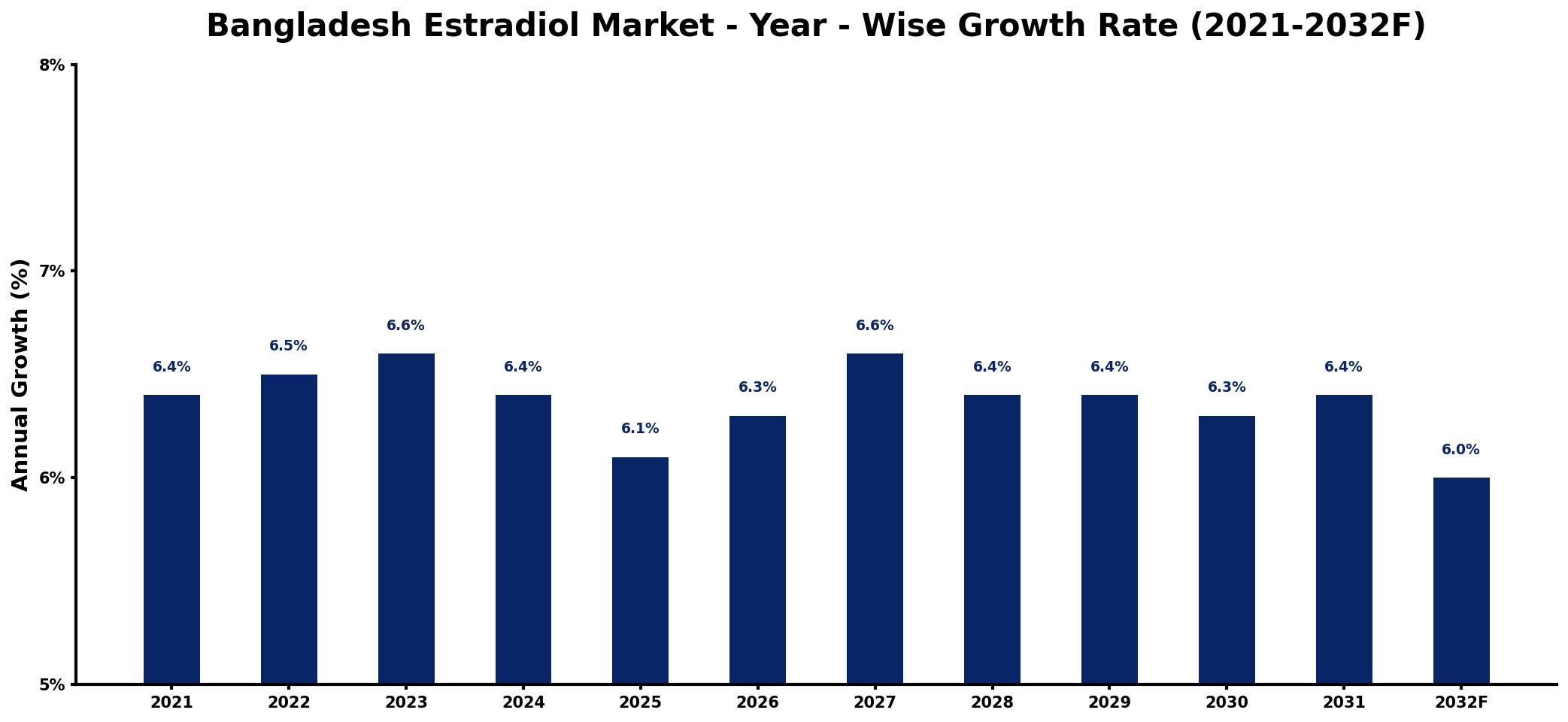
The table below presents the year‑wise growth rates along with the key drivers influencing the market
| Year | Growth Rate | Major Drivers |
| 2021 | 6.4% | Rising healthcare investment initiatives |
| 2022 | 6.5% | Increased awareness of hormone therapies |
| 2023 | 6.6% | Growing aging population demands |
| 2024 | 6.4% | Expanding women's health programs |
| 2025 | 6.1% | Strengthening pharmaceutical distribution networks |
| 2026 | 6.3% | Innovative research funding growth |
| 2027 | 6.6% | Enhanced regulatory support frameworks |
| 2028 | 6.4% | Growing partnerships with healthcare providers |
| 2029 | 6.4% | Increased patient education campaigns |
| 2030 | 6.3% | Broadening telemedicine adoption rates |
| 2031 | 6.4% | Strengthened supply chain resilience |
| 2032 | 6.0% | growing downstream application demand |
Note: Market size estimations and growth projections presented in this report are based on 6Wresearch's proprietary forecasting methodology, utilizing the latest available industry data, government publications, and primary research inputs.
Bangladesh Estradiol Market Synopsis
In Bangladesh, the rising prevalence of hormonal disorders, particularly among women undergoing menopause, has created a robust demand for estradiol treatments. The healthcare sector is progressively adapting to address these needs, underscoring the importance of offering accessible hormonal therapies. These developments are complemented by initiatives aimed at educating healthcare professionals about the benefits of estradiol therapy, enhancing treatment accessibility.
The market is distinguished by a variety of estradiol formulations, including tablets, transdermal patches, creams, and injections. This diversity not only caters to varying patient preferences but also addresses specific therapeutic requirements. However, the market continues to face challenges regarding affordability and public awareness, which could impede broader adoption of estradiol therapies.
Bangladesh Estradiol Market Key Takeaways
- The market is driven by increasing awareness regarding women's hormonal health and the rise of related disorders.
- Innovation in delivery methods, such as transdermal patches, is changing treatment dynamics.
- Regulatory measures are aimed at ensuring the quality and safety of estradiol products in Bangladesh.
- Targeted educational campaigns are essential to improve the understanding of estradiol therapies among healthcare professionals.
- Investment in product development and partnerships with healthcare providers will enhance market penetration.
Evaluation of Restraints in Bangladesh Estradiol Market
Several factors pose limitations to the growth of the Bangladesh Estradiol Market. A primary concern is the limited awareness among both healthcare professionals and patients, which results in underutilization of estradiol therapies. Additionally, regulatory constraints and the ongoing challenge of counterfeit products in the market hinder confidence in treatment options. Cultural attitudes surrounding women's health issues further complicate open dialogue about menopause and hormone therapy, necessitating focused efforts to break down these barriers.
Bangladesh Estradiol Market Trends
Current trends in the Bangladesh Estradiol Market highlight a shift towards patient-centric treatment options. The rising preference for alternative delivery methods, such as transdermal patches and vaginal creams, is reshaping hormone replacement therapy dynamics. The emphasis on personalized dosing regimens indicates a growing awareness among patients and healthcare providers regarding tailored treatment solutions. This trend not only enhances patient adherence but also promotes a more nuanced understanding of individual hormonal health needs.
Bangladesh Estradiol Market Opportunities
The Bangladesh Estradiol Market offers considerable opportunities for growth, particularly for pharmaceutical companies looking to invest in estradiol production and innovative delivery systems. As women's health advocacy continues to gain momentum, there is an increasing demand for accessible and effective hormone replacement therapies. Companies that engage in research and development of new formulations or explore strategic partnerships with healthcare providers can gain significant competitive advantages in this evolving market landscape.
Government Initiatives in the Bangladesh Estradiol Market
Government policies in Bangladesh concerning the estradiol market primarily focus on regulating the safety and efficacy of hormone therapies. The Directorate General of Drug Administration (DGDA) oversees the quality control measures of estradiol products, ensuring compliance with Good Manufacturing Practices (GMP). Initiatives aimed at maintaining affordability and enhancing public awareness about the safe use of these therapies are also in place. Such measures help safeguard public health and promote responsible use of estradiol products.
Future Insights of the Bangladesh Estradiol Market
Looking ahead to 2026-2032, the Bangladesh Estradiol Market is expected to continue its upward trajectory, driven by rising health consciousness and an expanding healthcare infrastructure. As awareness regarding menopausal health and hormonal disorders grows, more healthcare professionals are likely to recommend estradiol therapies, solidifying their role in treatment regimens. Continuous innovation in drug formulations and delivery systems will further enhance the market's appeal, leading to sustained growth.
Bangladesh Estradiol Market Latest Developments (2025 - 2026)
In recent months, the Bangladesh Estradiol Market has seen a notable increase in public and private initiatives aimed at improving healthcare access for women. Educational campaigns have gained traction, focusing on the benefits of estradiol therapy and its various formulations. Additionally, advancements in product delivery methods are being explored to enhance patient adherence and satisfaction. Regulatory authorities continue to enforce strict quality control measures to ensure the integrity of estradiol products available in the market.
Bangladesh Estradiol Market - Key Attractiveness of the Report
- 10 Years of Market Numbers
- Historical Data Starting from 2022 to 2025
- Base Year: 2025
- Forecast Data until 2032
- Key Performance Indicators Impacting the Market
- Major Upcoming Developments and Projects
Key Highlights of the Report:
- Bangladesh Estradiol Market Outlook
- Market Size of Bangladesh Estradiol Market, 2025
- Forecast of Bangladesh Estradiol Market, 2032
- Historical Data and Forecast of Bangladesh Estradiol Revenues & Volume for the Period 2022-2032F
- Bangladesh Estradiol Market Trend Evolution
- Bangladesh Estradiol Market Drivers and Challenges
- Bangladesh Estradiol Price Trends
- Bangladesh Estradiol Porter's Five Forces
- Bangladesh Estradiol Industry Life Cycle
- Historical Data and Forecast of Bangladesh Estradiol Market Revenues & Volume By Product Type for the Period 2022-2032F
- Historical Data and Forecast of Bangladesh Estradiol Market Revenues & Volume By a-Estradiol for the Period 2022-2032F
- Historical Data and Forecast of Bangladesh Estradiol Market Revenues & Volume By End-User for the Period 2022-2032F
- Historical Data and Forecast of Bangladesh Estradiol Market Revenues & Volume By Pharmaceutical for the Period 2022-2032F
- Historical Data and Forecast of Bangladesh Estradiol Market Revenues & Volume By Biological Research for the Period 2022-2032F
- Historical Data and Forecast of Bangladesh Estradiol Market Revenues & Volume By Others for the Period 2022-2032F
- Bangladesh Estradiol Import Export Trade Statistics
- Market Opportunity Assessment By Product Type
- Market Opportunity Assessment By End-User
- Bangladesh Estradiol Top Companies Market Share
- Bangladesh Estradiol Competitive Benchmarking By Technical and Operational Parameters
- Bangladesh Estradiol Company Profiles
- Bangladesh Estradiol Key Strategic Recommendations






































