Bangladesh Fish Farming Market Size, Share & Growth Rate
The Bangladesh Fish Farming Market was estimated at USD 399 Million in 2025 and is projected to reach USD 574 Million by 2032, growing at a CAGR of 5.3% from 2026 to 2032. This growth trajectory is primarily fueled by the surging domestic demand for fish as a vital protein source, alongside the continued expansion of aquaculture practices across the nation. The sector's resilience is further strengthened by favorable climatic conditions and abundant water resources, which underpin the ongoing shifts toward more sustainable farming methodologies.
Bangladesh Fish Farming Market Year-wise Growth Rate and Key Drivers
This graph highlights how the Bangladesh Fish Farming Market has steadily grown over the years, supported by major growth factors.
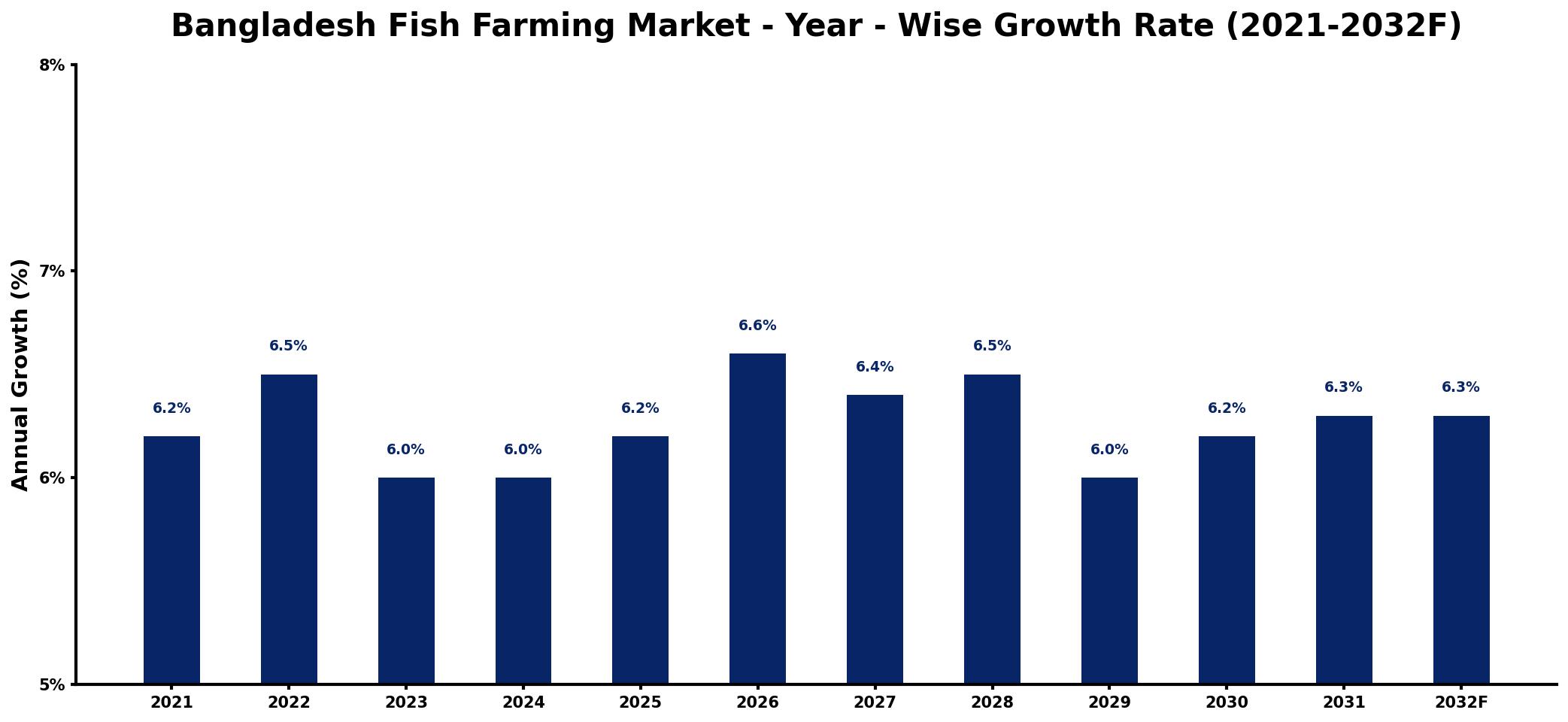
The table below presents the year‑wise growth rates along with the key drivers influencing the market
| Year | Growth Rate | Major Drivers |
| 2021 | 6.2% | Rising consumer protein demand |
| 2022 | 6.5% | Increased investment in aquaculture |
| 2023 | 6.0% | Expansion of export markets |
| 2024 | 6.0% | Growing awareness of nutrition |
| 2025 | 6.2% | Technological advancements in production |
| 2026 | 6.6% | Supportive government policies implemented |
| 2027 | 6.4% | Emerging sustainable practices adopted |
| 2028 | 6.5% | Diversification of product offerings |
| 2029 | 6.0% | Enhanced supply chain efficiency |
| 2030 | 6.2% | Rising urban population growth |
| 2031 | 6.3% | Increased focus on food security |
| 2032 | 6.3% | Strengthened regional trade agreements |
Note: Market size estimations and growth projections presented in this report are based on 6Wresearch's proprietary forecasting methodology, utilizing the latest available industry data, government publications, and primary research inputs.
Bangladesh Fish Farming Market Synopsis
The fish farming industry in Bangladesh plays a crucial role in addressing the country's food security challenges, providing millions with livelihoods and a steady source of nutrition. With small-scale farmers at the forefront, the market showcases a rich diversity of fish species, including Tilapia, Pangasius, and Carp, cultivated across a variety of aquaculture systems.
As the market transitions toward modernization and commercial practices, there's an observable increase in technology adoption and integration of biosecurity measures. This evolution reflects a growing commitment to enhancing productivity and ensuring the sustainability of fish farming practices in the face of emerging environmental challenges.
Bangladesh Fish Farming Market Key Takeaways
- The sector is witnessing a shift towards sustainable and environmentally friendly aquaculture practices.
- Small-scale farmers currently dominate the market, but commercial operations are on the rise.
- Government support plays a critical role in promoting growth and modernization in the industry.
- Technological innovations are being increasingly adopted to boost productivity and efficiency.
- Challenges such as water pollution and disease outbreaks require strategic interventions for sustainability.
Evaluation of Restraints in Bangladesh Fish Farming Market
Despite the promising outlook, the Bangladesh fish farming market faces significant restraints that impede its full potential. Water pollution from industrial runoff and agricultural practices remains a pervasive issue, undermining fish health and productivity. Moreover, outbreaks of diseases can decimate fish populations, impacting supply and profitability. Farmers often struggle with inadequate access to quality feed and veterinary care, which further stunts growth. The competition from imported fish products also puts pressure on local producers, making it essential to prioritize advancements in practices and efficiency to navigate these challenges effectively.
Bangladesh Fish Farming Market Trends
Several trends are emerging that are reshaping the Bangladesh fish farming market. A prominent shift towards integrated farming systems is evident, where fish farming is combined with agricultural practices to optimize resource use and enhance sustainability. Furthermore, an increased emphasis on biosecurity measures is driving improvements in the health and quality of fish products. Technological advancements, such as the incorporation of recirculating aquaculture systems (RAS) and precision farming techniques, are helping farmers achieve higher yields and efficiency.
Bangladesh Fish Farming Market Opportunities
The market holds considerable investment opportunities driven by both domestic consumption and export potential. The growing preference for value-added fish products, including processed and frozen varieties, opens new avenues for business development. Additionally, investments in modern aquaculture technologies can significantly enhance production efficiency, enabling farmers to meet the increasing demand for fish in both local and international markets. As government initiatives continue to bolster sustainable practices, the landscape for growth in the fish farming sector looks increasingly favorable.
Government Initiatives in the Bangladesh Fish Farming Market
The Bangladeshi government has introduced various policies aimed at supporting the fish farming market. These include subsidies and financial incentives to encourage sustainable aquaculture practices, as well as efforts to improve access to credit for fish farmers. The establishment of quality standards for fish production and research initiatives further reflect a commitment to enhancing the sector's viability and sustainability. Collectively, these policies are designed to boost industry growth, secure food supply chains, and stimulate economic development.
Future Insights of the Bangladesh Fish Farming Market
Looking ahead to 2026-2032, the Bangladesh fish farming market is set for a promising trajectory. The combination of increasing protein demand, technological adoption, and supportive government policies will likely catalyze the sector's expansion. As wild fish stocks continue to deplete, aquaculture will play an even more critical role in meeting nutritional needs. Enhanced practices and innovations will enable the industry to overcome existing challenges, positioning it for sustained growth and improved contributions to the agricultural economy.
Bangladesh Fish Farming Market Latest Developments (2025 - 2026)
Recent developments indicate a steady momentum in the Bangladesh fish farming sector, with increased efforts directed towards research and technological integration. Initiatives aimed at enhancing biosecurity protocols are gaining traction, reflecting a growing awareness of disease management among farmers. Additionally, advancements in aquaculture training programs are being implemented, aimed at equipping farmers with modern techniques and practices that promote sustainable production. These ongoing changes are anticipated to contribute positively to market dynamics.
Bangladesh Fish Farming Market - Key Attractiveness of the Report
- 10 Years of Market Numbers
- Historical Data Starting from 2022 to 2025
- Base Year: 2025
- Forecast Data until 2032
- Key Performance Indicators Impacting the Market
- Major Upcoming Developments and Projects
Key Highlights of the Report:
- Bangladesh Fish Farming Market Outlook
- Market Size of Bangladesh Fish Farming Market, 2025
- Forecast of Bangladesh Fish Farming Market, 2032
- Historical Data and Forecast of Bangladesh Fish Farming Revenues & Volume for the Period 2022-2032F
- Bangladesh Fish Farming Market Trend Evolution
- Bangladesh Fish Farming Market Drivers and Challenges
- Bangladesh Fish Farming Price Trends
- Bangladesh Fish Farming Porter's Five Forces
- Bangladesh Fish Farming Industry Life Cycle
- Historical Data and Forecast of Bangladesh Fish Farming Market Revenues & Volume By Environment for the Period 2022-2032F
- Historical Data and Forecast of Bangladesh Fish Farming Market Revenues & Volume By Marine Water for the Period 2022-2032F
- Historical Data and Forecast of Bangladesh Fish Farming Market Revenues & Volume By Fresh Water for the Period 2022-2032F
- Historical Data and Forecast of Bangladesh Fish Farming Market Revenues & Volume By Brackish Water for the Period 2022-2032F
- Historical Data and Forecast of Bangladesh Fish Farming Market Revenues & Volume By Fish Type for the Period 2022-2032F
- Historical Data and Forecast of Bangladesh Fish Farming Market Revenues & Volume By Pompano for the Period 2022-2032F
- Historical Data and Forecast of Bangladesh Fish Farming Market Revenues & Volume By Snappers for the Period 2022-2032F
- Historical Data and Forecast of Bangladesh Fish Farming Market Revenues & Volume By Groupers for the Period 2022-2032F
- Historical Data and Forecast of Bangladesh Fish Farming Market Revenues & Volume By Salmon for the Period 2022-2032F
- Historical Data and Forecast of Bangladesh Fish Farming Market Revenues & Volume By Milkfish for the Period 2022-2032F
- Historical Data and Forecast of Bangladesh Fish Farming Market Revenues & Volume By Tuna for the Period 2022-2032F
- Historical Data and Forecast of Bangladesh Fish Farming Market Revenues & Volume By Tilapia for the Period 2022-2032F
- Historical Data and Forecast of Bangladesh Fish Farming Market Revenues & Volume By Others for the Period 2022-2032F
- Bangladesh Fish Farming Import Export Trade Statistics
- Market Opportunity Assessment By Environment
- Market Opportunity Assessment By Fish Type
- Bangladesh Fish Farming Top Companies Market Share
- Bangladesh Fish Farming Competitive Benchmarking By Technical and Operational Parameters
- Bangladesh Fish Farming Company Profiles
- Bangladesh Fish Farming Key Strategic Recommendations






































