Bangladesh Foot Care Products Market Size, Share & Growth Rate
The Bangladesh Foot Care Products Market was estimated at USD 463 Million in 2025 and is projected to reach USD 608 Million by 2032, growing at a CAGR of 4.0% from 2026 to 2032. This growth trajectory is being driven primarily by increasing consumer awareness surrounding foot health and hygiene, alongside rising disposable income levels. Moreover, the expanding retail sector, complemented by the growth of e-commerce platforms, is making foot care products more accessible to a broader audience, further stimulating demand.
Bangladesh Foot Care Products Market Year-wise Growth Rate and Key Drivers
This graph highlights how the Bangladesh Foot Care Products Market has steadily grown over the years, supported by major growth factors.
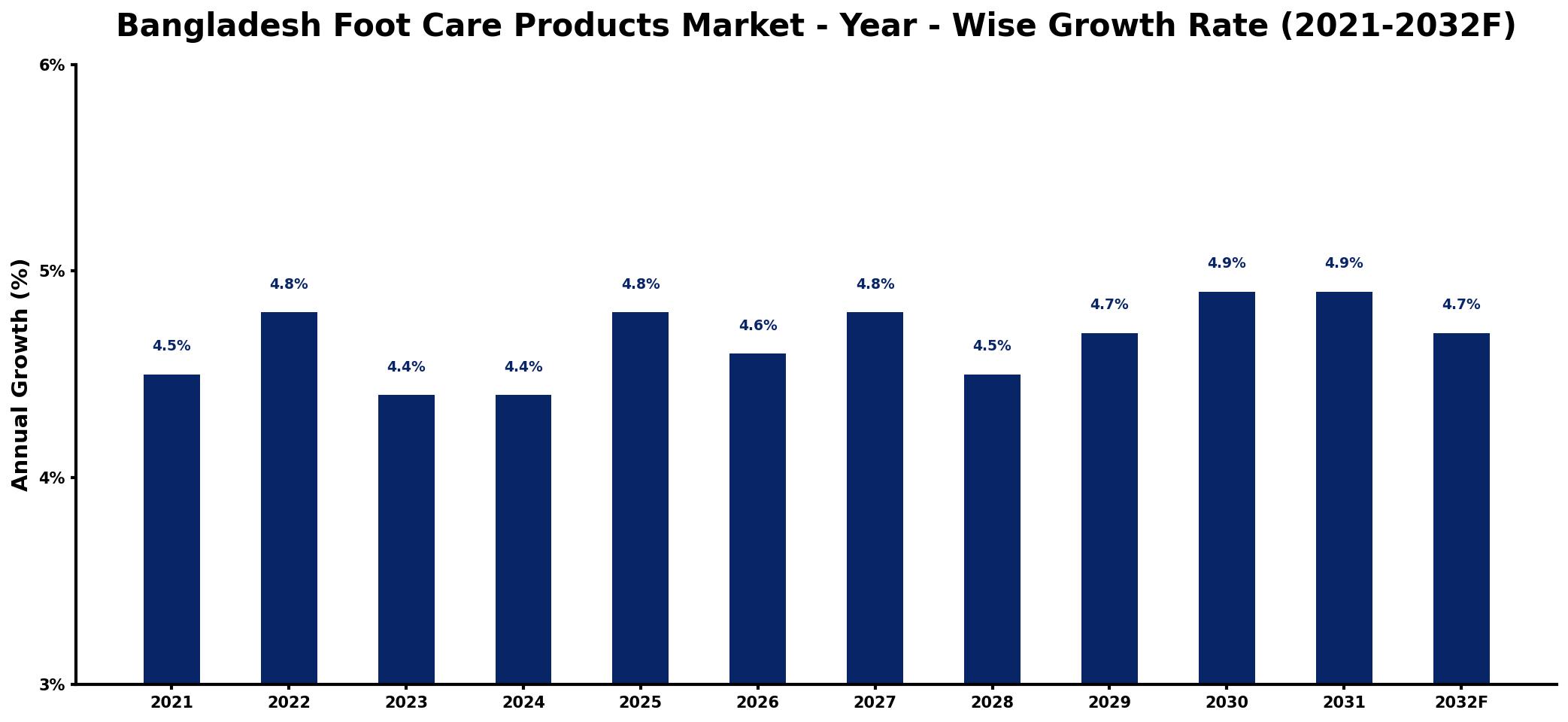
The table below presents the year‑wise growth rates along with the key drivers influencing the market
| Year | Growth Rate | Major Drivers |
| 2021 | 4.5% | Rising consumer health awareness |
| 2022 | 4.8% | Increase in disposable incomes |
| 2023 | 4.4% | Growing demand for wellness solutions |
| 2024 | 4.4% | Expansion of retail distribution channels |
| 2025 | 4.8% | Innovations in natural ingredients |
| 2026 | 4.6% | Emergence of online shopping platforms |
| 2027 | 4.8% | stronger distribution network expansion |
| 2028 | 4.5% | Higher spending on personal hygiene |
| 2029 | 4.7% | Growth in e-commerce sales |
| 2030 | 4.9% | Surge in health-conscious lifestyles |
| 2031 | 4.9% | increased overall sector activity |
| 2032 | 4.7% | Increased investments in research |
Note: Market size estimations and growth projections presented in this report are based on 6Wresearch's proprietary forecasting methodology, utilizing the latest available industry data, government publications, and primary research inputs.
Bangladesh Foot Care Products Market Synopsis
In Bangladesh, the foot care products market is undergoing a transformative phase as consumers become increasingly conscious of foot health. The surge in demand is particularly evident for products such as foot creams, scrubs, and specialized footwear tailored to address common issues like dryness and cracked heels. This heightened awareness is fueled by a growing focus on personal grooming and self-care.
Another noteworthy trend is the shift toward natural and organic products, as consumers seek safer, chemical-free alternatives. The market is diversifying with a variety of offerings that cater to specific foot concerns, which is further bolstered by innovations in product formulations. Such developments highlight a burgeoning segment that prioritizes holistic foot care solutions.
Bangladesh Foot Care Products Market Key Takeaways
- The market is witnessing a shift towards eco-friendly and organic foot care products, reflecting changing consumer preferences.
- Specialized foot care solutions targeting issues like cracked heels and fungal infections are increasingly popular.
- The rise of e-commerce platforms is enhancing product accessibility and convenience for consumers.
- Innovative product formats, including foot masks and electronic care devices, are gaining traction.
- Strategic marketing and educational campaigns are critical for overcoming awareness barriers in rural areas.
Evaluation of Restraints in Bangladesh Foot Care Products Market
Despite the promising growth trajectory, the Bangladesh Foot Care Products Market faces notable challenges. Limited awareness regarding foot care in rural communities significantly restricts potential customer bases, impacting overall demand. Additionally, the prevalence of counterfeit products erodes trust in established brands and complicates consumer choices. Distribution issues, particularly in remote areas, further hinder market penetration, while price sensitivity among consumers may deter them from investing in premium offerings. These factors necessitate targeted educational initiatives and enhanced distribution networks to unlock the market's full potential.
Bangladesh Foot Care Products Market Trends
A notable trend in the Bangladesh Foot Care Products Market is the escalating consumer interest in natural and organic formulations. This is driven by a broader movement toward health consciousness and environmental sustainability. Additionally, multifunctional products that offer moisturizing, exfoliating, and anti-bacterial benefits are becoming increasingly desirable. Moreover, the emergence of modern product formats, such as peel-off foot masks and electronic devices for foot care, illustrates a shift towards more innovative and convenient solutions that cater to contemporary lifestyle demands.
Bangladesh Foot Care Products Market Opportunities
The Bangladesh Foot Care Products Market is ripe with investment opportunities as consumer awareness about foot health continues to rise. Urbanization trends are creating a growing demand for diverse foot care solutions, particularly in the realms of natural and organic products. Collaborations with local manufacturers and retailers to introduce affordable yet high-quality products could yield significant returns. Furthermore, as self-care trends become more popular, the market is positioned to capitalize on the increased focus on personal grooming routines, offering ample scope for growth and innovation.
Government Initiatives in the Bangladesh Foot Care Products Market
The Bangladeshi government is actively engaged in fostering a favorable environment for the foot care products market. Policies are in place to enforce quality standards, ensuring product safety and efficacy. The government promotes domestic manufacturing to bolster local production capabilities, ultimately reducing dependency on imports. Enhanced regulatory frameworks are being developed to simplify the approval process for new products while ensuring compliance with labeling and advertising standards. These initiatives aim to stimulate market competitiveness while safeguarding consumer interests.
Future Insights of the Bangladesh Foot Care Products Market
Looking ahead to 2026-2032, the Bangladesh Foot Care Products Market is expected to maintain a steady growth trajectory, spurred by rising disposable incomes and an aging population increasingly aware of foot health issues. The growing incidence of conditions such as diabetes and arthritis is likely to enhance the demand for specialized foot care solutions. As key industry players focus on continuous innovation and expansion of product lines, the market is set to provide lucrative opportunities for businesses, reflecting an ongoing emphasis on personal grooming and wellness.
Bangladesh Foot Care Products Market Latest Developments (2025 - 2026)
Recent industry developments highlight a pronounced shift towards product innovation, with several brands launching new offerings that cater to specific foot care concerns. There has been an uptick in marketing campaigns aimed at raising awareness of foot health, particularly in under-served rural areas. Additionally, partnerships between local manufacturers and global brands have emerged, enhancing the product range available to consumers and facilitating the introduction of high-quality, affordable options into the market. This focus on collaboration is expected to bolster competitiveness within the sector.
Bangladesh Foot Care Products Market - Key Attractiveness of the Report
- 10 Years of Market Numbers
- Historical Data Starting from 2022 to 2025
- Base Year: 2025
- Forecast Data until 2032
- Key Performance Indicators Impacting the Market
- Major Upcoming Developments and Projects
Key Highlights of the Report:
- Bangladesh Foot Care Products Market Outlook
- Market Size of Bangladesh Foot Care Products Market, 2025
- Forecast of Bangladesh Foot Care Products Market, 2032
- Historical Data and Forecast of Bangladesh Foot Care Products Revenues & Volume for the Period 2022-2032F
- Bangladesh Foot Care Products Market Trend Evolution
- Bangladesh Foot Care Products Market Drivers and Challenges
- Bangladesh Foot Care Products Price Trends
- Bangladesh Foot Care Products Porter's Five Forces
- Bangladesh Foot Care Products Industry Life Cycle
- Historical Data and Forecast of Bangladesh Foot Care Products Market Revenues & Volume By Application for the Period 2022-2032F
- Historical Data and Forecast of Bangladesh Foot Care Products Market Revenues & Volume By Sports & Athletics for the Period 2022-2032F
- Historical Data and Forecast of Bangladesh Foot Care Products Market Revenues & Volume By Medical for the Period 2022-2032F
- Historical Data and Forecast of Bangladesh Foot Care Products Market Revenues & Volume By Personal Comfort for the Period 2022-2032F
- Historical Data and Forecast of Bangladesh Foot Care Products Market Revenues & Volume By Distribution Channel for the Period 2022-2032F
- Historical Data and Forecast of Bangladesh Foot Care Products Market Revenues & Volume By Drug Stores & Pharmacies for the Period 2022-2032F
- Historical Data and Forecast of Bangladesh Foot Care Products Market Revenues & Volume By Hospitals & Specialty Clinics for the Period 2022-2032F
- Historical Data and Forecast of Bangladesh Foot Care Products Market Revenues & Volume By Online Stores for the Period 2022-2032F
- Historical Data and Forecast of Bangladesh Foot Care Products Market Revenues & Volume By Others for the Period 2022-2032F
- Bangladesh Foot Care Products Import Export Trade Statistics
- Market Opportunity Assessment By Application
- Market Opportunity Assessment By Distribution Channel
- Bangladesh Foot Care Products Top Companies Market Share
- Bangladesh Foot Care Products Competitive Benchmarking By Technical and Operational Parameters
- Bangladesh Foot Care Products Company Profiles
- Bangladesh Foot Care Products Key Strategic Recommendations






































