Bangladesh Functional Apparel Market Size, Share & Growth Rate
The Bangladesh Functional Apparel Market was estimated at USD 191 Million in 2025 and is projected to reach USD 252 Million by 2032, growing at a CAGR of 4.0% from 2026 to 2032. This growth trajectory is primarily fueled by the increasing awareness of health and fitness among Bangladeshi consumers, alongside a shift towards active lifestyles. The demand for innovative sportswear, activewear, and performance-enhancing clothing continues to rise, driven by a younger demographic that values both functionality and style.
Bangladesh Functional Apparel Market Year-wise Growth Rate and Key Drivers
This graph highlights how the Bangladesh Functional Apparel Market has steadily grown over the years, supported by major growth factors.
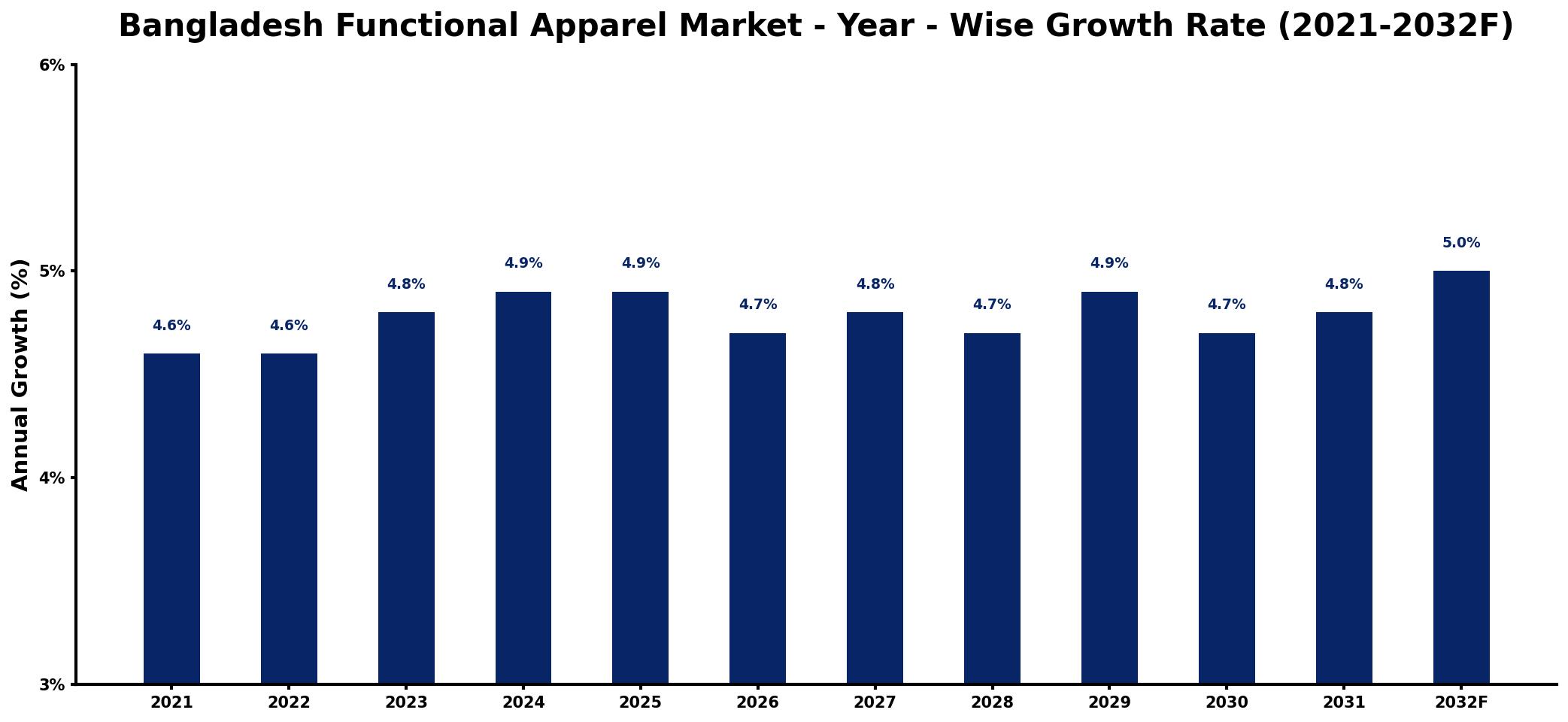
The table below presents the year‑wise growth rates along with the key drivers influencing the market
| Year | Growth Rate | Major Drivers |
| 2021 | 4.6% | Rising interest in fitness activities |
| 2022 | 4.6% | Growth in eco-friendly materials |
| 2023 | 4.8% | Increase in online shopping trends |
| 2024 | 4.9% | Expansion of sports events calendar |
| 2025 | 4.9% | Enhanced technology in textiles |
| 2026 | 4.7% | Growing influence of social media |
| 2027 | 4.8% | Rising consumer health consciousness |
| 2028 | 4.7% | Investment in local manufacturing facilities |
| 2029 | 4.9% | growing regional consumption patterns |
| 2030 | 4.7% | Emergence of new retail formats |
| 2031 | 4.8% | Strengthening of export markets |
| 2032 | 5.0% | strengthening underlying market demand |
Note: Market size estimations and growth projections presented in this report are based on 6Wresearch's proprietary forecasting methodology, utilizing the latest available industry data, government publications, and primary research inputs.
Bangladesh Functional Apparel Market Synopsis
The demand for moisture-wicking fabrics and breathable materials is at an all-time high in Bangladesh, as consumers seek apparel that not only enhances their performance but also provides comfort during various activities. This market uniquely caters to diverse segments, including sports, outdoor, and specialized workwear, underscoring the growing need for multi-functional clothing solutions.
Moreover, local manufacturers are increasingly focusing on integrating advanced technologies and sustainable materials into their product offerings. This commitment is reflected in the market's response to shifting consumer preferences, as individuals become more conscious of the environmental impact of their clothing choices.
Bangladesh Functional Apparel Market Key Takeaways
- The market is expected to grow steadily due to rising health and fitness awareness among consumers.
- Innovative materials such as moisture-wicking fabrics and breathable membranes are key drivers of demand.
- Local manufacturers are prioritizing sustainable practices to align with consumer expectations.
- Government policies are fostering R&D initiatives to support innovation within the sector.
- The emergence of younger demographics is significantly influencing the styles and functionalities sought in apparel.
Evaluation of Restraints in Bangladesh Functional Apparel Market
Despite the promising growth of the Bangladesh Functional Apparel Market, several limitations hinder its full potential. One major challenge lies in the continuous demand for material innovation; developing high-performance fabrics that meet consumer expectations for comfort and style necessitates significant investment in research and development. Furthermore, achieving effective market differentiation in a crowded space can be difficult, as many brands strive to offer similar functionalities in their products. Ensuring product safety and meeting regulatory standards also presents ongoing hurdles for manufacturers, which can impact market entry and expansion.
Bangladesh Functional Apparel Market Trends
Current trends indicate a noticeable shift towards apparel that is not only functional but also fashionable. Consumers increasingly demand stylish designs that can transition from gym to casual wear, blurring the lines between performance and everyday apparel. Additionally, advancements in fabric technology, including the use of eco-friendly materials, are gaining traction as consumers prioritize sustainable options. This focus on sustainability is further reinforced by a rising global consciousness about environmental issues.
Bangladesh Functional Apparel Market Opportunities
The Bangladesh Functional Apparel Market presents ample opportunities for growth and investment, particularly in the realm of technology-driven apparel. Companies that can successfully leverage advancements in fabric technology, such as integrating smart textiles or enhancing moisture management systems, stand to gain a competitive advantage. Moreover, tapping into e-commerce platforms and leveraging digital marketing strategies can significantly enhance reach to the growing online consumer base, particularly among younger demographics.
Government Initiatives in the Bangladesh Functional Apparel Market
The Bangladeshi government is actively promoting innovation and sustainability in the functional apparel sector through various initiatives. Policies aimed at supporting research and development are crucial for fostering collaboration between industry players and research institutions. Furthermore, incentives for adopting environmentally friendly materials and manufacturing processes reflect a commitment to enhancing the sector's sustainability. These initiatives align with global trends toward responsible consumption and production.
Future Insights of the Bangladesh Functional Apparel Market
Looking ahead to 2026-2032, the Bangladesh Functional Apparel Market is poised for substantial growth, driven by the ongoing evolution of consumer preferences. As awareness of health and fitness continues to rise, the demand for high-performance and multifunctional apparel will likely increase. Additionally, as technology advances, we can expect to see more innovative products entering the market, emphasizing comfort, performance, and style. The collaboration between manufacturers and policymakers will be essential in navigating challenges while capitalizing on the sector's growth potential.
Bangladesh Functional Apparel Market Latest Developments (2025 - 2026)
Recent developments in the Bangladesh Functional Apparel Market have focused on enhancing product offerings through advanced material technology. Many manufacturers are emphasizing the integration of smart textiles that provide additional functionalities, such as temperature regulation and enhanced moisture management. There has also been a notable increase in partnerships between local brands and international research institutions to promote innovation in the sector, aiming to elevate the quality and performance of functional apparel.
Bangladesh Functional Apparel Market - Key Attractiveness of the Report
- 10 Years of Market Numbers
- Historical Data Starting from 2022 to 2025
- Base Year: 2025
- Forecast Data until 2032
- Key Performance Indicators Impacting the Market
- Major Upcoming Developments and Projects
Key Highlights of the Report:
- Bangladesh Functional Apparel Market Outlook
- Market Size of Bangladesh Functional Apparel Market, 2025
- Forecast of Bangladesh Functional Apparel Market, 2032
- Historical Data and Forecast of Bangladesh Functional Apparel Revenues & Volume for the Period 2022-2032F
- Bangladesh Functional Apparel Market Trend Evolution
- Bangladesh Functional Apparel Market Drivers and Challenges
- Bangladesh Functional Apparel Price Trends
- Bangladesh Functional Apparel Porter's Five Forces
- Bangladesh Functional Apparel Industry Life Cycle
- Historical Data and Forecast of Bangladesh Functional Apparel Market Revenues & Volume By Product Type for the Period 2022-2032F
- Historical Data and Forecast of Bangladesh Functional Apparel Market Revenues & Volume By Sportswear for the Period 2022-2032F
- Historical Data and Forecast of Bangladesh Functional Apparel Market Revenues & Volume By Activewear for the Period 2022-2032F
- Historical Data and Forecast of Bangladesh Functional Apparel Market Revenues & Volume By Protective Clothing for the Period 2022-2032F
- Historical Data and Forecast of Bangladesh Functional Apparel Market Revenues & Volume By Others for the Period 2022-2032F
- Historical Data and Forecast of Bangladesh Functional Apparel Market Revenues & Volume By Application for the Period 2022-2032F
- Historical Data and Forecast of Bangladesh Functional Apparel Market Revenues & Volume By Sports Industry for the Period 2022-2032F
- Historical Data and Forecast of Bangladesh Functional Apparel Market Revenues & Volume By Outdoor Clothing for the Period 2022-2032F
- Historical Data and Forecast of Bangladesh Functional Apparel Market Revenues & Volume By Healthcare sector for the Period 2022-2032F
- Historical Data and Forecast of Bangladesh Functional Apparel Market Revenues & Volume By Distribution Channel for the Period 2022-2032F
- Historical Data and Forecast of Bangladesh Functional Apparel Market Revenues & Volume By Offline Store for the Period 2022-2032F
- Historical Data and Forecast of Bangladesh Functional Apparel Market Revenues & Volume By Online Store for the Period 2022-2032F
- Bangladesh Functional Apparel Import Export Trade Statistics
- Market Opportunity Assessment By Product Type
- Market Opportunity Assessment By Application
- Market Opportunity Assessment By Distribution Channel
- Bangladesh Functional Apparel Top Companies Market Share
- Bangladesh Functional Apparel Competitive Benchmarking By Technical and Operational Parameters
- Bangladesh Functional Apparel Company Profiles
- Bangladesh Functional Apparel Key Strategic Recommendations






































