Bangladesh Furniture Market (2026-2032) | Outlook, Companies, Analysis, Growth, Value, Revenue, Share, Size, Trends, Industry & Forecast
Market Forecast By Material Types (Plastic, Wood, Metal, Other), By Applications (Residential, Commercial) And Competitive Landscape
| Product Code: ETC009772 | Publication Date: Oct 2020 | Updated Date: Mar 2026 | Product Type: Report | |
| Publisher: 6Wresearch | Author: Ravi Bhandari | No. of Pages: 70 | No. of Figures: 35 | No. of Tables: 5 |
Bangladesh Furniture Market Size Growth Rate
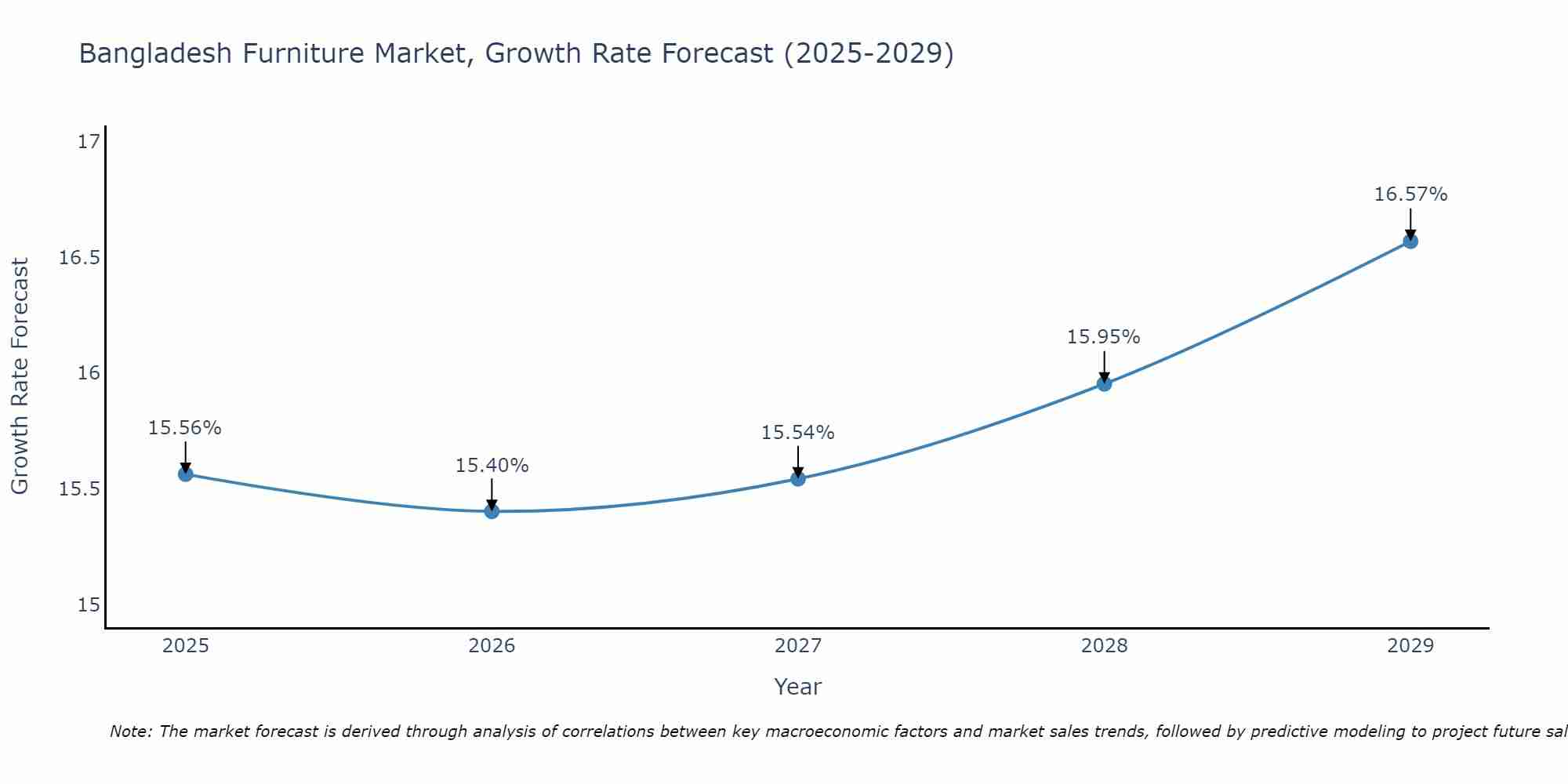
The Bangladesh Furniture Market is projected to witness mixed growth rate patterns during 2025 to 2029. The growth rate starts at 15.56% in 2025 and reaches 16.57% by 2029.
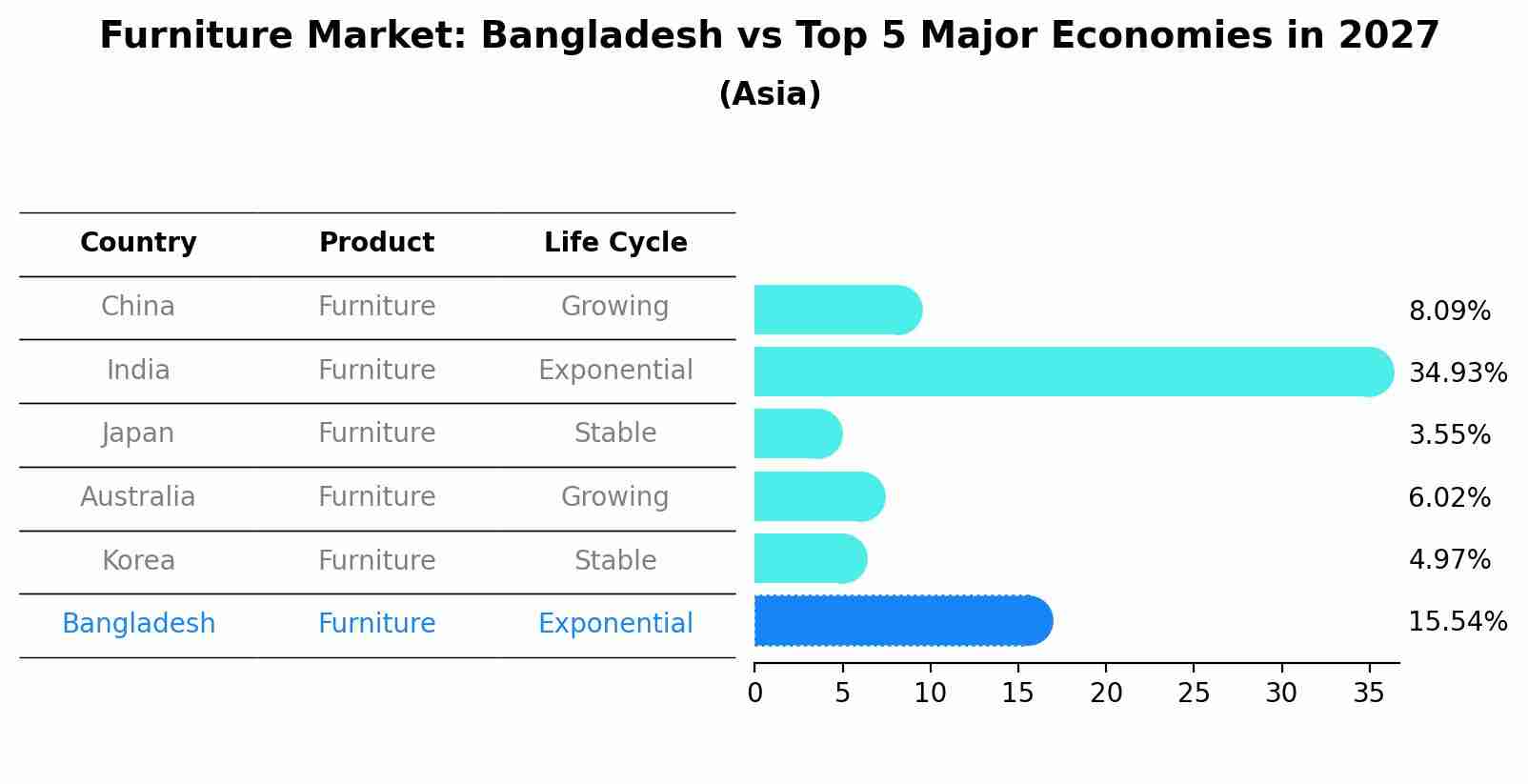
Furniture Market: Bangladesh vs Top 5 Major Economies in 2027 (Asia)
By 2027, Bangladesh's Furniture market is forecasted to achieve a exponential growth rate of 15.54%, with China leading the Asia region, followed by India, Japan, Australia and South Korea.
Bangladesh Furniture Market Growth Rate
According to 6Wresearch internal database and industry insights, the Bangladesh Furniture Market is projected to grow at a compound annual growth rate (CAGR) of 8.5% during the forecast period (2026–2032).
Topics Covered in the Bangladesh Furniture Market Report
The Bangladesh Furniture Market report thoroughly covers the market by material types and applications. The report provides a detailed analysis of ongoing market trends, opportunities/high-growth areas, and market drivers that will help stakeholders align strategies based on current and future market dynamics.
Bangladesh Furniture Market Highlights
| Report Name | Bangladesh Furniture Market |
| Forecast Period | 2026–2032 |
| CAGR | 8.5% |
| Growing Sector | Export-Oriented and Modular Furniture |
Bangladesh Furniture Market Synopsis
Bangladesh Furniture Market is projected to attain enormous expansion in the coming years on the back of a significant industrial shift from traditional, manual carpentry to sophisticated, mechanized mass production. Apart from this, the growth is primarily bolstered by the "National Export Policy" and the government's focus on diversifying the export basket beyond readymade garments. On the other hand, several localized factors are also benefiting the market growth. For instance, the rapid development of Special Economic Zones (SEZs) has provided a dedicated infrastructure for large-scale furniture units.
Evaluation of Growth Drivers in Bangladesh Furniture Market
Below are some prominent drivers and their influence on the market dynamics:
| Drivers | Primary Segments Affected | Why It Matters |
| Urban Housing Boom | By Application (Residential) | Vertical living in metros requires space-saving, modular furniture units. |
| Mechanization Shift | By Material Types (Wood, Metal) | Automation reduces production costs and enhances the precision of finishes. |
| Export Incentives | By Material Types (Wood) | Government cash incentives on exports make local brands globally competitive. |
| Commercial Expansion | By Application (Commercial) | Growth in IT parks and corporate offices drives the demand for ergonomic seating. |
| Retail Penetration | By Application (Residential) | Branded showrooms in Tier-2 cities are replacing unorganized local workshops. |
Bangladesh Furniture Market is projected to grow at a CAGR of 8.5% during the forecast period (2026-2032). Owing to increasing urbanization, rising investments in manufacturing automation, and strong demand from the residential and hospitality sectors, the growth is expected to double during the projected period. Increasing preference for eco-friendly, seasoned wood and flat-pack furniture is accelerating its adoption to a major extent. Apart from this, major advancements in lacquer finishing technologies and the rise of e-commerce platforms are further spurring Bangladesh Furniture Market growth across metropolitan and semi-urban locations.
Evaluation of Restraints in Bangladesh Furniture Market
Below are some prominent restraints and their influence on the market dynamics:
| Restraints | Primary Segments Affected | What This Means |
| Raw Material Duties | By Material Types (Wood, Metal) | High import tariffs on timber and hardware increase the final product price. |
| Logistics Constraints | By Application (Residential) | Improper road infrastructure in remote areas complicates the delivery of bulky items. |
| Skilled Labor Gap | By Material Types (Other) | Inappropriate training in modern design software limits innovation for SMEs. |
| Timber Scarcity | By Material Types (Wood) | Firm forest conservation laws lead to a shortage of high-quality local Teak. |
| Power Fluctuations | By Application (Commercial) | Frequent energy shortages in industrial belts disrupt mechanized production lines. |
Bangladesh Furniture Market Challenges
Bangladesh Furniture Market is expected to maintain its upward momentum during the forecast period. However, the high dependency on imported raw materials like adhesives, fabrics, and specialized hardware remains a major hurdle for small-scale players. In addition, inadequate internationally recognized testing laboratories within the country often leads to delays in export certifications. Also, there is a persistent challenge of "Copy-Paste" designs, where a lack of original design education makes it difficult for local manufacturers to compete with global design leaders in the premium segment.
Bangladesh Furniture Market Trends
The market for furniture in Bangladesh is set to grow in the upcoming years with the presence of latest trends such as:
- Development of Modular and Flat-Pack Designs: To cater to the shrinking apartment sizes in Dhaka and Chattogram, brands are launching "knock-down" furniture that is easy to transport and assemble.
- Eco-Friendly and Seasoned Wood: There is a growing shift toward using FSC-certified and chemically seasoned wood to avert warping and ensure longevity, appealing to quality-conscious buyers.
- Incorporation of E-Commerce and VR: Major players are executing Virtual Reality (VR) tools on their websites, allowing customers to visualize how a sofa or wardrobe will look in their specific room before purchasing.
Investment Opportunities in the Bangladesh Furniture Market
Here is a list of major investment opportunities in the Bangladesh Furniture Industry:
- Backward Linkage Industries: Investing in local manufacturing of furniture hardware (hinges, sliders) and wood-coating materials presents a massive opportunity to reduce import reliance.
- Technical Design Institutes: There is a major gap for specialized academies that teach CAD/CAM and modern furniture design to bridge the skill gap in the workforce.
- Hotel and Resort Furnishing: With the rise of domestic tourism in Cox’s Bazar and Sylhet, long-term contracts for furnishing new hospitality projects offer stable revenue streams.
Top 5 Leading Players in the Bangladesh Furniture Market
Below is a list of prominent companies leading the Bangladesh Furniture Market:
1. Hatil Complex Ltd.
| Company Name | Hatil Complex Ltd. |
|---|---|
| Established Year | 1989 |
| Headquarters | Dhaka, Bangladesh |
| Official Website | Click Here |
Hatil is one of the leading furniture manufacturers in Bangladesh, offering a wide range of high-quality residential and office furniture. The company is known for its durable wooden furniture and commitment to sustainability, producing eco-friendly designs that appeal to modern consumers.
2. Partex Furniture Ltd.
| Company Name | Partex Furniture Ltd. |
|---|---|
| Established Year | 1973 |
| Headquarters | Dhaka, Bangladesh |
| Official Website | Click Here |
Partex Furniture is a prominent name in the Bangladesh furniture market, offering a variety of furniture products, including bedroom sets, dining tables, and office furniture. The company has built a reputation for producing both traditional and contemporary furniture using high-quality materials.
3. Navana Furniture
| Company Name | Navana Furniture |
|---|---|
| Established Year | 2002 |
| Headquarters | Dhaka, Bangladesh |
| Official Website | Click Here |
A rapidly growing brand under the Navana Group, it focuses on modern, functional lifestyle furniture and has consistently won awards for its innovative showroom displays.
4. Otobi Limited
| Company Name | Otobi Limited |
|---|---|
| Established Year | 1975 |
| Headquarters | Dhaka, Bangladesh |
| Official Website | Click Here |
Founded by renowned artist Nitun Kundu, Otobi is a household name that revolutionized the market with contemporary designs and a vast network of retail points across the country.
5. Akhtar Furnishers
| Company Name | Akhtar Furnishers |
|---|---|
| Established Year | 1976 |
| Headquarters | Dhaka, Bangladesh |
| Official Website | Click Here |
Famous for its timeless Victorian-style solid wood furniture, the company also operates a specialized furniture academy to train skilled technicians for the industry.
Government Initiatives in the Bangladesh Furniture Market
According to Bangladeshi Government Data, they have played an important role through initiatives like the National Export Policy 2024-27, which includes furniture as a "Highest Priority Sector," providing up to 15% cash incentives for exporters. Also, the Dhaka International Trade Fair (DITF) serves as a primary platform for state-level support, allowing manufacturers to showcase local innovation to international buyers. Along with this, the SME Foundation of Bangladesh also encourages local artisans through subsidized loans and technical workshops which aimed at enhancing the quality of products made in rural furniture clusters.
Future Insights of the Bangladesh Furniture Market
In the years to come, the Bangladesh Furniture Market is anticipated to witness steady growth on the back of rapid urbanization, growing disposable incomes, and transforming consumer preferences for modern and customized furniture solutions. Apart from this, the proliferation of the real estate sector, particularly in residential and commercial developments, is anticipated to aid demand for high-quality furniture. Further, the increasing influence of e-commerce platforms and digital marketing is forecast to propel market accessibility, allowing manufacturers to reach a broader consumer base.
Market Segmentation Analysis
The report offers a comprehensive study of the following market segments and their leading categories:
By Material Types – Wood to Lead the Market
According to Rishil, Senior Research Analyst, 6Wresearch, the wood segment is anticipated to lead as Bangladeshi consumers maintain a deep cultural preference for natural timber, specifically Teak, Gamar, and Mahogany. Despite the rise of alternatives, solid wood and high-quality seasoned wood are viewed as status symbols and long-term assets.
By Applications – Residential to Lead the Market
Residential is expected to dominate the Bangladesh Furniture Market share due to the massive urban migration and the rising number of nuclear families. As more people move into modern apartments, the demand for complete bedroom sets, dining units, and living room sofas remains the primary revenue generator for the industry.
Key Attractiveness of the Report
- 10 Years of Market Numbers
- Historical Data Starting from 2022 to 2025
- Base Year: 2025
- Forecast Data until 2032
- Key Performance Indicators Impacting the Market
- Major Upcoming Developments and Projects
Key Highlights of the Report:
- Bangladesh Furniture Market Outlook
- Market Size of Bangladesh Furniture Market, 2025
- Forecast of Bangladesh Furniture Market, 2032
- Historical Data and Forecast of Bangladesh Furniture Revenues & Volume for the Period 2022-2032
- Bangladesh Furniture Market Trend Evolution
- Bangladesh Furniture Market Drivers and Challenges
- Bangladesh Furniture Price Trends
- Bangladesh Furniture Porter's Five Forces
- Bangladesh Furniture Industry Life Cycle
- Historical Data and Forecast of Bangladesh Furniture Market Revenues & Volume By Material Types for the Period 2022-2032
- Historical Data and Forecast of Bangladesh Furniture Market Revenues & Volume By Plastic for the Period 2022-2032
- Historical Data and Forecast of Bangladesh Furniture Market Revenues & Volume By Wood for the Period 2022-2032
- Historical Data and Forecast of Bangladesh Furniture Market Revenues & Volume By Metal for the Period 2022-2032
- Historical Data and Forecast of Bangladesh Furniture Market Revenues & Volume By Other for the Period 2022-2032
- Historical Data and Forecast of Bangladesh Furniture Market Revenues & Volume By Applications for the Period 2022-2032
- Historical Data and Forecast of Bangladesh Furniture Market Revenues & Volume By Residential for the Period 2022-2032
- Historical Data and Forecast of Bangladesh Furniture Market Revenues & Volume By Commercial for the Period 2022-2032
- Bangladesh Furniture Import Export Trade Statistics
- Market Opportunity Assessment By Material Types
- Market Opportunity Assessment By Applications
- Bangladesh Furniture Top Companies Market Share
- Bangladesh Furniture Competitive Benchmarking By Technical and Operational Parameters
- Bangladesh Furniture Company Profiles
- Bangladesh Furniture Key Strategic Recommendations
Market Segmentation Analysis
The Report offers a comprehensive study of the subsequent market segments and their leading categories.
By Material Type
- Plastic
- Wood
- Metal
- Other
By Application
- Commercial
- Residential
Bangladesh Furniture Market (2026-2032): FAQs
The Bangladesh Furniture Market is projected to grow at a CAGR of 8.5% during the forecast period 2026–2032.
Urbanization, a growing middle class, as well as increasing disposable income, are key drivers for the furniture market in Bangladesh.
Challenges include high raw material costs, competition from imports, and a shortage of skilled labor in the furniture manufacturing sector.
Opportunities include investment in local manufacturing, expanding e-commerce platforms, and collaboration with real estate developers for bulk orders.
6Wresearch actively monitors the Bangladesh Furniture Market and publishes its comprehensive annual report, highlighting emerging trends, growth drivers, revenue analysis, and forecast outlook. Our insights help businesses to make data-backed strategic decisions with ongoing market dynamics. Our analysts track relevent industries related to the Bangladesh Furniture Market, allowing our clients with actionable intelligence and reliable forecasts tailored to emerging regional needs.
Yes, we provide customisation as per your requirements. To learn more, feel free to contact us on sales@6wresearch.com
| 1 Executive Summary |
| 2 Introduction |
| 2.1 Key Highlights of the Report |
| 2.2 Report Description |
| 2.3 Market Scope & Segmentation |
| 2.4 Research Methodology |
| 2.5 Assumptions |
| 3 Bangladesh Furniture Market Overview |
| 3.1 Bangladesh Country Macro Economic Indicators |
| 3.2 Bangladesh Furniture Market Revenues & Volume, 2022 & 2032F |
| 3.3 Bangladesh Furniture Market - Industry Life Cycle |
| 3.4 Bangladesh Furniture Market - Porter's Five Forces |
| 3.5 Bangladesh Furniture Market Revenues & Volume Share, By Material Types, 2022 & 2032F |
| 3.6 Bangladesh Furniture Market Revenues & Volume Share, By Applications, 2022 & 2032F |
| 4 Bangladesh Furniture Market Dynamics |
| 4.1 Impact Analysis |
| 4.2 Market Drivers |
| 4.3 Market Restraints |
| 5 Bangladesh Furniture Market Trends |
| 6 Bangladesh Furniture Market, By Types |
| 6.1 Bangladesh Furniture Market, By Material Types |
| 6.1.1 Overview and Analysis |
| 6.1.2 Bangladesh Furniture Market Revenues & Volume, By Material Types, 2022 - 2032F |
| 6.1.3 Bangladesh Furniture Market Revenues & Volume, By Plastic, 2022 - 2032F |
| 6.1.4 Bangladesh Furniture Market Revenues & Volume, By Wood, 2022 - 2032F |
| 6.1.5 Bangladesh Furniture Market Revenues & Volume, By Metal, 2022 - 2032F |
| 6.1.6 Bangladesh Furniture Market Revenues & Volume, By Other, 2022 - 2032F |
| 6.2 Bangladesh Furniture Market, By Applications |
| 6.2.1 Overview and Analysis |
| 6.2.2 Bangladesh Furniture Market Revenues & Volume, By Residential, 2022 - 2032F |
| 6.2.3 Bangladesh Furniture Market Revenues & Volume, By Commercial, 2022 - 2032F |
| 7 Bangladesh Furniture Market Import-Export Trade Statistics |
| 7.1 Bangladesh Furniture Market Export to Major Countries |
| 7.2 Bangladesh Furniture Market Imports from Major Countries |
| 8 Bangladesh Furniture Market Key Performance Indicators |
| 9 Bangladesh Furniture Market - Opportunity Assessment |
| 9.1 Bangladesh Furniture Market Opportunity Assessment, By Material Types, 2022 & 2032F |
| 9.2 Bangladesh Furniture Market Opportunity Assessment, By Applications, 2022 & 2032F |
| 10 Bangladesh Furniture Market - Competitive Landscape |
| 10.1 Bangladesh Furniture Market Revenue Share, By Companies, 2025 |
| 10.2 Bangladesh Furniture Market Competitive Benchmarking, By Operating and Technical Parameters |
| 11 Company Profiles |
| 12 Recommendations |
| 13 Disclaimer |
Global Go To Market Strategy - 2030
Export potential enables firms to identify high-growth global markets with greater confidence by combining advanced trade intelligence with a structured quantitative methodology. The framework analyzes emerging demand trends and country-level import patterns while integrating macroeconomic and trade datasets such as GDP and population forecasts, bilateral import–export flows, tariff structures, elasticity differentials between developed and developing economies, geographic distance, and import demand projections. Using weighted trade values from 2020–2024 as the base period to project country-to-country export potential for 2030, these inputs are operationalized through calculated drivers such as gravity model parameters, tariff impact factors, and projected GDP per-capita growth. Through an analysis of hidden potentials, demand hotspots, and market conditions that are most favorable to success, this method enables firms to focus on target countries, maximize returns, and global expansion with data, backed by accuracy.
By factoring in the projected importer demand gap that is currently unmet and could be potential opportunity, it identifies the potential for the Exporter (Country) among 190 countries, against the general trade analysis, which identifies the biggest importer or exporter.
To discover high-growth global markets and optimize your business strategy:
Click Here
Request Primary Research & Report
- Single User License$ 1,995
- Department License$ 2,400
- Site License$ 3,120
- Global License$ 3,795

Leadership Perspectives from Industry Events
Search
6Wresearch in the News
 Forbes
Citing 6Wresearch analytics to map global infrastructure and pharmaceutical industry trajectories.
 Bloomberg Law
Direct syndication of 6Wresearch's macro data points, capturing complex supply chain shifts.
 Reuters
Tracking industrial manufacturing adjustments and electronic security ecosystem scaling.
 Mint
Mint
Utilizing deep-tech sector market sizing to analyze global automation and robotics.
 The Economic Times
Anchoring features on industrial IoT growth metrics and connected smart-grid devices.
 Business Standard
Featuring strategic evaluations of Advanced Driver Assistance Systems (ADAS) and AI road safety.
 The Hindu
Spotlighting core commercial metrics ranging from unmanned aerial vehicles (UAVs) to consumer durables.
 Financial Express
Anchoring quarterly reviews on cross-border real estate tech and structural hardware manufacturing.
 Yahoo Finance
Syndicating the tracker's $30.1 billion untapped-market findings, spotlighting Japan, the US and China as India's top new-potential importers.
 India Today
Carrying the release on smartphones leading India's export potential to $94 billion by 2031, per 6WExportGTM data.
 Dailyhunt
Distributing the tracker findings to its regional readership, framing India's export diversification into Japan and Mexico.
 PR Newswire Original release
Publishing the full India Export Attractiveness Tracker 2026, detailing new trade corridors across iron ore, LCVs and pharmaceuticals.
 The Industrial
Highlighting the tracker's read on India's semiconductor ambitions and long-term chip-assembly export potential.
 PTI News
Reporting on the $66.81 billion pharmaceuticals export opportunity flagged in the tracker, amid looming US generic-drug tariffs.
 Tribune India
Covering the tracker's tariff-versus-regulation analysis across India's mature export markets in the US, China and UAE.
 ANI News
Amplifying the report's findings on polished diamonds, refined petroleum and medicines as India's core export engines.
 International Business Magazine
Covering the report's insight into how AEB, blind spot detection, and driver monitoring are reshaping India's ADAS market.
 Focus Gaming News
Highlighting the research forecast for Egypt's gambling market, projecting steady growth through 2032.
Thought Leadership and Analyst Meet





Our Clients








Latest Reports
- Namibia Financial Asset Management Market (2026-2032)
- Mozambique Financial Asset Management Market (2026-2032)
- Montenegro Financial Asset Management Market (2026-2032)
- Mongolia Financial Asset Management Market (2026-2032)
- Monaco Financial Asset Management Market (2026-2032)
- Micronesia Financial Asset Management Market (2026-2032)
- Mauritius Financial Asset Management Market (2026-2032)
- Mauritania Financial Asset Management Market (2026-2032)
- Marshall Islands Financial Asset Management Market (2026-2032)
- Malta Financial Asset Management Market (2026-2032)
Industry Events and Analyst Meet

EV India Expo 2026

HIMTEX 2026

India Refining Summit 2026

India EV Show 2026

EV tech India Expo 2026
Whitepaper
- Middle East & Africa Commercial Security Market Click here to view more.
- Middle East & Africa Fire Safety Systems & Equipment Market Click here to view more.
- GCC Drone Market Click here to view more.
- Middle East Lighting Fixture Market Click here to view more.
- GCC Physical & Perimeter Security Market Click here to view more.


