Bangladesh High Strength Steel Market Size, Share & Growth Rate
The Bangladesh High Strength Steel Market was estimated at USD 601 Million in 2025 and is projected to reach USD 853 Million by 2032, growing at a CAGR of 5.1% from 2026 to 2032. This growth trajectory is significantly influenced by the rising demand for durable and lightweight materials in construction and automotive industries. Additionally, increasing investments in infrastructure development and urbanization are further driving the need for advanced high-strength steel applications.
Bangladesh High Strength Steel Market Year-wise Growth Rate and Key Drivers
This graph highlights how the Bangladesh High Strength Steel Market has steadily grown over the years, supported by major growth factors.
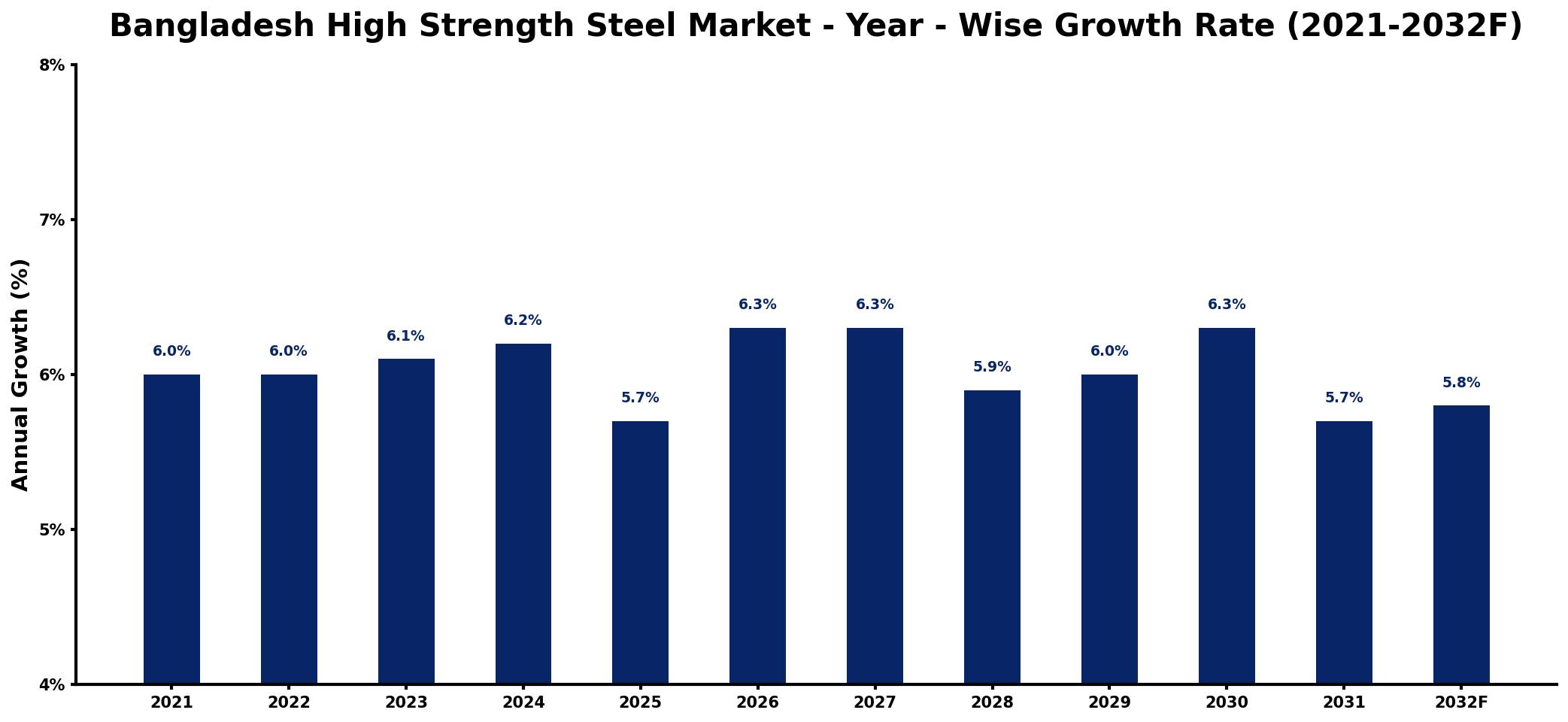
The table below presents the year‑wise growth rates along with the key drivers influencing the market
| Year | Growth Rate | Major Drivers |
| 2021 | 6.0% | Infrastructure projects increase demand |
| 2022 | 6.0% | Manufacturing sector growth accelerates |
| 2023 | 6.1% | Construction industry expansion continues |
| 2024 | 6.2% | Renewable energy investments rise significantly |
| 2025 | 5.7% | Automotive sector experiences resurgence |
| 2026 | 6.3% | Transportation infrastructure upgrades planned |
| 2027 | 6.3% | Export opportunities in emerging markets |
| 2028 | 5.9% | Technological advancements drive production |
| 2029 | 6.0% | Urbanization trends support construction growth |
| 2030 | 6.3% | Government initiatives promote investment |
| 2031 | 5.7% | Sustainability initiatives influence demand |
| 2032 | 5.8% | R&D funding enhances industry competitiveness |
Note: Market size estimations and growth projections presented in this report are based on 6Wresearch's proprietary forecasting methodology, utilizing the latest available industry data, government publications, and primary research inputs.
Bangladesh High Strength Steel Market Synopsis
In recent years, the Bangladesh High Strength Steel Market has seen a surge in demand driven by advancements in engineering and construction methodologies. As industries focus on enhancing structural performance while minimizing weight, the shift towards high-strength steel solutions has become more pronounced.
Looking ahead, the market is poised for significant transformation. With government policies aligning more closely with sustainable development goals, theres an increasing push for eco-friendly materials and technologies, bolstering the case for high-strength steels. This dynamic environment suggests a future ripe with potential for both established players and newcomers.
Bangladesh High Strength Steel Market Key Takeaways
- The market is anticipated to grow robustly, reflecting a shift towards lightweight and durable materials.
- Key sectors driving this demand include construction, automotive, and infrastructure.
- Technological advancements in material science are facilitating improved high-strength steel production techniques.
- Strong government support and policy initiatives are fostering an environment conducive to market growth.
- Collaborative efforts among stakeholders are vital to overcoming existing barriers to adoption.
Evaluation of Restraints in Bangladesh High Strength Steel Market
The Bangladesh High Strength Steel Market faces several constraints that could temper its growth. High material costs and the complexity involved in fabrication present challenges for producers. Furthermore, the adoption of high-strength steel is often hampered by issues related to welding techniques and design limitations, which can complicate production processes. To navigate these challenges, its essential for industry stakeholders to engage in meaningful collaboration and invest in innovative technologies that enhance the usability of high-strength steel in various applications.
Bangladesh High Strength Steel Market Trends
A key trend influencing the Bangladesh High Strength Steel Market is the ongoing shift towards sustainability and lightweight solutions in construction. Companies are increasingly adopting advanced high-strength steels (AHSS) and ultra-high-strength steels (UHSS) to improve energy efficiency and reduce carbon footprints. Additionally, digital technologies and automation in production processes are becoming more prevalent, streamlining operations and enhancing product quality.
Another emerging trend is the growing importance of customization in steel production. As industries seek materials tailored to specific applications, manufacturers are investing in R&D to develop specialized high-strength steel grades that meet unique performance criteria.
Bangladesh High Strength Steel Market Opportunities
The landscape of opportunities within the Bangladesh High Strength Steel Market is expanding, particularly with the rapid urbanization and infrastructural development projects underway. The increasing government investment in public infrastructure, including roads, bridges, and housing, is set to provide significant market openings. Additionally, the automotive sectors pursuit of lightweight materials to enhance fuel efficiency presents a ripe opportunity for high-strength steel producers to cater to evolving industry needs. Adopting innovative manufacturing techniques and forming strategic partnerships could further bolster growth in this dynamic market.
Government Initiatives in the Bangladesh High Strength Steel Market
The government of Bangladesh is actively promoting initiatives aimed at enhancing the high strength steel market through supportive policies and regulations. These efforts include funding for research and development in advanced material technologies and setting standards that encourage the use of high-strength steels in key industries. By collaborating with various stakeholders, including industry players and academic institutions, the government aims to strengthen the infrastructure sector and promote the adoption of high-performance materials that align with national development goals.
Future Insights of the Bangladesh High Strength Steel Market
Between 2026 and 2032, the Bangladesh High Strength Steel Market is expected to evolve significantly, driven by technological advancements and increasing market demand. As industries prioritize structural integrity and weight optimization, high-strength steel solutions will become integral to construction and automotive sectors. This period will likely witness a further alignment of industry standards with international benchmarks, promoting the quality and safety of high-strength steel applications. Continued investment in innovation will be crucial for stakeholders looking to capitalize on the emerging opportunities within this growing market.
Bangladesh High Strength Steel Market Latest Developments (2025 - 2026)
Recent developments within the Bangladesh High Strength Steel Market indicate a growing focus on collaboration among industry players to enhance production capabilities. Ongoing research projects are exploring the use of new alloy compositions that could improve the performance and weldability of high-strength steels. Additionally, government-backed initiatives are facilitating training programs aimed at equipping the workforce with the necessary skills to handle advanced steel fabrication technologies, ensuring the industry keeps pace with global standards.
Bangladesh High Strength Steel Market - Key Attractiveness of the Report
- 10 Years of Market Numbers
- Historical Data Starting from 2022 to 2025
- Base Year: 2025
- Forecast Data until 2032
- Key Performance Indicators Impacting the Market
- Major Upcoming Developments and Projects
Key Highlights of the Report:
- Bangladesh High Strength Steel Market Outlook
- Market Size of Bangladesh High Strength Steel Market, 2025
- Forecast of Bangladesh High Strength Steel Market, 2032
- Historical Data and Forecast of Bangladesh High Strength Steel Revenues & Volume for the Period 2022-2032F
- Bangladesh High Strength Steel Market Trend Evolution
- Bangladesh High Strength Steel Market Drivers and Challenges
- Bangladesh High Strength Steel Price Trends
- Bangladesh High Strength Steel Porter's Five Forces
- Bangladesh High Strength Steel Industry Life Cycle
- Historical Data and Forecast of Bangladesh High Strength Steel Market Revenues & Volume By Product Type for the Period 2022-2032F
- Historical Data and Forecast of Bangladesh High Strength Steel Market Revenues & Volume By Dual Phase Steel for the Period 2022-2032F
- Historical Data and Forecast of Bangladesh High Strength Steel Market Revenues & Volume By Bake Hardenable Steel for the Period 2022-2032F
- Historical Data and Forecast of Bangladesh High Strength Steel Market Revenues & Volume By Carbon Manganese Steel for the Period 2022-2032F
- Historical Data and Forecast of Bangladesh High Strength Steel Market Revenues & Volume By Other Product Types for the Period 2022-2032F
- Historical Data and Forecast of Bangladesh High Strength Steel Market Revenues & Volume By Application for the Period 2022-2032F
- Historical Data and Forecast of Bangladesh High Strength Steel Market Revenues & Volume By Automotive for the Period 2022-2032F
- Historical Data and Forecast of Bangladesh High Strength Steel Market Revenues & Volume By Construction for the Period 2022-2032F
- Historical Data and Forecast of Bangladesh High Strength Steel Market Revenues & Volume By Yellow Goods and Mining Equipment for the Period 2022-2032F
- Historical Data and Forecast of Bangladesh High Strength Steel Market Revenues & Volume By Aviation and Marine for the Period 2022-2032F
- Historical Data and Forecast of Bangladesh High Strength Steel Market Revenues & Volume By Other Applications for the Period 2022-2032F
- Bangladesh High Strength Steel Import Export Trade Statistics
- Market Opportunity Assessment By Product Type
- Market Opportunity Assessment By Application
- Bangladesh High Strength Steel Top Companies Market Share
- Bangladesh High Strength Steel Competitive Benchmarking By Technical and Operational Parameters
- Bangladesh High Strength Steel Company Profiles
- Bangladesh High Strength Steel Key Strategic Recommendations






































