Bangladesh Industrial Furnace Market Size, Share & Growth Rate
The Bangladesh Industrial Furnace Market was estimated at USD 117 Million in 2025 and is projected to reach USD 127 Million by 2032, growing at a CAGR of 1.2% from 2026 to 2032. This growth is driven by the acceleration of industrialization across various sectors, including steel and automotive, as well as heightened infrastructure development initiatives. In addition, the rising consumer demand for energy-efficient heating solutions is propelling manufacturers to innovate and modernize their offerings.
Bangladesh Industrial Furnace Market Year-wise Growth Rate and Key Drivers
This graph highlights how the Bangladesh Industrial Furnace Market has steadily grown over the years, supported by major growth factors.
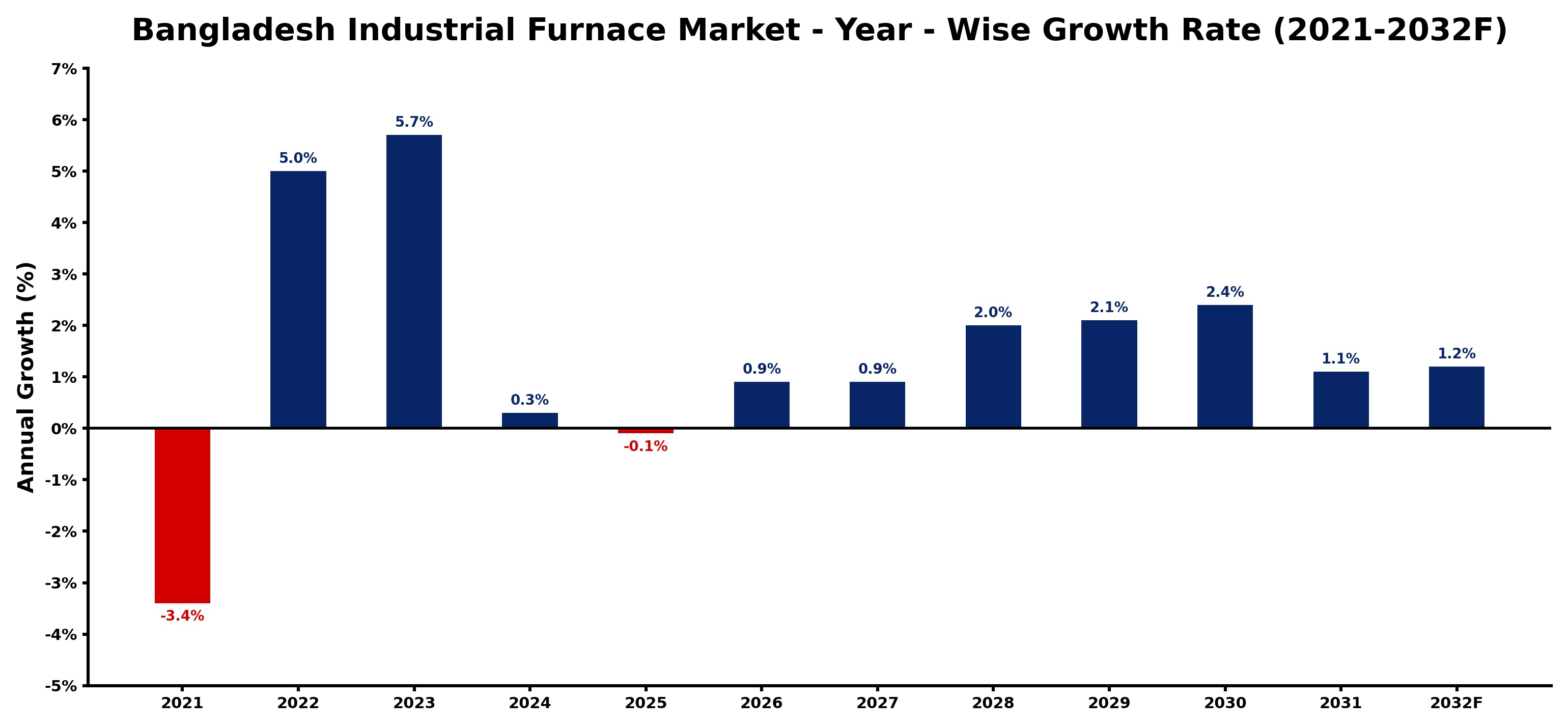
The table below presents the year‑wise growth rates along with the key drivers influencing the market
| Year | Growth Rate | Major Drivers |
| 2021 | -3.4% | Diminished manufacturing investments decreased demand for industrial furnace equipment |
| 2022 | 5.0% | Local textile factories boost demand for high efficiency industrial furnaces |
| 2023 | 5.7% | Boosted steel mill upgrades optimized furnace energy consumption efficiency |
| 2024 | 0.3% | Digital twin technology adoption optimizes furnace operation efficiency |
| 2025 | -0.1% | Manufacturing slowdowns curtailed demand for industrial furnace installations |
| 2026 | 0.9% | Manufacturing upgrades in textile plants boost furnace demand significantly |
| 2027 | 0.9% | Higher manufacturing investments boost demand for energy efficient furnaces |
| 2028 | 2.0% | Improved furnace efficiency boosted production rates in metalworking sectors |
| 2029 | 2.1% | Improved textile sector demand boosts furnace production and investment |
| 2030 | 2.4% | Steel production surge drives refractory material demand in Bangladesh |
| 2031 | 1.1% | Regional furnace upgrades optimize energy consumption for manufacturers |
| 2032 | 1.2% | Expanded local manufacturing capacities boosted industrial furnace demand significantly |
Note - Market size estimations and growth projections presented in this report are based on 6Wresearch’s advanced forecasting approach, validated with industry datasets as of June 2026.
Bangladesh Industrial Furnace Market Synopsis
The most significant force shaping the Bangladesh Industrial Furnace Market is the ongoing shift towards energy efficiency and sustainability. As industries strive to minimize their carbon footprint, the demand for eco-friendly furnace technologies has surged, prompting a wave of innovation.
Furthermore, government initiatives that advocate for cleaner production methods and energy-efficient technologies are bolstering market dynamics. These policies not only encourage the adoption of modern furnaces but also provide necessary incentives for businesses investing in greener solutions.
Bangladesh Industrial Furnace Market Key Takeaways
- The market is being driven by rapid industrialization and infrastructure development.
- There is a significant push for energy-efficient and environmentally sustainable heating solutions.
- Technological advancements are enabling improvements in furnace efficiency and performance.
- Government policies are fostering an environment conducive to sustainable industrial growth.
- Investment opportunities exist in upgrading existing furnace technologies and offering customized solutions.
Evaluation of Restraints in Bangladesh Industrial Furnace Market
Despite the positive outlook, several constraints limit the full potential of the Bangladesh Industrial Furnace Market. A primary concern is the high initial investment required for modern furnace technologies, which can deter smaller enterprises. Additionally, the skills gap in the workforce presents operational challenges, as inadequate training can lead to inefficiencies and safety hazards. Furthermore, outdated technologies still prevail in many facilities, leading to increased energy consumption and operational costs. These factors combined create a complex landscape for market players looking to expand and innovate.
Bangladesh Industrial Furnace Market Trends
Current trends indicate a strong move towards integrating renewable energy sources into furnace operations. Technologies harnessing biomass and solar energy are gaining traction as industries seek sustainable solutions. Moreover, the adoption of advanced automation systems is becoming increasingly common, allowing for enhanced operational efficiency and reduced downtime. Customization in furnace design is also on the rise, addressing specific industry needs while promoting versatility and adaptability.
Bangladesh Industrial Furnace Market Opportunities
There are significant growth and investment opportunities within the Bangladesh Industrial Furnace Market. Modernizing existing installations for greater energy efficiency presents a lucrative avenue for both local and foreign investors. The demand for maintenance and repair services is also rising as the manufacturing sector continues to expand, creating opportunities for specialized service providers. Finally, leveraging partnerships with local manufacturers to develop innovative furnace solutions tailored to the unique demands of the Bangladeshi market can yield substantial rewards.
Government Initiatives in the Bangladesh Industrial Furnace Market
The Bangladeshi government is actively promoting energy efficiency and environmental sustainability through a variety of policies. The Environment Conservation Rules are aimed at establishing emissions standards for industrial furnaces, which help mitigate air pollution. Additionally, the National Energy Policy encourages industries to adopt energy-efficient technologies, providing subsidies and incentives to businesses that embrace cleaner practices. These initiatives are pivotal in fostering a more sustainable industrial furnace sector while ensuring compliance with environmental regulations.
Future Insights of the Bangladesh Industrial Furnace Market
Looking ahead to 2026-2032, the Bangladesh Industrial Furnace Market is expected to experience steady growth, driven by an increasing focus on industrialization and sustainability. With ongoing government support for manufacturing and infrastructure improvement, the demand for industrial furnaces is set to rise. Innovations in automation and digital technologies will further enhance the market's landscape, providing smarter, more efficient solutions. However, attention must be paid to the challenges of high initial costs and fluctuating raw material prices that may impact growth. Overall, the future appears promising for both investors and manufacturers in this evolving market.
Bangladesh Industrial Furnace Market Latest Developments (May 2025 - June 2026)
Recent developments in the Bangladesh Industrial Furnace Market indicate a strong trend towards upgrading existing technologies to meet contemporary energy standards. Numerous industry stakeholders are engaging in collaborative efforts to develop innovative, sustainable furnace solutions. There is also a growing interest in modular furnace designs that offer flexibility and efficiency tailored to specific operational needs. This evolution reflects the industry's commitment to balancing performance with environmental responsibility.
Bangladesh Industrial Furnace Market - Key Attractiveness of the Report
- 10 Years of Market Numbers
- Historical Data Starting from 2022 to 2025
- Base Year: 2025
- Forecast Data until 2032
- Key Performance Indicators Impacting the Market
- Major Upcoming Developments and Projects
Key Highlights of the Report:
- Bangladesh Industrial Furnace Market Outlook
- Market Size of Bangladesh Industrial Furnace Market, 2025
- Forecast of Bangladesh Industrial Furnace Market, 2032
- Historical Data and Forecast of Bangladesh Industrial Furnace Revenues & Volume for the Period 2022-2032F
- Bangladesh Industrial Furnace Market Trend Evolution
- Bangladesh Industrial Furnace Market Drivers and Challenges
- Bangladesh Industrial Furnace Price Trends
- Bangladesh Industrial Furnace Porter's Five Forces
- Bangladesh Industrial Furnace Industry Life Cycle
- Historical Data and Forecast of Bangladesh Industrial Furnace Market Revenues & Volume By Furnace Type for the Period 2022-2032F
- Historical Data and Forecast of Bangladesh Industrial Furnace Market Revenues & Volume By Gas/fuel Operated Industrial Furnace for the Period 2022-2032F
- Historical Data and Forecast of Bangladesh Industrial Furnace Market Revenues & Volume By Electrically Operated Industrial Furnace for the Period 2022-2032F
- Historical Data and Forecast of Bangladesh Industrial Furnace Market Revenues & Volume By Arrangement for the Period 2022-2032F
- Historical Data and Forecast of Bangladesh Industrial Furnace Market Revenues & Volume By Tube or Clamshell Type for the Period 2022-2032F
- Historical Data and Forecast of Bangladesh Industrial Furnace Market Revenues & Volume By Box Type for the Period 2022-2032F
- Historical Data and Forecast of Bangladesh Industrial Furnace Market Revenues & Volume By Bottom Loading & Car Bottom Furnace for the Period 2022-2032F
- Historical Data and Forecast of Bangladesh Industrial Furnace Market Revenues & Volume By Top Loading Furnace for the Period 2022-2032F
- Historical Data and Forecast of Bangladesh Industrial Furnace Market Revenues & Volume By Others for the Period 2022-2032F
- Historical Data and Forecast of Bangladesh Industrial Furnace Market Revenues & Volume By End-User for the Period 2022-2032F
- Historical Data and Forecast of Bangladesh Industrial Furnace Market Revenues & Volume By Metals & Mining for the Period 2022-2032F
- Historical Data and Forecast of Bangladesh Industrial Furnace Market Revenues & Volume By Transportation for the Period 2022-2032F
- Historical Data and Forecast of Bangladesh Industrial Furnace Market Revenues & Volume By Oil & Gas for the Period 2022-2032F
- Historical Data and Forecast of Bangladesh Industrial Furnace Market Revenues & Volume By Chemicals for the Period 2022-2032F
- Historical Data and Forecast of Bangladesh Industrial Furnace Market Revenues & Volume By Others for the Period 2022-2032F
- Bangladesh Industrial Furnace Import Export Trade Statistics
- Market Opportunity Assessment By Furnace Type
- Market Opportunity Assessment By Arrangement
- Market Opportunity Assessment By End-User
- Bangladesh Industrial Furnace Top Companies Market Share
- Bangladesh Industrial Furnace Competitive Benchmarking By Technical and Operational Parameters
- Bangladesh Industrial Furnace Company Profiles
- Bangladesh Industrial Furnace Key Strategic Recommendations






































