Bangladesh Intrusion Detection And Prevention Systems Market Size, Share & Growth Rate
The Bangladesh Intrusion Detection And Prevention Systems Market was estimated at USD 477 Million in 2025 and is projected to reach USD 595 Million by 2032, growing at a CAGR of 3.2% from 2026 to 2032. This growth is fueled by the increasing prevalence of cyber threats, which has heightened the urgency for robust security measures among businesses. Additionally, the government's push for improved cybersecurity infrastructure and heightened awareness of data protection among organizations are significant contributors to this upward trajectory.
Bangladesh Intrusion Detection And Prevention Systems Market Year-wise Growth Rate and Key Drivers
This graph highlights how the Bangladesh Intrusion Detection And Prevention Systems Market has steadily grown over the years, supported by major growth factors.
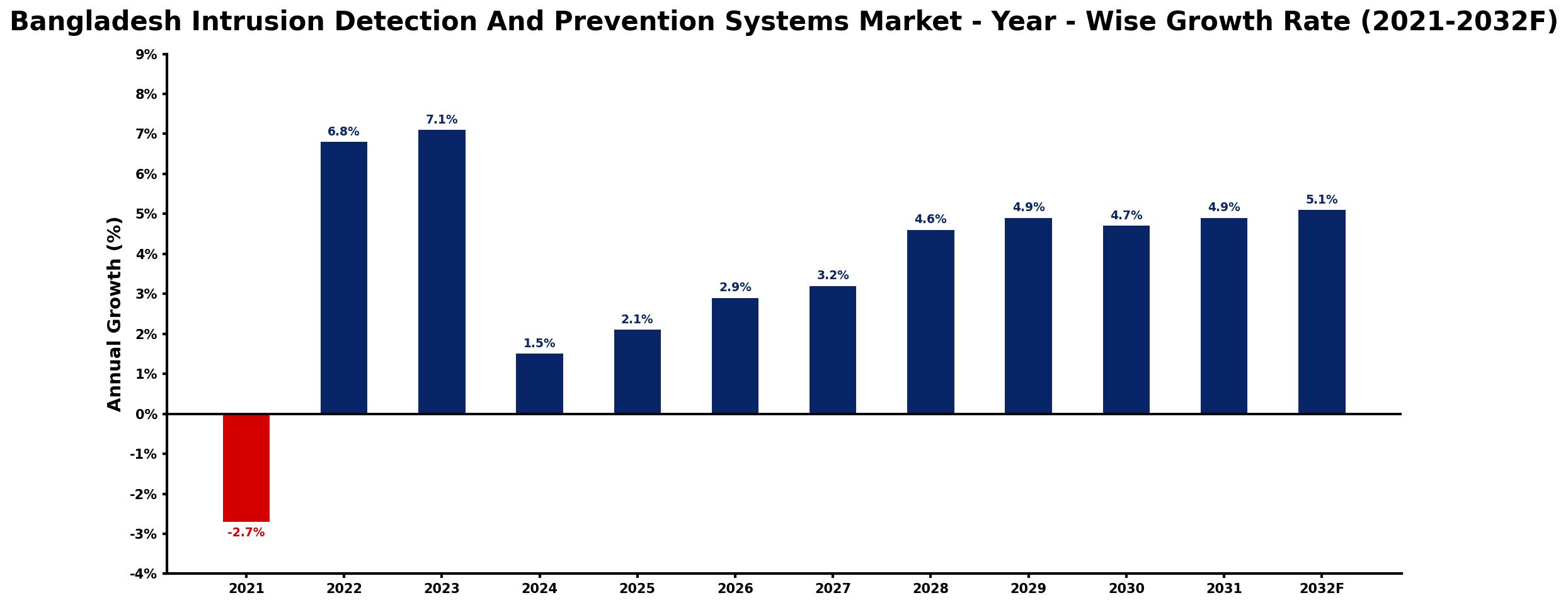
The table below presents the year‑wise growth rates along with the key drivers influencing the market
| Year | Growth Rate | Major Drivers |
| 2021 | -2.7% | decreased investments in cybersecurity infrastructure |
| 2022 | 6.8% | growing demand for enhanced security |
| 2023 | 7.1% | increased focus on data protection |
| 2024 | 1.5% | expansion of digital transformation initiatives |
| 2025 | 2.1% | rising adoption of cloud solutions |
| 2026 | 2.9% | growth in regulatory compliance requirements |
| 2027 | 3.2% | surge in cyber threat awareness |
| 2028 | 4.6% | increased funding for security startups |
| 2029 | 4.9% | increased overall sector activity |
| 2030 | 4.7% | rising need for remote security |
| 2031 | 4.9% | growing automotive sector requirements |
| 2032 | 5.1% | increased integration of AI technologies |
Note: Market size estimations and growth projections presented in this report are based on 6Wresearch's proprietary forecasting methodology, utilizing the latest available industry data, government publications, and primary research inputs.
Bangladesh Intrusion Detection And Prevention Systems Market Synopsis
In recent years, the Bangladesh Intrusion Detection and Prevention Systems market has witnessed a surge in demand, primarily driven by the escalating threats posed by cyberattacks. Organizations are increasingly recognizing the need to protect their sensitive data and network integrity, spurring investments in advanced security solutions. This evolving landscape has also led to a greater focus on real-time monitoring and response capabilities, essential for combating sophisticated cyber threats.
The market is characterized by a growing emphasis on integrating cutting-edge technologies such as artificial intelligence and machine learning, which enable enhanced threat detection and proactive measures. As small and medium-sized enterprises (SMEs) enhance their cybersecurity posture, the demand for user-friendly and cost-effective IDPS solutions is expected to grow, further shaping the market dynamics.
Bangladesh Intrusion Detection And Prevention Systems Market Key Takeaways
- Strong growth anticipated in the market, propelled by escalating cybersecurity threats.
- Government regulations are increasingly mandating the implementation of cybersecurity measures.
- Adoption of cloud-based IDPS solutions is on the rise, offering scalability and flexibility.
- AI and machine learning integration is becoming a standard for advanced threat detection.
- SMEs are increasingly investing in IDPS, recognizing the importance of cybersecurity.
Evaluation of Restraints in Bangladesh Intrusion Detection And Prevention Systems Market
Despite the positive growth trajectory of the Bangladesh Intrusion Detection and Prevention Systems market, several restraints persist. One significant barrier is the limited understanding and awareness of IDPS importance among small and medium enterprises. This lack of insight often leads to underinvestment in cybersecurity solutions. Furthermore, the high implementation and maintenance costs of effective IDPS can deter organizations with budget constraints from making necessary upgrades. The dearth of skilled professionals in the cybersecurity domain also poses a challenge, as organizations struggle to find expertise capable of managing these systems efficiently. Finally, the rapidly evolving nature of cyber threats necessitates constant updates to IDPS, creating a landscape of continuous investment and adaptation.
Bangladesh Intrusion Detection And Prevention Systems Market Trends
The market is currently experiencing significant trends that are shaping demand and technological advancements. A key trend is the growing shift toward cloud-based IDPS solutions, which offer enhanced scalability and operational flexibility for businesses. Additionally, the incorporation of artificial intelligence and machine learning capabilities is revolutionizing threat detection, enabling organizations to respond swiftly to potential breaches. This evolution is accompanied by an increasing focus on user-friendly interfaces and cost-effective solutions, particularly appealing to SMEs looking to bolster their cybersecurity defenses without overwhelming financial burdens.
Bangladesh Intrusion Detection And Prevention Systems Market Opportunities
Investment opportunities in the Bangladesh Intrusion Detection and Prevention Systems market are ripe, driven by the rising awareness of cyber threats among businesses. As organizations continue to digitize operations, the protection of networks and data assets remains paramount. Vendors that focus on providing advanced threat detection, real-time monitoring, and proactive response capabilities can tap into this burgeoning market. Moreover, sectors such as finance, healthcare, and e-commerce are increasingly prioritizing cybersecurity, creating ample opportunities for IDPS solution providers to meet evolving demands.
Government Initiatives in the Bangladesh Intrusion Detection And Prevention Systems Market
While specific policies targeting the Intrusion Detection and Prevention Systems market are not yet in place, the broader cybersecurity framework established by the Bangladesh government plays a crucial role. The Digital Security Act of 2018 aims to combat cybercrime and fortify digital infrastructure, providing a foundation for cybersecurity initiatives. Additionally, the establishment of the Bangladesh Computer Incident Response Team (BGD e-Gov CIRT) enhances the nations cybersecurity readiness. Organizations looking to invest in IDPS solutions are encouraged to engage with these governmental bodies to ensure compliance and gain insights into best practices for cybersecurity enhancement.
Future Insights of the Bangladesh Intrusion Detection And Prevention Systems Market
The future of the Bangladesh Intrusion Detection and Prevention Systems market appears optimistic, as increasing cyber threats and security breaches drive demand for comprehensive cybersecurity solutions. The digital transformation across various sectors, combined with the adoption of cloud services, amplifies the need for effective IDPS. Government initiatives aimed at enhancing cybersecurity measures and regulatory requirements for data protection will further stimulate market growth. As businesses continue to prioritize the safeguarding of sensitive information, innovative IDPS solutions are expected to emerge, fulfilling the evolving needs of the market.
Bangladesh Intrusion Detection And Prevention Systems Market Latest Developments (2025 - 2026)
In the latest developments within the Bangladesh Intrusion Detection and Prevention Systems market, there has been a noticeable uptick in collaborations between technology providers and SMEs. These partnerships aim to create customized solutions that address specific security needs while remaining cost-effective. Additionally, advancements in threat intelligence platforms are making significant strides, offering businesses enhanced capabilities in identifying and mitigating risks. Government-led initiatives have also started to facilitate workshops and training sessions aimed at raising awareness and equipping organizations with the necessary skills to navigate the cybersecurity landscape effectively.
Bangladesh Intrusion Detection And Prevention Systems Market - Key Attractiveness of the Report
- 10 Years of Market Numbers
- Historical Data Starting from 2022 to 2025
- Base Year: 2025
- Forecast Data until 2032
- Key Performance Indicators Impacting the Market
- Major Upcoming Developments and Projects
Key Highlights of the Report:
- Bangladesh Intrusion Detection And Prevention Systems Market Outlook
- Market Size of Bangladesh Intrusion Detection And Prevention Systems Market, 2025
- Forecast of Bangladesh Intrusion Detection And Prevention Systems Market, 2032
- Historical Data and Forecast of Bangladesh Intrusion Detection And Prevention Systems Revenues & Volume for the Period 2022-2032F
- Bangladesh Intrusion Detection And Prevention Systems Market Trend Evolution
- Bangladesh Intrusion Detection And Prevention Systems Market Drivers and Challenges
- Bangladesh Intrusion Detection And Prevention Systems Price Trends
- Bangladesh Intrusion Detection And Prevention Systems Porter's Five Forces
- Bangladesh Intrusion Detection And Prevention Systems Industry Life Cycle
- Historical Data and Forecast of Bangladesh Intrusion Detection And Prevention Systems Market Revenues & Volume By Components for the Period 2022-2032F
- Historical Data and Forecast of Bangladesh Intrusion Detection And Prevention Systems Market Revenues & Volume By Solutions for the Period 2022-2032F
- Historical Data and Forecast of Bangladesh Intrusion Detection And Prevention Systems Market Revenues & Volume By Services for the Period 2022-2032F
- Historical Data and Forecast of Bangladesh Intrusion Detection And Prevention Systems Market Revenues & Volume By Type for the Period 2022-2032F
- Historical Data and Forecast of Bangladesh Intrusion Detection And Prevention Systems Market Revenues & Volume By Network-based for the Period 2022-2032F
- Historical Data and Forecast of Bangladesh Intrusion Detection And Prevention Systems Market Revenues & Volume By Wireless-based for the Period 2022-2032F
- Historical Data and Forecast of Bangladesh Intrusion Detection And Prevention Systems Market Revenues & Volume By Network Behavior Analysis for the Period 2022-2032F
- Historical Data and Forecast of Bangladesh Intrusion Detection And Prevention Systems Market Revenues & Volume By Host-based for the Period 2022-2032F
- Historical Data and Forecast of Bangladesh Intrusion Detection And Prevention Systems Market Revenues & Volume By Organization Size for the Period 2022-2032F
- Historical Data and Forecast of Bangladesh Intrusion Detection And Prevention Systems Market Revenues & Volume By Small And Medium-sized Enterprises for the Period 2022-2032F
- Historical Data and Forecast of Bangladesh Intrusion Detection And Prevention Systems Market Revenues & Volume By Large Enterprise for the Period 2022-2032F
- Historical Data and Forecast of Bangladesh Intrusion Detection And Prevention Systems Market Revenues & Volume By Deployment Mode for the Period 2022-2032F
- Historical Data and Forecast of Bangladesh Intrusion Detection And Prevention Systems Market Revenues & Volume By Cloud for the Period 2022-2032F
- Historical Data and Forecast of Bangladesh Intrusion Detection And Prevention Systems Market Revenues & Volume By On-premises for the Period 2022-2032F
- Historical Data and Forecast of Bangladesh Intrusion Detection And Prevention Systems Market Revenues & Volume By Verticals for the Period 2022-2032F
- Historical Data and Forecast of Bangladesh Intrusion Detection And Prevention Systems Market Revenues & Volume By Banking, Financial Services And Insurance for the Period 2022-2032F
- Historical Data and Forecast of Bangladesh Intrusion Detection And Prevention Systems Market Revenues & Volume By Government And Defense for the Period 2022-2032F
- Historical Data and Forecast of Bangladesh Intrusion Detection And Prevention Systems Market Revenues & Volume By Healthcare for the Period 2022-2032F
- Historical Data and Forecast of Bangladesh Intrusion Detection And Prevention Systems Market Revenues & Volume By Information Technology And Telecom for the Period 2022-2032F
- Historical Data and Forecast of Bangladesh Intrusion Detection And Prevention Systems Market Revenues & Volume By Retail And Ecommerce for the Period 2022-2032F
- Historical Data and Forecast of Bangladesh Intrusion Detection And Prevention Systems Market Revenues & Volume By Manufacturing for the Period 2022-2032F
- Historical Data and Forecast of Bangladesh Intrusion Detection And Prevention Systems Market Revenues & Volume By Others for the Period 2022-2032F
- Bangladesh Intrusion Detection And Prevention Systems Import Export Trade Statistics
- Market Opportunity Assessment By Components
- Market Opportunity Assessment By Type
- Market Opportunity Assessment By Organization Size
- Market Opportunity Assessment By Deployment Mode
- Market Opportunity Assessment By Verticals
- Bangladesh Intrusion Detection And Prevention Systems Top Companies Market Share
- Bangladesh Intrusion Detection And Prevention Systems Competitive Benchmarking By Technical and Operational Parameters
- Bangladesh Intrusion Detection And Prevention Systems Company Profiles
- Bangladesh Intrusion Detection And Prevention Systems Key Strategic Recommendations






































