Bangladesh Magnesium Metal Market Size, Share & Growth Rate
The Bangladesh Magnesium Metal Market was estimated at USD 421 Million in 2025 and is projected to reach USD 579 Million by 2032, growing at a CAGR of 4.7% from 2026 to 2032. This anticipated growth is primarily fueled by the increasing demand from the automotive and aerospace sectors, where magnesium's lightweight and high-strength properties are critical. Furthermore, ongoing infrastructure development projects in Bangladesh and advancements in magnesium production technologies are expected to significantly enhance market opportunities.
Bangladesh Magnesium Metal Market Year-wise Growth Rate and Key Drivers
This graph highlights how the Bangladesh Magnesium Metal Market has steadily grown over the years, supported by major growth factors.
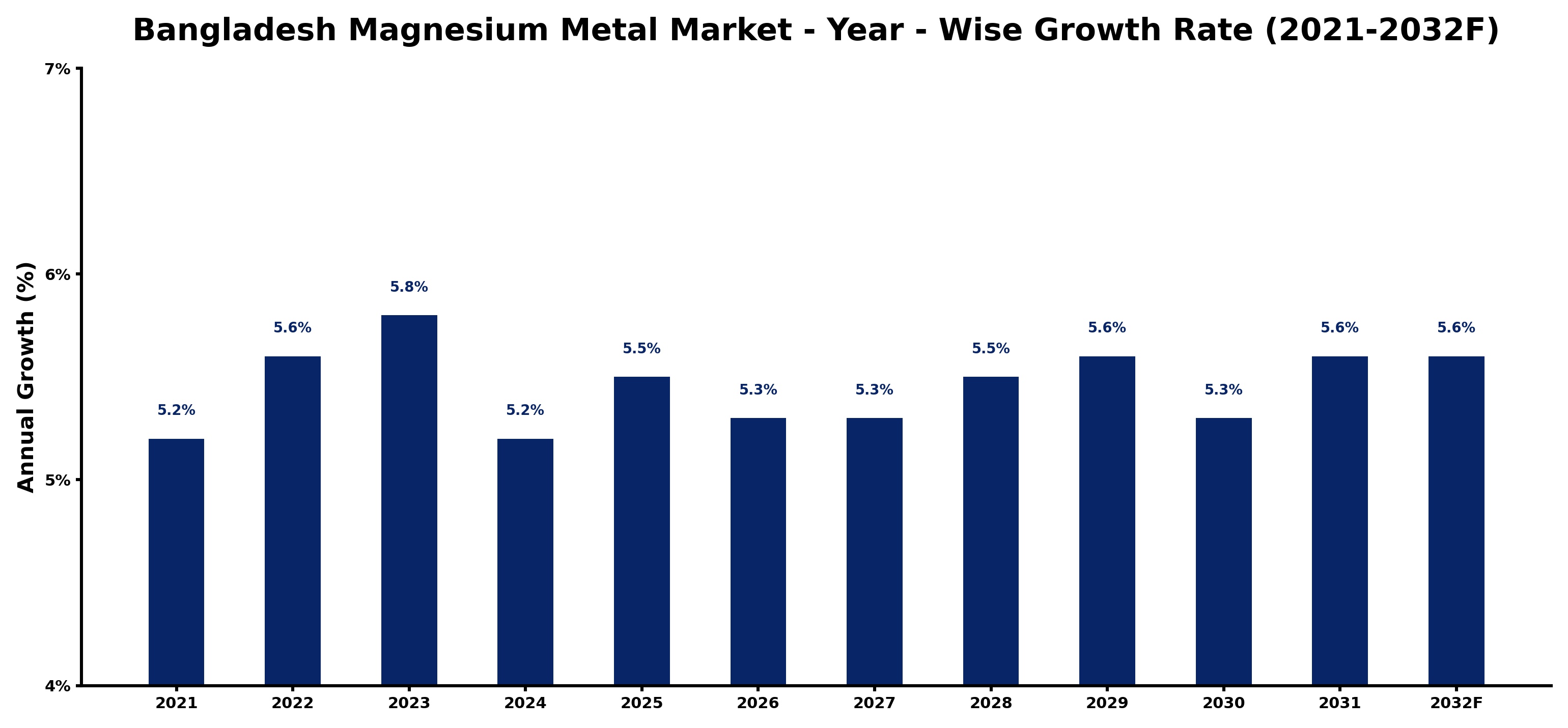
The table below presents the year‑wise growth rates along with the key drivers influencing the market
| Year | Growth Rate | Major Drivers |
| 2021 | 5.2% | Increased automotive production demand |
| 2022 | 5.6% | Construction sector growth accelerated usage |
| 2023 | 5.8% | Aerospace applications expanded significantly |
| 2024 | 5.2% | Electronics manufacturing drove consumption |
| 2025 | 5.5% | Renewable energy projects increased demand |
| 2026 | 5.3% | Alloy production requirements rose sharply |
| 2027 | 5.3% | Consumer goods market expanded rapidly |
| 2028 | 5.5% | Healthcare technology adoption increased usage |
| 2029 | 5.6% | Defense sector investments boosted growth |
| 2030 | 5.3% | Research and development funding increased |
| 2031 | 5.6% | Infrastructure projects enhanced demand |
| 2032 | 5.6% | Export opportunities expanded significantly |
Note - Market size estimations and growth projections presented in this report are based on 6Wresearch’s advanced forecasting approach, validated with industry datasets as of June 2026.
Bangladesh Magnesium Metal Market Synopsis
As the demand for lightweight materials grows in Bangladesh, the magnesium metal market is rapidly evolving to meet the needs of diverse industries. The automotive sector, in particular, is leading this transformation, driven by a shift towards more efficient and sustainable manufacturing processes.
In addition to automotive applications, aerospace and electronics are increasingly embracing magnesium alloys for their remarkable strength-to-weight ratio. This shift not only enhances product performance but also aligns with global trends toward sustainability and reduced environmental impact.
Bangladesh Magnesium Metal Market Key Takeaways
- The market is experiencing growth due to rising applications in automotive, aerospace, and electronics.
- Investment in R&D is essential to overcome challenges related to production capacity and costs.
- Government policies are favoring foreign investments and sustainable practices in magnesium production.
- Awareness and education on magnesium's benefits among industries are critical for market expansion.
- The availability of raw materials in Bangladesh positions it favorably for local production enhancements.
Evaluation of Restraints in Bangladesh Magnesium Metal Market
The Bangladesh Magnesium Metal Market faces significant constraints, particularly due to limited domestic production capacity. This limitation compels reliance on imports, which can lead to increased costs and potential supply chain disruptions. Moreover, the fluctuation of global prices poses challenges for local manufacturers aiming to remain competitive. There's also a noticeable gap in awareness regarding the advantages of magnesium among various industries, which limits its adoption. Addressing these issues requires strategic initiatives to bolster local production capabilities, improve distribution networks, and elevate industry education about magnesium's unique properties and applications.
Bangladesh Magnesium Metal Market Trends
Currently, one of the most compelling trends in the Bangladesh Magnesium Metal Market is the growing shift towards sustainable manufacturing processes. Industries are increasingly recognizing the environmental benefits of utilizing lightweight materials like magnesium. Additionally, technological advancements in production methods are enabling more efficient use of resources and reducing waste, which is vital for maintaining cost competitiveness. There is also a rising trend of forming strategic collaborations between local and international players, enhancing product offerings and expanding distribution channels.
Bangladesh Magnesium Metal Market Opportunities
The investment landscape within the Bangladesh Magnesium Metal Market is promising, fueled by the burgeoning need for lightweight materials. The automotive and aerospace sectors' ongoing growth, coupled with the government's support for industrialization, presents a wealth of opportunities. Local availability of essential raw materials like dolomite and magnesite adds a competitive edge. Furthermore, enhancing partnerships with local manufacturers and research institutions can accelerate innovation and market penetration, enabling investors to seize the increasing demand for magnesium alloys in various applications.
Government Initiatives in the Bangladesh Magnesium Metal Market
The Bangladeshi government is actively promoting the magnesium metal market through a variety of initiatives aimed at fostering growth and sustainability. Policies designed to attract foreign investments include tax incentives and subsidies that encourage companies to enter the market. Furthermore, regulatory frameworks are being established to ensure environmentally friendly production practices, thereby minimizing the ecological impact of magnesium manufacturing. Public spending on research and development also plays a pivotal role in enhancing product quality and advancing technological capabilities within the sector.
Future Insights of the Bangladesh Magnesium Metal Market
Looking ahead to 2026-2032, the Bangladesh Magnesium Metal Market is positioned for steady growth. The increasing adoption of lightweight materials in key industries will drive demand, particularly as companies prioritize sustainability. Government initiatives supporting research and development, along with the ongoing infrastructure projects, will further bolster the market. However, addressing the challenges related to production capacity and cost management will be crucial to fully harnessing the growth potential. Overall, with a favorable policy environment and rising industry awareness, the market is on a path to gradual yet significant expansion.
Bangladesh Magnesium Metal Market Latest Developments (May 2025 - June 2026)
Recent developments in the Bangladesh Magnesium Metal Market indicate a strong focus on sustainability and innovation. Several initiatives have been launched to enhance local production capabilities while ensuring environmentally friendly practices. Collaboration between government and industry players is intensifying, aimed at promoting awareness of magnesium's benefits and applications. Furthermore, technological advancements in production processes are expected to significantly improve efficiency and reduce costs, setting a solid foundation for future market growth.
Bangladesh Magnesium Metal Market - Key Attractiveness of the Report
- 10 Years of Market Numbers
- Historical Data Starting from 2022 to 2025
- Base Year: 2025
- Forecast Data until 2032
- Key Performance Indicators Impacting the Market
- Major Upcoming Developments and Projects
Key Highlights of the Report:
- Bangladesh Magnesium Metal Market Outlook
- Market Size of Bangladesh Magnesium Metal Market, 2025
- Forecast of Bangladesh Magnesium Metal Market, 2032
- Historical Data and Forecast of Bangladesh Magnesium Metal Revenues & Volume for the Period 2022-2032F
- Bangladesh Magnesium Metal Market Trend Evolution
- Bangladesh Magnesium Metal Market Drivers and Challenges
- Bangladesh Magnesium Metal Price Trends
- Bangladesh Magnesium Metal Porter's Five Forces
- Bangladesh Magnesium Metal Industry Life Cycle
- Historical Data and Forecast of Bangladesh Magnesium Metal Market Revenues & Volume By Application for the Period 2022-2032F
- Historical Data and Forecast of Bangladesh Magnesium Metal Market Revenues & Volume By Die Casting for the Period 2022-2032F
- Historical Data and Forecast of Bangladesh Magnesium Metal Market Revenues & Volume By Aluminum Alloys for the Period 2022-2032F
- Historical Data and Forecast of Bangladesh Magnesium Metal Market Revenues & Volume By Titanium Reduction for the Period 2022-2032F
- Historical Data and Forecast of Bangladesh Magnesium Metal Market Revenues & Volume By Iron & Steel Making for the Period 2022-2032F
- Historical Data and Forecast of Bangladesh Magnesium Metal Market Revenues & Volume By Others for the Period 2022-2032F
- Historical Data and Forecast of Bangladesh Magnesium Metal Market Revenues & Volume By End-user Industry for the Period 2022-2032F
- Historical Data and Forecast of Bangladesh Magnesium Metal Market Revenues & Volume By Automotive for the Period 2022-2032F
- Historical Data and Forecast of Bangladesh Magnesium Metal Market Revenues & Volume By Aerospace for the Period 2022-2032F
- Historical Data and Forecast of Bangladesh Magnesium Metal Market Revenues & Volume By Electronics for the Period 2022-2032F
- Historical Data and Forecast of Bangladesh Magnesium Metal Market Revenues & Volume By Sports for the Period 2022-2032F
- Historical Data and Forecast of Bangladesh Magnesium Metal Market Revenues & Volume By Medical for the Period 2022-2032F
- Historical Data and Forecast of Bangladesh Magnesium Metal Market Revenues & Volume By Others for the Period 2022-2032F
- Bangladesh Magnesium Metal Import Export Trade Statistics
- Market Opportunity Assessment By Application
- Market Opportunity Assessment By End-user Industry
- Bangladesh Magnesium Metal Top Companies Market Share
- Bangladesh Magnesium Metal Competitive Benchmarking By Technical and Operational Parameters
- Bangladesh Magnesium Metal Company Profiles
- Bangladesh Magnesium Metal Key Strategic Recommendations






































