Bangladesh Metal Fabrication Market Size, Share & Growth Rate
The Bangladesh Metal Fabrication Market was estimated at USD 251 Million in 2025 and is projected to reach USD 333 Million by 2032, growing at a CAGR of 4.1% from 2026 to 2032. This growth trajectory is primarily driven by the rapid expansion of the construction and automotive sectors within the country. As urbanization accelerates and infrastructural projects gain momentum, the demand for customized metal components is surging, further propelling market growth.
Bangladesh Metal Fabrication Market Year-wise Growth Rate and Key Drivers
This graph highlights how the Bangladesh Metal Fabrication Market has steadily grown over the years, supported by major growth factors.
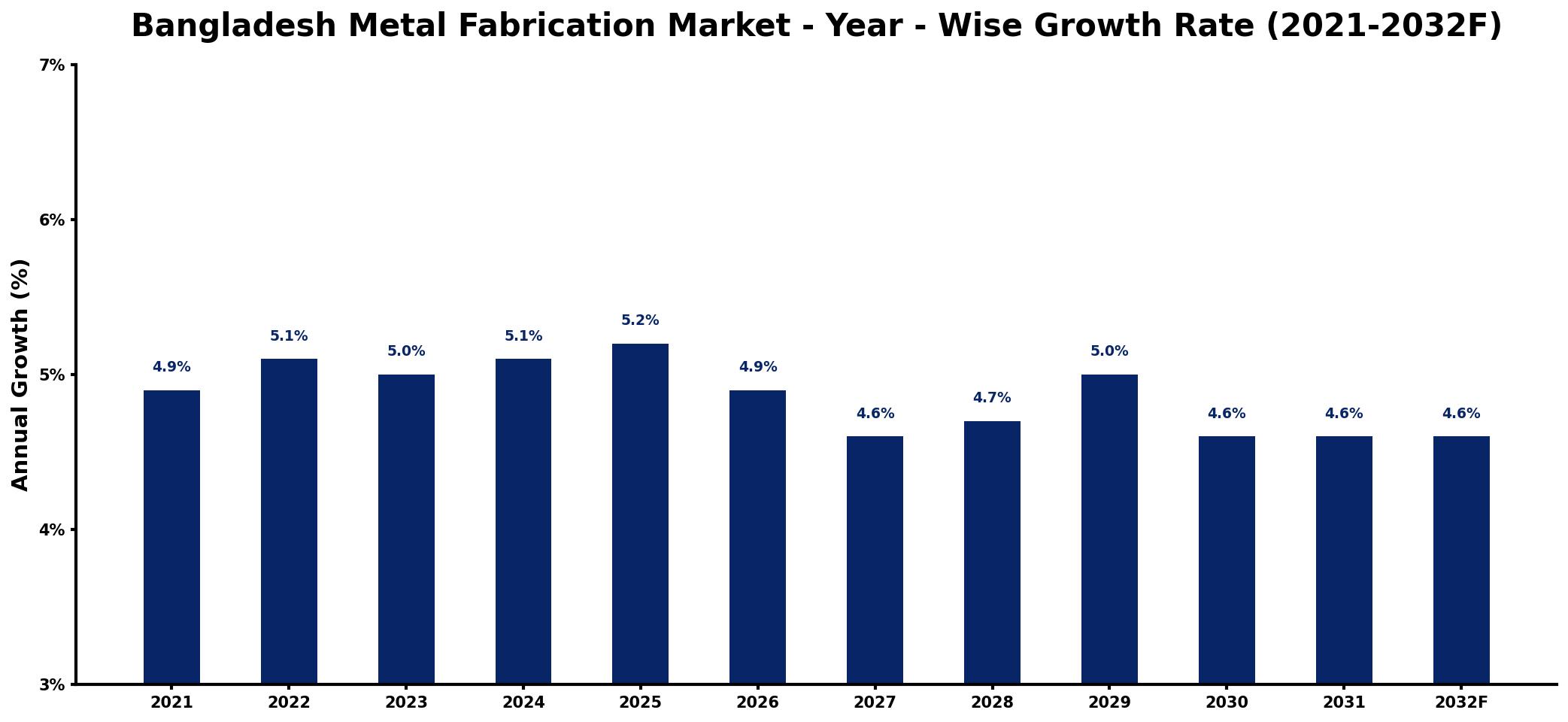
The table below presents the year‑wise growth rates along with the key drivers influencing the market
| Year | Growth Rate | Major Drivers |
| 2021 | 4.9% | Rising construction sector investments |
| 2022 | 5.1% | Increased demand for infrastructure projects |
| 2023 | 5.0% | Growing automotive industry requirements |
| 2024 | 5.1% | Expansion of renewable energy initiatives |
| 2025 | 5.2% | Surge in residential building projects |
| 2026 | 4.9% | Growing demand for industrial equipment |
| 2027 | 4.6% | Emerging technology adoption in sectors |
| 2028 | 4.7% | Increased focus on local production |
| 2029 | 5.0% | Rising exports to international markets |
| 2030 | 4.6% | Growing interest in sustainable practices |
| 2031 | 4.6% | Increased government infrastructure spending |
| 2032 | 4.6% | improved processing technologies adoption |
Note: Market size estimations and growth projections presented in this report are based on 6Wresearch's proprietary forecasting methodology, utilizing the latest available industry data, government publications, and primary research inputs.
Bangladesh Metal Fabrication Market Synopsis
The most significant force shaping the Bangladesh Metal Fabrication Market is the ongoing construction boom. Increased investment in infrastructure, particularly in urban areas, is creating a robust demand for various metal fabrication services and products. This surge is further amplified by the automotive industry, which increasingly relies on fabricated metal components to meet growing production needs.
Additionally, the trend towards customization in metal fabrication is gaining traction. As industries require tailored solutions, businesses are adapting to meet these specific demands, thus enhancing their competitive edge in a growing market. Overall, the convergence of industrial expansion and evolving consumer preferences is setting a positive growth landscape.
Bangladesh Metal Fabrication Market Key Takeaways
- The market is poised for substantial growth, projected to reach USD 333 Million by 2032.
- Urbanization and industrialization are significant drivers of market demand.
- Customization in metal fabrication is increasingly sought after by various sectors.
- The automotive sector is a crucial contributor to the market's growth trajectory.
- Government initiatives may bolster investment and infrastructure development in the sector.
Evaluation of Restraints in Bangladesh Metal Fabrication Market
Despite the promising growth, several restraints are limiting the potential of the Bangladesh Metal Fabrication Market. A notable challenge is the technological limitations that hinder operational efficiency and productivity in fabrication processes. Additionally, the industry faces a shortage of skilled labor, which compromises the quality of work and slows down project completion. Volatile raw material prices can also strain profit margins, creating further complexities for businesses. The necessity for precision and stringent quality control adds another layer of difficulty, especially when deadlines are tight. These challenges must be navigated effectively to sustain growth.
Bangladesh Metal Fabrication Market Trends
Several trends are currently shaping the Bangladesh Metal Fabrication Market. Firstly, the adoption of advanced technologies such as automation and robotics is transforming fabrication processes, enhancing efficiency and precision. Secondly, there is a growing emphasis on sustainability, prompting companies to incorporate eco-friendly practices and materials in their production methods. The rising use of computer-aided design (CAD) tools further allows for greater customization, catering to the specific needs of various industries. These trends not only reflect changing consumer preferences but also position companies to be more competitive in a rapidly evolving market.
Bangladesh Metal Fabrication Market Opportunities
Opportunities within the Bangladesh Metal Fabrication Market are expanding as investments in infrastructure continue to rise. The governments focus on developing industrial corridors and smart cities presents significant avenues for growth. Moreover, the automotive industrys shift toward electric vehicles is likely to increase demand for specialized fabricated components. Additionally, exploring international markets for exports offers potential revenue streams for local companies. By aligning with these emerging opportunities, businesses can leverage their capabilities to tap into new customer bases.
Government Initiatives in the Bangladesh Metal Fabrication Market
The Bangladesh government is increasingly recognizing the importance of the metal fabrication sector in driving economic growth. Policies may include incentives for investment in manufacturing infrastructure, aiming to bolster production capabilities. Skills development programs are also being introduced to address the skilled labor shortage and enhance the technical competencies of the workforce. Trade facilitation measures could further aid in easing export processes, promoting a competitive environment for local companies in the international arena. Overall, these initiatives signify a commitment to fostering sustainable growth in the metal fabrication industry.
Future Insights of the Bangladesh Metal Fabrication Market
Looking ahead to 2026-2032, the Bangladesh Metal Fabrication Market is expected to experience notable advancements. Continued urbanization will likely spur demand for diverse fabrication services, while technological upgrades will facilitate more efficient production techniques. As industries diversify, opportunities for customized metal components will grow, further driving market expansion. The anticipated rise in government-backed infrastructure projects is set to play a critical role in shaping the market landscape, creating a favorable environment for investment and innovation.
Bangladesh Metal Fabrication Market Latest Developments (2025 - 2026)
In recent months, the Bangladesh Metal Fabrication Market has seen a shift towards adopting more advanced fabrication technologies. Companies are increasingly investing in automation to enhance production efficiency. Additionally, collaboration between industry players and educational institutions is on the rise, aimed at addressing the skilled labor gap through targeted training programs. As environmental concerns gain prominence, more firms are exploring sustainable practices and materials, positioning themselves as responsible market participants. These developments signify an evolving landscape focused on innovation and sustainability.
Bangladesh Metal Fabrication Market - Key Attractiveness of the Report
- 10 Years of Market Numbers
- Historical Data Starting from 2022 to 2025
- Base Year: 2025
- Forecast Data until 2032
- Key Performance Indicators Impacting the Market
- Major Upcoming Developments and Projects
Key Highlights of the Report:
- Bangladesh Metal Fabrication Market Outlook
- Market Size of Bangladesh Metal Fabrication Market, 2025
- Forecast of Bangladesh Metal Fabrication Market, 2032
- Historical Data and Forecast of Bangladesh Metal Fabrication Revenues & Volume for the Period 2022-2032F
- Bangladesh Metal Fabrication Market Trend Evolution
- Bangladesh Metal Fabrication Market Drivers and Challenges
- Bangladesh Metal Fabrication Price Trends
- Bangladesh Metal Fabrication Porter's Five Forces
- Bangladesh Metal Fabrication Industry Life Cycle
- Historical Data and Forecast of Bangladesh Metal Fabrication Market Revenues & Volume By End-user Industry for the Period 2022-2032F
- Historical Data and Forecast of Bangladesh Metal Fabrication Market Revenues & Volume By Manufacturing for the Period 2022-2032F
- Historical Data and Forecast of Bangladesh Metal Fabrication Market Revenues & Volume By Power and Utilities for the Period 2022-2032F
- Historical Data and Forecast of Bangladesh Metal Fabrication Market Revenues & Volume By Construction for the Period 2022-2032F
- Historical Data and Forecast of Bangladesh Metal Fabrication Market Revenues & Volume By Oil and Gas for the Period 2022-2032F
- Historical Data and Forecast of Bangladesh Metal Fabrication Market Revenues & Volume By Other End-user Industries for the Period 2022-2032F
- Historical Data and Forecast of Bangladesh Metal Fabrication Market Revenues & Volume By Metal Folding for the Period 2022-2032F
- Historical Data and Forecast of Bangladesh Metal Fabrication Market Revenues & Volume By Product category for the Period 2022-2032F
- Historical Data and Forecast of Bangladesh Metal Fabrication Market Revenues & Volume By Structural steel fabrication for the Period 2022-2032F
- Historical Data and Forecast of Bangladesh Metal Fabrication Market Revenues & Volume By Process Equipment Fabrication for the Period 2022-2032F
- Bangladesh Metal Fabrication Import Export Trade Statistics
- Market Opportunity Assessment By End-user Industry
- Market Opportunity Assessment By Product category
- Bangladesh Metal Fabrication Top Companies Market Share
- Bangladesh Metal Fabrication Competitive Benchmarking By Technical and Operational Parameters
- Bangladesh Metal Fabrication Company Profiles
- Bangladesh Metal Fabrication Key Strategic Recommendations






































