Bangladesh Non-alcoholic Drink Market Summary
The bangladesh non-alcoholic drink market was estimated at USD 318 Million in 2025 and is projected to reach USD 438 Million by 2032, growing at a CAGR of 5.7% from 2026 to 2032.
Bangladesh Non-alcoholic Drink Market Year-wise Growth Rate and Key Drivers
This graph highlights how the Bangladesh Non-alcoholic Drink Market has steadily grown over the past five years, supported by major growth factors.
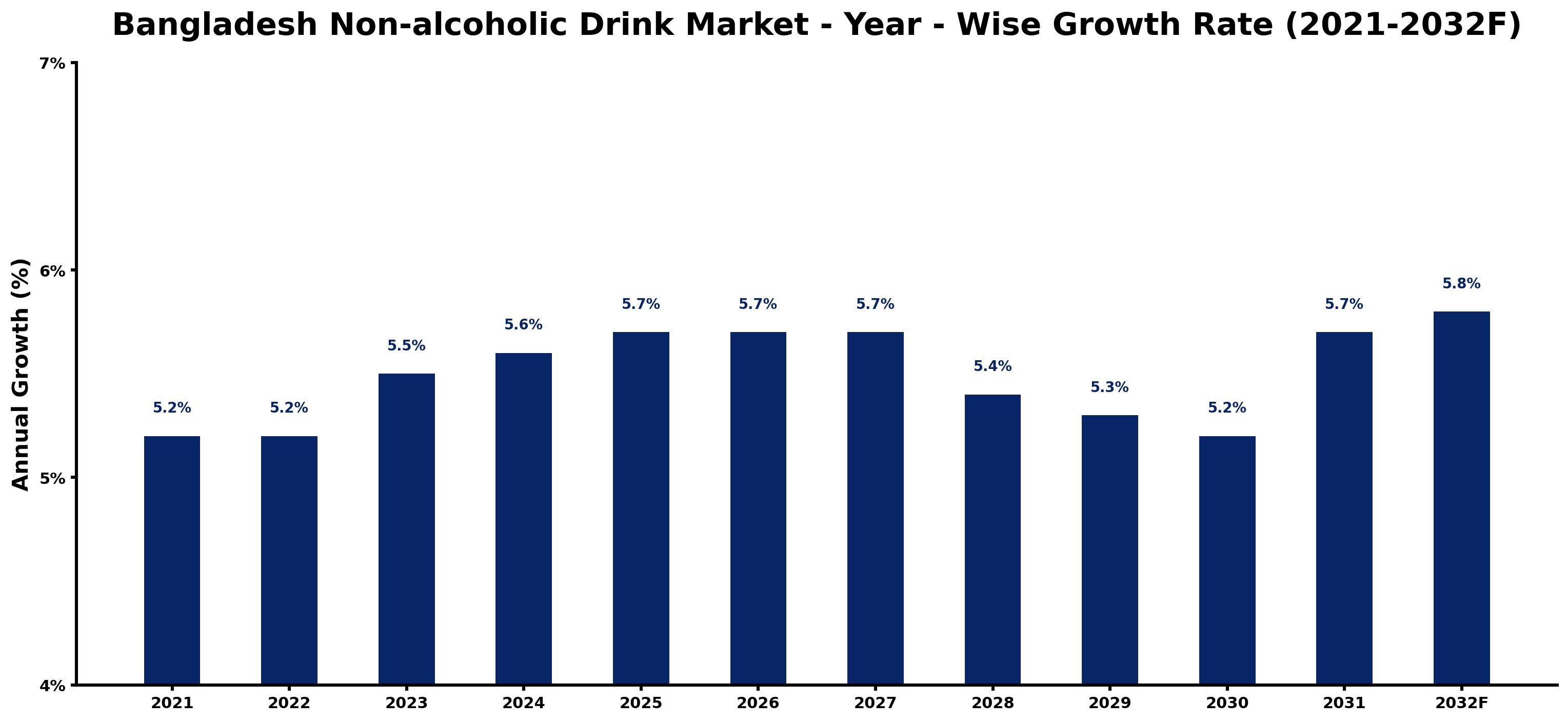
The table below presents the year wise growth rates along with the key drivers influencing the market
| Year | Growth Rate | Major Drivers |
| 2021 | 5.2% | Bangladesh's urban populations increasingly prefer healthier beverage options for hydration. |
| 2022 | 5.2% | Local brands innovate with natural ingredients to cater to health-conscious consumers. |
| 2023 | 5.5% | E-commerce platforms expand, providing convenient access to non-alcoholic beverages nationwide. |
| 2024 | 5.6% | Consumer awareness around health drives demand for sugar-free drink alternatives. |
| 2025 | 5.7% | Increased disposable income enhances spending on premium and organic drink segments. |
| 2026 | 5.7% | Local entrepreneurs tap into traditional flavors, blending culture with health trends. |
| 2027 | 5.7% | Partnerships between brands and health influencers educate consumers on beverage choices. |
| 2028 | 5.4% | Sustainability trends prompt brands to adopt eco-friendly packaging solutions. |
| 2029 | 5.3% | Rural markets begin to reflect urban preferences, diversifying product offerings significantly. |
| 2030 | 5.2% | Innovative marketing campaigns target younger demographics, emphasizing lifestyle integration. |
| 2031 | 5.7% | Technological advancements streamline production, enhancing product variety and availability. |
| 2032 | 5.8% | Physical retail stores evolve into experiential centers, showcasing beverage innovations. |
Note - Market size estimations and growth projections presented in this report are based on 6Wresearch's advanced forecasting approach, validated with industry datasets as of June 2026.
Bangladesh Non-alcoholic Drink Market Synopsis
The Bangladesh Non-alcoholic Drink Market is projected to reach 5.7% and witness significant growth during the forecast period (2026-2032). This dynamic market includes a wide array of beverages such as carbonated soft drinks, fruit juices, flavored beverages, energy drinks, bottled water, tea, and coffee. Given the country's hot and humid climate, these drinks play a critical role in hydration and consumer satisfaction. With the rising trend towards healthier beverages, there is an increasing demand for options that feature reduced sugar, natural ingredients, and functional benefits. The market is set to expand, driven by consumer behavior shifts, enhanced disposable incomes, and innovative marketing strategies.
Bangladesh Non-alcoholic Drink Market Growth Drivers
A multitude of factors contribute to the growth of the Bangladesh Non-alcoholic Drink Market. One of the primary drivers is the surge in health consciousness among consumers, prompting a shift towards beverages formulated with natural ingredients and lower sugar content. Furthermore, manufacturers are diversifying their product lines to meet distinct consumer preferences, which is enhancing market engagement. Increased urbanization and rising disposable income also play a significant role in amplifying demand for premium non-alcoholic drinks. Additionally, effective marketing initiatives are vital to attracting a broader audience, as brands emphasize lifestyle compatibility through strategic campaigns. Ultimately, evolving tastes and preferences among consumers ensure that manufacturers continue exploring innovation within the sector.
Bangladesh Non-alcoholic Drink Market Challenges and Restraints
Despite its growth potential, the Bangladesh Non-alcoholic Drink Market faces several challenges that could hinder its trajectory. One significant challenge is the increasing health concerns surrounding sugar-laden beverages, which may compel consumers to opt for alternatives. The competitive landscape is intensifying, with alternative beverages, such as infused waters and herbal teas, gaining popularity and challenging traditional categories. Furthermore, pricing pressures are affecting profit margins as manufacturers strive to remain competitive while adhering to consumer demands for higher-quality ingredients. Adapting to changing regulations and maintaining compliance with government standards can also create additional hurdles for stakeholders in this market. Lastly, the ongoing challenge of managing production costs while ensuring product differentiation remains a critical focus for companies operating in this sector.
Bangladesh Non-alcoholic Drink Market Government Investment and Initiatives
The government of Bangladesh plays a pivotal role in regulating and developing the Non-alcoholic Drink Market through various policies and initiatives. To promote public health, authorities have established quality standards for beverage production, ensuring that products meet safety requirements and consumer expectations. These regulations include labeling requirements that provide clear nutritional information, enabling consumers to make informed choices about their beverages. Additionally, public awareness campaigns are conducted to encourage healthier drinking habits among the population. The government is also focused on fostering investments in the beverage sector, which may lead to wider distribution networks and enhanced market accessibility. Overall, these initiatives aim to create a healthier drinking environment by promoting transparency and encouraging responsible consumption.
Bangladesh Non-alcoholic Drink Market Latest Developments (May 2025 - June 2026)
In the recent period from May 2025 to June 2026, significant trends have emerged in the Bangladesh Non-alcoholic Drink Market, reflecting changing consumer preferences and industry direction. A marked increase in the introduction of functional beverages has been noted, with brands focusing on products that offer health benefits beyond basic refreshment. This includes the rise of herbal and organic drinks that cater to health-conscious consumers looking for alternatives to traditional soft drinks. Sustainability has also become a prominent theme, as companies explore eco-friendly packaging solutions to address environmental concerns. Additionally, the competitive landscape has witnessed intensified marketing initiatives aimed at promoting unique product attributes, especially among younger demographic groups. Overall, the shift towards health, wellness, and sustainability signifies a transformational period for the non-alcoholic beverage sector in Bangladesh.
Bangladesh Non-alcoholic Drink Market - Key Attractiveness of the Report
- 10 Years of Market Numbers
- Historical Data Starting from 2022 to 2025
- Base Year: 2025
- Forecast Data until 2032
- Key Performance Indicators Impacting the Market
- Major Upcoming Developments and Projects
Key Highlights of the Report:
- Bangladesh Non-alcoholic Drink Market Outlook
- Market Size of Bangladesh Non-alcoholic Drink Market, 2025
- Forecast of Bangladesh Non-alcoholic Drink Market, 2032
- Historical Data and Forecast of Bangladesh Non-alcoholic Drink Revenues & Volume for the Period 2022-2032F
- Bangladesh Non-alcoholic Drink Market Trend Evolution
- Bangladesh Non-alcoholic Drink Market Drivers and Challenges
- Bangladesh Non-alcoholic Drink Price Trends
- Bangladesh Non-alcoholic Drink Porter's Five Forces
- Bangladesh Non-alcoholic Drink Industry Life Cycle
- Historical Data and Forecast of Bangladesh Non-alcoholic Drink Market Revenues & Volume By Product Types for the Period 2022-2032F
- Historical Data and Forecast of Bangladesh Non-alcoholic Drink Market Revenues & Volume By Carbonated?Drinks for the Period 2022-2032F
- Historical Data and Forecast of Bangladesh Non-alcoholic Drink Market Revenues & Volume By Non-Carbonated?Drinks for the Period 2022-2032F
- Historical Data and Forecast of Bangladesh Non-alcoholic Drink Market Revenues & Volume By Distribution Channel for the Period 2022-2032F
- Historical Data and Forecast of Bangladesh Non-alcoholic Drink Market Revenues & Volume By Online for the Period 2022-2032F
- Historical Data and Forecast of Bangladesh Non-alcoholic Drink Market Revenues & Volume By Offline for the Period 2022-2032F
- Bangladesh Non-alcoholic Drink Import Export Trade Statistics
- Market Opportunity Assessment By Product Types
- Market Opportunity Assessment By Distribution Channel
- Bangladesh Non-alcoholic Drink Top Companies Market Share
- Bangladesh Non-alcoholic Drink Competitive Benchmarking By Technical and Operational Parameters
- Bangladesh Non-alcoholic Drink Company Profiles
- Bangladesh Non-alcoholic Drink Key Strategic Recommendations






































