Ecuador Non-alcoholic Drink Market Top 5 Importing Countries and Market Competition (HHI) Analysis
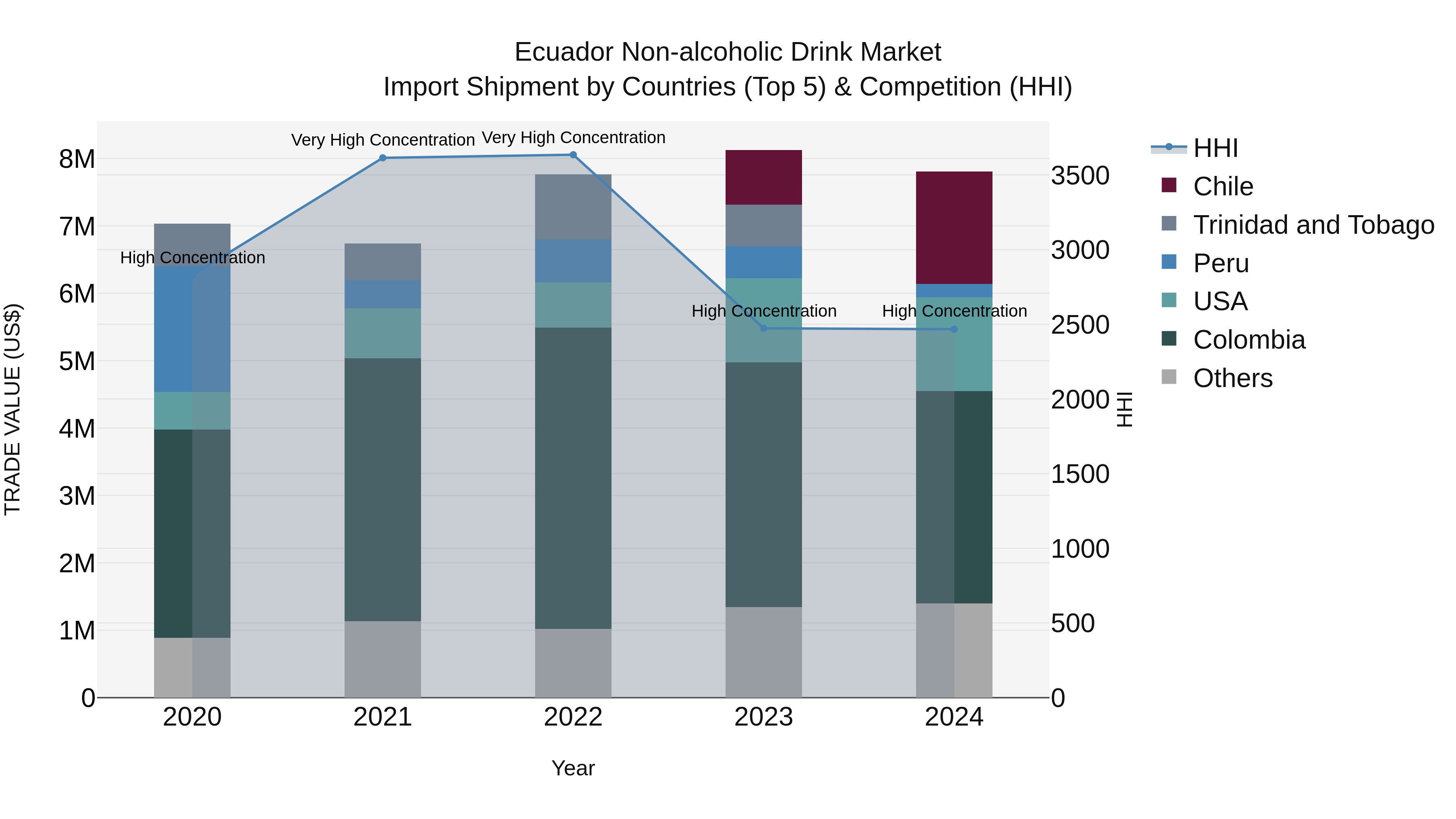
In 2024, Ecuador continued to see significant import shipments of non-alcoholic drinks, with top exporters being Colombia, Chile, USA, Guatemala, and Peru. The Market Top 5 Importing Countries and Market Competition (HHI) Analysis maintained a high concentration with a high Herfindahl-Hirschman Index (HHI). Despite a steady compound annual growth rate (CAGR) of 2.66% from 2020-2024, there was a slight decline in growth rate from 2023 to 2024 at -3.88%. This data suggests a competitive Market Top 5 Importing Countries and Market Competition (HHI) Analysis landscape and potential shifts in consumer preferences or economic conditions impacting the non-alcoholic beverage import Market Top 5 Importing Countries and Market Competition (HHI) Analysis in Ecuador.
Ecuador Export Potential Assessment For Non-alcoholic Drink Market (Values in USD Thousand)
Ecuador Non-alcoholic Drink Market Overview
Ecuadors non-alcoholic drink market is growing, with increased consumer demand for health-conscious beverages. This market includes products such as juices, energy drinks, and functional beverages.
Drivers of the market
The non-alcoholic drink market is experiencing growth due to the increasing health consciousness among consumers. As individuals seek healthier beverage options, the demand for low-calorie and functional drinks rises. The expansion of the food and beverage industry, along with innovative product offerings, supports the growth of the non-alcoholic drink market in Ecuador.
Challenges of the market
The Non-alcoholic Drink Market faces challenges related to changing consumer preferences and health consciousness. Companies must continually innovate to provide healthier and more diverse product offerings while navigating regulatory requirements regarding labeling and advertising. Additionally, competition from established brands can make it difficult for new entrants to gain market traction.
Government Policy of the market
To promote public health, the Ecuadorian government supports the non-alcoholic drink market through regulations that encourage the production of healthier beverage options. Policies promoting local sourcing and sustainable practices help enhance the market`s reputation while meeting consumer demand for healthier choices.
Key Highlights of the Report:
- Ecuador Non-alcoholic Drink Market Outlook
- Market Size of Ecuador Non-alcoholic Drink Market, 2024
- Forecast of Ecuador Non-alcoholic Drink Market, 2031
- Historical Data and Forecast of Ecuador Non-alcoholic Drink Revenues & Volume for the Period 2021-2031
- Ecuador Non-alcoholic Drink Market Trend Evolution
- Ecuador Non-alcoholic Drink Market Drivers and Challenges
- Ecuador Non-alcoholic Drink Price Trends
- Ecuador Non-alcoholic Drink Porter`s Five Forces
- Ecuador Non-alcoholic Drink Industry Life Cycle
- Historical Data and Forecast of Ecuador Non-alcoholic Drink Market Revenues & Volume By Product Types for the Period 2021-2031
- Historical Data and Forecast of Ecuador Non-alcoholic Drink Market Revenues & Volume By CarbonatedDrinks for the Period 2021-2031
- Historical Data and Forecast of Ecuador Non-alcoholic Drink Market Revenues & Volume By Non-CarbonatedDrinks for the Period 2021-2031
- Historical Data and Forecast of Ecuador Non-alcoholic Drink Market Revenues & Volume By Distribution Channel for the Period 2021-2031
- Historical Data and Forecast of Ecuador Non-alcoholic Drink Market Revenues & Volume By Online for the Period 2021-2031
- Historical Data and Forecast of Ecuador Non-alcoholic Drink Market Revenues & Volume By Offline for the Period 2021-2031
- Ecuador Non-alcoholic Drink Import Export Trade Statistics
- Market Opportunity Assessment By Product Types
- Market Opportunity Assessment By Distribution Channel
- Ecuador Non-alcoholic Drink Top Companies Market Share
- Ecuador Non-alcoholic Drink Competitive Benchmarking By Technical and Operational Parameters
- Ecuador Non-alcoholic Drink Company Profiles
- Ecuador Non-alcoholic Drink Key Strategic Recommendations






































