Bangladesh Personal Computers Market Size, Share & Growth Rate
The Bangladesh Personal Computers Market was estimated at USD 283 Million in 2025 and is projected to reach USD 399 Million by 2032, growing at a CAGR of 5.0% from 2026 to 2032. This growth trajectory is being propelled by increased disposable income, greater technology adoption, and government-led digitalization initiatives. As more Bangladeshi citizens gain access to personal computing, the market is expected to thrive, driven by a blend of urbanization and a youthful population eager for technological solutions.
Bangladesh Personal Computers Market Year-wise Growth Rate and Key Drivers
This graph highlights how the Bangladesh Personal Computers Market has steadily grown over the years, supported by major growth factors.
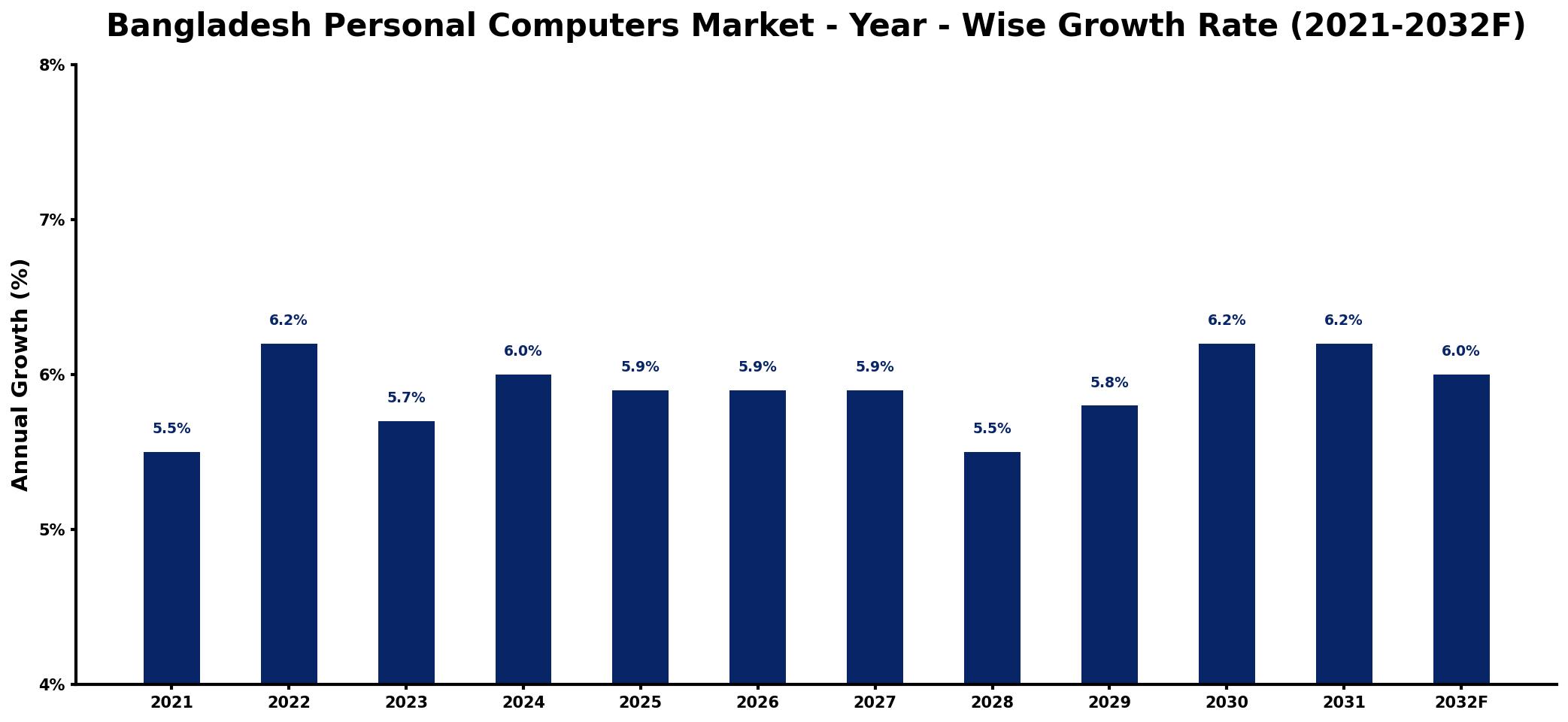
The table below presents the year‑wise growth rates along with the key drivers influencing the market
| Year | Growth Rate | Major Drivers |
| 2021 | 5.5% | Rising remote working trend |
| 2022 | 6.2% | Growing online education demand |
| 2023 | 5.7% | Increased digital service adoption |
| 2024 | 6.0% | Expansion of tech infrastructure |
| 2025 | 5.9% | Surge in e-commerce transactions |
| 2026 | 5.9% | Boost in gaming industry investments |
| 2027 | 5.9% | Adoption of cloud computing solutions |
| 2028 | 5.5% | Growth in fintech sector applications |
| 2029 | 5.8% | Increase in digital content creation |
| 2030 | 6.2% | Rising demand for cybersecurity solutions |
| 2031 | 6.2% | growing automotive sector requirements |
| 2032 | 6.0% | Growing interest in smart technologies |
Note: Market size estimations and growth projections presented in this report are based on 6Wresearch's proprietary forecasting methodology, utilizing the latest available industry data, government publications, and primary research inputs.
Bangladesh Personal Computers Market Synopsis
The strongest force shaping the Bangladesh Personal Computers Market is the increasing demand for mobility and technology-driven solutions. With remote work and online education becoming more prevalent, consumers are seeking versatile computing devices, such as laptops and tablets, that can meet their evolving needs.
As e-commerce platforms expand their reach into remote regions, the accessibility of personal computers is improving, making it easier for consumers and businesses alike to adopt this technology. The interplay of consumer demands and government support is fostering a robust growth environment for the market.
Bangladesh Personal Computers Market Key Takeaways
- Growing disposable income among consumers is increasing demand for personal computers.
- The market is experiencing a shift towards portable devices such as laptops and tablets.
- E-commerce platforms are significantly enhancing market accessibility in remote areas.
- Government initiatives are supporting digital literacy and local manufacturing of personal computers.
- Investment opportunities exist in customized solutions that cater to the diverse needs of consumers.
Evaluation of Restraints in Bangladesh Personal Computers Market
Despite the promising outlook, the Bangladesh Personal Computers Market is hindered by several restraints. One major challenge is the limited purchasing power of the general population, which can restrict access to personal computers. Infrastructure issues, including unreliable electricity and insufficient internet connectivity, further impede widespread adoption. Additionally, the market is in fierce competition with mobile devices, which offer similar functionalities at lower price points. There is also a noted lack of awareness about the comprehensive benefits of personal computers among certain segments of the population, which poses an obstacle to market expansion.
Bangladesh Personal Computers Market Trends
Current trends indicate a notable preference for affordable and portable computing devices. The demand for laptops and tablets is surging, driven by the flexibility they offer in both personal and professional settings. Additionally, there is a marked rise in interest for gaming laptops, appealing to tech-savvy consumers seeking high-performance devices. The shift towards e-commerce has also transformed how consumers purchase personal computers, making online sales increasingly prominent.
Bangladesh Personal Computers Market Opportunities
Investors have a multitude of opportunities in the Bangladesh Personal Computers Market. With the digitalization trend gaining momentum, creating partnerships with local retailers or manufacturers can be a lucrative venture. Theres also a clear demand for tailored solutions that cater to the unique needs of consumers, especially in rural areas. Furthermore, investments in after-sales services and warranty offerings can enhance customer satisfaction and loyalty, thereby fostering long-term business relationships.
Government Initiatives in the Bangladesh Personal Computers Market
The Bangladesh government has launched various initiatives to bolster the personal computers market. Key policies include the reduction of import duties on computer components to enhance affordability and tax incentives to encourage local manufacturing. Furthermore, the government is actively promoting digital literacy programs, aimed at increasing PC adoption across the population. Investments in infrastructure improvements to bolster internet connectivity are also part of the broader strategy to facilitate the growth of the PC market.
Future Insights of the Bangladesh Personal Computers Market
Looking ahead to 2026-2032, the Bangladesh Personal Computers Market appears poised for considerable growth. The combination of rising disposable incomes and an increasingly tech-savvy population will continue to drive demand for personal computers. Additionally, the lasting impacts of the COVID-19 pandemic, particularly the shift to remote work and online learning, are likely to have a sustained effect on market dynamics. As government policies further promote technology adoption, the market will likely witness significant innovations and advancements.
Bangladesh Personal Computers Market Latest Developments (2025 - 2026)
Recently, the Bangladesh Personal Computers Market has seen an uptick in collaborations between local manufacturers and international tech firms to boost production capacities. New product launches have focused on affordability and performance, catering to the growing demand from consumers. Efforts to enhance internet infrastructure have been ongoing, with public-private partnerships emerging to address connectivity challenges. Moreover, e-commerce platforms are increasingly leveraging data analytics to optimize customer experiences, signaling a shift towards a more consumer-focused sales strategy.
Bangladesh Personal Computers Market - Key Attractiveness of the Report
- 10 Years of Market Numbers
- Historical Data Starting from 2022 to 2025
- Base Year: 2025
- Forecast Data until 2032
- Key Performance Indicators Impacting the Market
- Major Upcoming Developments and Projects
Key Highlights of the Report:
- Bangladesh Personal Computers Market Outlook
- Market Size of Bangladesh Personal Computers Market, 2025
- Forecast of Bangladesh Personal Computers Market, 2032
- Historical Data and Forecast of Bangladesh Personal Computers Revenues & Volume for the Period 2022-2032F
- Bangladesh Personal Computers Market Trend Evolution
- Bangladesh Personal Computers Market Drivers and Challenges
- Bangladesh Personal Computers Price Trends
- Bangladesh Personal Computers Porter's Five Forces
- Bangladesh Personal Computers Industry Life Cycle
- Historical Data and Forecast of Bangladesh Personal Computers Market Revenues & Volume By Product Type for the Period 2022-2032F
- Historical Data and Forecast of Bangladesh Personal Computers Market Revenues & Volume By Desktop for the Period 2022-2032F
- Historical Data and Forecast of Bangladesh Personal Computers Market Revenues & Volume By Notebook for the Period 2022-2032F
- Historical Data and Forecast of Bangladesh Personal Computers Market Revenues & Volume By Workstation for the Period 2022-2032F
- Historical Data and Forecast of Bangladesh Personal Computers Market Revenues & Volume By Others for the Period 2022-2032F
- Historical Data and Forecast of Bangladesh Personal Computers Market Revenues & Volume By Distribution Channel for the Period 2022-2032F
- Historical Data and Forecast of Bangladesh Personal Computers Market Revenues & Volume By Business-To-Business (B2B) for the Period 2022-2032F
- Historical Data and Forecast of Bangladesh Personal Computers Market Revenues & Volume By Business-To-Consumer (B2C) for the Period 2022-2032F
- Historical Data and Forecast of Bangladesh Personal Computers Market Revenues & Volume By Application for the Period 2022-2032F
- Historical Data and Forecast of Bangladesh Personal Computers Market Revenues & Volume By Consumer for the Period 2022-2032F
- Historical Data and Forecast of Bangladesh Personal Computers Market Revenues & Volume By Commercial for the Period 2022-2032F
- Historical Data and Forecast of Bangladesh Personal Computers Market Revenues & Volume By Industrial for the Period 2022-2032F
- Bangladesh Personal Computers Import Export Trade Statistics
- Market Opportunity Assessment By Product Type
- Market Opportunity Assessment By Distribution Channel
- Market Opportunity Assessment By Application
- Bangladesh Personal Computers Top Companies Market Share
- Bangladesh Personal Computers Competitive Benchmarking By Technical and Operational Parameters
- Bangladesh Personal Computers Company Profiles
- Bangladesh Personal Computers Key Strategic Recommendations






































