Bangladesh Satellite IoT Market Size, Share & Growth Rate
The Bangladesh Satellite IoT Market was estimated at USD 261 Million in 2025 and is projected to reach USD 364 Million by 2032, growing at a CAGR of 4.9% from 2026 to 2032. This growth trajectory is driven by an escalating adoption of satellite IoT technologies across crucial sectors such as agriculture, transportation, and utilities. As rural connectivity becomes paramount, the demand for innovative solutions that facilitate remote monitoring and data collection continues to rise.
Bangladesh Satellite IoT Market Year-wise Growth Rate and Key Drivers
This graph highlights how the Bangladesh Satellite IoT Market has steadily grown over the years, supported by major growth factors.
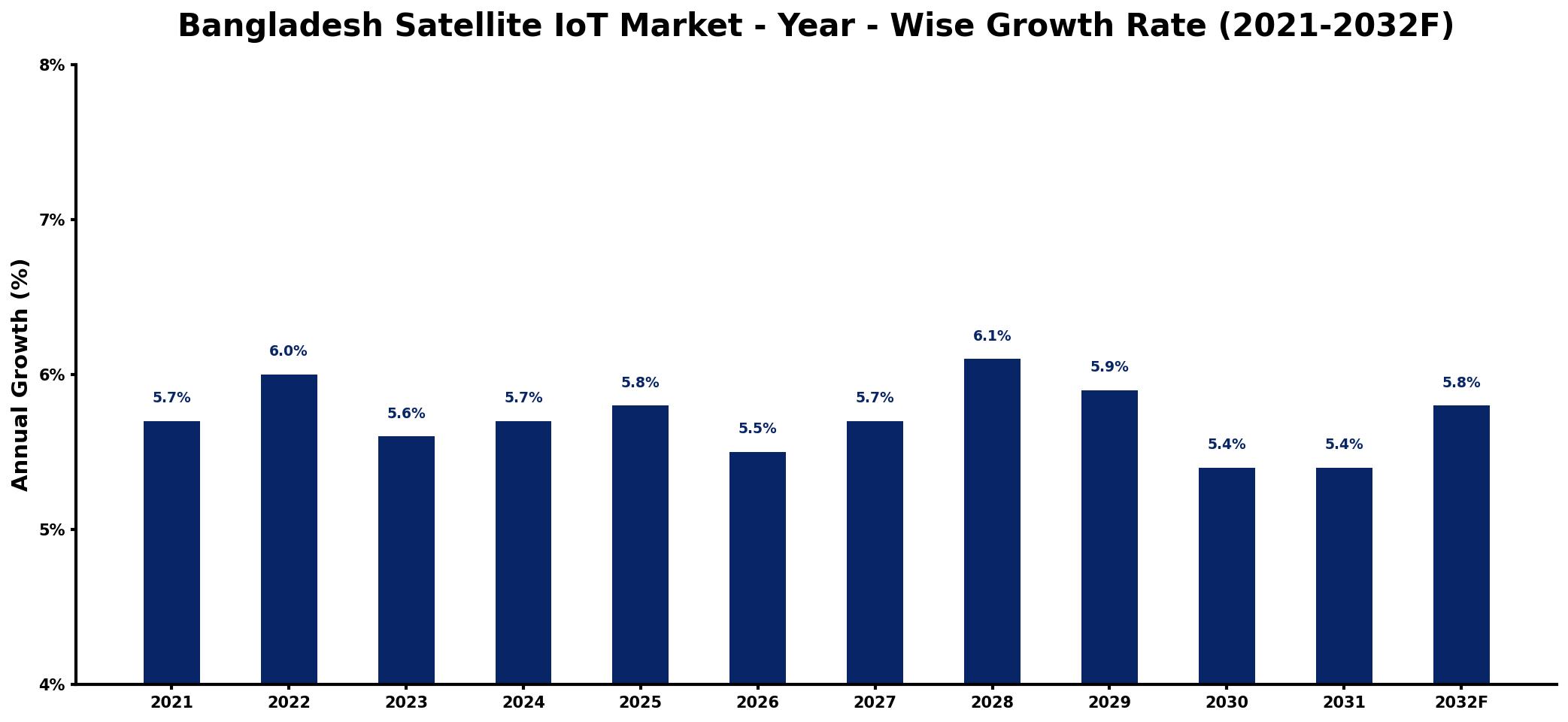
The table below presents the year‑wise growth rates along with the key drivers influencing the market
| Year | Growth Rate | Major Drivers |
| 2021 | 5.7% | Rising demand for smart agriculture |
| 2022 | 6.0% | Increased investment in renewable energy |
| 2023 | 5.6% | Expansion of logistics automation solutions |
| 2024 | 5.7% | Growth in environmental monitoring needs |
| 2025 | 5.8% | Surge in urban infrastructure projects |
| 2026 | 5.5% | Development of remote health services |
| 2027 | 5.7% | Emerging interest in smart cities |
| 2028 | 6.1% | Advancements in transportation management |
| 2029 | 5.9% | Greater focus on disaster management |
| 2030 | 5.4% | Boost in maritime safety initiatives |
| 2031 | 5.4% | Heightened interest in wildlife conservation |
| 2032 | 5.8% | expanding healthcare application demand |
Note: Market size estimations and growth projections presented in this report are based on 6Wresearch's proprietary forecasting methodology, utilizing the latest available industry data, government publications, and primary research inputs.
Bangladesh Satellite IoT Market Synopsis
A transformative force in the Bangladesh Satellite IoT market is the government's commitment to enhancing digital infrastructure and connectivity. This initiative not only addresses the technological needs of a growing population but also opens up new avenues for businesses seeking efficiency and real-time data access.
The market is characterized by a surge in innovative satellite IoT solutions tailored specifically for the Bangladeshi landscape. With an emphasis on affordability and efficacy, key industry stakeholders are striving to design devices and platforms that meet local demands, which is crucial for penetrating the rural segments of the economy.
Bangladesh Satellite IoT Market Key Takeaways
- The market is anticipated to witness significant growth due to rising demand across agriculture, logistics, and transportation sectors.
- Investment opportunities are emerging in low-cost satellite devices and IoT platforms for enhanced data analytics.
- Government policies are strategically focused on improving satellite connectivity in underserved areas.
- Real-time data collection and monitoring solutions are becoming essential for operational efficiency in various industries.
- Awareness and education initiatives are crucial for fostering user understanding and adoption of satellite IoT technology.
Evaluation of Restraints in Bangladesh Satellite IoT Market
Despite its promising potential, the Bangladesh Satellite IoT market faces notable challenges. Limited satellite coverage across remote areas poses significant hurdles, creating gaps in service availability. High costs associated with satellite connectivity also restrict market penetration, especially for small and medium-sized enterprises. Furthermore, regulatory hurdles, including spectrum allocation complexities, can hinder the swift deployment of solutions. To unlock the market's full potential, addressing these barriers through strategic initiatives and improved awareness is essential.
Bangladesh Satellite IoT Market Trends
Several trends are shaping the Bangladesh Satellite IoT market. A marked increase in asset tracking solutions highlights businesses' need for real-time monitoring capabilities. The integration of satellite communications with IoT devices facilitates seamless connectivity, especially in remote areas where traditional network infrastructure may be lacking. Additionally, advanced satellite IoT platforms are emerging, offering enhanced data analytics to support informed decision-making processes across industries.
Bangladesh Satellite IoT Market Opportunities
The Bangladesh Satellite IoT market harbors significant investment opportunities, particularly within agriculture and environmental monitoring sectors. As farmers and businesses seek reliable connectivity solutions, satellite IoT technology presents a formidable way to bridge the existing digital divide. There is ample scope for venture capitalists and stakeholders to invest in satellite communications, IoT device manufacturing, and application development, ultimately enhancing operational efficiency and fostering growth in previously underserved markets.
Government Initiatives in the Bangladesh Satellite IoT Market
The Bangladeshi government has established a framework for promoting the Satellite IoT market through various policies and initiatives. The National Satellite IoT Policy aims to support the deployment of satellite-based services, focusing on regulatory frameworks and facilitating technology development. Additionally, the government prioritizes initiatives to enhance access to satellite connectivity, specifically targeting rural areas to ensure equitable digital growth.
Future Insights of the Bangladesh Satellite IoT Market
As we look ahead to 2026-2032, the Bangladesh Satellite IoT market is poised for substantial evolution. The continuous advancement in satellite technology coupled with the rising integration of IoT devices is expected to further drive demand. Government efforts to enhance infrastructure and connectivity will play a pivotal role, while businesses increasingly recognize the value of satellite IoT in boosting operational efficiency and real-time insights. This dynamic environment promises a wealth of opportunities for stakeholders looking to capitalize on the ongoing transformation.
Bangladesh Satellite IoT Market Latest Developments (2025 - 2026)
Recently, the Bangladesh Satellite IoT market has witnessed a flurry of activity. Initiatives aimed at expanding satellite connectivity in rural regions have gained momentum, reflecting a strong commitment to bridging the digital divide. Additionally, industry players are innovating to create affordable satellite IoT devices, responding to the growing demand for cost-effective solutions. Collaborative efforts among various stakeholders are paving the way for enhanced innovation and service delivery in the sector.
Bangladesh Satellite IoT Market - Key Attractiveness of the Report
- 10 Years of Market Numbers
- Historical Data Starting from 2022 to 2025
- Base Year: 2025
- Forecast Data until 2032
- Key Performance Indicators Impacting the Market
- Major Upcoming Developments and Projects
Key Highlights of the Report:
- Bangladesh Satellite IoT Market Outlook
- Market Size of Bangladesh Satellite IoT Market, 2025
- Forecast of Bangladesh Satellite IoT Market, 2032
- Historical Data and Forecast of Bangladesh Satellite IoT Revenues & Volume for the Period 2022-2032F
- Bangladesh Satellite IoT Market Trend Evolution
- Bangladesh Satellite IoT Market Drivers and Challenges
- Bangladesh Satellite IoT Price Trends
- Bangladesh Satellite IoT Porter's Five Forces
- Bangladesh Satellite IoT Industry Life Cycle
- Historical Data and Forecast of Bangladesh Satellite IoT Market Revenues & Volume By Service Type for the Period 2022-2032F
- Historical Data and Forecast of Bangladesh Satellite IoT Market Revenues & Volume By Satellite IoT Backhaul for the Period 2022-2032F
- Historical Data and Forecast of Bangladesh Satellite IoT Market Revenues & Volume By Direct-to-satellite for the Period 2022-2032F
- Historical Data and Forecast of Bangladesh Satellite IoT Market Revenues & Volume By Frequency Band for the Period 2022-2032F
- Historical Data and Forecast of Bangladesh Satellite IoT Market Revenues & Volume By L-Band for the Period 2022-2032F
- Historical Data and Forecast of Bangladesh Satellite IoT Market Revenues & Volume By Ku-and Ka-Band for the Period 2022-2032F
- Historical Data and Forecast of Bangladesh Satellite IoT Market Revenues & Volume By S-Band for the Period 2022-2032F
- Historical Data and Forecast of Bangladesh Satellite IoT Market Revenues & Volume By Other Bands for the Period 2022-2032F
- Historical Data and Forecast of Bangladesh Satellite IoT Market Revenues & Volume By Organization Size for the Period 2022-2032F
- Historical Data and Forecast of Bangladesh Satellite IoT Market Revenues & Volume By Large Enterprises for the Period 2022-2032F
- Historical Data and Forecast of Bangladesh Satellite IoT Market Revenues & Volume By Small & Medium Sized Enterprises for the Period 2022-2032F
- Historical Data and Forecast of Bangladesh Satellite IoT Market Revenues & Volume By Vertical for the Period 2022-2032F
- Historical Data and Forecast of Bangladesh Satellite IoT Market Revenues & Volume By Maritime for the Period 2022-2032F
- Historical Data and Forecast of Bangladesh Satellite IoT Market Revenues & Volume By Oil & Gas for the Period 2022-2032F
- Historical Data and Forecast of Bangladesh Satellite IoT Market Revenues & Volume By Transportation & Logistics for the Period 2022-2032F
- Historical Data and Forecast of Bangladesh Satellite IoT Market Revenues & Volume By Energy & Utilities for the Period 2022-2032F
- Historical Data and Forecast of Bangladesh Satellite IoT Market Revenues & Volume By Agriculture for the Period 2022-2032F
- Historical Data and Forecast of Bangladesh Satellite IoT Market Revenues & Volume By Healthcare for the Period 2022-2032F
- Historical Data and Forecast of Bangladesh Satellite IoT Market Revenues & Volume By Military & Defense for the Period 2022-2032F
- Historical Data and Forecast of Bangladesh Satellite IoT Market Revenues & Volume By Other Verticals for the Period 2022-2032F
- Bangladesh Satellite IoT Import Export Trade Statistics
- Market Opportunity Assessment By Service Type
- Market Opportunity Assessment By Frequency Band
- Market Opportunity Assessment By Organization Size
- Market Opportunity Assessment By Vertical
- Bangladesh Satellite IoT Top Companies Market Share
- Bangladesh Satellite IoT Competitive Benchmarking By Technical and Operational Parameters
- Bangladesh Satellite IoT Company Profiles
- Bangladesh Satellite IoT Key Strategic Recommendations






































