Bangladesh Spend Analytics Market Size & Growth Rate (2026-2032)
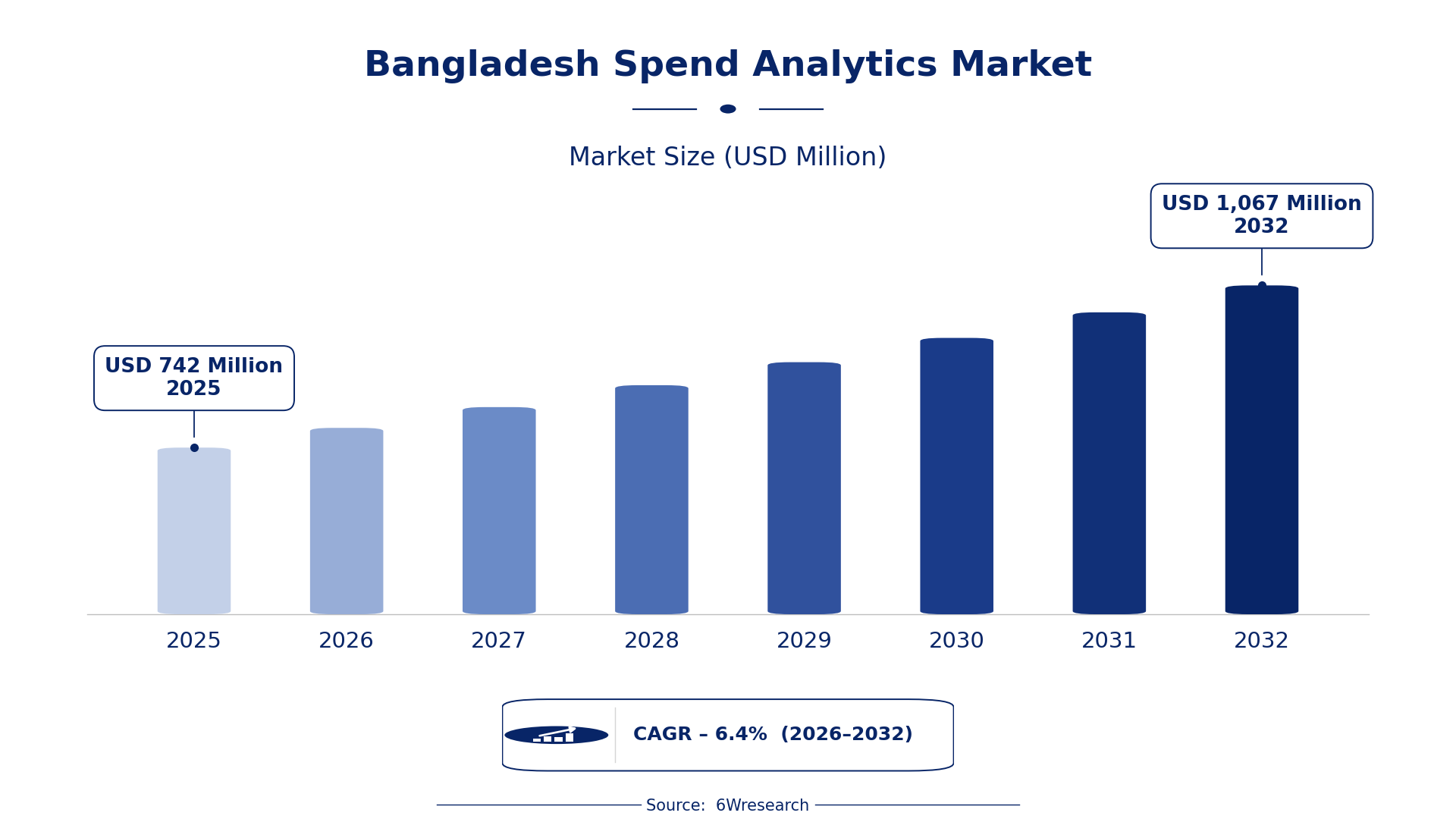
The Bangladesh Spend Analytics Market was estimated at USD 742 Million in 2025 and is projected to reach USD 1067 Million by 2032, growing at a CAGR of 6.4% from 2026 to 2032.
Bangladesh Spend Analytics Market Synopsis
The Bangladesh Spend Analytics Market is experiencing rapid growth as organizations increasingly recognize the importance of data-driven decision-making. Companies are adopting analytics tools to refine their spending practices, improve procurement efficiencies, and mitigate financial risks. This trend is particularly pronounced as businesses grapple with the complexities of a digital economy.
Enhanced visibility into expenditure and supplier performance is driving the demand for sophisticated spend analytics platforms. As digital payment systems and e-commerce continue to expand in Bangladesh, the need for effective spend management solutions is becoming a critical priority for organizations across various sectors.
Bangladesh Spend Analytics Market Year-wise Growth Rate and Key Drivers
This graph illustrates the annual growth rates of the Bangladesh Spend Analytics Market from 2021 to 2032, highlighting a steady upward trajectory and projected expansion over the forecast period.
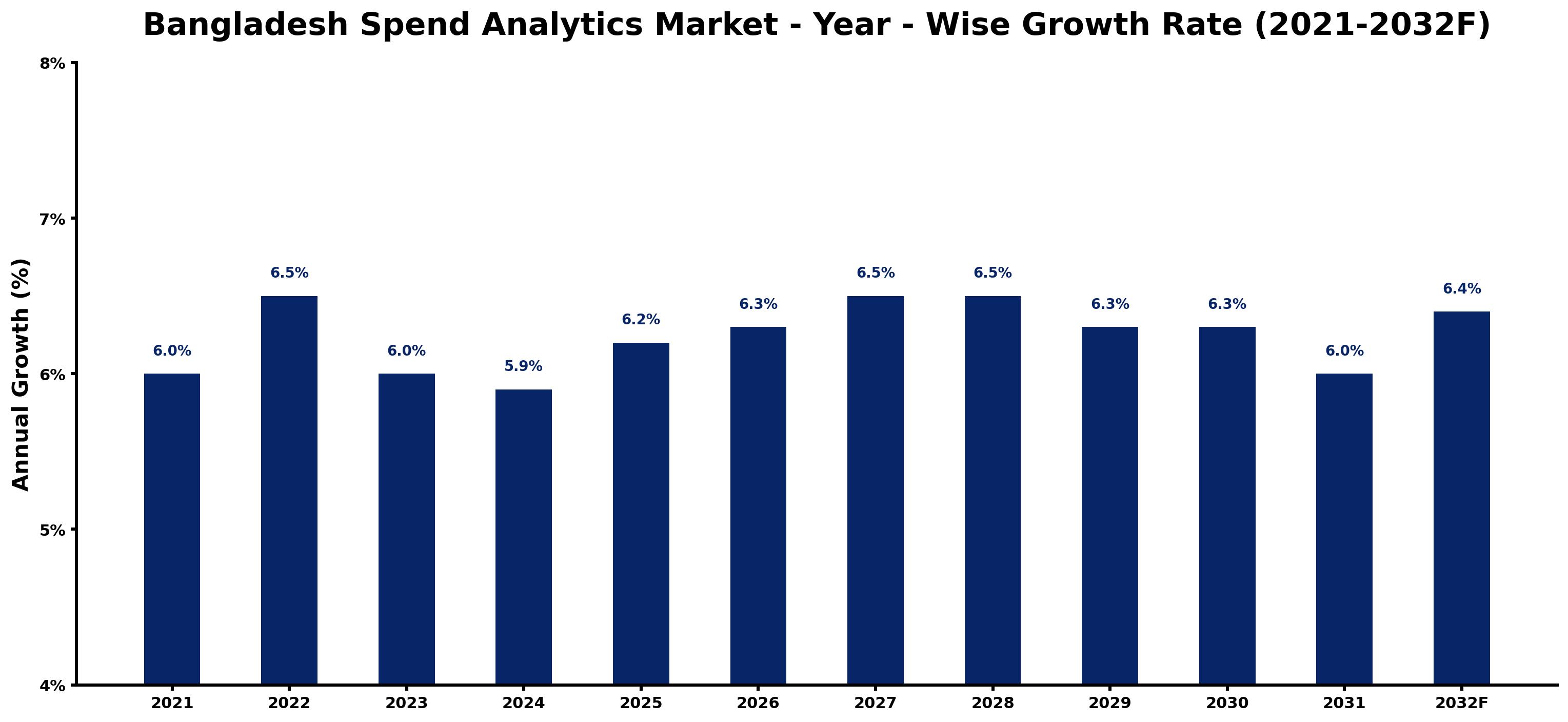
The table below presents the year‑wise growth rates along with the key drivers influencing the market
| Year | Growth Rate | Major Drivers |
| 2021 | 6.0% | Increased digital payment adoption across Bangladeshi businesses. |
| 2022 | 6.5% | Rising government push for transparency in public spending. |
| 2023 | 6.0% | Growing focus on data-driven decision-making in corporations. |
| 2024 | 5.9% | Regulatory encouragement for fintech in procurement strategies. |
| 2025 | 6.2% | Increased awareness of cost control among SMEs. |
| 2026 | 6.3% | Technological advancements in cloud-based spend solutions. |
| 2027 | 6.5% | Surge in e-commerce spending patterns influencing analytics. |
| 2028 | 6.5% | Enhanced financial literacy driving analytics tool adoption. |
| 2029 | 6.3% | Local startups innovating in spend management technologies. |
| 2030 | 6.3% | Demand for efficient resource allocation in public sector. |
| 2031 | 6.0% | Usage of AI in financial forecasting gaining traction. |
| 2032 | 6.4% | Increased collaboration among businesses for procurement efficiency. |
Note: Market size estimations and growth projections presented in this report are based on 6Wresearch's proprietary forecasting methodology, utilizing the latest available industry data, government publications, and primary research inputs.
Bangladesh Spend Analytics Market Key Takeaways
Below are some of the specific key takeaways from the market, including:
- Growing adoption of advanced analytics solutions to optimize spending.
- Increasing integration of AI and machine learning in spend analytics tools.
- Emergence of cloud-based platforms enhancing accessibility and scalability.
- Focus on predictive analytics to facilitate proactive decision-making.
- Opportunities for customized solutions tailored to various industry needs.
Evaluation of Restraints in Bangladesh Spend Analytics Market
Despite its growth potential, the Bangladesh Spend Analytics Market faces several constraints. A primary challenge is the limited availability of high-quality data sources, which hampers the accuracy of analytics. Organizations often lack standardized processes for data collection and analysis, making it difficult to derive actionable insights. Additionally, a shortage of skilled professionals knowledgeable in spend analytics further complicates market expansion.
Many businesses are also hindered by outdated technology infrastructure and resistance to adopting new tools. on top of that, navigating a rapidly changing regulatory environment and ensuring compliance with data privacy laws presents additional challenges for companies attempting to leverage analytics effectively.
Bangladesh Spend Analytics Market Trends
The market is being shaped by various trends that signal a shift towards more advanced analytics capabilities. The integration of artificial intelligence and machine learning is transforming traditional spend analytics into more predictive and prescriptive tools. Businesses are increasingly looking for cloud-based solutions that offer flexibility and scalability, allowing them to adapt to changing market conditions.
Additionally, as e-commerce continues to proliferate, organizations are prioritizing tools that enable them to track and analyze expenses across diverse categories. This trend reflects a broader movement towards data-centric decision-making, with companies seeking to optimize costs and improve procurement efficiency.
Bangladesh Spend Analytics Market Opportunities
Genuine growth opportunities in the Bangladesh Spend Analytics Market lie in the development of customized solutions tailored to the unique needs of various industries. Companies can also tap into underserved regions where demand for spend analytics tools is growing but remains unmet. on top of that, providing training and support services will enable organizations to maximize their investments in analytics, ensuring they derive maximum value from these technologies.
Government Initiatives in the Bangladesh Spend Analytics Market
The government of Bangladesh is actively promoting transparency and efficiency within the Spend Analytics Market through various initiatives. Recently, the government implemented mandatory compliance with procurement laws, facilitating a more structured approach to spending. Currently, there are ongoing efforts to streamline purchasing processes via e-procurement systems, which are enhancing accountability in both public and private sectors.
Looking ahead, plans are underway to establish oversight mechanisms to monitor spending patterns more effectively. This initiative aims to bolster data security and privacy in analytics activities, encouraging organizations to adopt best practices. Such policies are critical for fostering a competitive and sustainable market environment.
Future Insights of the Bangladesh Spend Analytics Market
From 2026 to 2032, the Bangladesh Spend Analytics Market is expected to experience substantial growth as organizations increasingly adopt advanced analytics tools. The rising demand for cost-saving solutions, coupled with government initiatives promoting digital transformation, will play a crucial role in market expansion. As awareness of data-driven decision-making grows, businesses will continue to invest in analytics solutions to enhance financial performance and secure a competitive edge.
Bangladesh Spend Analytics Market Latest Developments
Recent activity in the Bangladesh Spend Analytics Market reflects a dynamic environment. A major technology vendor launched a cloud-based spend analytics platform in early 2025, providing organizations with enhanced visibility into their spending patterns. Currently, a leading regional operator is undertaking a project to integrate AI capabilities into existing analytics tools, which began in mid-2025 and remains underway.
Looking to the future, another key player is expected to initiate a new training program aimed at helping organizations maximize their analytics investments, set to begin in the second half of 2026. These developments highlight the increasing focus on leveraging analytics for improved procurement and cost management.
Bangladesh Spend Analytics Market - Key Attractiveness of the Report
- 10 Years of Market Numbers
- Historical Data Starting from 2022 to 2025
- Base Year: 2025
- Forecast Data until 2032
- Key Performance Indicators Impacting the Market
- Major Upcoming Developments and Projects
Key Highlights of the Report:
- Bangladesh Spend Analytics Market Outlook
- Market Size of Bangladesh Spend Analytics Market, 2025
- Forecast of Bangladesh Spend Analytics Market, 2032
- Historical Data and Forecast of Bangladesh Spend Analytics Revenues & Volume for the Period 2022-2032F
- Bangladesh Spend Analytics Market Trend Evolution
- Bangladesh Spend Analytics Market Drivers and Challenges
- Bangladesh Spend Analytics Price Trends
- Bangladesh Spend Analytics Porter's Five Forces
- Bangladesh Spend Analytics Industry Life Cycle
- Historical Data and Forecast of Bangladesh Spend Analytics Market Revenues & Volume By Application for the Period 2022-2032F
- Historical Data and Forecast of Bangladesh Spend Analytics Market Revenues & Volume By Financial management for the Period 2022-2032F
- Historical Data and Forecast of Bangladesh Spend Analytics Market Revenues & Volume By Risk management for the Period 2022-2032F
- Historical Data and Forecast of Bangladesh Spend Analytics Market Revenues & Volume By Governance and compliance management for the Period 2022-2032F
- Historical Data and Forecast of Bangladesh Spend Analytics Market Revenues & Volume By Supplier sourcing and performance management for the Period 2022-2032F
- Historical Data and Forecast of Bangladesh Spend Analytics Market Revenues & Volume By Demand and supply forecasting for the Period 2022-2032F
- Historical Data and Forecast of Bangladesh Spend Analytics Market Revenues & Volume By Others for the Period 2022-2032F
- Historical Data and Forecast of Bangladesh Spend Analytics Market Revenues & Volume By Component for the Period 2022-2032F
- Historical Data and Forecast of Bangladesh Spend Analytics Market Revenues & Volume By Software for the Period 2022-2032F
- Historical Data and Forecast of Bangladesh Spend Analytics Market Revenues & Volume By Services for the Period 2022-2032F
- Historical Data and Forecast of Bangladesh Spend Analytics Market Revenues & Volume By Analytics Type for the Period 2022-2032F
- Historical Data and Forecast of Bangladesh Spend Analytics Market Revenues & Volume By Predictive for the Period 2022-2032F
- Historical Data and Forecast of Bangladesh Spend Analytics Market Revenues & Volume By Prescriptive for the Period 2022-2032F
- Historical Data and Forecast of Bangladesh Spend Analytics Market Revenues & Volume By Descriptive for the Period 2022-2032F
- Historical Data and Forecast of Bangladesh Spend Analytics Market Revenues & Volume By Business Function for the Period 2022-2032F
- Historical Data and Forecast of Bangladesh Spend Analytics Market Revenues & Volume By Finance for the Period 2022-2032F
- Historical Data and Forecast of Bangladesh Spend Analytics Market Revenues & Volume By Information Technology (IT) for the Period 2022-2032F
- Historical Data and Forecast of Bangladesh Spend Analytics Market Revenues & Volume By Marketing for the Period 2022-2032F
- Historical Data and Forecast of Bangladesh Spend Analytics Market Revenues & Volume By Procurement for the Period 2022-2032F
- Historical Data and Forecast of Bangladesh Spend Analytics Market Revenues & Volume By Deployment Model for the Period 2022-2032F
- Historical Data and Forecast of Bangladesh Spend Analytics Market Revenues & Volume By On-premises for the Period 2022-2032F
- Historical Data and Forecast of Bangladesh Spend Analytics Market Revenues & Volume By Cloud for the Period 2022-2032F
- Historical Data and Forecast of Bangladesh Spend Analytics Market Revenues & Volume By Organization Size for the Period 2022-2032F
- Historical Data and Forecast of Bangladesh Spend Analytics Market Revenues & Volume By Small and Medium Enterprises (SMEs) for the Period 2022-2032F
- Historical Data and Forecast of Bangladesh Spend Analytics Market Revenues & Volume By Large enterprises for the Period 2022-2032F
- Historical Data and Forecast of Bangladesh Spend Analytics Market Revenues & Volume By Industry Vertical for the Period 2022-2032F
- Historical Data and Forecast of Bangladesh Spend Analytics Market Revenues & Volume By Manufacturing for the Period 2022-2032F
- Historical Data and Forecast of Bangladesh Spend Analytics Market Revenues & Volume By Retail and eCommerce for the Period 2022-2032F
- Historical Data and Forecast of Bangladesh Spend Analytics Market Revenues & Volume By Government and defense for the Period 2022-2032F
- Historical Data and Forecast of Bangladesh Spend Analytics Market Revenues & Volume By Healthcare and life sciences for the Period 2022-2032F
- Historical Data and Forecast of Bangladesh Spend Analytics Market Revenues & Volume By Telecommunications and IT for the Period 2022-2032F
- Historical Data and Forecast of Bangladesh Spend Analytics Market Revenues & Volume By Energy and utilities for the Period 2022-2032F
- Historical Data and Forecast of Bangladesh Spend Analytics Market Revenues & Volume By Banking, Financial Services, and Insurance (BFSI) for the Period 2022-2032F
- Bangladesh Spend Analytics Import Export Trade Statistics
- Market Opportunity Assessment By Application
- Market Opportunity Assessment By Component
- Market Opportunity Assessment By Analytics Type
- Market Opportunity Assessment By Business Function
- Market Opportunity Assessment By Deployment Model
- Market Opportunity Assessment By Organization Size
- Market Opportunity Assessment By Industry Vertical
- Bangladesh Spend Analytics Top Companies Market Share
- Bangladesh Spend Analytics Competitive Benchmarking By Technical and Operational Parameters
- Bangladesh Spend Analytics Company Profiles
- Bangladesh Spend Analytics Key Strategic Recommendations






































