Bangladesh Tire Machinery Market Size, Share & Growth Rate
The Bangladesh Tire Machinery Market was estimated at USD 179 Million in 2025 and is projected to reach USD 252 Million by 2032, growing at a CAGR of 5.0% from 2026 to 2032. This growth trajectory is primarily driven by the robust expansion of the automotive sector, which has been fueled by increasing domestic and export demand for vehicles. Furthermore, government initiatives aimed at bolstering local manufacturing capabilities play a critical role in enhancing market dynamics.
Bangladesh Tire Machinery Market Year-wise Growth Rate and Key Drivers
This graph highlights how the Bangladesh Tire Machinery Market has steadily grown over the years, supported by major growth factors.
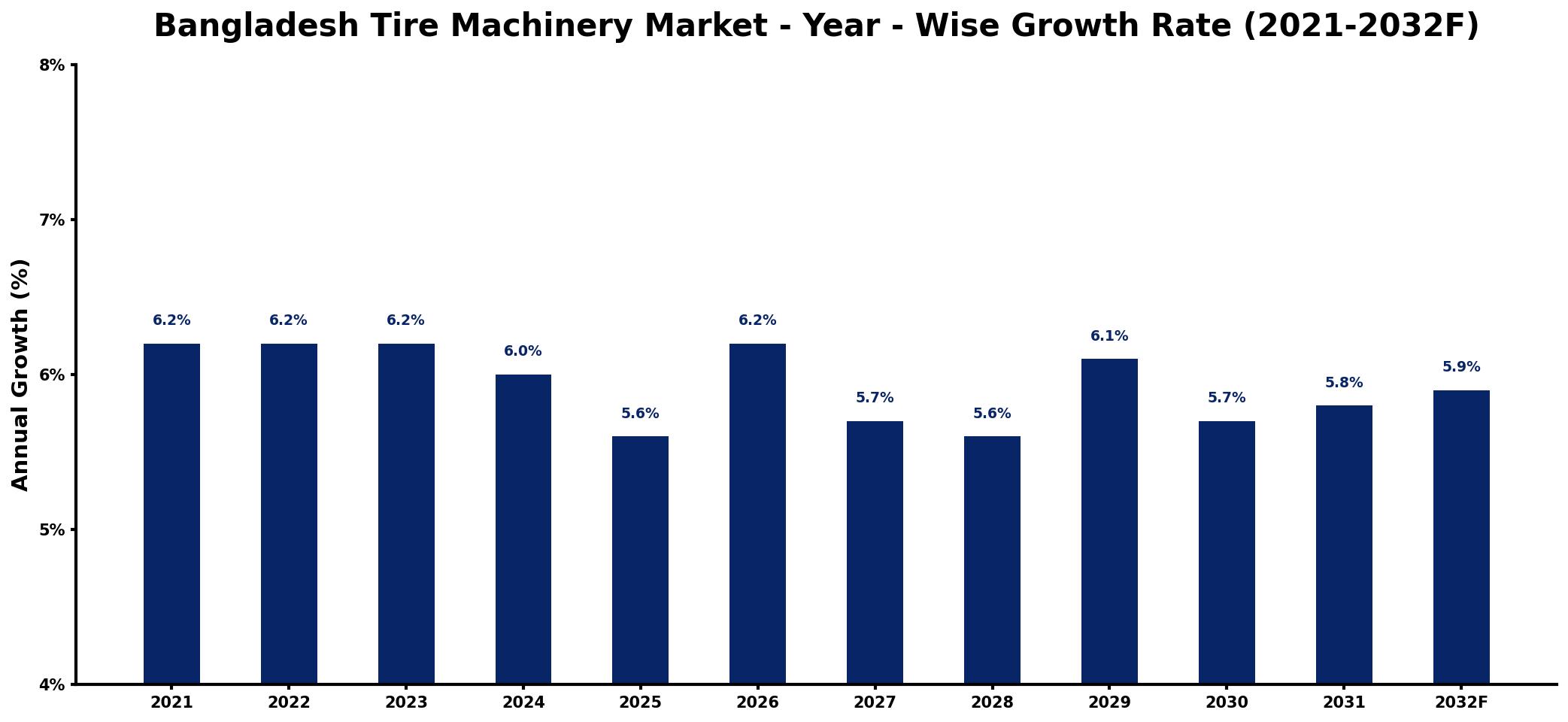
The table below presents the year‑wise growth rates along with the key drivers influencing the market
| Year | Growth Rate | Major Drivers |
| 2021 | 6.2% | Rising automotive production rates |
| 2022 | 6.2% | Increased demand for transportation |
| 2023 | 6.2% | Growth in infrastructure investments |
| 2024 | 6.0% | Surge in export opportunities |
| 2025 | 5.6% | Expansion of local manufacturers |
| 2026 | 6.2% | Technological advancements in production |
| 2027 | 5.7% | stronger distribution network expansion |
| 2028 | 5.6% | Investment in renewable energy sources |
| 2029 | 6.1% | Rising consumer spending power |
| 2030 | 5.7% | Strengthening trade agreements globally |
| 2031 | 5.8% | Emergence of electric vehicle market |
| 2032 | 5.9% | Increased focus on sustainability |
Note: Market size estimations and growth projections presented in this report are based on 6Wresearch's proprietary forecasting methodology, utilizing the latest available industry data, government publications, and primary research inputs.
Bangladesh Tire Machinery Market Synopsis
In Bangladesh, the tire machinery landscape is transforming as domestic manufacturers invest in advanced production technologies. The demand for high-quality tire manufacturing machinery, including tire building machines and curing presses, is on the rise, reflecting an industry poised for modernization.
Furthermore, as the automotive market expands, so does the need for reliable testing equipment to ensure tire safety and performance. This convergence of increased production capabilities and quality assurance is expected to bolster the overall growth of the Bangladesh Tire Machinery Market.
Bangladesh Tire Machinery Market Key Takeaways
- The market is experiencing steady growth, driven by rising demand for tires in the automotive sector.
- Technological advancements, particularly in automation and robotics, are reshaping the tire machinery landscape.
- There is a growing emphasis on sustainable practices, with manufacturers adopting eco-friendly materials and processes.
- Collaborations between local firms and international suppliers are enhancing technological access and capabilities.
- Government initiatives are focused on promoting domestic production to reduce reliance on imports.
Evaluation of Restraints in Bangladesh Tire Machinery Market
Despite the promising outlook, the Bangladesh Tire Machinery Market faces several restraints that could impede its growth. A notable challenge is the heavy reliance on imported machinery, which can lead to increased operational costs and supply chain vulnerabilities. Additionally, the high initial setup costs of advanced machinery may deter some manufacturers from upgrading their facilities. Compounding these issues is a shortage of skilled labor capable of operating and maintaining specialized equipment, which poses a barrier to maximizing the efficiency of new technologies. Moreover, infrastructural constraints, such as power supply inconsistencies and transportation inadequacies, can limit production capabilities and market reach.
Bangladesh Tire Machinery Market Trends
The landscape of the Bangladesh Tire Machinery Market is characterized by several prevailing trends. First and foremost, there is an increased demand for automation, as manufacturers seek to enhance operational efficiency and product quality. Investments are being directed towards cutting-edge machinery, including tire building machines and advanced curing presses, to adapt to these evolving requirements. Additionally, a growing focus on sustainability is prompting manufacturers to incorporate eco-friendly technologies into their production processes, aiming to minimize energy consumption and waste. Lastly, partnerships and collaborations between local producers and international machinery suppliers are becoming more common, enabling access to advanced technologies and expanded product offerings.
Bangladesh Tire Machinery Market Opportunities
The Bangladesh Tire Machinery Market is ripe with opportunities for growth and investment. The burgeoning automotive industry presents a significant need for high-quality tire manufacturing equipment, driving demand for modern machinery. This creates a market for suppliers of both new machinery and upgrades to existing equipment. Additionally, opportunities exist in offering maintenance and repair services, as well as training and support for manufacturers in need of skilled personnel. Collaborating with international machinery developers to introduce cutting-edge automation solutions represents another lucrative avenue for enhancing production capabilities in the country.
Government Initiatives in the Bangladesh Tire Machinery Market
The Bangladeshi government is actively promoting local manufacturing through various policies aimed at the tire machinery sector. These initiatives include providing tax incentives, subsidies, and low-interest loans designed to stimulate domestic production and reduce dependence on imports. Furthermore, regulatory frameworks ensure that the machinery produced meets quality and safety standards, bolstering consumer confidence in locally manufactured products. The government also emphasizes research and development within the sector to enhance competitiveness and foster innovation.
Future Insights of the Bangladesh Tire Machinery Market
Looking ahead to the period from 2026 to 2032, the Bangladesh Tire Machinery Market is expected to witness substantial growth driven by increasing automotive demands and government efforts to support local manufacturing. With greater awareness surrounding road safety and the essential role of quality tires, the demand for advanced tire production technologies will continue to rise. The integration of automation and digitalization is set to reshape the manufacturing landscape, enhancing productivity and operational efficiency. As these trends develop, the market will likely see significant innovation and collaboration, positioning it for robust future growth.
Bangladesh Tire Machinery Market Latest Developments (2025 - 2026)
Recent developments in the Bangladesh Tire Machinery Market indicate a growing trend towards modernization and technological integration. Manufacturers are increasingly embracing advanced technologies and automation to enhance production capabilities. Additionally, partnerships with foreign suppliers are being established to facilitate the transfer of cutting-edge machinery and practices, aligning with the market's shift toward sustainability and efficiency. These movements demonstrate the sector's adaptability and commitment to meeting the evolving demands of the automotive industry.
Bangladesh Tire Machinery Market - Key Attractiveness of the Report
- 10 Years of Market Numbers
- Historical Data Starting from 2022 to 2025
- Base Year: 2025
- Forecast Data until 2032
- Key Performance Indicators Impacting the Market
- Major Upcoming Developments and Projects
Key Highlights of the Report:
- Bangladesh Tire Machinery Market Outlook
- Market Size of Bangladesh Tire Machinery Market, 2025
- Forecast of Bangladesh Tire Machinery Market, 2032
- Historical Data and Forecast of Bangladesh Tire Machinery Revenues & Volume for the Period 2022-2032F
- Bangladesh Tire Machinery Market Trend Evolution
- Bangladesh Tire Machinery Market Drivers and Challenges
- Bangladesh Tire Machinery Price Trends
- Bangladesh Tire Machinery Porter's Five Forces
- Bangladesh Tire Machinery Industry Life Cycle
- Historical Data and Forecast of Bangladesh Tire Machinery Market Revenues & Volume By Type for the Period 2022-2032F
- Historical Data and Forecast of Bangladesh Tire Machinery Market Revenues & Volume By Mixing Machine/ Rubber Mixers for the Period 2022-2032F
- Historical Data and Forecast of Bangladesh Tire Machinery Market Revenues & Volume By Calendaring Machine for the Period 2022-2032F
- Historical Data and Forecast of Bangladesh Tire Machinery Market Revenues & Volume By Extrusion Machines for the Period 2022-2032F
- Historical Data and Forecast of Bangladesh Tire Machinery Market Revenues & Volume By Multi Extrusion Lines for the Period 2022-2032F
- Historical Data and Forecast of Bangladesh Tire Machinery Market Revenues & Volume By Inner Liner Lines for the Period 2022-2032F
- Historical Data and Forecast of Bangladesh Tire Machinery Market Revenues & Volume By Extruders for the Period 2022-2032F
- Historical Data and Forecast of Bangladesh Tire Machinery Market Revenues & Volume By Cooling Units for the Period 2022-2032F
- Historical Data and Forecast of Bangladesh Mixing Machine/ Rubber Mixers Tire Machinery Market Revenues & Volume By Cutting Machines for the Period 2022-2032F
- Historical Data and Forecast of Bangladesh Tire Machinery Market Revenues & Volume By Tire Type for the Period 2022-2032F
- Historical Data and Forecast of Bangladesh Tire Machinery Market Revenues & Volume By Radial Tire for the Period 2022-2032F
- Historical Data and Forecast of Bangladesh Tire Machinery Market Revenues & Volume By Bias Tire for the Period 2022-2032F
- Historical Data and Forecast of Bangladesh Tire Machinery Market Revenues & Volume By Application for the Period 2022-2032F
- Historical Data and Forecast of Bangladesh Tire Machinery Market Revenues & Volume By Two-wheeler tires for the Period 2022-2032F
- Historical Data and Forecast of Bangladesh Tire Machinery Market Revenues & Volume By Passenger Vehicle Tires for the Period 2022-2032F
- Historical Data and Forecast of Bangladesh Tire Machinery Market Revenues & Volume By Hatchback for the Period 2022-2032F
- Historical Data and Forecast of Bangladesh Tire Machinery Market Revenues & Volume By Sedan for the Period 2022-2032F
- Historical Data and Forecast of Bangladesh Tire Machinery Market Revenues & Volume By Utility Vehicles for the Period 2022-2032F
- Historical Data and Forecast of Bangladesh Tire Machinery Market Revenues & Volume By Light Commercial Vehicle Tires for the Period 2022-2032F
- Historical Data and Forecast of Bangladesh Tire Machinery Market Revenues & Volume By Medium & Heavy Commercial Vehicle Tires for the Period 2022-2032F
- Historical Data and Forecast of Bangladesh Tire Machinery Market Revenues & Volume By Off-road Vehicle Tires for the Period 2022-2032F
- Bangladesh Tire Machinery Import Export Trade Statistics
- Market Opportunity Assessment By Type
- Market Opportunity Assessment By Tire Type
- Market Opportunity Assessment By Application
- Bangladesh Tire Machinery Top Companies Market Share
- Bangladesh Tire Machinery Competitive Benchmarking By Technical and Operational Parameters
- Bangladesh Tire Machinery Company Profiles
- Bangladesh Tire Machinery Key Strategic Recommendations






































