Bangladesh Unified Communications as a Service Market Size, Share & Growth Rate
The Bangladesh Unified Communications as a Service Market was estimated at USD 918 Million in 2025 and is projected to reach USD 1304 Million by 2032, growing at a CAGR of 5.1% from 2026 to 2032. This growth trajectory is propelled by a surge in demand for integrated communication solutions, which are increasingly favored by organizations aiming to enhance collaboration across diverse teams. The shift towards cloud-based platforms enables firms to streamline operations, reduce costs, and adapt more effectively to remote work trends, a necessity in todays dynamic business landscape.
Bangladesh Unified Communications as a Service Market Year-wise Growth Rate and Key Drivers
This graph highlights how the Bangladesh Unified Communications as a Service Market has steadily grown over the years, supported by major growth factors.
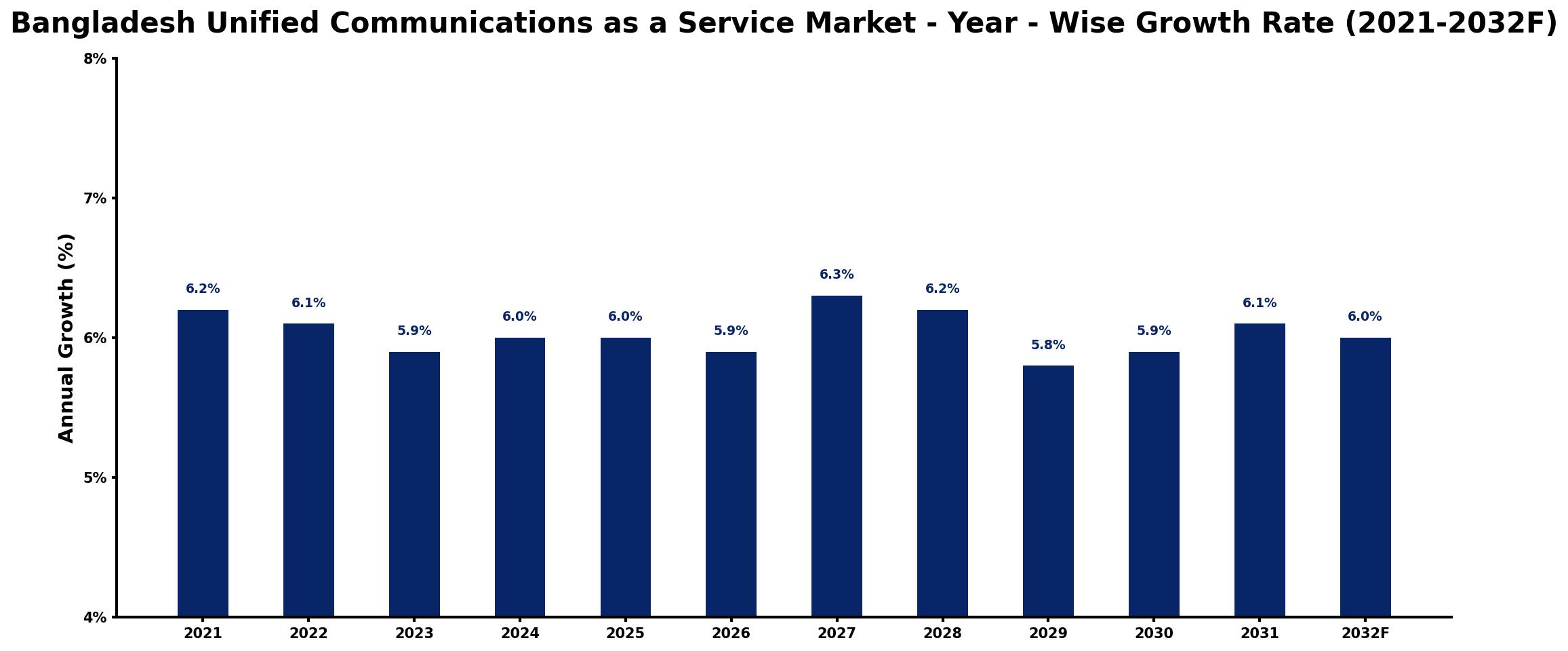
The table below presents the year‑wise growth rates along with the key drivers influencing the market
| Year | Growth Rate | Major Drivers |
| 2021 | 6.2% | Rising remote work adoption rates |
| 2022 | 6.1% | Increased investment in technology |
| 2023 | 5.9% | Growing need for collaboration tools |
| 2024 | 6.0% | Expansion of digital infrastructure initiatives |
| 2025 | 6.0% | Surge in cloud computing adoption |
| 2026 | 5.9% | Demand for flexible work solutions |
| 2027 | 6.3% | Growth in enterprise digital transformation |
| 2028 | 6.2% | Increase in mobile workforce solutions |
| 2029 | 5.8% | Emergence of new startups |
| 2030 | 5.9% | growing regional consumption patterns |
| 2031 | 6.1% | Rise in data security concerns |
| 2032 | 6.0% | Growing demand for integrated platforms |
Note: Market size estimations and growth projections presented in this report are based on 6Wresearch's proprietary forecasting methodology, utilizing the latest available industry data, government publications, and primary research inputs.
Bangladesh Unified Communications as a Service Market Synopsis
The Bangladesh Unified Communications as a Service Market has been gaining significant momentum, characterized by a rapid embrace of advanced communication technologies. As companies recognize the importance of effective digital communication, the shift towards UCaaS solutions is transforming how businesses interact and collaborate.
Looking forward, the market is expected to witness even more substantial growth, driven by further digital transformation and increased internet penetration. Organizations across various sectors are anticipated to continue investing in UCaaS, seeking comprehensive solutions that enhance operational efficiency and workforce agility.
Bangladesh Unified Communications as a Service Market Key Takeaways
- The market is set for robust expansion, with projected growth reaching USD 1304 Million by 2032.
- Integration of diverse communication tools within single platforms is a key driver of market adoption.
- Remote work trends are enhancing demand for flexible and scalable communication solutions.
- Despite rapid growth, infrastructure challenges and security concerns remain significant hurdles.
- Government policies aimed at improving digital infrastructure will play a crucial role in market dynamics.
Evaluation of Restraints in Bangladesh Unified Communications as a Service Market
While the prospects for the UCaaS market in Bangladesh are promising, several challenges threaten to impede its full potential. A key restraint lies in the country's infrastructure; limited internet penetration and inconsistent network connectivity create barriers to seamless implementation and user experience. Additionally, concerns surrounding data security and privacy can undermine the trust businesses place in cloud-based communication systems. These issues highlight the need for enhanced regulatory frameworks and robust IT support to foster growth in this sector.
Bangladesh Unified Communications as a Service Market Trends
A number of current and emerging trends are shaping the landscape of the Bangladesh UCaaS market. The increasing emphasis on hybrid work environments is driving demand for solutions that enable seamless collaboration regardless of physical location. Additionally, the integration of artificial intelligence into UCaaS platforms is beginning to enhance functionalities like customer support and analytics, thus improving overall service efficiency. Furthermore, businesses are increasingly looking for customizable solutions that cater to their unique needs, contributing to a more competitive marketplace.
Bangladesh Unified Communications as a Service Market Opportunities
The UCaaS market in Bangladesh presents substantial growth and investment opportunities for businesses ready to innovate. With ongoing digital transformation initiatives, there is a pressing need for scalable communication solutions across various sectors including education, healthcare, and finance. Moreover, as government initiatives work towards improving digital infrastructure, companies that leverage these advancements are positioned to capitalize on the expanding market. Investments in security enhancements will also attract businesses concerned about data privacy, creating a pathway for targeted service providers.
Government Initiatives in the Bangladesh Unified Communications as a Service Market
The Bangladeshi government recognizes the vital role of modern communication technologies in bolstering economic growth. To this end, various policies are being developed to promote the adoption of UCaaS solutions. Initiatives aimed at enhancing internet connectivity and digital literacy are pivotal in fostering an environment conducive to growth. Additionally, the government may provide investment incentives for companies that introduce innovative UCaaS offerings, while also working to streamline regulatory processes to support the deployment of these crucial solutions.
Future Insights of the Bangladesh Unified Communications as a Service Market
From 2026 to 2032, the Bangladesh UCaaS market is expected to evolve significantly, driven by technological advancements and increasing market acceptance. Businesses will likely seek more comprehensive solutions that encompass not just communication tools but also collaborative features tailored to remote and hybrid work dynamics. As more organizations invest in digital transformation, a stronger demand for secure and reliable UCaaS platforms will emerge, fostering an environment ripe for innovation and growth.
Bangladesh Unified Communications as a Service Market Latest Developments (2025 - 2026)
Recent developments in the UCaaS market have showcased an increasing shift toward integrated platforms that offer comprehensive communication solutions. As businesses ramp up their digital strategies, new features aimed at enhancing user experience and security are being rolled out. Furthermore, local enterprises are beginning to collaborate with global technology providers to leverage advanced capabilities, setting the stage for rapid market evolution.
Bangladesh Unified Communications as a Service Market - Key Attractiveness of the Report
- 10 Years of Market Numbers
- Historical Data Starting from 2022 to 2025
- Base Year: 2025
- Forecast Data until 2032
- Key Performance Indicators Impacting the Market
- Major Upcoming Developments and Projects
Key Highlights of the Report:
- Bangladesh Unified Communications as a Service Market Outlook
- Market Size of Bangladesh Unified Communications as a Service Market, 2025
- Forecast of Bangladesh Unified Communications as a Service Market, 2032
- Historical Data and Forecast of Bangladesh Unified Communications as a Service Revenues & Volume for the Period 2022-2032F
- Bangladesh Unified Communications as a Service Market Trend Evolution
- Bangladesh Unified Communications as a Service Market Drivers and Challenges
- Bangladesh Unified Communications as a Service Price Trends
- Bangladesh Unified Communications as a Service Porter's Five Forces
- Bangladesh Unified Communications as a Service Industry Life Cycle
- Historical Data and Forecast of Bangladesh Unified Communications as a Service Market Revenues & Volume By Component for the Period 2022-2032F
- Historical Data and Forecast of Bangladesh Unified Communications as a Service Market Revenues & Volume By Telephony for the Period 2022-2032F
- Historical Data and Forecast of Bangladesh Unified Communications as a Service Market Revenues & Volume By Unified Messaging for the Period 2022-2032F
- Historical Data and Forecast of Bangladesh Unified Communications as a Service Market Revenues & Volume By Conferencing for the Period 2022-2032F
- Historical Data and Forecast of Bangladesh Unified Communications as a Service Market Revenues & Volume By Collaboration Platforms And Applications for the Period 2022-2032F
- Historical Data and Forecast of Bangladesh Unified Communications as a Service Market Revenues & Volume By Organization Size for the Period 2022-2032F
- Historical Data and Forecast of Bangladesh Unified Communications as a Service Market Revenues & Volume By SMEs for the Period 2022-2032F
- Historical Data and Forecast of Bangladesh Unified Communications as a Service Market Revenues & Volume By Large Enterprises for the Period 2022-2032F
- Historical Data and Forecast of Bangladesh Unified Communications as a Service Market Revenues & Volume By Vertical for the Period 2022-2032F
- Historical Data and Forecast of Bangladesh Unified Communications as a Service Market Revenues & Volume By BFSI for the Period 2022-2032F
- Historical Data and Forecast of Bangladesh Unified Communications as a Service Market Revenues & Volume By Telecom and IT for the Period 2022-2032F
- Historical Data and Forecast of Bangladesh Unified Communications as a Service Market Revenues & Volume By Consumer Goods and Retail for the Period 2022-2032F
- Historical Data and Forecast of Bangladesh Unified Communications as a Service Market Revenues & Volume By Healthcare for the Period 2022-2032F
- Historical Data and Forecast of Bangladesh Unified Communications as a Service Market Revenues & Volume By Public Sector and Utilities for the Period 2022-2032F
- Historical Data and Forecast of Bangladesh Unified Communications as a Service Market Revenues & Volume By Logistics and Transportation for the Period 2022-2032F
- Historical Data and Forecast of Bangladesh Unified Communications as a Service Market Revenues & Volume By Travel and Hospitality for the Period 2022-2032F
- Historical Data and Forecast of Bangladesh Unified Communications as a Service Market Revenues & Volume By Others (Education, Media and Entertainment, and Manufacturing) for the Period 2022-2032F
- Bangladesh Unified Communications as a Service Import Export Trade Statistics
- Market Opportunity Assessment By Component
- Market Opportunity Assessment By Organization Size
- Market Opportunity Assessment By Vertical
- Bangladesh Unified Communications as a Service Top Companies Market Share
- Bangladesh Unified Communications as a Service Competitive Benchmarking By Technical and Operational Parameters
- Bangladesh Unified Communications as a Service Company Profiles
- Bangladesh Unified Communications as a Service Key Strategic Recommendations






































