Belgium Coal Tar Market Top 5 Importing Countries and Market Competition (HHI) Analysis
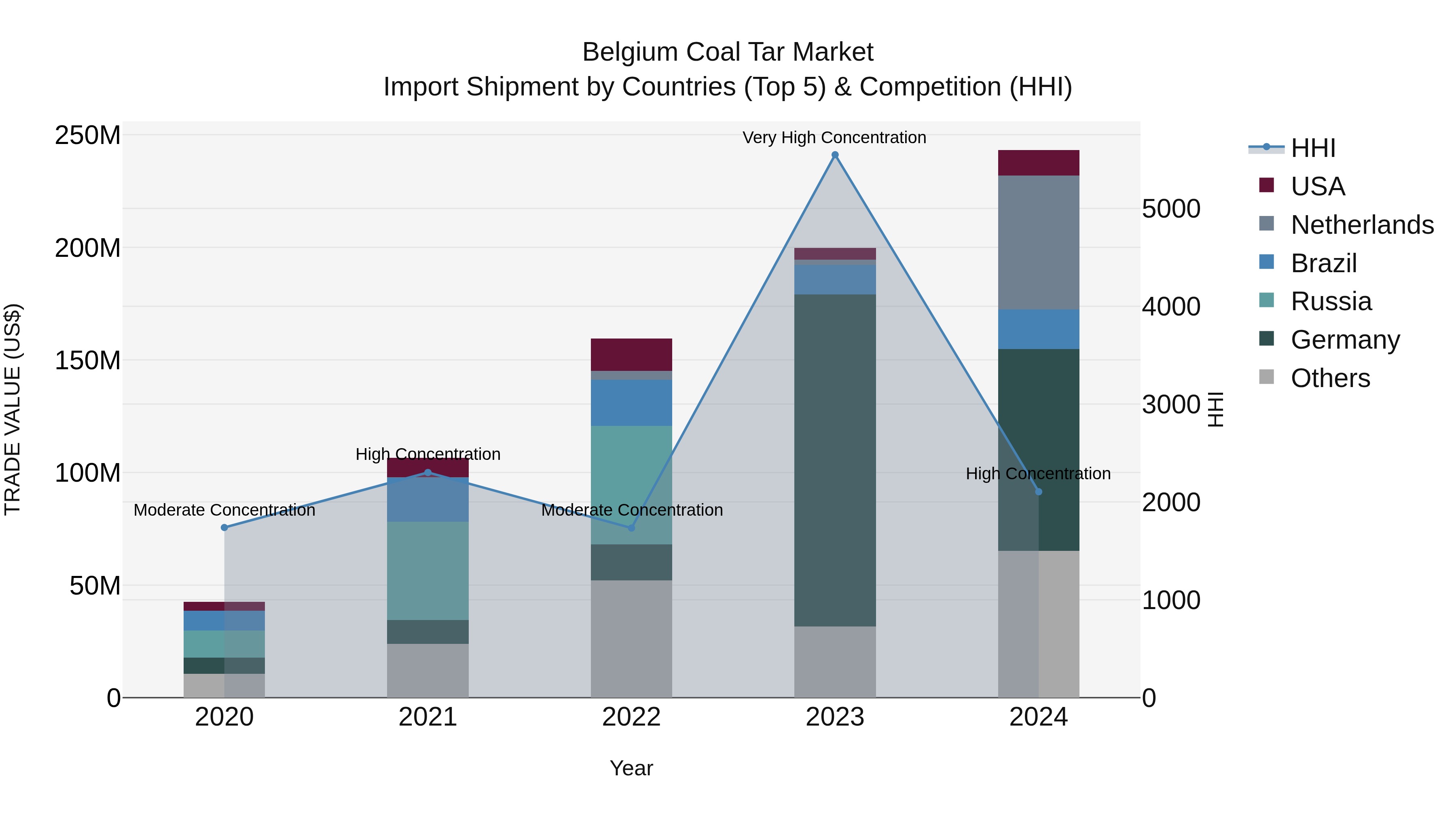
Belgium`s coal tar import market in 2024 continued to be dominated by key exporters such as Germany, Netherlands, Brazil, USA, and Denmark. Despite a slightly lower Herfindahl-Hirschman Index (HHI) indicating a shift towards high concentration rather than very high in 2024, the market remained competitive. With a remarkable compound annual growth rate (CAGR) of 54.65% from 2020 to 2024 and a solid growth rate of 21.78% from 2023 to 2024, the coal tar import sector in Belgium shows promising expansion and sustained interest from top exporting countries.
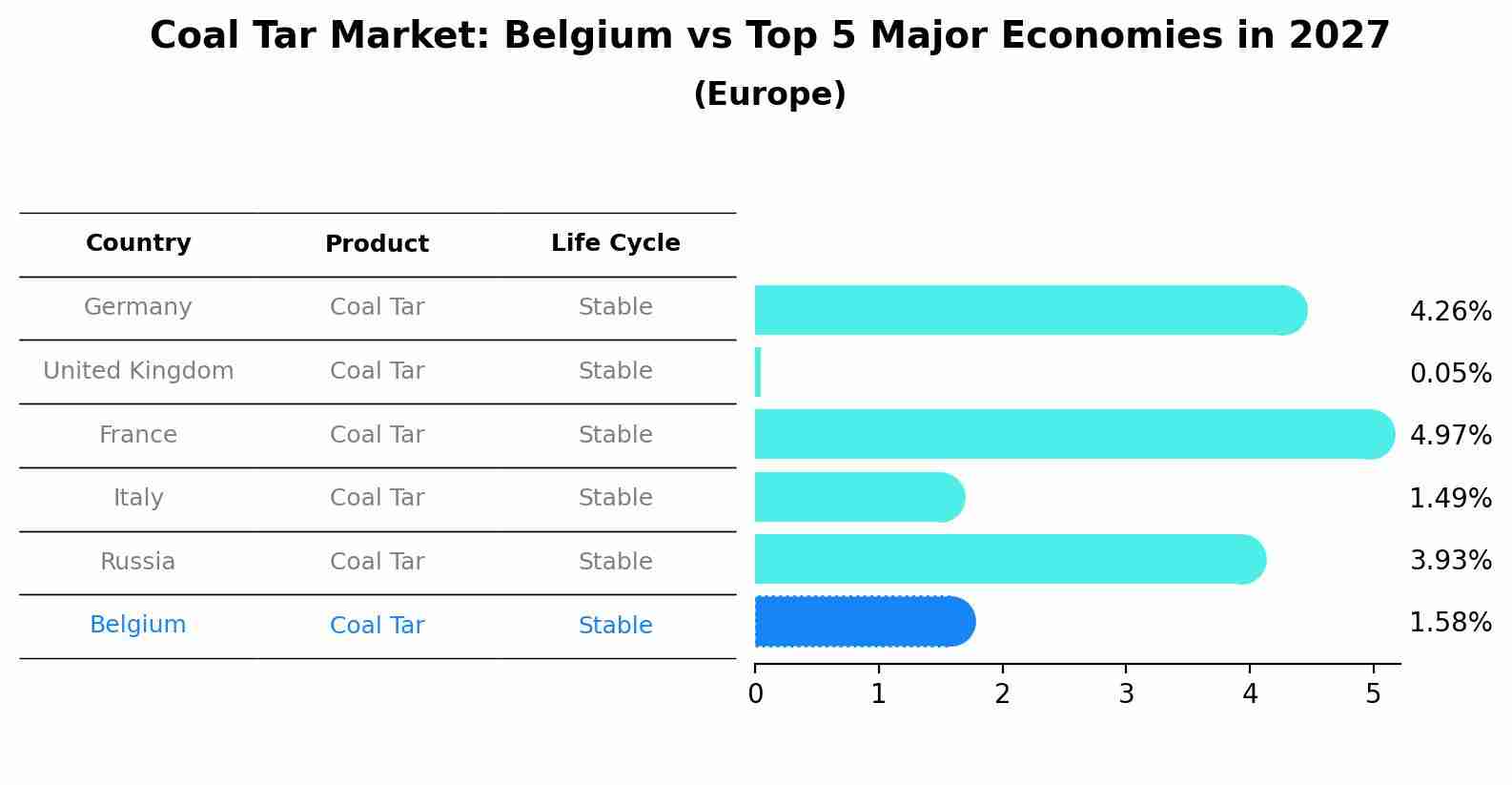
Coal Tar Market: Belgium vs Top 5 Major Economies in 2027 (Europe)
The Coal Tar market in Belgium is projected to grow at a stable growth rate of 1.58% by 2027, within the Europe region led by Germany, along with other countries like United Kingdom, France, Italy and Russia, collectively shaping a dynamic and evolving market environment driven by innovation and increasing adoption of emerging technologies.
Belgium Coal Tar Market Overview
The coal tar market in Belgium is influenced by its use in various industrial applications, including as a raw material in the production of chemicals, dyes, and pharmaceuticals. Despite the decline in coal-related industries, coal tar remains relevant due to its applications in specialty products and as a by-product of coal processing.
Drivers of the market
The drivers of the Belgium coal tar market include the extensive use of coal tar in various industrial applications, such as the production of chemicals, roofing, and paving. The demand for coal tar in the construction industry for waterproofing and protective coatings is significant. Additionally, the chemical industry relies on coal tar as a raw material for producing a range of chemicals, including benzene, toluene, and naphthalene. The market is also driven by the growth of end-use industries and the development of infrastructure projects.
Challenges of the market
The coal tar market in Belgium faces challenges related to health and environmental concerns. Coal tar, being a byproduct of coal processing, contains harmful substances that pose health risks and environmental hazards. This has led to stringent regulations and increased scrutiny, affecting the production and use of coal tar. Companies in this market need to invest in technologies that mitigate these risks and comply with regulatory standards to ensure sustainability.
Government Policy of the market
The coal tar market in Belgium is shaped by environmental regulations and industry practices aimed at minimizing the use of hazardous materials. Belgium`s strict environmental policies and regulations concerning the handling and disposal of coal tar influence market dynamics. The government promotes alternatives to coal tar and supports research into safer and more sustainable materials. This regulatory environment affects the demand for coal tar and encourages the development of environmentally friendly alternatives.
Key Highlights of the Report:
- Belgium Coal Tar Market Outlook
- Market Size of Belgium Coal Tar Market, 2024
- Forecast of Belgium Coal Tar Market, 2031
- Historical Data and Forecast of Belgium Coal Tar Revenues & Volume for the Period 2021-2031
- Belgium Coal Tar Market Trend Evolution
- Belgium Coal Tar Market Drivers and Challenges
- Belgium Coal Tar Price Trends
- Belgium Coal Tar Porter`s Five Forces
- Belgium Coal Tar Industry Life Cycle
- Historical Data and Forecast of Belgium Coal Tar Market Revenues & Volume By Type for the Period 2021-2031
- Historical Data and Forecast of Belgium Coal Tar Market Revenues & Volume By Low Temperature Coal Tar for the Period 2021-2031
- Historical Data and Forecast of Belgium Coal Tar Market Revenues & Volume By Medium Temperature Coal Tar for the Period 2021-2031
- Historical Data and Forecast of Belgium Coal Tar Market Revenues & Volume By High Temperature Coal Tar for the Period 2021-2031
- Historical Data and Forecast of Belgium Coal Tar Market Revenues & Volume By Application for the Period 2021-2031
- Historical Data and Forecast of Belgium Coal Tar Market Revenues & Volume By Coal Tar Pitch for the Period 2021-2031
- Historical Data and Forecast of Belgium Coal Tar Market Revenues & Volume By Carbon Black Oil for the Period 2021-2031
- Historical Data and Forecast of Belgium Coal Tar Market Revenues & Volume By Specialty Oils for the Period 2021-2031
- Historical Data and Forecast of Belgium Coal Tar Market Revenues & Volume By End-use for the Period 2021-2031
- Historical Data and Forecast of Belgium Coal Tar Market Revenues & Volume By Aluminum Industry for the Period 2021-2031
- Historical Data and Forecast of Belgium Coal Tar Market Revenues & Volume By Roofing for the Period 2021-2031
- Historical Data and Forecast of Belgium Coal Tar Market Revenues & Volume By Tire Industry for the Period 2021-2031
- Historical Data and Forecast of Belgium Coal Tar Market Revenues & Volume By Paint Industry for the Period 2021-2031
- Historical Data and Forecast of Belgium Coal Tar Market Revenues & Volume By Wood Preservation for the Period 2021-2031
- Historical Data and Forecast of Belgium Coal Tar Market Revenues & Volume By Others for the Period 2021-2031
- Historical Data and Forecast of Belgium Coal Tar Market Revenues & Volume By Marketing Channel for the Period 2021-2031
- Historical Data and Forecast of Belgium Coal Tar Market Revenues & Volume By Online for the Period 2021-2031
- Historical Data and Forecast of Belgium Coal Tar Market Revenues & Volume By Offline for the Period 2021-2031
- Belgium Coal Tar Import Export Trade Statistics
- Market Opportunity Assessment By Type
- Market Opportunity Assessment By Application
- Market Opportunity Assessment By End-use
- Market Opportunity Assessment By Marketing Channel
- Belgium Coal Tar Top Companies Market Share
- Belgium Coal Tar Competitive Benchmarking By Technical and Operational Parameters
- Belgium Coal Tar Company Profiles
- Belgium Coal Tar Key Strategic Recommendations






































