Belgium Industrial Vacuum Cleaner Market Top 5 Importing Countries and Market Competition (HHI) Analysis
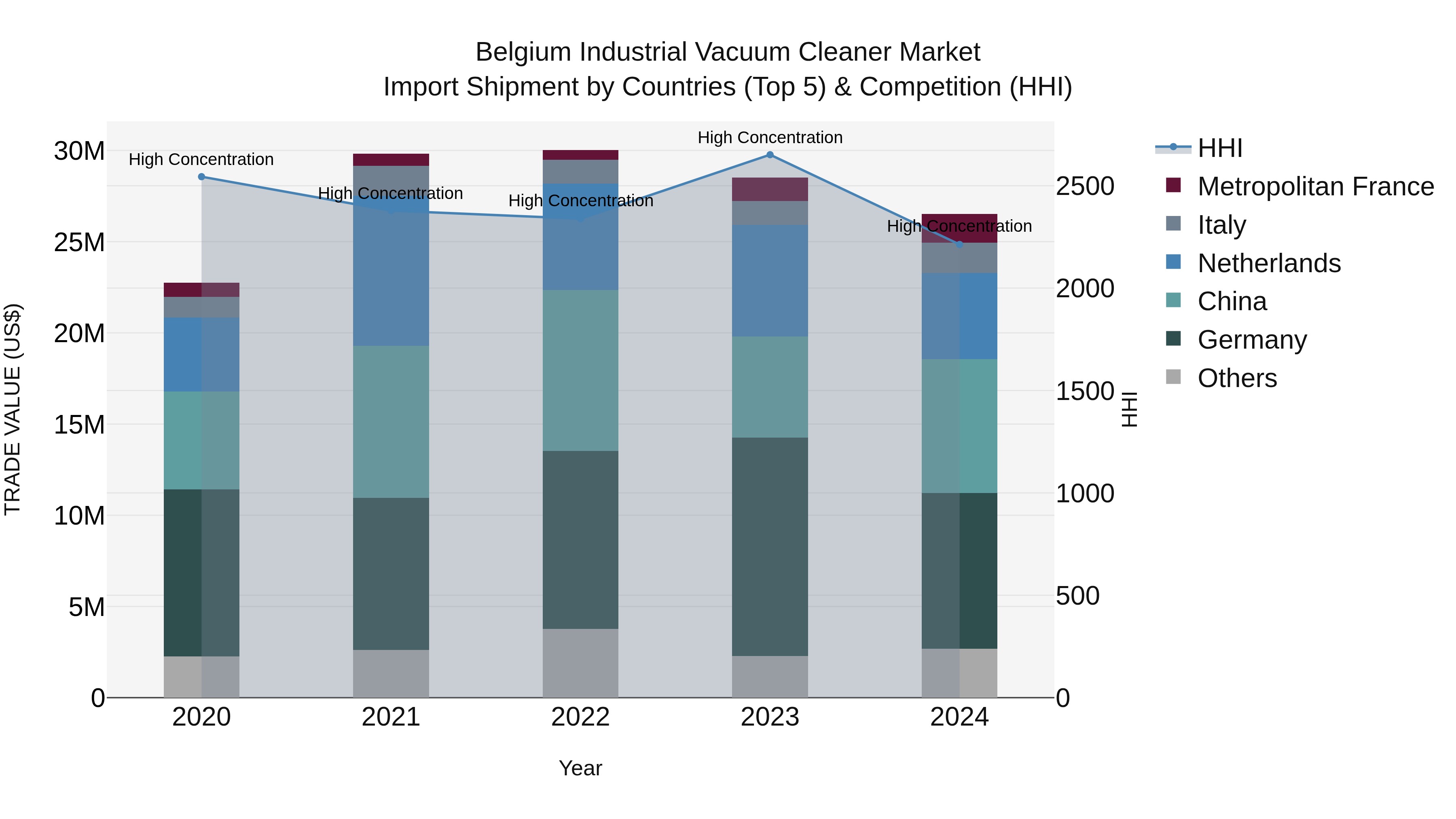
In 2024, Belgium continued to see a steady flow of industrial vacuum cleaner imports, with top exporting countries being Germany, China, Netherlands, Italy, and Metropolitan France. Despite a slight decline in growth rate from 2023 to 2024, the industry maintained a high level of market concentration, as indicated by the high Herfindahl-Hirschman Index (HHI). With a respectable compound annual growth rate (CAGR) of 3.91% from 2020 to 2024, the Belgian market for industrial vacuum cleaners remains a key area of interest for manufacturers and suppliers.
Belgium Industrial Vacuum Cleaner Market Overview
The industrial vacuum cleaner market in Belgium is expanding due to the need for efficient cleaning solutions in industrial settings. Industrial vacuum cleaners are used for maintaining cleanliness and safety in manufacturing plants, warehouses, and other facilities. The market is driven by innovations in vacuum cleaner technology that improve performance and energy efficiency.
Drivers of the market
The industrial vacuum cleaner market in Belgium is driven by the need for efficient cleaning solutions in various industries. Industrial vacuum cleaners are essential for maintaining cleanliness and hygiene in manufacturing facilities, warehouses, and commercial spaces. The increasing emphasis on workplace safety and hygiene standards boosts the demand for industrial vacuum cleaners. Additionally, the adoption of advanced cleaning technologies and the development of specialized vacuum cleaners for different applications drive market growth. The growth of industries such as pharmaceuticals, food processing, and electronics, which require stringent cleanliness standards, further propels the market.
Challenges of the market
The industrial vacuum cleaner market faces challenges such as the need for continuous innovation to improve efficiency and performance, which requires significant research and development investment. The market also contends with competition from international manufacturers, particularly those offering lower-cost products. Ensuring compliance with environmental and safety standards adds to production costs and complexity.
Government Policy of the market
The industrial vacuum cleaner market in Belgium is regulated by policies that ensure product safety and energy efficiency. The government enforces compliance with European standards for vacuum cleaners, promoting the use of energy-efficient and high-performance products. Financial incentives are available for companies developing innovative and sustainable vacuum cleaning technologies.
Key Highlights of the Report:
- Belgium Industrial Vacuum Cleaner Market Outlook
- Market Size of Belgium Industrial Vacuum Cleaner Market, 2024
- Forecast of Belgium Industrial Vacuum Cleaner Market, 2031
- Historical Data and Forecast of Belgium Industrial Vacuum Cleaner Revenues & Volume for the Period 2021-2031
- Belgium Industrial Vacuum Cleaner Market Trend Evolution
- Belgium Industrial Vacuum Cleaner Market Drivers and Challenges
- Belgium Industrial Vacuum Cleaner Price Trends
- Belgium Industrial Vacuum Cleaner Porter`s Five Forces
- Belgium Industrial Vacuum Cleaner Industry Life Cycle
- Historical Data and Forecast of Belgium Industrial Vacuum Cleaner Market Revenues & Volume By Type for the Period 2021-2031
- Historical Data and Forecast of Belgium Industrial Vacuum Cleaner Market Revenues & Volume By Dry for the Period 2021-2031
- Historical Data and Forecast of Belgium Industrial Vacuum Cleaner Market Revenues & Volume By Wet & Dry for the Period 2021-2031
- Historical Data and Forecast of Belgium Industrial Vacuum Cleaner Market Revenues & Volume By Power Source for the Period 2021-2031
- Historical Data and Forecast of Belgium Industrial Vacuum Cleaner Market Revenues & Volume By Electric for the Period 2021-2031
- Historical Data and Forecast of Belgium Industrial Vacuum Cleaner Market Revenues & Volume By Pneumatic for the Period 2021-2031
- Historical Data and Forecast of Belgium Industrial Vacuum Cleaner Market Revenues & Volume By Industry for the Period 2021-2031
- Historical Data and Forecast of Belgium Industrial Vacuum Cleaner Market Revenues & Volume By Food & Beverages for the Period 2021-2031
- Historical Data and Forecast of Belgium Industrial Vacuum Cleaner Market Revenues & Volume By Metalworking for the Period 2021-2031
- Historical Data and Forecast of Belgium Industrial Vacuum Cleaner Market Revenues & Volume By Pharmaceuticals for the Period 2021-2031
- Historical Data and Forecast of Belgium Industrial Vacuum Cleaner Market Revenues & Volume By Manufacturing for the Period 2021-2031
- Historical Data and Forecast of Belgium Industrial Vacuum Cleaner Market Revenues & Volume By Building & Construction for the Period 2021-2031
- Historical Data and Forecast of Belgium Industrial Vacuum Cleaner Market Revenues & Volume By Others for the Period 2021-2031
- Belgium Industrial Vacuum Cleaner Import Export Trade Statistics
- Market Opportunity Assessment By Type
- Market Opportunity Assessment By Power Source
- Market Opportunity Assessment By Industry
- Belgium Industrial Vacuum Cleaner Top Companies Market Share
- Belgium Industrial Vacuum Cleaner Competitive Benchmarking By Technical and Operational Parameters
- Belgium Industrial Vacuum Cleaner Company Profiles
- Belgium Industrial Vacuum Cleaner Key Strategic Recommendations






































