Bolivia Urea Market Top 5 Importing Countries and Market Competition (HHI) Analysis
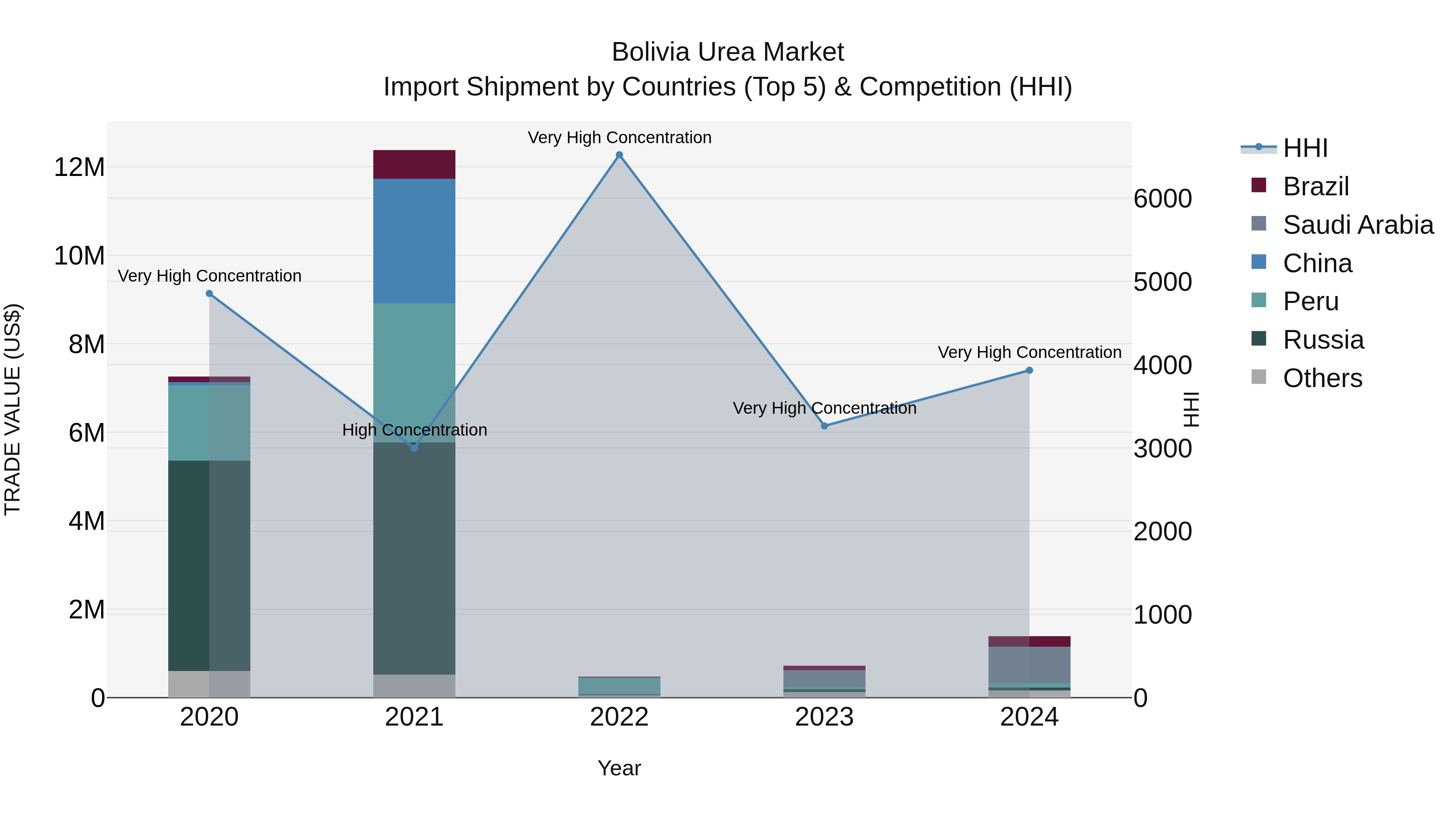
Bolivia urea import market in 2024 continued to be dominated by key exporting countries such as Saudi Arabia, Brazil, USA, Peru, and Russia. The High Herfindahl-Hirschman Index (HHI) indicates a significant level of concentration among these top exporters. Despite a negative compound annual growth rate (CAGR) from 2020 to 2024, the market showed a remarkable growth spurt in 2024 with a growth rate of 91.75%, reflecting dynamic shifts in the global urea trade landscape. This data suggests ongoing competitiveness and market dynamics shaping Bolivia urea import sector.
Bolivia Urea Market Overview
The urea market in Bolivia is influenced by the demand for this essential nitrogenous fertilizer in agriculture. Urea is widely used to enhance crop yields and improve soil fertility. Market growth is driven by the expansion of the agricultural sector, increasing adoption of modern farming techniques, and government initiatives to boost agricultural productivity. Additionally, rising awareness of sustainable farming practices and advancements in urea production technology contribute to market expansion.
Drivers of the market
The urea market in Bolivia is experiencing growth due to the increasing demand for fertilizers in the agriculture sector. Urea is widely used as a nitrogen-release fertilizer, essential for enhancing crop yield and soil fertility. The market is driven by the expansion of agricultural activities, government initiatives to improve agricultural productivity, and the growing awareness among farmers about the benefits of urea fertilizers. Additionally, the development of local production facilities and the reduction of import dependency further support market growth.
Challenges of the market
The urea market in Bolivia faces several challenges including high production costs, dependency on imports, and fluctuations in global prices. Urea production involves complex chemical processes that can be expensive, particularly when local production capabilities are limited. Bolivia relies heavily on imports to meet its demand, making the market vulnerable to international price volatility and supply chain disruptions. Additionally, fluctuations in global urea prices impact the cost and availability of urea in Bolivia, creating instability in the market.
Government Policy of the market
The Urea Market in Bolivia is significantly influenced by government policies related to agriculture, fertilizer subsidies, and environmental regulations. The Bolivian government supports the use of urea as a key fertilizer to boost agricultural productivity through subsidies and incentives aimed at farmers. Policies promoting sustainable agricultural practices and efficient fertilizer use drive market growth. Additionally, regulations ensuring the quality and environmental impact of urea production and application contribute to market expansion.
Key Highlights of the Report:
- Bolivia Urea Market Outlook
- Market Size of Bolivia Urea Market, 2024
- Forecast of Bolivia Urea Market, 2031
- Historical Data and Forecast of Bolivia Urea Revenues & Volume for the Period 2021-2031
- Bolivia Urea Market Trend Evolution
- Bolivia Urea Market Drivers and Challenges
- Bolivia Urea Price Trends
- Bolivia Urea Porter`s Five Forces
- Bolivia Urea Industry Life Cycle
- Historical Data and Forecast of Bolivia Urea Market Revenues & Volume By Grade for the Period 2021-2031
- Historical Data and Forecast of Bolivia Urea Market Revenues & Volume By Fertilizer for the Period 2021-2031
- Historical Data and Forecast of Bolivia Urea Market Revenues & Volume By Feed for the Period 2021-2031
- Historical Data and Forecast of Bolivia Urea Market Revenues & Volume By Technical for the Period 2021-2031
- Historical Data and Forecast of Bolivia Urea Market Revenues & Volume By End-user Industry for the Period 2021-2031
- Historical Data and Forecast of Bolivia Urea Market Revenues & Volume By Agriculture for the Period 2021-2031
- Historical Data and Forecast of Bolivia Urea Market Revenues & Volume By Chemical for the Period 2021-2031
- Historical Data and Forecast of Bolivia Urea Market Revenues & Volume By Automotive for the Period 2021-2031
- Historical Data and Forecast of Bolivia Urea Market Revenues & Volume By Medical for the Period 2021-2031
- Historical Data and Forecast of Bolivia Urea Market Revenues & Volume By Others for the Period 2021-2031
- Bolivia Urea Import Export Trade Statistics
- Market Opportunity Assessment By Grade
- Market Opportunity Assessment By End-user Industry
- Bolivia Urea Top Companies Market Share
- Bolivia Urea Competitive Benchmarking By Technical and Operational Parameters
- Bolivia Urea Company Profiles
- Bolivia Urea Key Strategic Recommendations






































