Botswana Forklift Market Year-wise Growth Rate (2021-2031F)
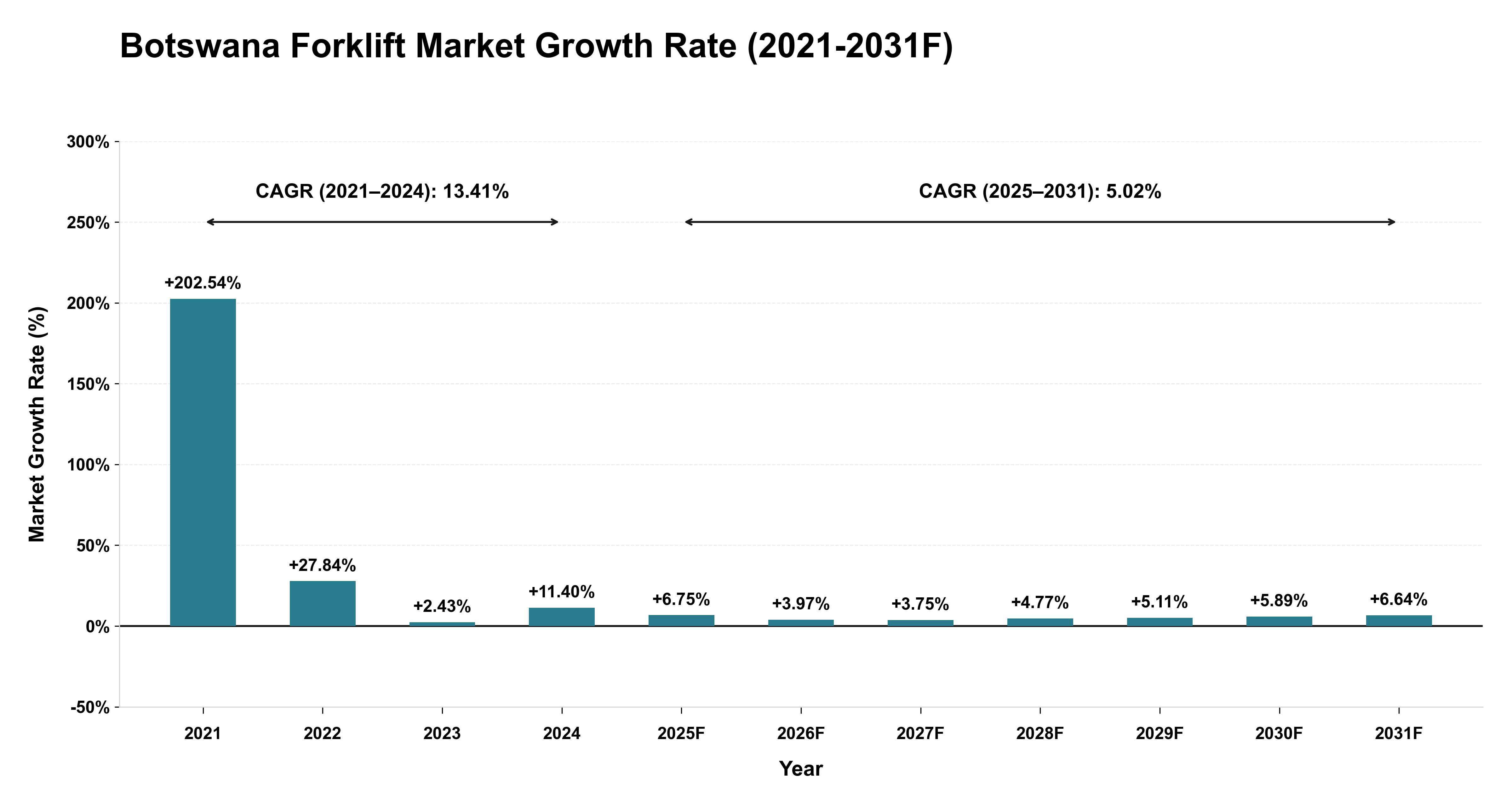
The Botswana Forklift Market witnessed remarkable growth from 2021 to 2024, with an exceptional surge of 202.54% in 2021, followed by subsequent annual growth rates of 27.84%, 2.43%, and 11.40%. This period was characterized by a booming industrial sector, increased construction activities, and infrastructure development, driving the demand for forklifts. However, looking ahead to the forecast period of 2025-2031, the market is expected to stabilize with a CAGR of 5.02%. The deceleration in growth rates post-2024 can be attributed to market saturation in key industries, moderate economic expansion, and technological advancements leading to improved operational efficiency and reduced demand for new forklift purchases at higher frequencies. The market is poised for steady growth supported by ongoing industrial activities but at a more sustainable pace compared to the previous years.
Key Highlights of the Report:
- Botswana Forklift Market Outlook
- Market Size of Botswana Forklift Market, 2025
- Forecast of Botswana Forklift Market, 2032
- Historical Data and Forecast of Botswana Forklift Revenues & Volume for the Period 2022-2032F
- Botswana Forklift Market Trend Evolution
- Botswana Forklift Market Drivers and Challenges
- Botswana Forklift Price Trends
- Botswana Forklift Porter`s Five Forces
- Botswana Forklift Industry Life Cycle
- Historical Data and Forecast of Botswana Forklift Market Revenues & Volume By Class for the Period 2022-2032F
- Historical Data and Forecast of Botswana Forklift Market Revenues & Volume By Class 1 for the Period 2022-2032F
- Historical Data and Forecast of Botswana Forklift Market Revenues & Volume By 2 for the Period 2022-2032F
- Historical Data and Forecast of Botswana Forklift Market Revenues & Volume By 3 for the Period 2022-2032F
- Historical Data and Forecast of Botswana Forklift Market Revenues & Volume By 4/5 for the Period 2022-2032F
- Historical Data and Forecast of Botswana Forklift Market Revenues & Volume By Propulsion for the Period 2022-2032F
- Historical Data and Forecast of Botswana Forklift Market Revenues & Volume By Electric for the Period 2022-2032F
- Historical Data and Forecast of Botswana Forklift Market Revenues & Volume By ICE for the Period 2022-2032F
- Historical Data and Forecast of Botswana Forklift Market Revenues & Volume By Battery Type for the Period 2022-2032F
- Historical Data and Forecast of Botswana Forklift Market Revenues & Volume By Li-Ion for the Period 2022-2032F
- Historical Data and Forecast of Botswana Forklift Market Revenues & Volume By Lead Acid for the Period 2022-2032F
- Botswana Forklift Import Export Trade Statistics
- Market Opportunity Assessment By Class
- Market Opportunity Assessment By Propulsion
- Market Opportunity Assessment By Battery Type
- Botswana Forklift Top Companies Market Share
- Botswana Forklift Competitive Benchmarking By Technical and Operational Parameters
- Botswana Forklift Company Profiles
- Botswana Forklift Key Strategic Recommendations






































