Brazil Accounting Software Market Size, Share & Growth Rate
The Brazil Accounting Software Market was estimated at USD 446 Million in 2025 and is projected to reach USD 532 Million by 2032, growing at a CAGR of 2.6% from 2026 to 2032. This steady growth trajectory is primarily driven by ongoing digital transformation initiatives across various industries in Brazil, where businesses are increasingly seeking efficiency through automation. The heightened focus on regulatory compliance, particularly in the wake of evolving financial reporting standards, further fuels demand for advanced accounting solutions that can keep pace with these requirements.
Brazil Accounting Software Market Year-wise Growth Rate and Key Drivers
This graph highlights how the Brazil Accounting Software Market has steadily grown over the years, supported by major growth factors.
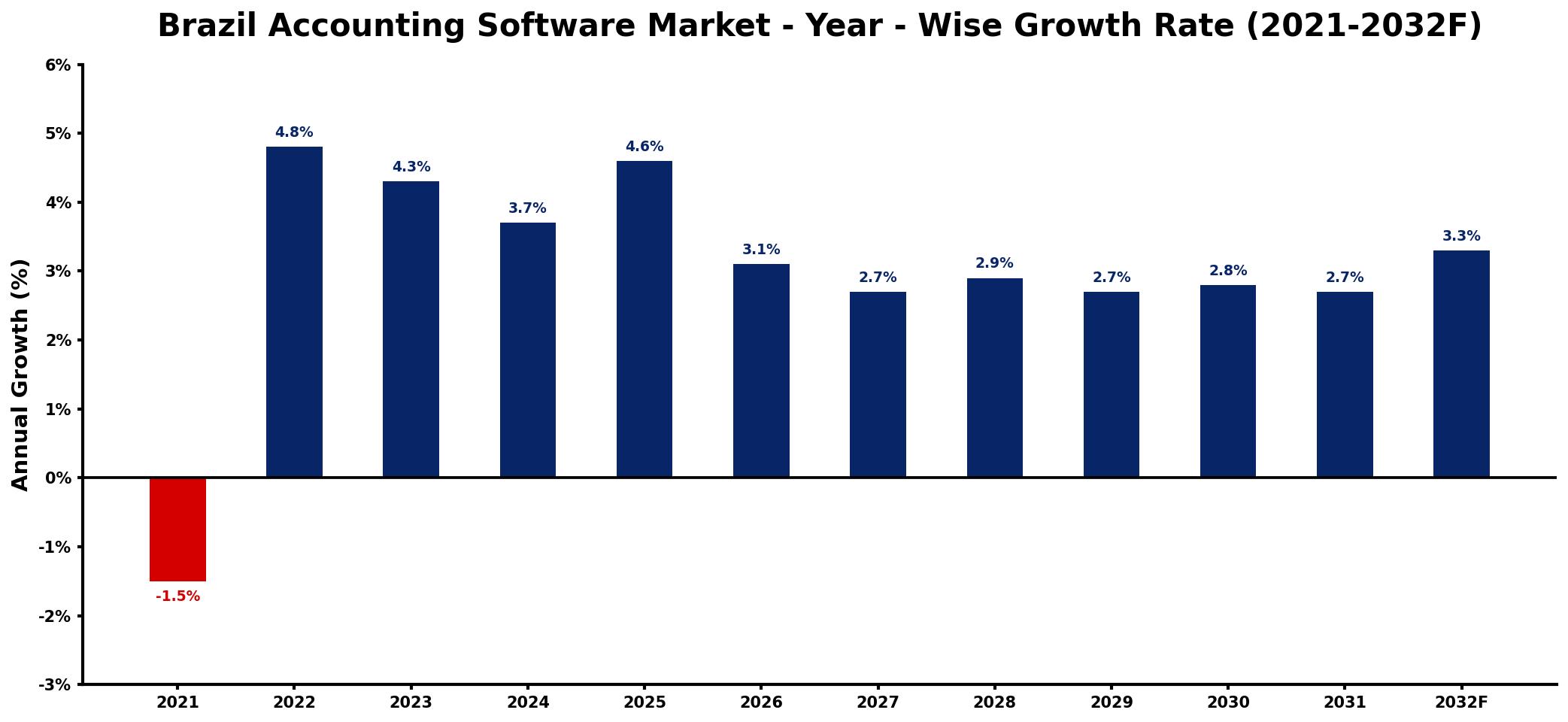
The table below presents the year‑wise growth rates along with the key drivers influencing the market
| Year | Growth Rate | Major Drivers |
| 2021 | -1.5% | decreased business investment activity |
| 2022 | 4.8% | increased digital transformation initiatives |
| 2023 | 4.3% | growing demand for automation solutions |
| 2024 | 3.7% | expansion of small business sector |
| 2025 | 4.6% | rising interest in cloud technologies |
| 2026 | 3.1% | enhanced regulatory compliance requirements |
| 2027 | 2.7% | growth in remote work adoption |
| 2028 | 2.9% | increased focus on data security |
| 2029 | 2.7% | surge in e-commerce transactions |
| 2030 | 2.8% | growing need for financial analytics |
| 2031 | 2.7% | increased capital investment inflows |
| 2032 | 3.3% | increased investment in AI applications |
Note: Market size estimations and growth projections presented in this report are based on 6Wresearch's proprietary forecasting methodology, utilizing the latest available industry data, government publications, and primary research inputs.
Brazil Accounting Software Market Synopsis
The current landscape of the Brazil Accounting Software Market is predominantly shaped by the rapid digitization of financial processes. Enterprises, ranging from small businesses to large corporations, are transitioning to sophisticated software solutions that enhance their bookkeeping and reporting capabilities while ensuring compliance with local regulations.
Another pivotal force in this market is the increasing demand for cloud-based accounting solutions. The flexibility, cost-effectiveness, and scalability these platforms offer are attracting a growing number of users, positioning cloud technology as a cornerstone in the evolution of accounting practices throughout Brazil.
Brazil Accounting Software Market Key Takeaways
- Digital transformation is driving significant adoption of accounting software among Brazilian enterprises.
- The shift towards cloud-based solutions is reshaping user expectations and industry standards.
- Regulatory compliance continues to be a critical factor influencing software selection and implementation.
- Companies must navigate competition from diverse financial management solutions and evolving technologies.
- Government policies are shaping the framework within which accounting software operates in Brazil.
Evaluation of Restraints in Brazil Accounting Software Market
Despite the encouraging growth prospects, the Brazil Accounting Software Market faces several restraints that could hinder its progress. One significant challenge is the rapid pace of technological advancement, which demands that software providers continually innovate to stay relevant. Furthermore, businesses grapple with the complexities of customizing software solutions to meet unique regulatory requirements, which can delay implementation. Data security concerns are also paramount, as companies must ensure robust protections for sensitive financial information. Additionally, competition from alternative financial management solutions adds pressure on pricing and market penetration strategies, potentially stifling growth.
Brazil Accounting Software Market Trends
The Brazil Accounting Software Market is witnessing several transformative trends that are shaping its future. A notable trend is the increasing integration of artificial intelligence (AI) and machine learning (ML) capabilities in accounting software, allowing for more accurate forecasting and enhanced decision-making processes. Another trend is the growing importance of mobile-friendly applications, catering to the need for on-the-go access to financial data, which is essential for todays dynamic business environments. Additionally, there is a rising emphasis on sustainability and ethical accounting practices, prompting software developers to integrate features that support these initiatives.
Brazil Accounting Software Market Opportunities
Investors and businesses have a wealth of opportunities within the Brazil Accounting Software Market. One of the most significant growth areas lies in the provision of tailored solutions for niche sectors, such as startups and SMEs that require scalable and affordable accounting tools. Furthermore, partnerships with local financial institutions to offer integrated services can open new revenue streams. As more companies migrate to cloud-based solutions, there's also a growing opportunity for providers to innovate with subscription-based pricing models that enhance user retention and lifetime value.
Government Initiatives in the Brazil Accounting Software Market
The role of government policy in the Brazil Accounting Software Market is substantial, primarily through regulations that govern financial reporting and compliance standards. Initiatives aimed at promoting digitalization in accounting practices are encouraging businesses to adopt advanced software solutions. Furthermore, the Brazilian government has introduced measures to facilitate the importation and distribution of accounting software that meets national regulations, ensuring adherence to data privacy, encryption, and audit requirements.
Future Insights of the Brazil Accounting Software Market
Looking ahead to 2026-2032, the Brazil Accounting Software Market is poised for steady growth, bolstered by the continued push for digital transformation across all business sectors. As regulatory frameworks evolve, software solutions that offer compliance features will be in high demand. Additionally, the integration of emerging technologies, such as AI and blockchain, is expected to redefine efficiency and reliability in accounting practices. Overall, businesses that can adapt to these trends will likely thrive in a competitive landscape.
Brazil Accounting Software Market Latest Developments (2025 - 2026)
In recent months, the Brazil Accounting Software Market has seen a surge in innovative product launches aimed at enhancing user experience and compliance capabilities. Companies are increasingly focusing on providing enhanced data analytics features and more intuitive user interfaces to meet the rising expectations of users. Additionally, collaborations between tech firms and traditional financial institutions have gained traction, fostering an ecosystem that supports integrated financial solutions tailored to local needs.
Brazil Accounting Software Market - Key Attractiveness of the Report
- 10 Years of Market Numbers
- Historical Data Starting from 2022 to 2025
- Base Year: 2025
- Forecast Data until 2032
- Key Performance Indicators Impacting the Market
- Major Upcoming Developments and Projects
Key Highlights of the Report:
- Brazil Accounting Software Market Outlook
- Market Size of Brazil Accounting Software Market, 2025
- Forecast of Brazil Accounting Software Market, 2032
- Historical Data and Forecast of Brazil Accounting Software Revenues & Volume for the Period 2022-2032F
- Brazil Accounting Software Market Trend Evolution
- Brazil Accounting Software Market Drivers and Challenges
- Brazil Accounting Software Price Trends
- Brazil Accounting Software Porter's Five Forces
- Brazil Accounting Software Industry Life Cycle
- Historical Data and Forecast of Brazil Accounting Software Market Revenues & Volume By Component for the Period 2022-2032F
- Historical Data and Forecast of Brazil Accounting Software Market Revenues & Volume By Software for the Period 2022-2032F
- Historical Data and Forecast of Brazil Accounting Software Market Revenues & Volume By Services for the Period 2022-2032F
- Historical Data and Forecast of Brazil Accounting Software Market Revenues & Volume By Enterprise Size for the Period 2022-2032F
- Historical Data and Forecast of Brazil Accounting Software Market Revenues & Volume By Large for the Period 2022-2032F
- Historical Data and Forecast of Brazil Accounting Software Market Revenues & Volume By Small & Medium for the Period 2022-2032F
- Historical Data and Forecast of Brazil Accounting Software Market Revenues & Volume By Type for the Period 2022-2032F
- Historical Data and Forecast of Brazil Accounting Software Market Revenues & Volume By Spreadsheets for the Period 2022-2032F
- Historical Data and Forecast of Brazil Accounting Software Market Revenues & Volume By ERP for the Period 2022-2032F
- Historical Data and Forecast of Brazil Accounting Software Market Revenues & Volume By Custom Accounting Software for the Period 2022-2032F
- Historical Data and Forecast of Brazil Accounting Software Market Revenues & Volume By Tax Management Software for the Period 2022-2032F
- Historical Data and Forecast of Brazil Accounting Software Market Revenues & Volume By End-use Industry for the Period 2022-2032F
- Historical Data and Forecast of Brazil Accounting Software Market Revenues & Volume By BFSI for the Period 2022-2032F
- Historical Data and Forecast of Brazil Accounting Software Market Revenues & Volume By IT & Telecommunication for the Period 2022-2032F
- Historical Data and Forecast of Brazil Accounting Software Market Revenues & Volume By Government & Public Sector for the Period 2022-2032F
- Historical Data and Forecast of Brazil Accounting Software Market Revenues & Volume By Automotive for the Period 2022-2032F
- Historical Data and Forecast of Brazil Accounting Software Market Revenues & Volume By Retail & Consumer Goods for the Period 2022-2032F
- Historical Data and Forecast of Brazil Accounting Software Market Revenues & Volume By Oil & Gas for the Period 2022-2032F
- Historical Data and Forecast of Brazil Accounting Software Market Revenues & Volume By Manufacturing for the Period 2022-2032F
- Historical Data and Forecast of Brazil Accounting Software Market Revenues & Volume By Others for the Period 2022-2032F
- Brazil Accounting Software Import Export Trade Statistics
- Market Opportunity Assessment By Component
- Market Opportunity Assessment By Enterprise Size
- Market Opportunity Assessment By Type
- Market Opportunity Assessment By End-use Industry
- Brazil Accounting Software Top Companies Market Share
- Brazil Accounting Software Competitive Benchmarking By Technical and Operational Parameters
- Brazil Accounting Software Company Profiles
- Brazil Accounting Software Key Strategic Recommendations






































