Brazil Air Traffic Control (ATC) Equipment Market Size, Share & Growth Rate
The Brazil Air Traffic Control (ATC) Equipment Market was estimated at USD 500 Million in 2025 and is projected to reach USD 689 Million by 2032, growing at a CAGR of 4.7% from 2026 to 2032. This growth trajectory can be attributed to the rising demand for air travel in Brazil, leading to increased airport expansions and the urgent necessity for modern ATC systems. Enhanced safety and efficiency in air traffic management are critical for supporting this burgeoning aviation sector, further driving investments in advanced ATC technologies.
Brazil Air Traffic Control (ATC) Equipment Market Year-wise Growth Rate and Key Drivers
This graph highlights how the Brazil Air Traffic Control (ATC) Equipment Market has steadily grown over the years, supported by major growth factors.
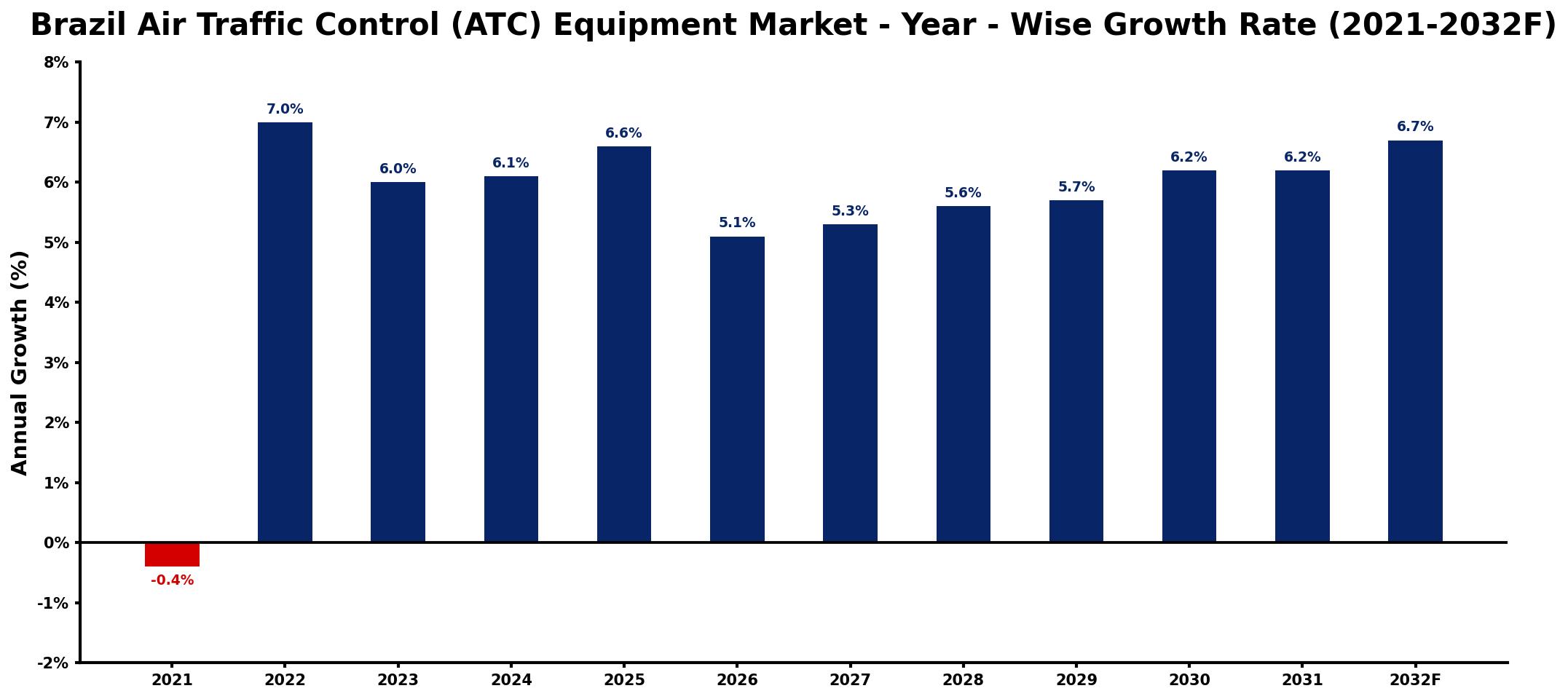
The table below presents the year‑wise growth rates along with the key drivers influencing the market
| Year | Growth Rate | Major Drivers |
| 2021 | -0.4% | reduction in infrastructure investments |
| 2022 | 7.0% | increased government spending initiatives |
| 2023 | 6.0% | rising passenger travel demand |
| 2024 | 6.1% | expansion of private sector projects |
| 2025 | 6.6% | growing technological advancements adoption |
| 2026 | 5.1% | enhanced safety regulations implementation |
| 2027 | 5.3% | increased international trade activities |
| 2028 | 5.6% | development of new urban centers |
| 2029 | 5.7% | growing regional tourism opportunities |
| 2030 | 6.2% | upgraded modernization programs announced |
| 2031 | 6.2% | strengthening international trade flows |
| 2032 | 6.7% | increased focus on sustainability initiatives |
Note: Market size estimations and growth projections presented in this report are based on 6Wresearch's proprietary forecasting methodology, utilizing the latest available industry data, government publications, and primary research inputs.
Brazil Air Traffic Control (ATC) Equipment Market Synopsis
The Brazilian government is actively pursuing modernization initiatives aimed at upgrading existing air traffic control infrastructures. This includes investments in cutting-edge technology to improve safety and operational efficiency across the nation's airspace. As a result, market participants must adapt to evolving regulatory landscapes while integrating new solutions that enhance air traffic management.
Moreover, the increasing emphasis on cybersecurity in ATC systems cannot be overlooked. With a rising number of cyber threats targeting aviation, Brazil's air traffic control systems must not only embrace innovation but also implement robust security measures to protect both infrastructure and data integrity.
Brazil Air Traffic Control (ATC) Equipment Market Key Takeaways
- The market is driven by the significant growth of air travel in Brazil and airport expansions.
- Ongoing modernization efforts are essential for improving safety and operational efficiency.
- Cybersecurity is a growing concern that necessitates investment in protective technologies.
- Collaboration between public and private sectors is crucial for effective infrastructure development.
- Regulatory compliance will remain a primary focus as the market evolves.
Evaluation of Restraints in Brazil Air Traffic Control (ATC) Equipment Market
While the Brazil Air Traffic Control Equipment Market is on an upward trajectory, several restraints are affecting its full potential. Key among these is the substantial financial investment required for infrastructure development and modernization. Compliance with stringent regulatory frameworks further complicates the landscape, as market participants must ensure adherence to international aviation standards. Additionally, the challenges of integrating advanced technologies into existing systems pose risks that must be carefully managed to mitigate operational disruptions.
Brazil Air Traffic Control (ATC) Equipment Market Trends
The landscape of the Brazil Air Traffic Control Equipment Market is increasingly influenced by automation and digitalization trends. Technologies such as artificial intelligence and machine learning are being integrated to enhance predictive analytics and streamline air traffic operations. Furthermore, there is a noticeable push towards implementing NextGen ATC systems that enable more efficient use of airspace and reduced environmental impact. Additionally, the integration of unmanned aerial vehicles (UAVs) into the air traffic management system is shaping future operations and regulatory requirements.
Brazil Air Traffic Control (ATC) Equipment Market Opportunities
The market offers substantial opportunities, particularly in the realm of technology investments. Advanced radar systems, satellite-based navigation solutions, and real-time data analytics platforms are in high demand. Moreover, partnerships with tech companies specializing in cybersecurity present avenues for enhancing system resilience against potential threats. As Brazil continues to expand its aviation infrastructure, the need for innovative solutions in air traffic management will only grow, opening doors for companies equipped to meet these challenges.
Government Initiatives in the Brazil Air Traffic Control (ATC) Equipment Market
The Brazilian government plays a pivotal role in shaping the Air Traffic Control Equipment Market. Initiatives focused on enhancing safety and operational efficiency form the backbone of its policies. This includes significant investments in modernizing ATC infrastructure and launching training programs aimed at developing skilled air traffic controllers. Compliance with international standards is also a priority, ensuring that Brazils airspace remains safe and competitive on a global scale.
Future Insights of the Brazil Air Traffic Control (ATC) Equipment Market
Looking ahead to 2026-2032, the Brazil Air Traffic Control Equipment Market is poised for substantial advancements. The continued growth of air travel will necessitate further investments in ATC infrastructure, with an emphasis on advanced technologies that enhance safety and efficiency. Integration of smart systems and analytics will likely become commonplace, providing operators with invaluable insights. As the regulatory framework evolves, so too will the industry's capacity to adapt to new challenges and opportunities, ensuring a safe and efficient airspace for future generations.
Brazil Air Traffic Control (ATC) Equipment Market Latest Developments (2025 - 2026)
Recent developments in the Brazil Air Traffic Control Equipment Market indicate a shift towards incorporating cutting-edge technologies aimed at addressing both efficiency and cybersecurity concerns. There is a growing trend of collaboration among industry stakeholders to foster innovation and expedite the modernization of air traffic management systems. Additionally, the implementation of pilot projects focusing on integrating UAVs into the national airspace is gaining traction, reflecting a proactive approach to future air traffic challenges.
Brazil Air Traffic Control (ATC) Equipment Market - Key Attractiveness of the Report
- 10 Years of Market Numbers
- Historical Data Starting from 2022 to 2025
- Base Year: 2025
- Forecast Data until 2032
- Key Performance Indicators Impacting the Market
- Major Upcoming Developments and Projects
Key Highlights of the Report:
- Brazil Air Traffic Control (ATC) Equipment Market Outlook
- Market Size of Brazil Air Traffic Control (ATC) Equipment Market, 2025
- Forecast of Brazil Air Traffic Control (ATC) Equipment Market, 2032
- Historical Data and Forecast of Brazil Air Traffic Control (ATC) Equipment Revenues & Volume for the Period 2022-2032F
- Brazil Air Traffic Control (ATC) Equipment Market Trend Evolution
- Brazil Air Traffic Control (ATC) Equipment Market Drivers and Challenges
- Brazil Air Traffic Control (ATC) Equipment Price Trends
- Brazil Air Traffic Control (ATC) Equipment Porter's Five Forces
- Brazil Air Traffic Control (ATC) Equipment Industry Life Cycle
- Historical Data and Forecast of Brazil Air Traffic Control (ATC) Equipment Market Revenues & Volume By Product for the Period 2022-2032F
- Historical Data and Forecast of Brazil Air Traffic Control (ATC) Equipment Market Revenues & Volume By Communications Equipment for the Period 2022-2032F
- Historical Data and Forecast of Brazil Air Traffic Control (ATC) Equipment Market Revenues & Volume By Navigation Equipment for the Period 2022-2032F
- Historical Data and Forecast of Brazil Air Traffic Control (ATC) Equipment Market Revenues & Volume By Surveillance Equipment for the Period 2022-2032F
- Historical Data and Forecast of Brazil Air Traffic Control (ATC) Equipment Market Revenues & Volume By Air Traffic Control Equipment Application Outlook (USD Million, 2023-2032) for the Period 2022-2032F
- Historical Data and Forecast of Brazil Air Traffic Control (ATC) Equipment Market Revenues & Volume By Commercial Aircraft for the Period 2022-2032F
- Historical Data and Forecast of Brazil Air Traffic Control (ATC) Equipment Market Revenues & Volume By Private Aircraft for the Period 2022-2032F
- Historical Data and Forecast of Brazil Air Traffic Control (ATC) Equipment Market Revenues & Volume By Military Aircraft for the Period 2022-2032F
- Brazil Air Traffic Control (ATC) Equipment Import Export Trade Statistics
- Market Opportunity Assessment By Product
- Brazil Air Traffic Control (ATC) Equipment Top Companies Market Share
- Brazil Air Traffic Control (ATC) Equipment Competitive Benchmarking By Technical and Operational Parameters
- Brazil Air Traffic Control (ATC) Equipment Company Profiles
- Brazil Air Traffic Control (ATC) Equipment Key Strategic Recommendations






































