Brazil Aquaculture & Marine Products Market Size, Share & Growth Rate
The Brazil Aquaculture & Marine Products Market was estimated at USD 117 Million in 2025 and is projected to reach USD 139 Million by 2032, growing at a CAGR of 2.5% from 2026 to 2032. This growth trajectory is fueled by a significant uptick in seafood consumption, driven by health-conscious consumers seeking protein alternatives. Furthermore, the rising preference for aquaculture as a sustainable solution amidst dwindling wild fish stocks underscores the sectors potential to meet both domestic and international seafood demands.
Brazil Aquaculture & Marine Products Market Year-wise Growth Rate and Key Drivers
This graph highlights how the Brazil Aquaculture & Marine Products Market has steadily grown over the years, supported by major growth factors.
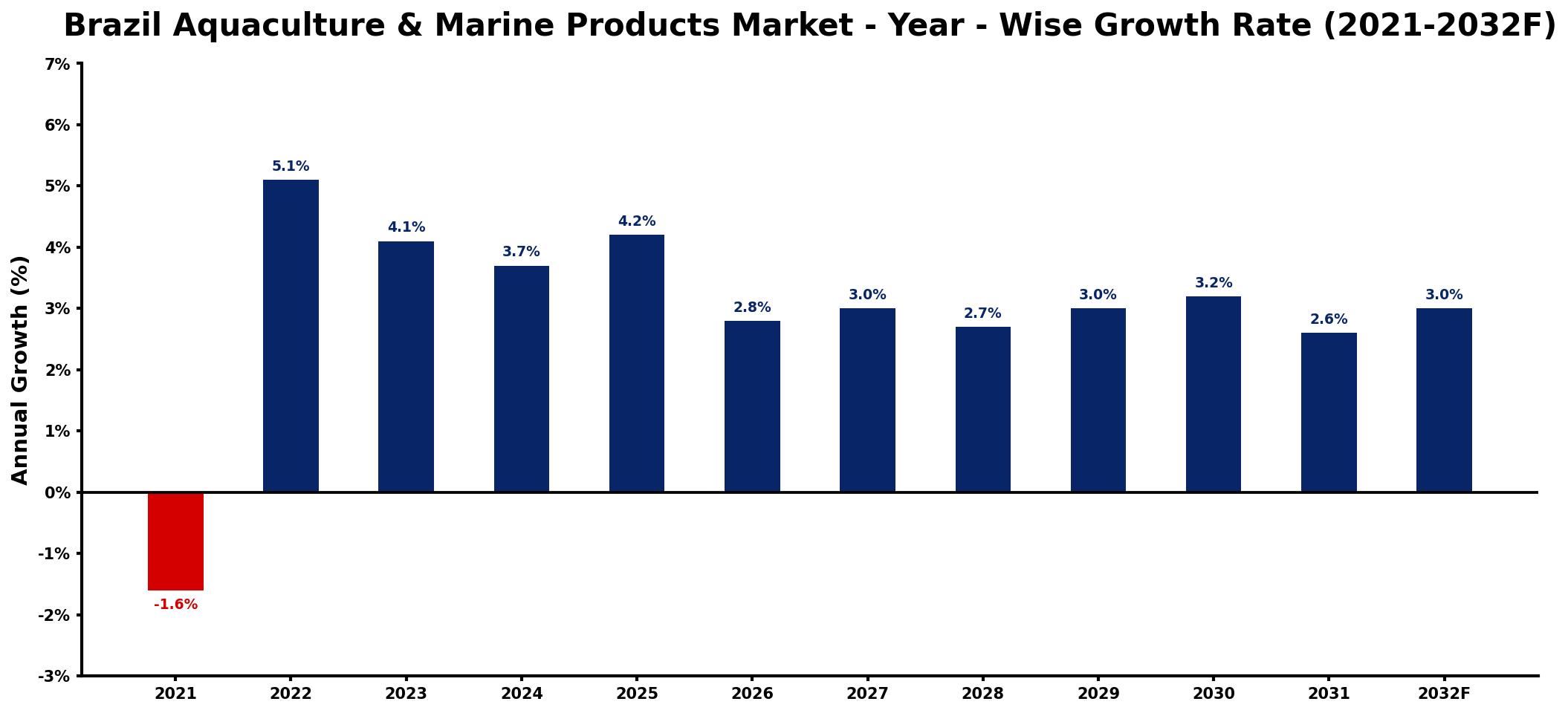
The table below presents the year‑wise growth rates along with the key drivers influencing the market
| Year | Growth Rate | Major Drivers |
| 2021 | -1.6% | decrease in consumer spending patterns |
| 2022 | 5.1% | growing demand for sustainable sourcing |
| 2023 | 4.1% | increased investment in technology adoption |
| 2024 | 3.7% | expansion of distribution networks globally |
| 2025 | 4.2% | rising popularity of healthy diets |
| 2026 | 2.8% | enhanced focus on environmental regulations |
| 2027 | 3.0% | increased exports to international markets |
| 2028 | 2.7% | growth in recreational fishing activities |
| 2029 | 3.0% | development of innovative farming techniques |
| 2030 | 3.2% | growing automotive sector requirements |
| 2031 | 2.6% | increased collaboration with research institutions |
| 2032 | 3.0% | growing emphasis on traceability standards |
Note: Market size estimations and growth projections presented in this report are based on 6Wresearch's proprietary forecasting methodology, utilizing the latest available industry data, government publications, and primary research inputs.
Brazil Aquaculture & Marine Products Market Synopsis
Brazils aquaculture sector is at a pivotal juncture, characterized by booming production capabilities and an increasing consumer appetite for marine products. The extensive coastline and favorable climatic conditions empower local producers to cultivate a variety of species, including fish, shrimp, and shellfish, thereby enriching the market's offerings.
However, the market's expansion is not without its challenges. Environmental sustainability concerns and regulatory hurdles necessitate a robust framework for sustainable practices within aquaculture. As consumers increasingly prioritize traceability and ethical sourcing, the industry must adapt to these evolving expectations to enhance market viability.
- Brazils aquaculture sector is rapidly growing, with diverse marine product offerings driven by favorable environmental conditions.
- Sustainability and ethical sourcing are becoming pivotal in shaping consumer preferences within the market.
- Technological advancements are enhancing production efficiency and disease management in aquaculture operations.
- Government initiatives are supporting infrastructure development and sustainable practices to bolster market growth.
- Challenges related to environmental degradation and regulatory constraints must be strategically addressed to ensure long-term market viability.
The growth of Brazils aquaculture and marine products market faces several critical restraints. Environmental degradation poses a significant threat, as over-exploitation of resources and habitat destruction can lead to reduced biodiversity and compromised ecosystem health. Additionally, disease outbreaks can severely impact production, necessitating stringent management practices. Regulatory constraints further complicate the landscape, as industry players must navigate complex laws governing marine resource exploitation. This combination of factors underscores the need for a concerted effort to foster a more resilient aquaculture industry.
Current trends in Brazils aquaculture market are largely influenced by technological innovation and sustainable practices. The integration of advanced aquaculture technologies, such as recirculating aquaculture systems (RAS) and biofloc technology, is enhancing production efficiency and environmental sustainability. Additionally, there is a growing market for organic and certified sustainable seafood, prompting producers to adopt eco-friendly farming practices to appeal to increasingly conscious consumers.
The Brazilian aquaculture sector presents multiple growth and investment opportunities, particularly in expanding infrastructure and improving supply chain management. With increasing domestic and international demand for seafood, investing in state-of-the-art processing facilities and distribution networks can significantly enhance market competitiveness. Moreover, developing aquaculture practices that prioritize sustainability can open doors to new markets and consumer segments, positioning Brazil as a leader in responsibly sourced marine products.
The Brazilian government recognizes aquacultures potential to contribute to food security and economic development. Recent initiatives have focused on enhancing aquaculture infrastructure, including investments in hatcheries and processing facilities. Additionally, regulatory reforms aimed at promoting sustainable aquaculture practices and ensuring environmental protection are essential components of the governments strategy to boost the marine products market. These policies aim to balance economic growth with ecological sustainability, providing a roadmap for future industry development.
Looking ahead to 2026-2032, Brazils aquaculture and marine products market is set to experience transformative growth driven by sustainability and innovation. The demand for responsibly sourced seafood will continue to rise, pushing producers to adopt eco-friendly practices. Furthermore, advancements in aquaculture technology are expected to play a crucial role in overcoming production challenges, enhancing both yield and quality. As these trends coalesce, Brazil is poised to solidify its position as a significant player in the global seafood market.
Recent developments in Brazil's aquaculture sector indicate a shift towards greater technological integration and sustainability practices. Industry stakeholders are increasingly investing in innovative farming techniques and partnerships aimed at improving environmental stewardship. Additionally, consumer awareness campaigns are gaining traction, emphasizing the importance of traceability and ethical sourcing in seafood products. Such movements are likely to catalyze further growth in the sector, making it more competitive in both domestic and international markets.
- 10 Years of Market Numbers
- Historical Data Starting from 2022 to 2025
- Base Year: 2025
- Forecast Data until 2032
- Key Performance Indicators Impacting the Market
- Major Upcoming Developments and Projects
Key Highlights of the Report:
- Brazil Aquaculture & Marine Products Market Outlook
- Market Size of Brazil Aquaculture & Marine Products Market, 2025
- Forecast of Brazil Aquaculture & Marine Products Market, 2032
- Historical Data and Forecast of Brazil Aquaculture & Marine Products Revenues & Volume for the Period 2022-2032F
- Brazil Aquaculture & Marine Products Market Trend Evolution
- Brazil Aquaculture & Marine Products Market Drivers and Challenges
- Brazil Aquaculture & Marine Products Price Trends
- Brazil Aquaculture & Marine Products Porter's Five Forces
- Brazil Aquaculture & Marine Products Industry Life Cycle
- Historical Data and Forecast of Brazil Aquaculture & Marine Products Market Revenues & Volume By Rearing Product Type for the Period 2022-2032F
- Historical Data and Forecast of Brazil Aquaculture & Marine Products Market Revenues & Volume By Equipment for the Period 2022-2032F
- Historical Data and Forecast of Brazil Aquaculture & Marine Products Market Revenues & Volume By Chemicals for the Period 2022-2032F
- Historical Data and Forecast of Brazil Aquaculture & Marine Products Market Revenues & Volume By Pharmaceuticals for the Period 2022-2032F
- Historical Data and Forecast of Brazil Aquaculture & Marine Products Market Revenues & Volume By Fertilizers for the Period 2022-2032F
- Historical Data and Forecast of Brazil Aquaculture & Marine Products Market Revenues & Volume By Others for the Period 2022-2032F
- Historical Data and Forecast of Brazil Aquaculture & Marine Products Market Revenues & Volume By Type for the Period 2022-2032F
- Historical Data and Forecast of Brazil Aquaculture & Marine Products Market Revenues & Volume By Fisheries for the Period 2022-2032F
- Historical Data and Forecast of Brazil Aquaculture & Marine Products Market Revenues & Volume By Seaweeds for the Period 2022-2032F
- Historical Data and Forecast of Brazil Aquaculture & Marine Products Market Revenues & Volume By Microalgae for the Period 2022-2032F
- Historical Data and Forecast of Brazil Aquaculture & Marine Products Market Revenues & Volume By Crustaceans for the Period 2022-2032F
- Historical Data and Forecast of Brazil Aquaculture & Marine Products Market Revenues & Volume By Molluscs for the Period 2022-2032F
- Historical Data and Forecast of Brazil Aquaculture & Marine Products Market Revenues & Volume By Others for the Period 2022-2032F
- Historical Data and Forecast of Brazil Aquaculture & Marine Products Market Revenues & Volume By Production Type for the Period 2022-2032F
- Historical Data and Forecast of Brazil Aquaculture & Marine Products Market Revenues & Volume By Small-Scale for the Period 2022-2032F
- Historical Data and Forecast of Brazil Aquaculture & Marine Products Market Revenues & Volume By Medium & Large Scale for the Period 2022-2032F
- Historical Data and Forecast of Brazil Aquaculture & Marine Products Market Revenues & Volume By Culture for the Period 2022-2032F
- Historical Data and Forecast of Brazil Aquaculture & Marine Products Market Revenues & Volume By Freshwater for the Period 2022-2032F
- Historical Data and Forecast of Brazil Aquaculture & Marine Products Market Revenues & Volume By Brackish Water for the Period 2022-2032F
- Historical Data and Forecast of Brazil Aquaculture & Marine Products Market Revenues & Volume By Marine for the Period 2022-2032F
- Brazil Aquaculture & Marine Products Import Export Trade Statistics
- Market Opportunity Assessment By Rearing Product Type
- Market Opportunity Assessment By Type
- Market Opportunity Assessment By Production Type
- Market Opportunity Assessment By Culture
- Brazil Aquaculture & Marine Products Top Companies Market Share
- Brazil Aquaculture & Marine Products Competitive Benchmarking By Technical and Operational Parameters
- Brazil Aquaculture & Marine Products Company Profiles
- Brazil Aquaculture & Marine Products Key Strategic Recommendations






































