Brazil Artificial Intelligence in Retail Market Size & Growth Rate (2026-2032)
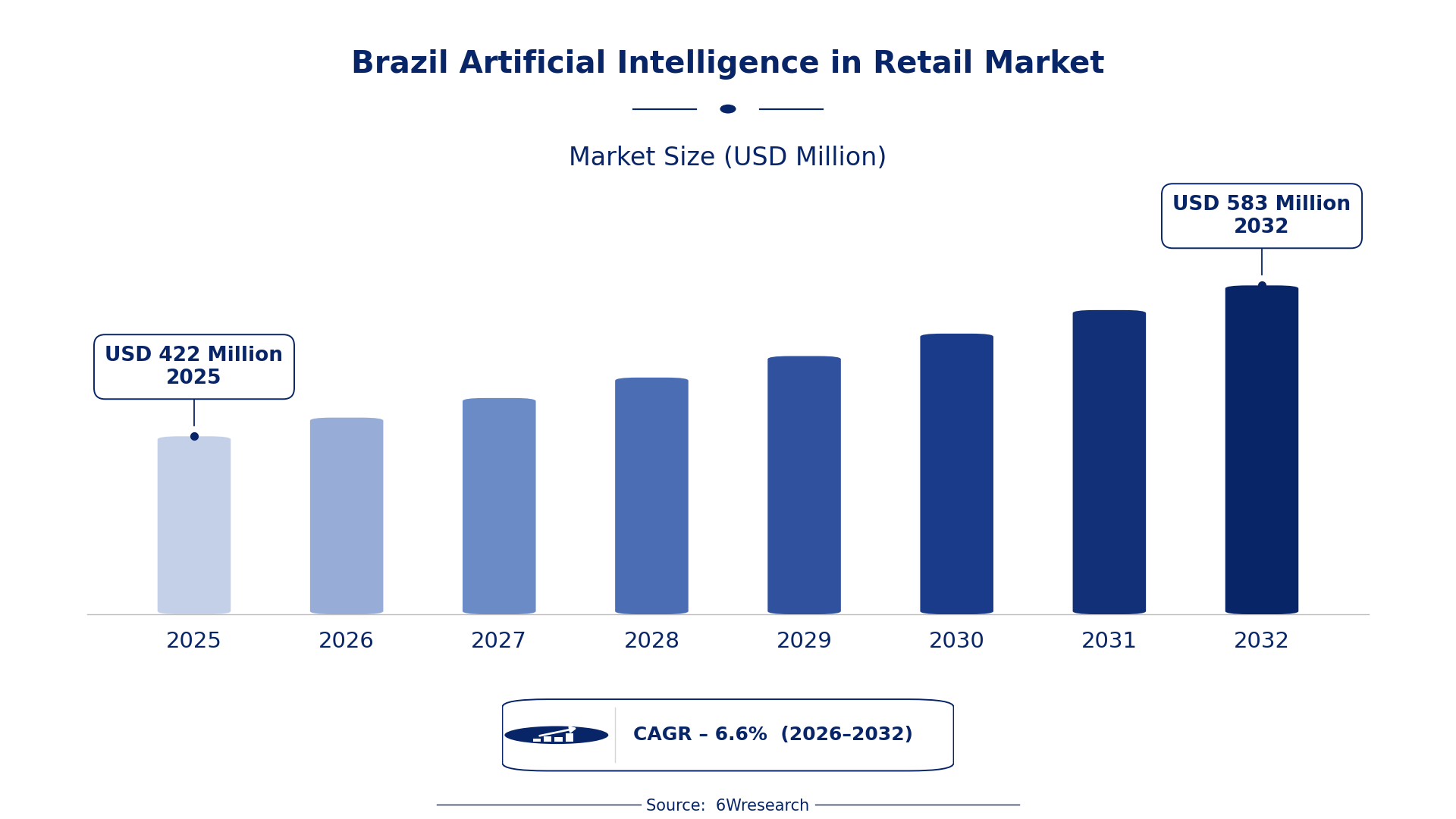
The Brazil Artificial Intelligence in Retail Market was estimated at USD 422 Million in 2025 and is projected to reach USD 583 Million by 2032, growing at a CAGR of 6.6% from 2026 to 2032.
Brazil Artificial Intelligence in Retail Market Synopsis
The integration of artificial intelligence in Brazil's retail sector is not just a trend; it’s a fundamental shift in how businesses operate. From personalized shopping experiences to efficient inventory management, AI is becoming a key driver of competitive advantage. Retailers are increasingly recognizing the value of AI in enhancing customer engagement and streamlining operations.
As the Brazilian retail landscape evolves, AI technologies are at the forefront, reshaping traditional models. The ability to harness big data for insights is enabling retailers to make informed decisions that boost efficiency and customer satisfaction. This market is not just growing; it’s transforming how retailers connect with consumers.
Brazil Artificial Intelligence in Retail Market Year-wise Growth Rate and Key Drivers
This graph illustrates the annual growth rates of the Brazil Artificial Intelligence in Retail Market from 2021 to 2032, highlighting a steady upward trajectory and projected expansion over the forecast period.
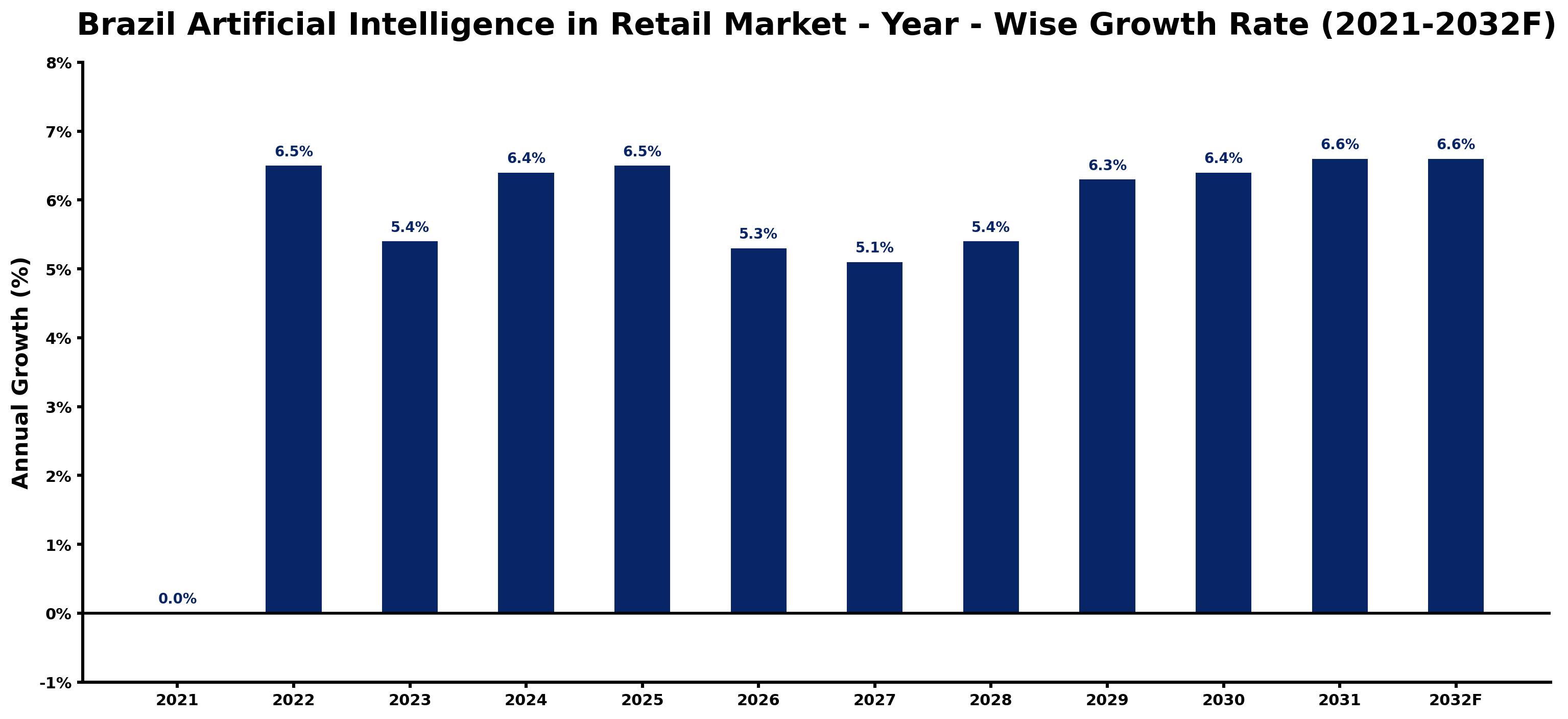
The table below presents the year‑wise growth rates along with the key drivers influencing the market
| Year | Growth Rate | Major Drivers |
| 2021 | 0.0% | Increasing adoption of advanced technologies |
| 2022 | 6.5% | Increased adoption of AI by Brazil's retail giants |
| 2023 | 5.4% | Government incentives for tech startups improving retail AI |
| 2024 | 6.4% | Rising middle class driving AI personalization in shopping |
| 2025 | 6.5% | Integration of local payment systems enhancing AI usage |
| 2026 | 5.3% | Consumer behavior analytics driven by Brazilian retail trends |
| 2027 | 5.1% | Investment in AI security solutions for e-commerce platforms |
| 2028 | 5.4% | Growing collaboration between retailers and local AI firms |
| 2029 | 6.3% | Rising digital payments fostering AI tools in retail |
| 2030 | 6.4% | Diverse retail sector adopting AI for inventory management |
| 2031 | 6.6% | Local AI research initiatives improving retail efficiencies |
| 2032 | 6.6% | Shift towards sustainability driving AI-driven retail solutions |
Note: Market size estimations and growth projections presented in this report are based on 6Wresearch's proprietary forecasting methodology, utilizing the latest available industry data, government publications, and primary research inputs.
Brazil Artificial Intelligence in Retail Market Key Takeaways
Below are some of the specific key takeaways from the market, including:
- The market is experiencing a steady growth trajectory, with a projected increase from USD 422 million in 2025 to USD 583 million by 2032.
- AI-driven solutions are enhancing decision-making processes for retailers, ultimately improving operational efficiency.
- Personalization through AI is becoming a cornerstone strategy for Brazilian retailers to engage customers effectively.
- Challenges such as technological resistance and ethical concerns are prominent as companies adopt AI technologies.
- Government initiatives are fostering an environment that encourages ethical AI use in retail, balancing innovation with consumer protection.
Evaluation of Restraints in Brazil Artificial Intelligence in Retail Market
The Brazil Artificial Intelligence in Retail Market faces several real restraints that hinder its full potential. One major issue is the resistance to adopting new technologies among traditional retailers who fear job displacement and operational disruptions. This hesitation can slow down the pace of innovation and delay implementation. Additionally, ethical implications surrounding AI decision-making are raising concerns among stakeholders, making it critical for retailers to engage in transparent discussions about AI's role and impact. Successfully addressing these challenges will require comprehensive change management strategies and stakeholder collaboration.
Brazil Artificial Intelligence in Retail Market Trends
Several trends are currently shaping the demand for AI technologies in Brazilian retail. The rise of e-commerce has accelerated the need for advanced analytics and personalization tools. Retailers are increasingly investing in AI to better understand consumer behavior and preferences, allowing for targeted marketing strategies. Another emerging trend is the incorporation of AI into supply chain operations, which enhances inventory management and reduces costs. As competition intensifies, these technologies are becoming indispensable for maintaining market relevance.
Brazil Artificial Intelligence in Retail Market Opportunities
Genuine growth opportunities lie in the development of AI applications tailored to local consumer behaviors and market needs. Retailers that focus on integrating AI into customer service, such as chatbots and virtual assistants, can significantly improve customer interactions. Additionally, leveraging AI for predictive analytics will enable retailers to anticipate market shifts and respond proactively. Partnerships with tech companies to innovate AI solutions specifically for the retail sector are also on the rise, creating avenues for investment and collaboration.
Government Initiatives in the Brazil Artificial Intelligence in Retail Market
The Brazilian government is actively promoting the ethical use of artificial intelligence in the retail sector, recognizing its transformative potential. Policies are being designed to support innovation while ensuring consumer protection. This regulatory framework aims to create a balanced environment that encourages responsible AI adoption in retail, which is crucial for both the industry and consumers.
- A regulatory framework introduced in 2025 mandates transparency in AI-driven retail practices to protect consumer rights.
- Currently ongoing is a national initiative aimed at enhancing digital infrastructure, which supports the integration of AI technologies in retail.
- A planned public-private initiative is expected to launch by 2027, focusing on developing AI training programs for retail staff to improve technological adoption.
- A recently completed assessment of AI's impact on consumer behavior in retail has provided valuable insights for future policy directions.
- The government is promoting collaboration between academia and industry to foster innovation in AI applications for retail.
Future Insights of the Brazil Artificial Intelligence in Retail Market
Looking ahead to 2026-2032, the Brazil Artificial Intelligence in Retail Market is set to undergo significant changes. Retailers will increasingly rely on AI for operational efficiencies and enhanced customer experiences. As technology evolves, new applications will emerge, particularly in areas like augmented reality for retail shopping experiences. The emphasis on ethical AI practices will also shape the market, as consumer awareness and regulatory scrutiny increase. Businesses that adapt quickly to these trends will likely emerge as leaders in this competitive landscape.
Brazil Artificial Intelligence in Retail Market Latest Developments
Over the last year, the Brazilian Artificial Intelligence in Retail Market has seen a surge in activity as companies strive to implement innovative solutions. The focus has shifted towards enhancing customer engagement through personalized experiences and improved operational processes. Retailers are increasingly investing in AI technologies to stay competitive and meet rising consumer expectations.
- A major technology vendor launched a new AI-driven analytics platform in Q1 2025, enhancing retailers' ability to forecast demand and manage inventory.
- An initiative that began in mid-2025 focuses on integrating AI into customer service operations, improving response times and satisfaction rates.
- By late 2025, a leading regional operator is expected to complete the rollout of AI-based supply chain management tools, aimed at reducing operational costs.
- A partnership between a local retail chain and a tech startup is currently underway, focusing on developing AI solutions for personalized marketing campaigns.
- An upcoming workshop series is planned for 2026, targeting retail professionals to enhance their understanding of AI applications and best practices.
Brazil Artificial Intelligence in Retail Market - Key Attractiveness of the Report
- 10 Years of Market Numbers
- Historical Data Starting from 2022 to 2025
- Base Year: 2025
- Forecast Data until 2032
- Key Performance Indicators Impacting the Market
- Major Upcoming Developments and Projects
Key Highlights of the Report:
- Brazil Artificial Intelligence in Retail Market Outlook
- Market Size of Brazil Artificial Intelligence in Retail Market, 2025
- Forecast of Brazil Artificial Intelligence in Retail Market, 2032
- Historical Data and Forecast of Brazil Artificial Intelligence in Retail Revenues & Volume for the Period 2022-2032F
- Brazil Artificial Intelligence in Retail Market Trend Evolution
- Brazil Artificial Intelligence in Retail Market Drivers and Challenges
- Brazil Artificial Intelligence in Retail Price Trends
- Brazil Artificial Intelligence in Retail Porter's Five Forces
- Brazil Artificial Intelligence in Retail Industry Life Cycle
- Historical Data and Forecast of Brazil Artificial Intelligence in Retail Market Revenues & Volume By Type for the Period 2022-2032F
- Historical Data and Forecast of Brazil Artificial Intelligence in Retail Market Revenues & Volume By Online for the Period 2022-2032F
- Historical Data and Forecast of Brazil Artificial Intelligence in Retail Market Revenues & Volume By Offline for the Period 2022-2032F
- Historical Data and Forecast of Brazil Artificial Intelligence in Retail Market Revenues & Volume By Service for the Period 2022-2032F
- Historical Data and Forecast of Brazil Artificial Intelligence in Retail Market Revenues & Volume By Professional for the Period 2022-2032F
- Historical Data and Forecast of Brazil Artificial Intelligence in Retail Market Revenues & Volume By Managed for the Period 2022-2032F
- Historical Data and Forecast of Brazil Artificial Intelligence in Retail Market Revenues & Volume By Technology for the Period 2022-2032F
- Historical Data and Forecast of Brazil Artificial Intelligence in Retail Market Revenues & Volume By Machine Learning for the Period 2022-2032F
- Historical Data and Forecast of Brazil Artificial Intelligence in Retail Market Revenues & Volume By Deep Learning for the Period 2022-2032F
- Historical Data and Forecast of Brazil Artificial Intelligence in Retail Market Revenues & Volume By NLP for the Period 2022-2032F
- Brazil Artificial Intelligence in Retail Import Export Trade Statistics
- Market Opportunity Assessment By Type
- Market Opportunity Assessment By Service
- Market Opportunity Assessment By Technology
- Brazil Artificial Intelligence in Retail Top Companies Market Share
- Brazil Artificial Intelligence in Retail Competitive Benchmarking By Technical and Operational Parameters
- Brazil Artificial Intelligence in Retail Company Profiles
- Brazil Artificial Intelligence in Retail Key Strategic Recommendations






































