Argentina Artificial Intelligence in Retail Market Size & Growth Rate (2026-2032)
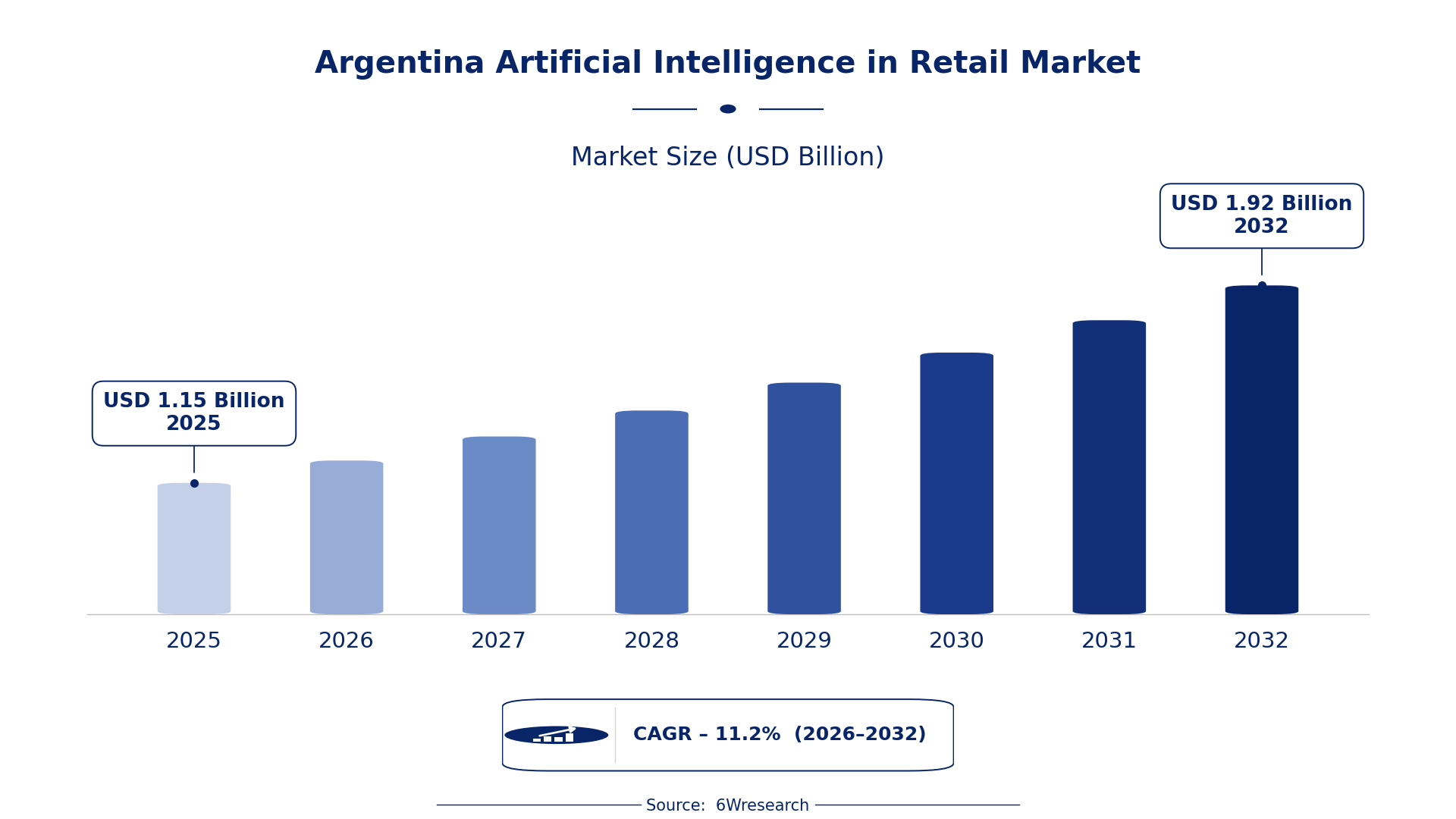
The Argentina Artificial Intelligence in Retail Market was estimated at USD 1147 Million in 2025 and is projected to reach USD 1923 Million by 2032, growing at a CAGR of 11.2% from 2026 to 2032.
Argentina Artificial Intelligence in Retail Market Synopsis
The retail sector in Argentina is undergoing a transformation, with artificial intelligence (AI) technologies leading the charge. Retailers are increasingly deploying AI-driven solutions to enhance customer interactions, streamline supply chains, and optimize inventory management. This shift is not merely technological; it's a response to an evolving consumer base that demands personalized experiences.
As AI continues to penetrate the retail market, companies are investing heavily in data analytics and machine learning to unlock insights from consumer behavior. This trend is proving beneficial, enabling retailers to not only meet but exceed the expectations of tech-savvy customers. With significant investments flowing into this sector, Argentina stands at the brink of an AI revolution in retail.
Argentina Artificial Intelligence in Retail Market Year-wise Growth Rate and Key Drivers
This graph illustrates the annual growth rates of the Argentina Artificial Intelligence in Retail Market from 2021 to 2032, highlighting a steady upward trajectory and projected expansion over the forecast period.
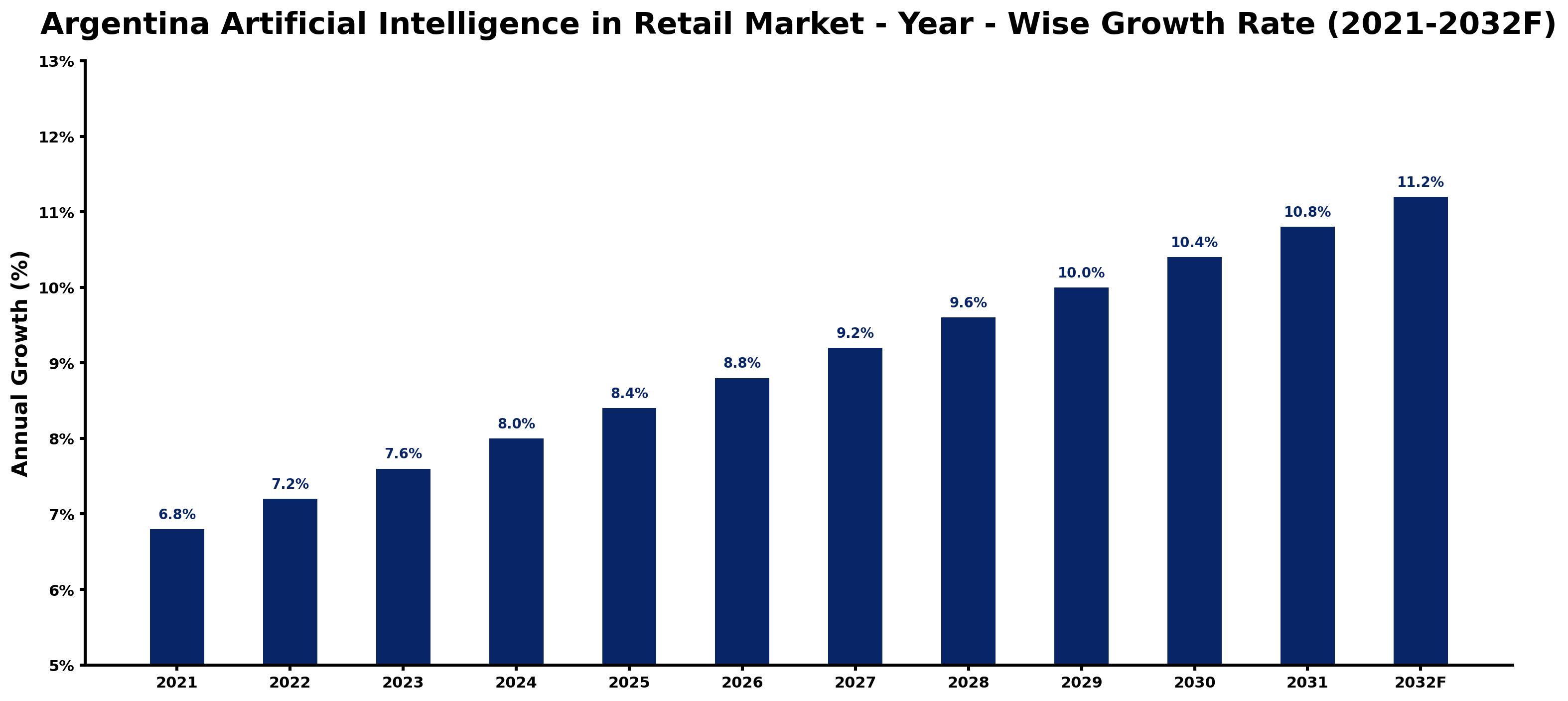
The table below presents the year‑wise growth rates along with the key drivers influencing the market
| Year | Growth Rate | Major Drivers |
| 2021 | 6.8% | Adoption of AI-driven chatbots by major retailers. |
| 2022 | 7.2% | Increasing investment in e-commerce platforms amidst inflation. |
| 2023 | 7.6% | Growth in local data centers enhancing AI processing capabilities. |
| 2024 | 8.0% | Expanded internet access boosting online retail consumption. |
| 2025 | 8.4% | Supportive government policies for tech startups in retail. |
| 2026 | 8.8% | Rise of mobile payment solutions integrating AI features. |
| 2027 | 9.2% | Partnerships between tech firms and retail giants emerging. |
| 2028 | 9.6% | Increased consumer trust in AI for shopping assistance. |
| 2029 | 10.0% | Focus on analytics to improve supply chain efficiencies. |
| 2030 | 10.4% | Development of local AI talent through university programs. |
| 2031 | 10.8% | Rising integration of customer feedback into AI systems. |
| 2032 | 11.2% | Standardization of data privacy regulations encouraging AI use. |
Note: Market size estimations and growth projections presented in this report are based on 6Wresearch's proprietary forecasting methodology, utilizing the latest available industry data, government publications, and primary research inputs.
Argentina Artificial Intelligence in Retail Market Key Takeaways
Below are some of the specific key takeaways from the market, including:
- The market is driven by rising demand for personalized shopping experiences and improved customer engagement.
- AI technologies are being utilized for predictive analytics, enabling tailored marketing strategies.
- Investment in AI-powered supply chain solutions is on the rise, enhancing operational efficiency.
- Data privacy regulations pose challenges to AI implementation, necessitating careful navigation by retailers.
- Emerging technologies like computer vision are set to redefine checkout processes in retail environments.
Evaluation of Restraints in Argentina Artificial Intelligence in Retail Market
The growth of the Argentina Artificial Intelligence in Retail Market faces several restraints that could impede its potential. A critical concern is the shortage of skilled professionals proficient in both AI technologies and retail applications. This gap in expertise hampers the ability of retailers to fully implement and benefit from AI solutions. on top of that, the costs associated with integrating AI systems, including data management and infrastructure upgrades, can be prohibitively high for many businesses. Data privacy concerns also loom large, as existing regulations create additional layers of complexity for retailers looking to adopt AI solutions safely and responsibly.
Argentina Artificial Intelligence in Retail Market Trends
Several trends are shaping the Argentina Artificial Intelligence in Retail Market. The use of AI-powered chatbots for customer service is gaining traction, providing instant assistance and enhancing customer satisfaction. Personalized product recommendations driven by advanced algorithms are becoming commonplace, allowing retailers to tailor offerings to individual consumer preferences. Additionally, inventory management optimization is increasingly relying on AI solutions to predict demand fluctuations, minimizing stockouts and overstock scenarios. These trends are not only revolutionizing customer interactions but also ensuring that retailers operate more efficiently.
Argentina Artificial Intelligence in Retail Market Opportunities
The Argentina Artificial Intelligence in Retail Market is rife with opportunities for growth and investment. Retailers can harness AI to mine customer data for deeper insights, informing more targeted marketing campaigns that resonate with consumers. The implementation of computer vision technology stands to enhance the shopping experience through smart checkout systems, streamlining transactions and reducing wait times. on top of that, AI algorithms can facilitate improved demand forecasting and pricing strategies, enabling retailers to respond more adeptly to market dynamics. These opportunities present a fertile ground for innovation and competitive differentiation.
Government Initiatives in the Argentina Artificial Intelligence in Retail Market
The Argentine government has yet to introduce specific regulations tailored to the application of AI in retail. However, existing data protection laws significantly affect AI's deployment in this sector. The Personal Data Protection Law and guidelines from the National Directorate for the Protection of Personal Data emphasize the importance of consumer privacy, influencing how retailers approach AI technology. As the retail landscape evolves, it is likely that policymakers will develop more targeted initiatives to address the unique challenges posed by AI.
- A regulatory framework emphasizing data privacy was established in 2023, impacting how retailers can leverage AI technologies.
- Currently, the government is working on a national digital infrastructure initiative aimed at enhancing internet access, which will facilitate better AI deployment in retail.
- Upcoming plans include a public-private partnership expected to explore ethical AI use in retail by 2025, focusing on consumer data protection.
- Ongoing discussions within the Global Privacy Assembly indicate Argentina's commitment to aligning its AI regulations with international standards.
Future Insights of the Argentina Artificial Intelligence in Retail Market
Looking ahead to 2026-2032, the Argentina Artificial Intelligence in Retail Market is set to flourish as businesses increasingly recognize the strategic advantages of AI technologies. With the surge in e-commerce and consumer expectations for tailored shopping experiences, retailers will prioritize investment in AI solutions. The convergence of advancements in machine learning and natural language processing will further drive innovation in this sector. As retailers adapt to these changes, those willing to embrace AI will likely find themselves at the forefront of a competitive marketplace.
Argentina Artificial Intelligence in Retail Market Latest Developments
Recent activity in the Argentina Artificial Intelligence in Retail Market indicates a strong push towards AI integration across various retail segments. Companies are actively exploring innovative solutions to enhance customer experiences and operational efficiency. This momentum reflects a broader trend of digital transformation within the industry.
- A major technology vendor launched an AI-driven inventory management system in early 2025, aimed at helping retailers optimize stock levels.
- In mid-2025, a partnership was formed between leading regional retailers and AI developers to enhance customer engagement through personalized marketing strategies.
- An initiative focused on implementing AI chatbots for customer service began in Q1 2025 and is currently being rolled out across multiple retail chains.
- Looking forward, a rollout of computer vision technology for automated checkout processes is planned to begin in late 2026.
Argentina Artificial Intelligence in Retail Market - Key Attractiveness of the Report
- 10 Years of Market Numbers
- Historical Data Starting from 2022 to 2025
- Base Year: 2025
- Forecast Data until 2032
- Key Performance Indicators Impacting the Market
- Major Upcoming Developments and Projects
Key Highlights of the Report:
- Argentina Artificial Intelligence in Retail Market Outlook
- Market Size of Argentina Artificial Intelligence in Retail Market, 2025
- Forecast of Argentina Artificial Intelligence in Retail Market, 2032
- Historical Data and Forecast of Argentina Artificial Intelligence in Retail Revenues & Volume for the Period 2022-2032F
- Argentina Artificial Intelligence in Retail Market Trend Evolution
- Argentina Artificial Intelligence in Retail Market Drivers and Challenges
- Argentina Artificial Intelligence in Retail Price Trends
- Argentina Artificial Intelligence in Retail Porter's Five Forces
- Argentina Artificial Intelligence in Retail Industry Life Cycle
- Historical Data and Forecast of Argentina Artificial Intelligence in Retail Market Revenues & Volume By Type for the Period 2022-2032F
- Historical Data and Forecast of Argentina Artificial Intelligence in Retail Market Revenues & Volume By Online for the Period 2022-2032F
- Historical Data and Forecast of Argentina Artificial Intelligence in Retail Market Revenues & Volume By Offline for the Period 2022-2032F
- Historical Data and Forecast of Argentina Artificial Intelligence in Retail Market Revenues & Volume By Service for the Period 2022-2032F
- Historical Data and Forecast of Argentina Artificial Intelligence in Retail Market Revenues & Volume By Professional for the Period 2022-2032F
- Historical Data and Forecast of Argentina Artificial Intelligence in Retail Market Revenues & Volume By Managed for the Period 2022-2032F
- Historical Data and Forecast of Argentina Artificial Intelligence in Retail Market Revenues & Volume By Technology for the Period 2022-2032F
- Historical Data and Forecast of Argentina Artificial Intelligence in Retail Market Revenues & Volume By Machine Learning for the Period 2022-2032F
- Historical Data and Forecast of Argentina Artificial Intelligence in Retail Market Revenues & Volume By Deep Learning for the Period 2022-2032F
- Historical Data and Forecast of Argentina Artificial Intelligence in Retail Market Revenues & Volume By NLP for the Period 2022-2032F
- Argentina Artificial Intelligence in Retail Import Export Trade Statistics
- Market Opportunity Assessment By Type
- Market Opportunity Assessment By Service
- Market Opportunity Assessment By Technology
- Argentina Artificial Intelligence in Retail Top Companies Market Share
- Argentina Artificial Intelligence in Retail Competitive Benchmarking By Technical and Operational Parameters
- Argentina Artificial Intelligence in Retail Company Profiles
- Argentina Artificial Intelligence in Retail Key Strategic Recommendations






































