Peru Artificial Intelligence in Retail Market Size & Growth Rate (2026-2032)
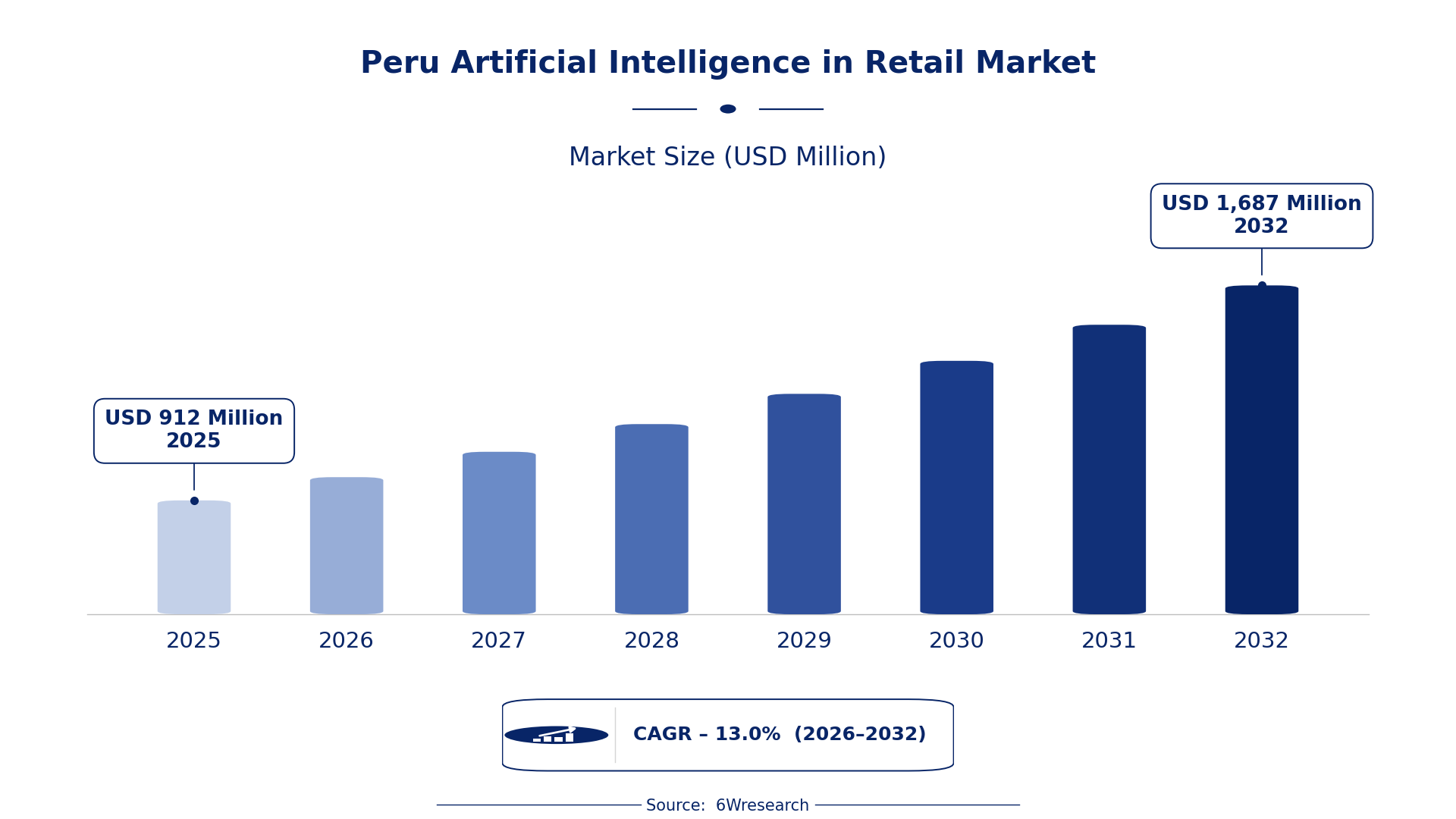
The Peru Artificial Intelligence in Retail Market was estimated at USD 912 Million in 2025 and is projected to reach USD 1687 Million by 2032, growing at a CAGR of 13.0% from 2026 to 2032.
Peru Artificial Intelligence in Retail Market Synopsis
In Peru, the adoption of artificial intelligence (AI) in retail is accelerating as businesses recognize the necessity of data-driven strategies. Retailers are increasingly implementing AI solutions to enhance customer interactions, streamline inventory processes, and boost overall sales performance.
The push towards AI in retail is spurred by a burgeoning e-commerce environment. As online shopping continues to gain traction, retailers are turning to AI technologies for improved customer insights, efficient supply chain management, and tailored marketing efforts, paving the way for substantial market growth.
Peru Artificial Intelligence in Retail Market Year-wise Growth Rate and Key Drivers
This graph illustrates the annual growth rates of the Peru Artificial Intelligence in Retail Market from 2021 to 2032, highlighting a steady upward trajectory and projected expansion over the forecast period.
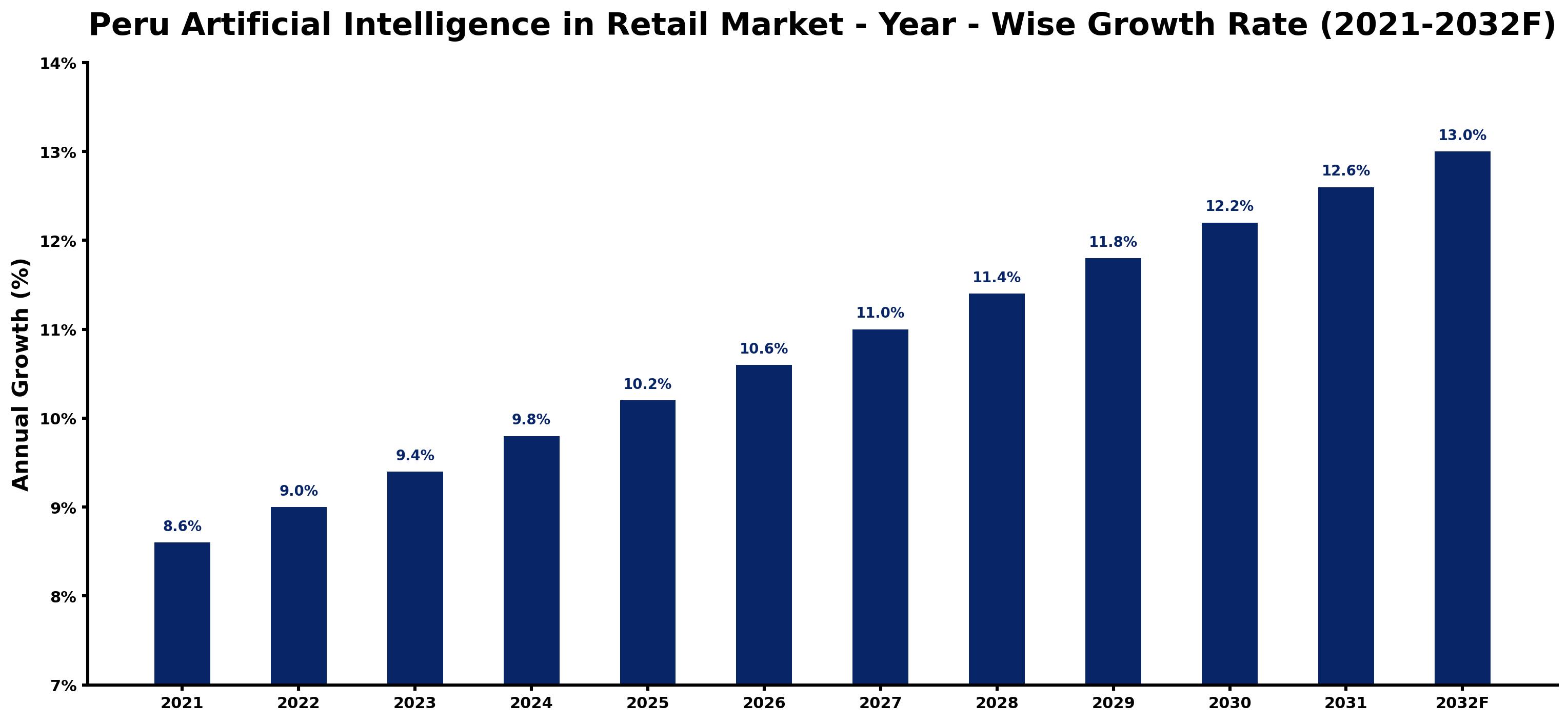
The table below presents the year‑wise growth rates along with the key drivers influencing the market
| Year | Growth Rate | Major Drivers |
| 2021 | 8.6% | Government promoting AI adoption through national digital agenda. |
| 2022 | 9.0% | Growing investment in e-commerce platforms enhancing retail AI use. |
| 2023 | 9.4% | Increased smartphone penetration boosting AI in consumer engagement. |
| 2024 | 9.8% | Aceleration of customer data integration driving AI solutions. |
| 2025 | 10.2% | Rise of local startups developing AI retail applications. |
| 2026 | 10.6% | Improved broadband connectivity enabling advanced AI technologies. |
| 2027 | 11.0% | Consumers demanding smarter inventory management solutions from retailers. |
| 2028 | 11.4% | Increased focus on customer experience enhancements via AI technology. |
| 2029 | 11.8% | Regulatory support for AI-driven data protection in retail. |
| 2030 | 12.2% | Retailers leveraging AI for automated customer service solutions. |
| 2031 | 12.6% | Higher demand for omni-channel retail solutions embracing AI. |
| 2032 | 13.0% | Development of AI tools tailored to local consumer preferences. |
Note: Market size estimations and growth projections presented in this report are based on 6Wresearch's proprietary forecasting methodology, utilizing the latest available industry data, government publications, and primary research inputs.
Peru Artificial Intelligence in Retail Market Key Takeaways
Below are some of the specific key takeaways from the market, including:
- AI technologies are being increasingly adopted for personalized recommendations and customer service automation.
- Retailers are leveraging predictive analytics to better understand consumer behavior and enhance operational efficiency.
- The growth of e-commerce is driving demand for AI solutions to optimize online customer engagement.
- Integration of AI tools is expected to improve inventory management and supply chain operations significantly.
- Investment in AI technologies is viewed as essential for staying competitive in the retail sector.
Evaluation of Restraints in Peru Artificial Intelligence in Retail Market
Despite the promising outlook, several challenges hinder the full adoption of AI in Peru's retail sector. High implementation costs present a considerable barrier, particularly for small and medium-sized enterprises that may lack the financial resources to invest in advanced technologies. on top of that, the shortage of skilled professionals proficient in AI and retail dynamics complicates the integration process.
Concerns around data privacy and security also loom large, as retailers navigate the complexities of handling consumer information. Resistance to change within organizations further complicates matters, requiring continuous workforce training and upskilling to adapt to AI tools effectively.
Peru Artificial Intelligence in Retail Market Trends
Several trends are emerging in the Peru Artificial Intelligence in Retail Market. The use of AI-powered chatbots for customer service is on the rise, allowing for real-time assistance and improved customer satisfaction. Personalized recommendation engines are becoming essential tools for retailers seeking to enhance the shopping experience.
on top of that, AI technologies are increasingly being deployed for inventory management optimization, helping retailers maintain stock levels and reduce waste. The focus on data-driven insights is pushing retailers to invest in advanced analytics solutions to tailor marketing strategies and meet consumer preferences effectively.
Peru Artificial Intelligence in Retail Market Opportunities
The Peru Artificial Intelligence in Retail Market presents numerous growth opportunities. Retailers are increasingly recognizing the potential of AI for targeted marketing campaigns and demand forecasting, enabling them to adapt to consumer trends swiftly. Enhanced supply chain efficiency through AI integration offers a further avenue for operational improvement.
As e-commerce continues to expand, AI solutions that enhance online shopping experiences are likely to attract significant investment. Additionally, the application of AI in fraud detection and data analysis for product development presents further avenues for retailers looking to innovate and stay ahead of the competition.
Government Initiatives in the Peru Artificial Intelligence in Retail Market
While there are currently no specific regulations directly targeting AI in the retail sector, the Peruvian government is actively promoting technology adoption through various initiatives. This regulatory environment encourages innovation and technology integration, setting a stage that could indirectly benefit the AI retail market.
- A recently completed program by the Ministry of Production aimed at supporting digital transformation in businesses, which may facilitate AI adoption in retail.
- A current initiative focused on enhancing digital literacy among retail employees, helping to address the skills gap in AI integration.
- Plans for a public-private partnership expected to launch in 2026 to develop digital infrastructure that supports AI applications in various sectors, including retail.
- An ongoing policy framework encouraging investment in technology startups, which may lead to the development of AI solutions tailored for retail.
Future Insights of the Peru Artificial Intelligence in Retail Market
Looking ahead to 2026-2032, the Peru Artificial Intelligence in Retail Market is set to thrive as retailers invest more heavily in AI technologies. The synergy between e-commerce growth and consumer demand for personalized experiences will drive substantial market advancements.
As AI capabilities continue to expand, retailers will likely prioritize customer engagement and operational efficiency. The emphasis on data analytics and predictive tools will become even more pronounced, shaping the future of retail in Peru.
Peru Artificial Intelligence in Retail Market Latest Developments
In the past year, activity within the Peru Artificial Intelligence in Retail Market has intensified, with several initiatives aimed at enhancing technology integration. Retailers are increasingly seeking innovative AI solutions to meet evolving consumer expectations and improve operational efficiency.
- A major technology vendor launched an AI-driven inventory management system in early 2025, designed to optimize stock levels and reduce waste.
- An ongoing partnership between a leading regional operator and a data analytics firm aims to deploy AI solutions for enhanced customer insights, starting in mid-2025.
- A planned rollout of AI-powered customer service chatbots is set to begin in Q3 2026, aiming to improve customer engagement across retail platforms.
- In early 2025, a prominent retailer successfully implemented a personalized recommendation engine, reporting a significant increase in online sales.
Peru Artificial Intelligence in Retail Market - Key Attractiveness of the Report
- 10 Years of Market Numbers
- Historical Data Starting from 2022 to 2025
- Base Year: 2025
- Forecast Data until 2032
- Key Performance Indicators Impacting the Market
- Major Upcoming Developments and Projects
Key Highlights of the Report:
- Peru Artificial Intelligence in Retail Market Outlook
- Market Size of Peru Artificial Intelligence in Retail Market, 2025
- Forecast of Peru Artificial Intelligence in Retail Market, 2032
- Historical Data and Forecast of Peru Artificial Intelligence in Retail Revenues & Volume for the Period 2022-2032F
- Peru Artificial Intelligence in Retail Market Trend Evolution
- Peru Artificial Intelligence in Retail Market Drivers and Challenges
- Peru Artificial Intelligence in Retail Price Trends
- Peru Artificial Intelligence in Retail Porter's Five Forces
- Peru Artificial Intelligence in Retail Industry Life Cycle
- Historical Data and Forecast of Peru Artificial Intelligence in Retail Market Revenues & Volume By Type for the Period 2022-2032F
- Historical Data and Forecast of Peru Artificial Intelligence in Retail Market Revenues & Volume By Online for the Period 2022-2032F
- Historical Data and Forecast of Peru Artificial Intelligence in Retail Market Revenues & Volume By Offline for the Period 2022-2032F
- Historical Data and Forecast of Peru Artificial Intelligence in Retail Market Revenues & Volume By Service for the Period 2022-2032F
- Historical Data and Forecast of Peru Artificial Intelligence in Retail Market Revenues & Volume By Professional for the Period 2022-2032F
- Historical Data and Forecast of Peru Artificial Intelligence in Retail Market Revenues & Volume By Managed for the Period 2022-2032F
- Historical Data and Forecast of Peru Artificial Intelligence in Retail Market Revenues & Volume By Technology for the Period 2022-2032F
- Historical Data and Forecast of Peru Artificial Intelligence in Retail Market Revenues & Volume By Machine Learning for the Period 2022-2032F
- Historical Data and Forecast of Peru Artificial Intelligence in Retail Market Revenues & Volume By Deep Learning for the Period 2022-2032F
- Historical Data and Forecast of Peru Artificial Intelligence in Retail Market Revenues & Volume By NLP for the Period 2022-2032F
- Peru Artificial Intelligence in Retail Import Export Trade Statistics
- Market Opportunity Assessment By Type
- Market Opportunity Assessment By Service
- Market Opportunity Assessment By Technology
- Peru Artificial Intelligence in Retail Top Companies Market Share
- Peru Artificial Intelligence in Retail Competitive Benchmarking By Technical and Operational Parameters
- Peru Artificial Intelligence in Retail Company Profiles
- Peru Artificial Intelligence in Retail Key Strategic Recommendations






































