Brazil Automotive Reversing Radar Market Size, Share & Growth Rate
The Brazil Automotive Reversing Radar Market was estimated at USD 291 Million in 2025 and is projected to reach USD 395 Million by 2032, growing at a CAGR of 4.5% from 2026 to 2032. This upward trajectory is being driven by an increasing emphasis on vehicle safety, led by government mandates that require the integration of advanced safety features in automobiles. As Brazilian consumers become more aware of the importance of vehicular safety, automakers are rapidly incorporating reversing radar systems, thereby fostering significant market growth.
Brazil Automotive Reversing Radar Market Year-wise Growth Rate and Key Drivers
This graph highlights how the Brazil Automotive Reversing Radar Market has steadily grown over the years, supported by major growth factors.
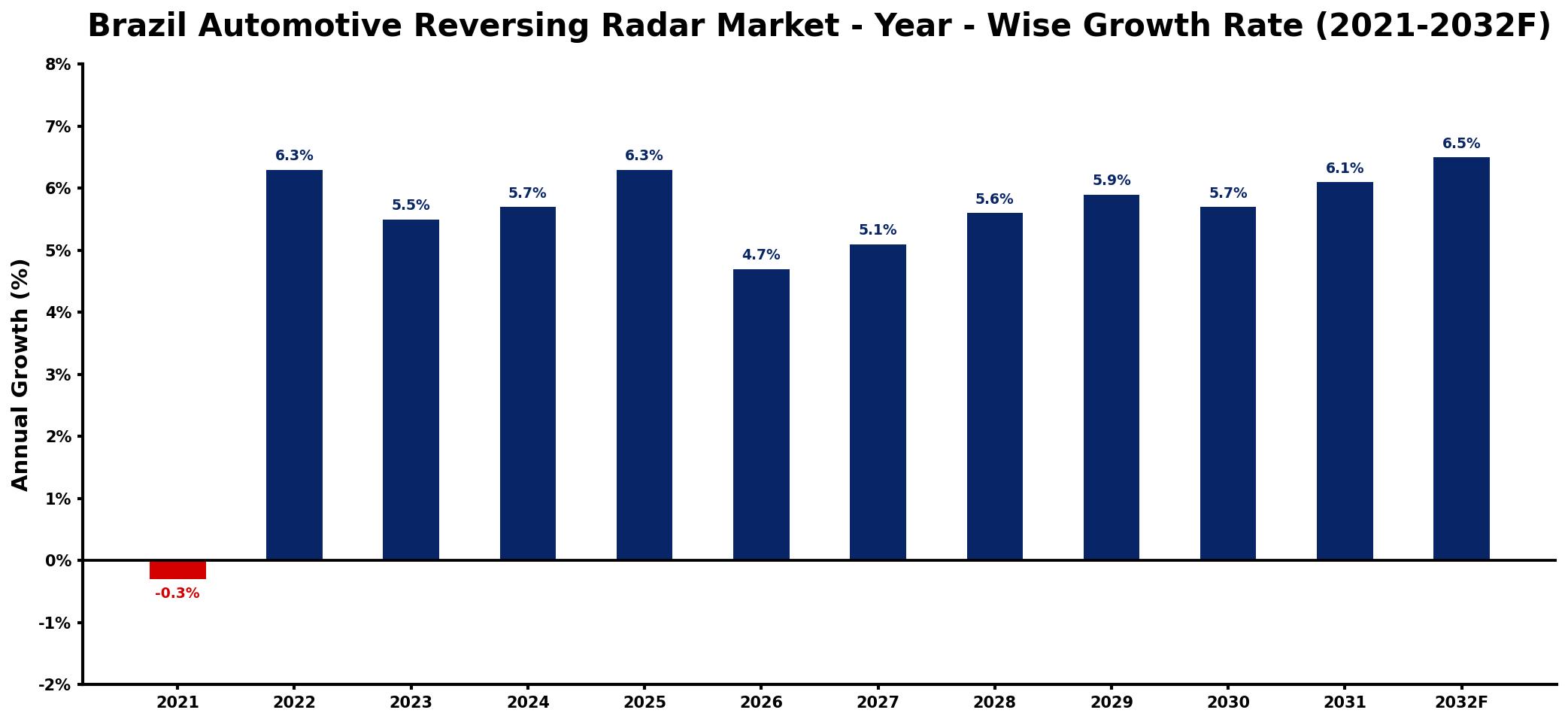
The table below presents the year‑wise growth rates along with the key drivers influencing the market
| Year | Growth Rate | Major Drivers |
| 2021 | -0.3% | decrease in consumer confidence |
| 2022 | 6.3% | rise in safety regulations |
| 2023 | 5.5% | growing demand for technology |
| 2024 | 5.7% | increase in vehicle production |
| 2025 | 6.3% | expansion of urban infrastructure |
| 2026 | 4.7% | higher consumer spending trends |
| 2027 | 5.1% | increased investment in innovation |
| 2028 | 5.6% | growing awareness of safety |
| 2029 | 5.9% | demand for advanced features |
| 2030 | 5.7% | increased pharmaceutical industry usage |
| 2031 | 6.1% | increased capital investment inflows |
| 2032 | 6.5% | increased focus on sustainability |
Note: Market size estimations and growth projections presented in this report are based on 6Wresearch's proprietary forecasting methodology, utilizing the latest available industry data, government publications, and primary research inputs.
Brazil Automotive Reversing Radar Market Synopsis
The most influential factor shaping the Brazil Automotive Reversing Radar Market today is the government's stringent regulatory framework aimed at enhancing road safety. These regulations not only compel automakers to adopt advanced driver assistance systems (ADAS) but also catalyze consumer demand for such safety features.
Furthermore, heightened consumer awareness regarding accident reduction has shifted buying preferences toward vehicles equipped with modern safety technologies. This cultural shift presents a compelling opportunity for manufacturers focused on developing and marketing reversing radar solutions that meet these evolving consumer needs.
Brazil Automotive Reversing Radar Market Key Takeaways
- The market is being driven by increasing consumer awareness and government regulations on vehicle safety.
- Integration of reversing radar systems is essential for compliance with emerging safety standards.
- Technological advancements in ADAS are expected to support market growth.
- Consumer demand for safety features is rapidly increasing, influencing automaker strategies.
- Challenges regarding regulatory frameworks and standardization remain pertinent for stakeholders.
Evaluation of Restraints in Brazil Automotive Reversing Radar Market
Despite the positive outlook, the Brazil Automotive Reversing Radar Market faces several limitations that could impede growth. One of the notable restraints is the complexity associated with enhancing safety features to meet regulatory requirements. Moreover, the lack of standardized practices for reversing radar systems can hinder seamless integration with other ADAS technologies. Additionally, low consumer awareness regarding the benefits of these safety features poses challenges for market penetration and acceptance. Stakeholders must navigate these intricacies to unlock the market's full potential.
Brazil Automotive Reversing Radar Market Trends
Current trends indicate a strong push towards the development of multi-functional reversing radar systems that offer additional features such as obstacle detection and lane-keeping assistance. Innovations in artificial intelligence and machine learning are also paving the way for smarter systems that can learn from their environment, significantly enhancing user safety. Moreover, collaborations between technology firms and automotive manufacturers are increasingly common, accelerating the pace at which advanced safety features are integrated into new vehicle models.
Brazil Automotive Reversing Radar Market Opportunities
The Brazil Automotive Reversing Radar Market presents considerable growth opportunities for manufacturers and investors alike. As the adoption of electric vehicles (EVs) continues to rise, there is potential for integrating sophisticated reversing radar systems into these vehicles. Additionally, the burgeoning ride-sharing industry creates a new demand for vehicles equipped with advanced safety features, opening avenues for partnerships with service providers. These factors create fertile ground for innovative companies ready to capitalize on the evolving market landscape.
Government Initiatives in the Brazil Automotive Reversing Radar Market
Brazil's government is actively promoting vehicle safety through various initiatives aimed at reducing road accidents. Regulatory frameworks are being established to mandate the inclusion of advanced safety features in vehicles, including reversing radar systems. These initiatives not only seek to enhance road safety but also stimulate the automotive industry to innovate and invest in new technologies, thereby creating a supportive environment for the automotive reversing radar market.
Future Insights of the Brazil Automotive Reversing Radar Market
Looking forward to the period between 2026 and 2032, the Brazil Automotive Reversing Radar Market is expected to witness robust growth driven by continuous advancements in technology and a strong regulatory environment advocating safety. Automakers will increasingly focus on integrating reversing radar systems within their vehicles as a standard feature, which will likely become a critical selling point for new models. As consumer expectations evolve, and safety becomes a priority, market players who innovate effectively will be well-positioned to lead.
Brazil Automotive Reversing Radar Market Latest Developments (2025 - 2026)
Recent developments in the Brazil Automotive Reversing Radar Market indicate a growing trend towards enhancing system capabilities through the use of advanced sensors and improved signal processing technologies. Furthermore, partnerships between automotive manufacturers and technology providers are on the rise, aimed at streamlining the integration of reversing radar with other vehicle systems. These initiatives not only aim to enhance safety features but also improve user experience, aligning with consumer demand for sophisticated automotive technology.
Brazil Automotive Reversing Radar Market - Key Attractiveness of the Report
- 10 Years of Market Numbers
- Historical Data Starting from 2022 to 2025
- Base Year: 2025
- Forecast Data until 2032
- Key Performance Indicators Impacting the Market
- Major Upcoming Developments and Projects
Key Highlights of the Report:
- Brazil Automotive Reversing Radar Market Outlook
- Market Size of Brazil Automotive Reversing Radar Market, 2025
- Forecast of Brazil Automotive Reversing Radar Market, 2032
- Historical Data and Forecast of Brazil Automotive Reversing Radar Revenues & Volume for the Period 2022-2032F
- Brazil Automotive Reversing Radar Market Trend Evolution
- Brazil Automotive Reversing Radar Market Drivers and Challenges
- Brazil Automotive Reversing Radar Price Trends
- Brazil Automotive Reversing Radar Porter's Five Forces
- Brazil Automotive Reversing Radar Industry Life Cycle
- Historical Data and Forecast of Brazil Automotive Reversing Radar Market Revenues & Volume By Type for the Period 2022-2032F
- Historical Data and Forecast of Brazil Automotive Reversing Radar Market Revenues & Volume By Ultrasonic for the Period 2022-2032F
- Historical Data and Forecast of Brazil Automotive Reversing Radar Market Revenues & Volume By Electromagnetic for the Period 2022-2032F
- Historical Data and Forecast of Brazil Automotive Reversing Radar Market Revenues & Volume By Application for the Period 2022-2032F
- Historical Data and Forecast of Brazil Automotive Reversing Radar Market Revenues & Volume By Passenger Vehicle for the Period 2022-2032F
- Historical Data and Forecast of Brazil Automotive Reversing Radar Market Revenues & Volume By Commercial Vehicle for the Period 2022-2032F
- Brazil Automotive Reversing Radar Import Export Trade Statistics
- Market Opportunity Assessment By Type
- Market Opportunity Assessment By Application
- Brazil Automotive Reversing Radar Top Companies Market Share
- Brazil Automotive Reversing Radar Competitive Benchmarking By Technical and Operational Parameters
- Brazil Automotive Reversing Radar Company Profiles
- Brazil Automotive Reversing Radar Key Strategic Recommendations






































