Mexico Automotive Reversing Radar Market Size, Share & Growth Rate
The Mexico Automotive Reversing Radar Market was estimated at USD 277 Million in 2025 and is projected to reach USD 362 Million by 2032, growing at a CAGR of 3.9% from 2026 to 2032. This growth trajectory is fueled by a heightened demand for vehicle safety features, particularly parking assistance systems, as consumers increasingly prioritize their safety on the road. Additionally, supportive governmental policies aimed at enhancing vehicle safety standards are catalyzing the adoption of reversing radar technologies across a broad spectrum of vehicles.
Mexico Automotive Reversing Radar Market Year-wise Growth Rate and Key Drivers
This graph highlights how the Mexico Automotive Reversing Radar Market has steadily grown over the years, supported by major growth factors.
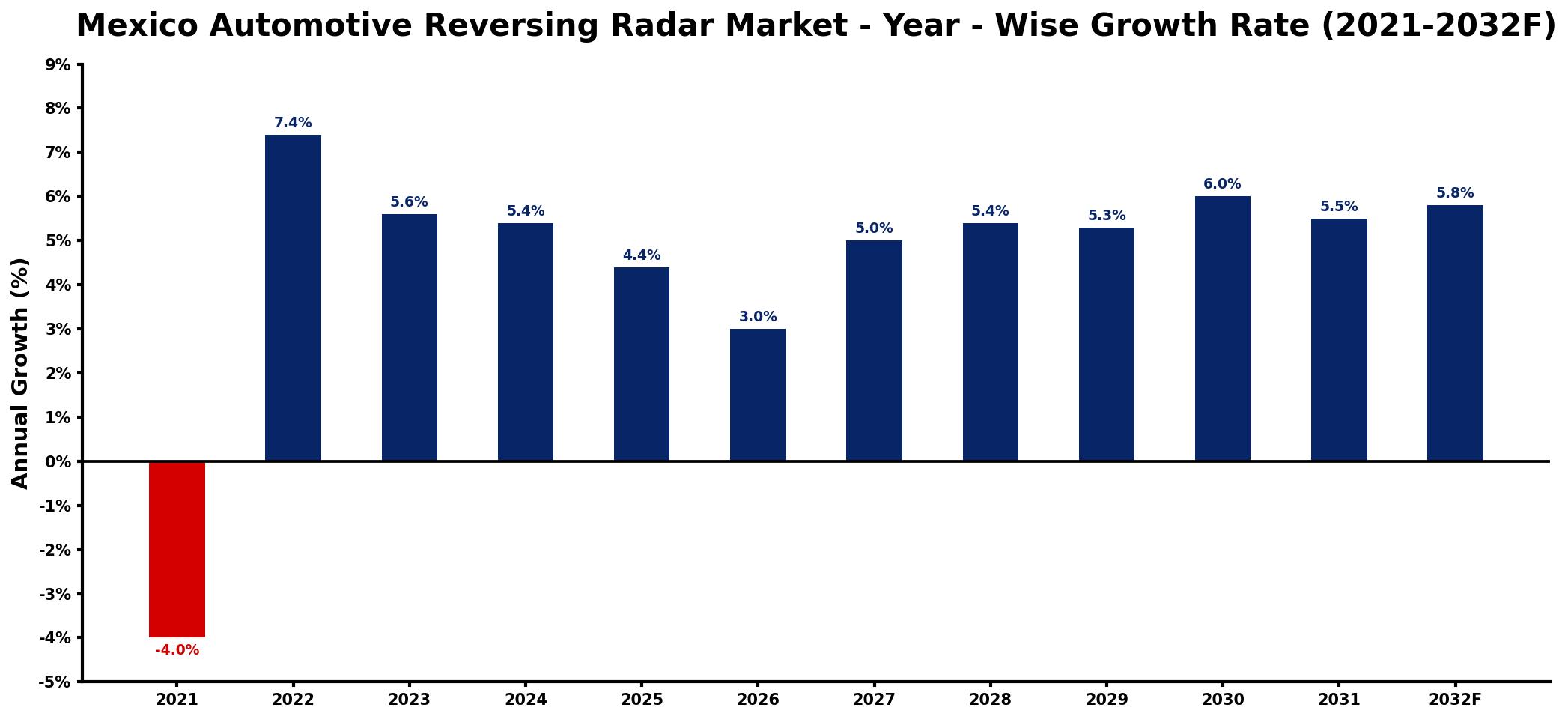
The table below presents the year‑wise growth rates along with the key drivers influencing the market
| Year | Growth Rate | Major Drivers |
| 2021 | -4.0% | decreased consumer spending on vehicles |
| 2022 | 7.4% | increased safety regulations adoption |
| 2023 | 5.6% | growing demand for vehicle safety |
| 2024 | 5.4% | rising investments in technology |
| 2025 | 4.4% | increased capital investment inflows |
| 2026 | 3.0% | growing popularity of smart vehicles |
| 2027 | 5.0% | increased consumer awareness safety features |
| 2028 | 5.4% | enhanced connectivity in vehicles |
| 2029 | 5.3% | growth in urban transportation solutions |
| 2030 | 6.0% | rising focus on sustainable mobility |
| 2031 | 5.5% | increased integration of advanced technologies |
| 2032 | 5.8% | strengthening international trade flows |
Note: Market size estimations and growth projections presented in this report are based on 6Wresearch's proprietary forecasting methodology, utilizing the latest available industry data, government publications, and primary research inputs.
Mexico Automotive Reversing Radar Market Synopsis
The strongest force currently shaping the Mexico Automotive Reversing Radar Market is the rising consumer awareness regarding vehicle safety. With an increasing number of accidents occurring during parking maneuvers, drivers are actively seeking solutions that enhance their safety and simplify parking tasks. This trend is compelling automotive manufacturers to integrate reversing radar systems as a standard feature in many new models.
Moreover, stringent regulations mandating the installation of parking sensors and backup cameras in vehicles are significantly propelling market growth. As these regulations become more prevalent, manufacturers are presented with opportunities to develop innovative radar sensor solutions, ensuring compatibility with a diverse range of vehicle types and enhancing overall adoption.
Mexico Automotive Reversing Radar Market Key Takeaways
- The market is driven by increasing demand for advanced vehicle safety features.
- Growing regulatory requirements mandate the inclusion of reversing radar systems in vehicles.
- There is a notable shift towards cost-effective and compact radar solutions.
- Consumer awareness regarding the safety benefits of reversing radars remains crucial for growth.
- Automotive manufacturers are increasingly adopting radar systems to meet consumer expectations.
Evaluation of Restraints in Mexico Automotive Reversing Radar Market
Despite the growth prospects, the Mexico Automotive Reversing Radar Market faces significant challenges related to consumer awareness and segmentation. Many potential customers are unaware of the advanced features and safety benefits that these systems provide, which can result in slower adoption rates. Additionally, manufacturers must navigate a complex landscape of varied consumer preferences and expectations, often needing to tailor their solutions to meet diverse market demands. This complexity can hinder the swift scalability of radar systems across different vehicle categories. Furthermore, price competition within the market may compress profit margins, making it essential for companies to balance cost management with innovation.
Mexico Automotive Reversing Radar Market Trends
One of the notable trends in the Mexico Automotive Reversing Radar Market is the integration of smart technologies into reversing systems. As vehicles become more connected, incorporating features such as smartphone connectivity and advanced obstacle detection is becoming increasingly commonplace. Additionally, there is a shift toward miniaturization, with manufacturers developing smaller, more efficient radar sensors that can be seamlessly integrated into a variety of vehicle models. This trend not only enhances the aesthetic appeal of vehicles but also encourages higher adoption rates, as these solutions are perceived as less intrusive.
Mexico Automotive Reversing Radar Market Opportunities
The market presents significant growth and investment opportunities driven by the increasing installation of reversing radar systems in the automotive aftermarket. With the rising number of vehicles on the road lacking modern safety features, there is a burgeoning market for retrofitting older models with advanced radar solutions. Furthermore, partnerships between radar manufacturers and automotive companies can lead to innovative product offerings that enhance safety and convenience. As safety regulations continue to tighten, the demand for reliable reversing radar systems will only grow, making it a prime area for strategic investments.
Government Initiatives in the Mexico Automotive Reversing Radar Market
The Mexican government is actively promoting the integration of automotive reversing radar systems through various initiatives. Policies are being enacted to incentivize manufacturers to include these safety features as standard equipment in new vehicles. Additionally, there are efforts to provide subsidies for consumers seeking to retrofit older models with aftermarket radar kits. By implementing regulations that focus on the effectiveness and reliability of reversing radar systems, the government is reinforcing the importance of safety in the automotive sector, thereby driving demand in this market.
Future Insights of the Mexico Automotive Reversing Radar Market
Looking ahead to the period from 2026 to 2032, the Mexico Automotive Reversing Radar Market is poised for robust growth as consumer awareness and safety regulations converge. The demand for innovative parking assistance technologies will likely increase, bolstered by further advancements in radar capabilities and smart vehicle integration. As automotive manufacturers increasingly focus on consumer safety features, reversing radar systems are expected to become ubiquitous in both new and existing vehicles. This positions the market for significant expansion, as both regulatory frameworks and consumer preferences align in favor of enhanced vehicle safety.
Mexico Automotive Reversing Radar Market Latest Developments (2025 - 2026)
Recent developments in the Mexico Automotive Reversing Radar Market indicate a growing trend towards enhanced sensor technologies, with manufacturers investing in research to improve obstacle detection accuracy. Industry stakeholders are also exploring collaborations with tech firms to develop integrated systems that leverage AI for better real-time decision-making during reversing maneuvers. Additionally, there are ongoing discussions around potential government incentives for retrofitting older vehicles with advanced safety features, suggesting a supportive regulatory environment for the market's expansion.
Mexico Automotive Reversing Radar Market - Key Attractiveness of the Report
- 10 Years of Market Numbers
- Historical Data Starting from 2022 to 2025
- Base Year: 2025
- Forecast Data until 2032
- Key Performance Indicators Impacting the Market
- Major Upcoming Developments and Projects
Key Highlights of the Report:
- Mexico Automotive Reversing Radar Market Outlook
- Market Size of Mexico Automotive Reversing Radar Market, 2025
- Forecast of Mexico Automotive Reversing Radar Market, 2032
- Historical Data and Forecast of Mexico Automotive Reversing Radar Revenues & Volume for the Period 2022-2032F
- Mexico Automotive Reversing Radar Market Trend Evolution
- Mexico Automotive Reversing Radar Market Drivers and Challenges
- Mexico Automotive Reversing Radar Price Trends
- Mexico Automotive Reversing Radar Porter's Five Forces
- Mexico Automotive Reversing Radar Industry Life Cycle
- Historical Data and Forecast of Mexico Automotive Reversing Radar Market Revenues & Volume By Type for the Period 2022-2032F
- Historical Data and Forecast of Mexico Automotive Reversing Radar Market Revenues & Volume By Ultrasonic for the Period 2022-2032F
- Historical Data and Forecast of Mexico Automotive Reversing Radar Market Revenues & Volume By Electromagnetic for the Period 2022-2032F
- Historical Data and Forecast of Mexico Automotive Reversing Radar Market Revenues & Volume By Application for the Period 2022-2032F
- Historical Data and Forecast of Mexico Automotive Reversing Radar Market Revenues & Volume By Passenger Vehicle for the Period 2022-2032F
- Historical Data and Forecast of Mexico Automotive Reversing Radar Market Revenues & Volume By Commercial Vehicle for the Period 2022-2032F
- Mexico Automotive Reversing Radar Import Export Trade Statistics
- Market Opportunity Assessment By Type
- Market Opportunity Assessment By Application
- Mexico Automotive Reversing Radar Top Companies Market Share
- Mexico Automotive Reversing Radar Competitive Benchmarking By Technical and Operational Parameters
- Mexico Automotive Reversing Radar Company Profiles
- Mexico Automotive Reversing Radar Key Strategic Recommendations






































