Chile Automotive Reversing Radar Market Size, Share & Growth Rate
The Chile Automotive Reversing Radar Market was estimated at USD 1412 Million in 2025 and is projected to reach USD 2626 Million by 2032, growing at a CAGR of 9.3% from 2026 to 2032. This robust growth trajectory is underpinned by increasing consumer awareness surrounding vehicle safety and a marked rise in the adoption of advanced driver assistance systems (ADAS). As the automotive industry in Chile continues to evolve, the integration of reversing radar systems is becoming a standard feature aimed at enhancing safety and mitigating collision risks during vehicle maneuvers.
Chile Automotive Reversing Radar Market Year-wise Growth Rate and Key Drivers
This graph highlights how the Chile Automotive Reversing Radar Market has steadily grown over the years, supported by major growth factors.
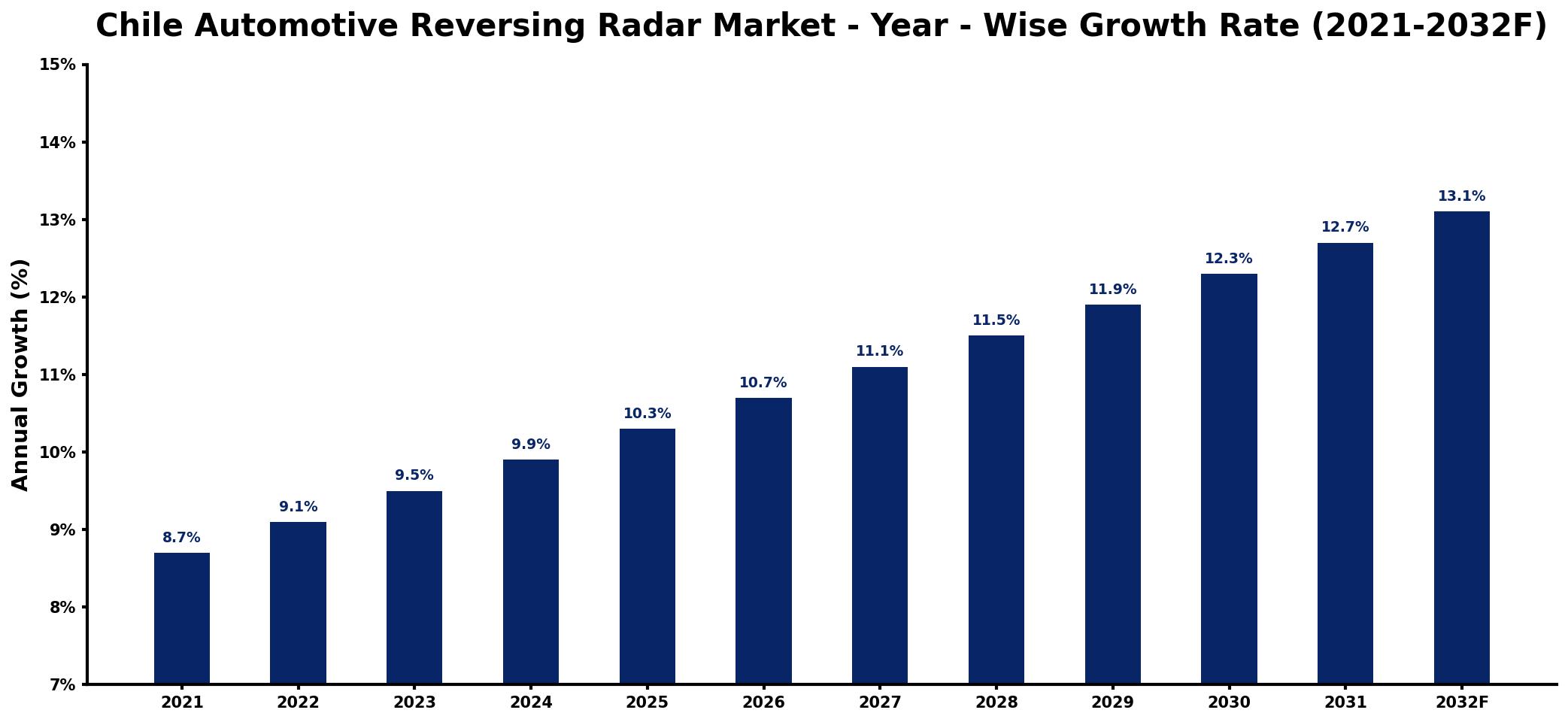
The table below presents the year‑wise growth rates along with the key drivers influencing the market
| Year | Growth Rate | Major Drivers |
| 2021 | 8.7% | rising consumer safety awareness |
| 2022 | 9.1% | increased vehicle production rates |
| 2023 | 9.5% | growing demand for technology |
| 2024 | 9.9% | expansion of smart vehicle features |
| 2025 | 10.3% | enhanced regulatory safety standards |
| 2026 | 10.7% | increased pharmaceutical industry usage |
| 2027 | 11.1% | increased urban population density |
| 2028 | 11.5% | growing e-commerce delivery services |
| 2029 | 11.9% | demand for fleet management solutions |
| 2030 | 12.3% | increased focus on sustainability |
| 2031 | 12.7% | growing commercial sector adoption |
| 2032 | 13.1% | rising popularity of electric vehicles |
Note: Market size estimations and growth projections presented in this report are based on 6Wresearch's proprietary forecasting methodology, utilizing the latest available industry data, government publications, and primary research inputs.
Chile Automotive Reversing Radar Market Synopsis
In Chile, the demand for automotive reversing radar systems is surging as more drivers recognize their importance in preventing accidents, particularly in urban environments with heavy pedestrian and vehicle traffic. The prevalence of reversing accidents has prompted manufacturers to innovate, leading to systems that not only detect obstacles but also offer enhanced features such as automatic braking and cross-traffic alerts.
Moreover, the Chilean government is actively promoting vehicle safety regulations, which are encouraging automotive manufacturers to incorporate reversing radar technologies into new models. This regulatory framework is essential for fostering a safer driving environment, driving both supply and demand in the market.
Chile Automotive Reversing Radar Market Key Takeaways
- The market is driven by rising awareness of vehicle safety and decreasing accident rates through effective reversing radar technology.
- Innovations in reversing radar systems are incorporating advanced features that further enhance vehicle safety during reversing maneuvers.
- Government regulations are mandating the inclusion of safety features in vehicles, propelling market adoption of reversing radar systems.
- The market is poised for significant growth as consumer demand for enhanced safety features continues to rise.
- The presence of counterfeit products presents challenges that need addressing to build consumer trust in genuine manufacturers.
Evaluation of Restraints in Chile Automotive Reversing Radar Market
Despite its promising growth, the Chile Automotive Reversing Radar Market faces notable constraints. The ongoing economic slowdown has negatively impacted consumer purchasing power, leading to a decrease in demand for automotive safety technologies. Additionally, the lack of standardized manufacturing practices complicates the landscape, creating barriers for manufacturers and causing confusion among consumers. Compounding these issues is the prevalence of counterfeit products, which undermines the credibility of legitimate manufacturers and poses risks for end-users. Addressing these challenges requires a concerted effort to enhance consumer awareness and stringent quality control measures to differentiate authentic products.
Chile Automotive Reversing Radar Market Trends
Current trends within the Chile Automotive Reversing Radar Market indicate a shift towards the integration of sophisticated technologies aimed at enhancing vehicle safety. Notably, manufacturers are increasingly focusing on features such as real-time alerts and vehicle-to-vehicle communication systems. Furthermore, the growing trend towards electric vehicles (EVs) is also influencing the adoption of advanced safety systems, including reversing radars, as consumers seek comprehensive safety solutions.
Additionally, advancements in sensor technology are leading to more accurate detection capabilities, allowing for greater integration within broader ADAS frameworks. This trend is shaping the future of automotive safety, with reversing radars playing a critical role in the development of autonomous driving technologies.
Chile Automotive Reversing Radar Market Opportunities
The future of the Chile Automotive Reversing Radar Market holds significant opportunities for growth, especially as awareness regarding road safety escalates. Investment in smart infrastructure that supports advanced driver-assistance technologies presents a lucrative avenue for manufacturers and investors alike. There is also a growing demand for retrofitting older vehicles with modern safety features, including reversing radars, which opens up a new customer segment for aftermarket services.
Furthermore, partnerships between automotive manufacturers and technology firms can foster innovation, leading to the development of next-generation reversing radar systems. As consumer preferences shift towards smarter, safer vehicles, those who capitalize on these opportunities will be positioned favorably in the market.
Government Initiatives in the Chile Automotive Reversing Radar Market
The Chilean government plays a pivotal role in shaping the automotive reversing radar market through various policies aimed at enhancing road safety. Initiatives that promote the adoption of advanced driver assistance systems (ADAS) are being implemented, alongside investments in road safety campaigns that highlight the importance of incorporating safety features in vehicles. Additionally, the government is working towards establishing guidelines and standards for the manufacture and implementation of automotive safety technologies, further solidifying the framework for market growth.
Future Insights of the Chile Automotive Reversing Radar Market
Looking ahead to the period from 2026 to 2032, the Chile Automotive Reversing Radar Market is poised for considerable advancements driven by both technological innovations and evolving consumer expectations. As the automotive sector increasingly embraces automation and smart technologies, reversing radar systems will play a crucial role in ensuring enhanced safety. The anticipated growth in electric vehicles and autonomous driving will further catalyze demand for advanced reversing radar technologies. Manufacturers who adapt to these trends and align with consumer needs will likely secure a competitive edge in this expanding market.
Chile Automotive Reversing Radar Market Latest Developments (2025 - 2026)
In recent months, the Chile Automotive Reversing Radar Market has witnessed a surge in product innovations and technological advancements. New systems with superior sensor technology and integration capabilities are being introduced, aimed at enhancing safety and user experience. Additionally, automotive manufacturers are increasingly collaborating with tech startups to develop next-generation safety features that incorporate reversing radar functionality, demonstrating a clear commitment to improving road safety standards. Public discourse surrounding vehicle safety continues to grow, resulting in heightened consumer expectations and the demand for state-of-the-art reversing radar solutions.
Chile Automotive Reversing Radar Market - Key Attractiveness of the Report
- 10 Years of Market Numbers
- Historical Data Starting from 2022 to 2025
- Base Year: 2025
- Forecast Data until 2032
- Key Performance Indicators Impacting the Market
- Major Upcoming Developments and Projects
Key Highlights of the Report:
- Chile Automotive Reversing Radar Market Outlook
- Market Size of Chile Automotive Reversing Radar Market, 2025
- Forecast of Chile Automotive Reversing Radar Market, 2032
- Historical Data and Forecast of Chile Automotive Reversing Radar Revenues & Volume for the Period 2022-2032F
- Chile Automotive Reversing Radar Market Trend Evolution
- Chile Automotive Reversing Radar Market Drivers and Challenges
- Chile Automotive Reversing Radar Price Trends
- Chile Automotive Reversing Radar Porter's Five Forces
- Chile Automotive Reversing Radar Industry Life Cycle
- Historical Data and Forecast of Chile Automotive Reversing Radar Market Revenues & Volume By Type for the Period 2022-2032F
- Historical Data and Forecast of Chile Automotive Reversing Radar Market Revenues & Volume By Ultrasonic for the Period 2022-2032F
- Historical Data and Forecast of Chile Automotive Reversing Radar Market Revenues & Volume By Electromagnetic for the Period 2022-2032F
- Historical Data and Forecast of Chile Automotive Reversing Radar Market Revenues & Volume By Application for the Period 2022-2032F
- Historical Data and Forecast of Chile Automotive Reversing Radar Market Revenues & Volume By Passenger Vehicle for the Period 2022-2032F
- Historical Data and Forecast of Chile Automotive Reversing Radar Market Revenues & Volume By Commercial Vehicle for the Period 2022-2032F
- Chile Automotive Reversing Radar Import Export Trade Statistics
- Market Opportunity Assessment By Type
- Market Opportunity Assessment By Application
- Chile Automotive Reversing Radar Top Companies Market Share
- Chile Automotive Reversing Radar Competitive Benchmarking By Technical and Operational Parameters
- Chile Automotive Reversing Radar Company Profiles
- Chile Automotive Reversing Radar Key Strategic Recommendations






































